





AI Tools for Dental Treatment Planning

Artificial intelligence (AI) is reshaping dental care by improving diagnostics, treatment planning, and workflows. With accuracy rates exceeding 90% in areas like caries detection and implant planning, AI is proving to be a reliable assistant for dentists. It analyses large datasets, identifies patterns, and supports personalised care through predictive insights. AI tools also reduce time spent on routine tasks, allowing clinicians to focus more on patient care. However, challenges like data privacy, ethical concerns, and the need for professional oversight remain.
Key Highlights:
- Diagnostics: AI detects dental issues like caries, periodontitis, and oral cancer with precision, often outperforming human specialists.
- Treatment Planning: AI uses patient data to create tailored plans, predict outcomes, and simulate treatment responses.
- Workflows: Automates tasks such as radiograph analysis, implant planning, and documentation, saving time.
- Limitations: Relies on diverse datasets, requires clinician verification, and raises privacy concerns.
AI is not replacing dentists. Instead, it supports them in delivering more accurate and efficient care while improving patient understanding and engagement.
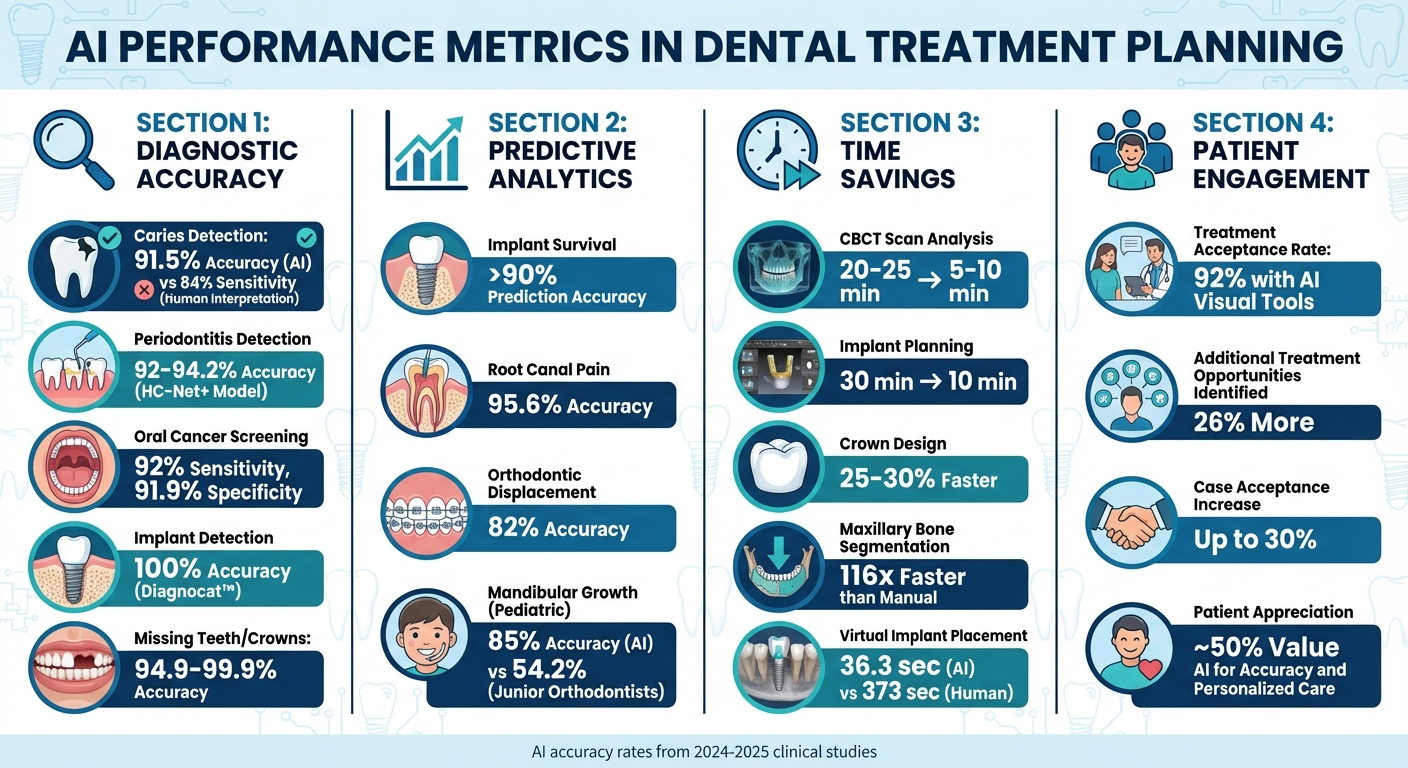
AI in Dentistry: Key Performance Metrics and Accuracy Rates
AI in Dentistry: Transforming Efficiency, Diagnosis, and Case Acceptance
sbb-itb-2be92ed
How AI Improves Diagnostic Accuracy
AI-powered diagnostic tools bring a new level of precision and consistency to the table, surpassing the limitations of manual interpretation. For instance, human clinicians often show variability in interpreting radiographs, with Cohen’s kappa values ranging from 0.454 to 0.482 [10]. In contrast, AI algorithms deliver standardised results, unaffected by factors like fatigue or experience. One standout example is the HC-Net+ model, which was tested internationally on 10,881 orthopantomograms. It achieved an impressive 92–94.2% accuracy in detecting stage II–IV periodontitis – outperforming specialists and significantly aiding junior dentists in making accurate diagnoses [10]. These achievements set the stage for the advanced image analysis techniques discussed below.
AI Analysis of Dental X-Rays and Scans
AI systems leverage advanced computer vision to scrutinise dental images with remarkable precision. Convolutional Neural Networks (CNNs) focus on analysing individual radiographs, while Recurrent Neural Networks (RNNs) handle image sequences, object detection, and the segmentation of anatomical boundaries [2]. For Cone Beam Computed Tomography (CBCT) scans, 3D CNNs automate tasks like mandibular segmentation and anomaly detection. Generative Adversarial Networks (GANs) enhance image quality by eliminating noise and correcting artefacts [6][11]. When it comes to assessing periodontal health, AI measures bone loss by calculating the distance between the cementoenamel junction and the marginal alveolar bone [10].
Commercial platforms further highlight AI’s capabilities. Diagnocat™, for example, underwent a 2024–2025 study involving 147 patients and 4,148 teeth. The AI system correctly identified 100% of dental implants and achieved near-perfect accuracy in detecting missing teeth and crowns, with rates ranging from 94.9% to 99.9% [12]. However, while tooth-level accuracy was exceptional, the patient-level "perfect match" accuracy – where an entire full-mouth report is error-free – was lower at 56.5%, due to the cumulative impact of minor errors [12]. This level of precision is instrumental in catching subtle dental issues early.
Early Detection of Dental Problems
AI has a knack for spotting subtle changes that might escape human eyes. In caries detection, for example, AI models have shown an accuracy of about 91.5%, with a pooled sensitivity of 88% compared to 84% for human interpretation [13][14]. This is especially useful for identifying early-stage lesions, which can be difficult to detect due to poor image quality or biological factors [2][10].
The HC-Net+ model exemplifies how AI can elevate diagnostic accuracy to match that of specialists while also broadening access to precision dentistry [10]. In oral cancer screening, a meta-analysis of AI-assisted detection for oral squamous cell carcinoma reported a pooled sensitivity of 92% and a specificity of 91.9% [6]. Similarly, in periodontitis detection, AI reduced the number of missed diagnoses from 54 (by humans) to 14 in certain external datasets [10]. These capabilities enable earlier intervention, allowing for proactive treatment before conditions worsen.
AI also enhances patient understanding through visual tools. For instance, AI-generated colour overlays and annotations make it easier for patients to see and grasp their dental issues compared to traditional greyscale radiographs. In one study, 92% of patients at a Minnesota dental clinic using Overjet AI technology agreed to treatment plans after viewing images that highlighted carious lesions and bone loss [9]. This improved communication fosters better patient engagement and compliance.
Personalised Treatment Planning with AI
AI isn’t just about diagnosing issues anymore – it’s reshaping how treatments are planned. By analysing a mix of data like medical history, genetics, diet, and habits, AI creates treatment strategies tailored to each patient’s specific needs. For instance, digital twin models combine imaging, scans, genetic data, and past medical records to simulate how a patient might respond to treatments before any actual procedures take place [6]. This means dentists can now customise treatment schedules and follow-up visits based on a patient’s risk profile and disease activity, rather than sticking to standard recall intervals [16].
AI also compares a patient’s data against millions of similar cases to predict outcomes and disease progression [16]. This technology doesn’t just help clinicians – it actively engages patients. For example, AI-powered visual tools can increase case acceptance by up to 30% [15][16]. Additionally, these tools help dentists identify 26% more treatment opportunities that might otherwise be missed during manual reviews [17].
AI is not replacing the clinician – it’s enhancing the clinician’s capabilities. Overjet empowers dental professionals to deliver more precise, efficient, and patient-centred treatment plans through actionable, real-time data.
Mario Paganini, Senior VP of Marketing at Overjet [15]
With these advanced diagnostic tools, treatment planning becomes more proactive and focused on achieving better outcomes for patients.
Predictive Analytics for Treatment Outcomes
Predictive analytics is transforming dentistry, moving it from a reactive approach to a proactive one. AI models can forecast risks like external root resorption, periodontal issues, or implant failure before they become serious problems. For instance, AI achieves over 90% accuracy in predicting implant survival, 95.6% accuracy for postoperative pain in root canal treatments, and 82% accuracy in predicting orthodontic aligner displacement [20][21][7][3][2]. In paediatric dentistry, AI predicts mandibular growth trends with 85% accuracy, far outperforming junior orthodontists who average just 54.2% [20].
These predictive capabilities are also valuable in surgical planning. AI systems can estimate critical intraoperative factors, such as implant drilling protocols and insertion torque, by analysing bone density and CBCT data. This reduces surgical variability and enhances precision [3]. For clinicians, this means cutting planning time from 30 minutes to just 10 minutes, all while maintaining accuracy within 1 millimetre [3].
By leveraging AI-driven algorithms, clinicians can now analyse vast amounts of patient data – from imaging scans to health records – allowing for more accurate, real-time assessments of treatment progress.
Xuanchi Guo, Shandong University [20]
These tools don’t just make surgeries more efficient; they also help dentists explain potential outcomes to patients, improving communication and trust.
Patient-Centred Care with AI
AI is making dental care more personal, helping dentists tailor treatments to individual needs and improving both patient satisfaction and compliance. A concept known as "Anatomical Intelligence" links dental imaging with specific patient health data to create customised solutions [22]. This shifts the consultation process from just a conversation between the patient and clinician to a collaborative effort that includes AI insights [23].
Visual tools like colour-coded overlays and automated reports show patients how their lifestyle choices – like poor brushing habits – directly impact their dental health [15][16][19]. AI can even simulate what might happen if treatments are delayed, which often motivates patients to stick to their care plans [16][18].
Beyond the clinic, AI supports ongoing care. Tools like smart toothbrushes monitor brushing habits in real time and provide personalised feedback to improve hygiene [18][6]. Voice-to-text systems capture important details from consultations, like lifestyle factors and medical history, ensuring accurate records without the need for manual data entry [17][6].
By streamlining routine charting, it gives our hygienists more time to focus on delivering personalised care.
Cameron Jones, VP of Hygiene Support at Aspen Dental [17]
Patients are increasingly open to these advancements. A survey in Germany revealed that nearly 50% of patients appreciate AI’s role in improving diagnostic accuracy and personalised care [6]. These insights integrate smoothly into dental workflows, reinforcing AI’s role in elevating the standard of care.
How AI Improves Dental Practice Workflows
AI isn’t just about diagnosing dental issues – it also transforms how dental practices operate day-to-day. By automating tasks like analysis and documentation, these systems free up clinicians to focus more on their patients. Plus, they integrate smoothly with existing software, making the transition easier. Let’s dive into how real-time analytics and system integration are reshaping dental imaging workflows.
AI tools connect directly with practice management systems, automatically updating patient records with AI-generated findings. This reduces the need for manual note-taking. Voice-activated charting tools are also becoming popular, with current accuracy for dental-specific terms ranging from 70% to 85% [6].
Real-Time Analysis and Clinical Decisions
AI tools are game-changers during appointments, offering instant insights that can speed up clinical decisions. For instance, when a dentist takes an X-ray, AI can immediately highlight issues like caries or bone loss using colour-coded overlays. This means same-day treatment discussions become possible [9].
Take Apple Tree Dental in Minnesota as an example. In 2024, they implemented Overjet AI across nine centres. A simple button in their patient records system launched AI-enhanced radiographs. The results? Dental therapists used this feature in 57.2% of clinical sessions, and 92% of surveyed patients said they were more likely to accept treatment after seeing the AI-generated visuals [9].
"Most of the time it makes exams faster."
– Anonymous Dental Assistant, Apple Tree Dental [9]
AI also speeds up traditionally time-consuming tasks. For instance:
- Analysing CBCT scans now takes 5–10 minutes instead of 20–25 minutes.
- Implant planning is cut down from 30 minutes to just 10 minutes.
- AI-designed crowns are produced 25%–30% faster than conventional CAD methods, with deep learning techniques being up to four times faster than traditional digital workflows [3][6].
Integration with Practice Management Systems
AI doesn’t just assist with clinical work – it also makes administrative tasks smoother. These systems integrate easily with tools like Dentrix, EagleSoft, or Open Dental, automating tasks such as verifying insurance eligibility, managing ICD-10 and CPT coding, and flagging missing documentation before claims are submitted. This helps reduce claim denials [24].
For practices looking to adopt AI, a phased approach works best. Start with one workflow, like claims validation or radiographic analysis. Assign a key clinician to create resource materials and share tips. Also, ensure your system supports open APIs like HL7 or FHIR for seamless data integration [9][24].
AI-enhanced workflows are redefining dentistry. By combining real-time data analysis with existing software, these tools empower clinicians without replacing the essential human touch in dental care.
AI Applications in Specialist Dental Treatments
AI is making waves in complex dental procedures, offering tools that improve precision and streamline treatment planning. From diagnostics to surgical applications, its role in specialist treatments like orthodontics and dental implants is expanding rapidly. Let’s dive into how AI is reshaping these areas.
AI in Orthodontics and Clear Aligner Treatment
AI is revolutionising orthodontics by automating tasks like tooth segmentation and identifying key landmarks for clear aligner treatments. These systems boast an impressive 98% accuracy, significantly reducing human errors in cephalometric analysis and malocclusion diagnosis [25][26][27]. By combining data from Cone-Beam Computed Tomography (CBCT) and intraoral scans, AI provides orthodontists with a detailed view of both tooth crowns and root positions [25][26]. Popular platforms like ClinCheck Pro 6.0 (Align Technology), Spark Approver (Ormco), and 3Shape Clear Aligner Studio already integrate AI into their treatment planning processes.
"AI may help orthodontists with treatment decisions, such as needing orthognathic surgery or tooth extractions." – Reena Wadia, Specialist Periodontist [33]
AI isn’t just limited to planning – it also supports remote monitoring of aligner progress. This means fewer in-office visits, making treatments more convenient for patients while maintaining oversight for orthodontists.
AI in Dental Implant Planning and Surgery
In dental implant surgery, AI has become a game-changer by automating the identification of crucial anatomical structures. Tasks like segmenting the inferior alveolar nerve, maxillary sinus, and alveolar bone from CBCT scans are now faster and more precise [8][28][32]. For instance, AI-driven segmentation of the maxillary alveolar bone is 116 times quicker than manual methods [28].
One standout example is Carestream Dental’s CS 3D Implant Premium software, launched in November 2025. Its "AI Auto Implant" feature identifies and numbers teeth automatically, merges CBCT scans with digital impressions, and calculates crown positions and implant dimensions using a database of over 100 manufacturers [30].
A study conducted in December 2025 at KU Leuven showcased the efficiency of AI in implant placement. The AI platform (Relu creator) placed virtual implants for missing mandibular molars in just 36.3 ± 7.3 seconds, compared to 373 ± 113 seconds for human experts. Accuracy was on par with clinical plans, with mean discrepancies of less than 1 mm in position and under 2° in angulation [29][31]. Additionally, AI models can predict implant survival rates with up to 94.48% accuracy by analysing factors like bone density and patient-specific characteristics [28].
However, while AI speeds up and refines processes, clinicians must carefully verify AI-segmented landmarks – especially the mandibular nerve – to avoid neurovascular complications [28][5].
Limitations and Ethical Considerations of AI in Dentistry
AI has undoubtedly improved treatment planning, but it’s far from flawless. Many AI systems rely on datasets that don’t fully represent Australia’s diverse population, which can lead to errors when applied across different ethnic groups [4][36]. Another concern is the ‘black box’ problem – many AI systems can’t explain the reasoning behind their diagnostic decisions. This lack of transparency makes it hard for clinicians to verify the accuracy of AI-generated results [2][6]. Additionally, AI can sometimes misread radiographic artefacts, like fissure sealants or dental materials, as signs of disease, potentially leading to unnecessary and invasive treatments [35].
From a legal perspective, the situation is clear-cut. According to Australian regulations, dental practitioners remain fully accountable for treatment outcomes, even when AI tools are involved [34][37]. The Dental Board of Australia reinforces this responsibility:
Regardless of what technology is used to advance healthcare, the practitioner remains responsible for delivering safe and quality care and for ensuring their own practice meets the professional obligations set out in their Code of Conduct [36].
This means that no matter how advanced the AI software is, the practitioner is ultimately responsible if anything goes wrong. These limitations highlight the importance of maintaining strict professional oversight.
The Need for Professional Oversight in AI-Assisted Care
AI works best as a tool to support – not replace – clinical judgement. One key concern is automation bias, where over-reliance on AI might cloud a clinician’s own decision-making [35][36]. It’s crucial for practitioners to independently verify AI outputs, particularly in radiographic assessments [40]. AI can streamline workflows, but clinicians must remain the ultimate authority on diagnosis and treatment decisions. This ensures that AI enhances decision-making without diminishing the value of human expertise.
A practical approach involves cross-checking AI findings with the patient’s clinical history, physical examination results, and other diagnostic tests [34]. While some studies report impressive outcomes – such as a 92% sensitivity in detecting oral squamous cell carcinoma and 0.79 sensitivity for caries diagnosis [6] – these results come from controlled environments. Everyday clinical practice is far more complex, requiring clinicians to interpret AI results within the broader context of each patient’s unique needs, health conditions, and preferences [23].
Patient Data Privacy and Security with AI
Beyond clinical oversight, ensuring patient data privacy is a critical concern. Dental practices must adhere to the Privacy Act 1988 and the 13 Australian Privacy Principles (APPs) when using AI tools [36][38]. Explicit informed consent is essential before uploading patient data to AI platforms [36][39].
To safeguard data, practices should implement measures such as multi-factor authentication, encrypted storage, and regular software audits to identify and address vulnerabilities [38]. In some cases, AI tools used for diagnosis or treatment planning may be classified as medical devices by the Therapeutic Goods Administration (TGA) [36]. The Australian Dental Association underscores the importance of proper data handling:
Any data must be obtained with appropriate permissions, controlled for privacy, verified for accuracy, solely used for its intended purpose, and stored securely [34].
Staff training is equally important to prevent breaches, such as sharing passwords or accessing patient data without proper authorisation [38]. By combining robust security protocols with informed oversight, dental practices can mitigate risks while leveraging AI’s potential.
The Future of AI in Dental Treatment Planning
AI is transforming dentistry, shifting the focus from reactive treatments to a model that prioritises prevention, precision, and personalisation. For instance, AI systems have shown diagnostic accuracy rates as high as 95% in detecting caries [1]. Additionally, AI-designed crowns can cut fabrication times by up to four times compared to traditional manual methods [3]. These advancements are just the beginning.
Future AI tools are expected to go beyond single-task functions by integrating multiple data sources, such as radiographs, 3D scans, genetic profiles, and treatment records. This integration will create digital twins – virtual models of patients that simulate how they might respond to various treatments. These simulations allow clinicians to test interventions virtually before applying them in real life. Technologies like federated learning will also play a role, enabling AI models to be trained collaboratively across institutions while safeguarding patient privacy [6]. These developments align well with existing dental practices, paving the way for further progress.
Explainable AI (XAI) is another area gaining traction. By using techniques like SHAP, XAI can clarify how diagnostic decisions are made, addressing concerns about the "black box" nature of many AI systems [6]. Meanwhile, AI-powered robotic systems are achieving impressive results in precision tasks like implant placement, with mean coronal deviations as low as 0.7 ± 0.3 mm [6].
The trend toward minimally invasive care is particularly encouraging. AI can monitor the success of preventive treatments like fluoride varnishes or sealants, helping clinicians intervene earlier to halt disease progression instead of resorting to surgical solutions [9]. This not only improves diagnostic reliability but also fosters better patient engagement.
Beyond the technical advancements, the role of AI in dentistry will also reshape clinical practices and decision-making. In Australia, the challenge lies in adopting these innovations responsibly. Dental education must include standardised AI training to prepare practitioners for evaluating AI-generated insights [1]. While AI excels at processing large volumes of data quickly and accurately, clinicians must remain the ultimate decision-makers. The goal is clear: AI serves to enhance clinical judgement, not replace it. As the technology continues to evolve, this principle will remain at its core.
FAQs
How does AI improve accuracy in dental diagnostics?
AI is transforming dental diagnostics by leveraging advanced algorithms like deep learning to process and analyse extensive sets of dental images. This allows the technology to pinpoint issues such as tooth decay, gum disease, and other oral health concerns with impressive accuracy.
What sets AI apart is its ability to detect subtle patterns that might elude even the most trained human eye. By offering this level of precision, it empowers dentists to make well-informed decisions, enabling earlier interventions. The result? More effective treatments and a noticeable boost in patient care quality.
What ethical issues should be considered when using AI in dental care?
The integration of AI into dental care brings up some important ethical challenges that need careful attention.
One major concern is patient data privacy and security. AI systems often require access to sensitive health information, such as radiographs and medical records, to function effectively. To safeguard this data, it’s crucial to adhere to the Australian Privacy Principles (APPs) and ensure patients give informed consent. Protecting confidentiality is non-negotiable when dealing with such personal information.
Another pressing issue is algorithmic bias. If AI systems are trained on data that doesn’t represent the full spectrum of patient diversity, the results can lead to unequal treatment outcomes. For example, certain patient groups might not receive the same level of accuracy in diagnosis or recommendations. To prevent this, AI systems must be designed with fairness, transparency, and accountability at their core.
Finally, while AI has the potential to improve dental care, it’s vital that these tools support rather than replace the expertise of dental professionals. Patient-centred care should always remain the priority. By using AI to complement clinical judgment, dental practitioners can enhance treatment planning without undermining trust or professional integrity.
How does AI improve dental treatment planning?
AI is reshaping how dental treatments are planned, offering tools that enable more accurate diagnostics and personalised care. One standout application is the creation of precise 3D models of a patient’s oral structures. These models allow dentists to conduct detailed analyses and design treatment strategies tailored to each individual.
With the help of predictive algorithms, AI can provide accurate forecasts of treatment outcomes. This capability helps dentists craft personalised plans for managing specific oral health issues like gum disease or cavities. Even more critically, AI aids in the early detection of severe conditions such as oral cancer, enabling timely and focused interventions.
By integrating AI into their practice, dental professionals can rely on data-driven insights to deliver customised care, which improves treatment success rates and enhances overall patient experiences.
Related Blog Posts
- AI in Dentistry: Benefits of Personalised Oral Health Insights
- AI-Powered Radiology: What Dentists Need to Know
- Ultimate Guide to AI in Dental Implant Radiology
- AI vs. Traditional Treatment Planning
Important Notice: Any surgical or invasive procedure carries risks. Before proceeding, you should seek a second opinion from an appropriately qualified health practitioner.
Individual results may vary. The information provided in this article is for educational purposes only and does not constitute medical advice.
Checkout Related Blogs




Get in touch with us
For more information, call us now to start feeling better. Or fill the form below to make appointment
The Latest News from Complete Smiles
How to Clean Clear Plastic Retainers
Checklist for Choosing Wearable Dental Devices
Checklist for Choosing Cloud AI Platforms in Dentistry
Complete Smiles Bella VistaAccepts All Major Health Funds, Including





