





AI vs. Traditional Treatment Planning
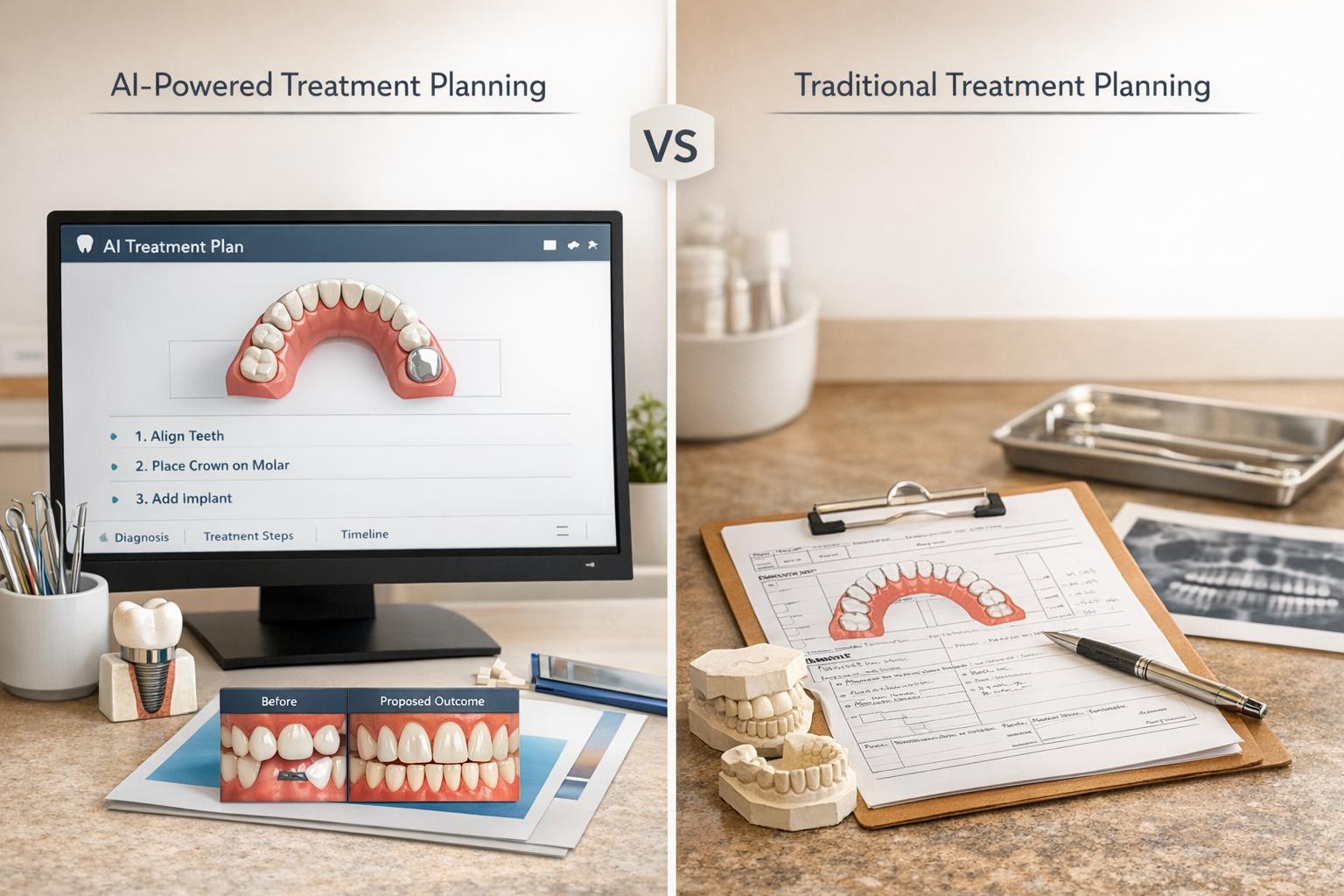
AI-driven treatment planning is transforming dental care in Australia. By combining advanced algorithms with clinical expertise, dentists can achieve faster, more precise results while maintaining the human touch essential for patient care. Here’s what you need to know:
- AI excels at speed and consistency, processing data in seconds and reducing planning time by up to 75%. It’s particularly effective for detecting early-stage issues, like decay or bone loss, and offers high diagnostic accuracy (up to 99.5% for implant site detection).
- Traditional methods rely on clinical judgement, offering a personalised approach that considers patient history, physical exams, and unique needs. However, it can be time-consuming and subject to variability due to human factors like fatigue.
- The best outcomes come from combining both approaches. AI handles repetitive tasks and data analysis, while dentists focus on complex decisions and patient communication.
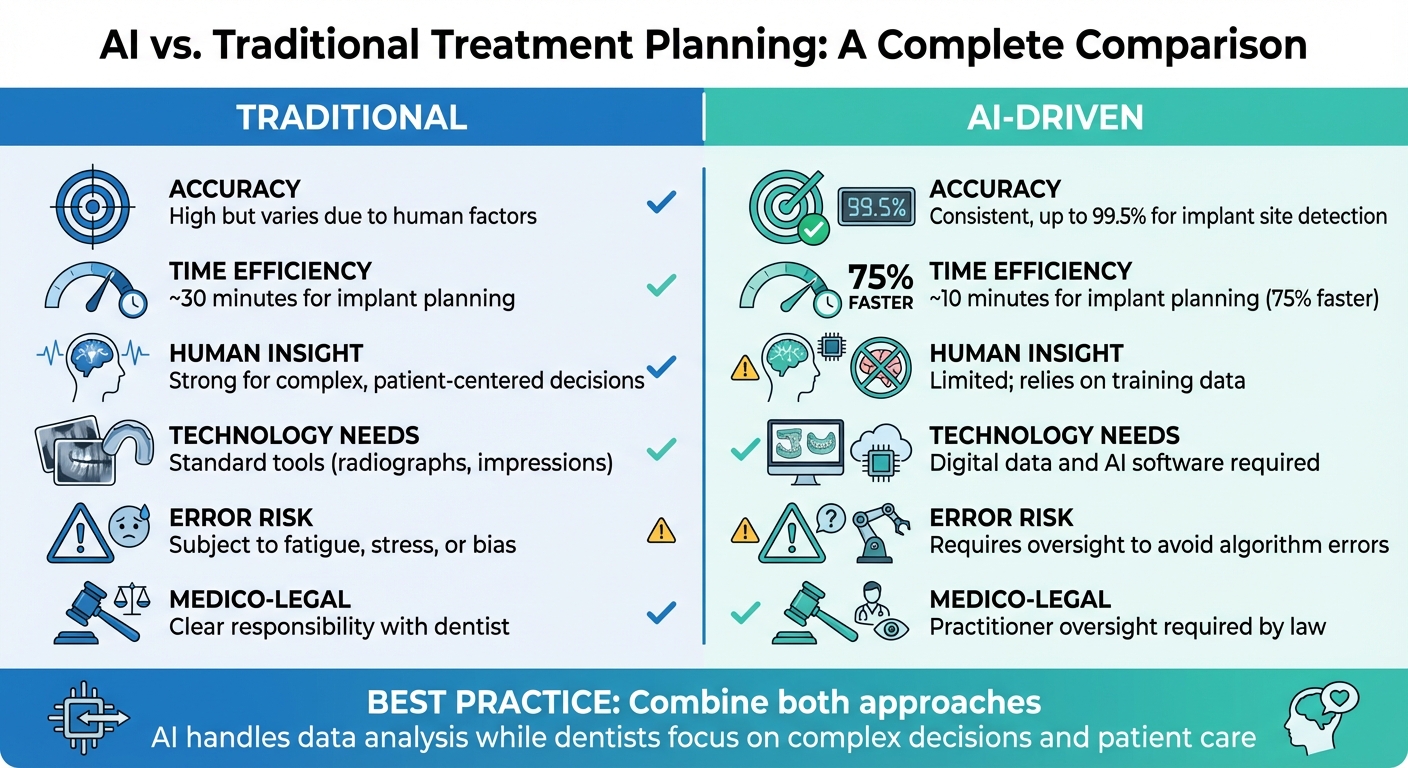
Quick Comparison
| Aspect | Traditional Methods | AI-Driven Methods |
|---|---|---|
| Accuracy | High but varies due to human factors | Consistent, with accuracy up to 99.5% |
| Time Efficiency | Slower; implant planning takes ~30 minutes | Faster; implant planning in ~10 minutes |
| Human Insight | Strong for complex, patient-centred decisions | Limited; relies on training data |
| Technology Needs | Standard tools (radiographs, impressions) | Requires digital data and AI software |
| Error Risk | Subject to fatigue, stress, or bias | Requires oversight to avoid algorithm errors |
| Medico-Legal | Clear responsibility lies with the dentist | Practitioner oversight required by law |
Takeaway: AI is a powerful tool but not a replacement for dentists. By blending AI’s precision with human expertise, Australian clinics can deliver faster, more accurate, and patient-focused care.
AI vs Traditional Dental Treatment Planning Comparison
How Traditional Treatment Planning Works
The Traditional Planning Process
In Australian dental clinics, traditional treatment planning involves a carefully structured approach. It starts with collecting detailed patient information through clinical examinations and reviewing medical histories to identify any underlying systemic factors. Diagnostic tools such as bitewing and periapical radiographs, OPGs, and clinical photographs play a key role in this stage [6][8][9].
The treatment is then divided into distinct phases: Urgent (addressing pain or infections), Control (stabilising oral health through procedures like scaling and caries removal), Definitive (restorative or cosmetic treatments, such as crowns or implants), and Maintenance (ongoing reviews every 3–6 months) [8]. This thorough assessment typically takes about 1.5 hours.
Patients are provided with written reports that detail the diagnosis, recommended treatments, alternative options, and cost estimates. This ensures they can make informed decisions about their care [8][9]. Dentist Ashish B. Parmar highlights this ethical responsibility:
"The dentist has an ethical responsibility to offer the patient the ideal treatment plan based on their goals, needs/wants and budget." [9]
Additionally, traditional planning often involves taking physical alginate or silicone impressions to create study models, which are used for bite analysis and treatment design [9][10].
This systematic approach forms the backbone of traditional treatment planning, providing a clear and methodical framework for dental care.
Benefits of Traditional Planning
One of the standout strengths of traditional planning is its reliance on clinical expertise, enabling dentists to make careful, well-considered decisions, especially in complex cases involving periodontics or prosthodontics [11]. The process prioritises patient-centred care by allowing direct discussions about clinical findings and individual needs, which helps build trust and address personal concerns [6][8].
The phased structure offers a clear, step-by-step roadmap, detailing specific tooth numbers, surfaces, and associated costs, which ensures continuity and transparency in care [8]. Comprehensive initial examinations, lasting 45 to 60 minutes, provide a complete understanding of a patient’s oral health [6].
However, despite its strengths, this traditional approach does come with certain limitations.
Drawbacks of Traditional Planning
Traditional treatment planning is not without its challenges. One key issue is the variability that arises from subjective clinical judgement. A dentist’s education, experience, and even their state of mind can influence treatment recommendations, leading to inconsistencies. As researchers from Melbourne Dental School point out:
"Individual clinical judgements are often made intuitively on limited heuristics to simplify decision making, which may lead to errors harmful to patients." [11]
Such intuitive decisions, based on limited information, can result in significant errors. For example, a study revealed that 21.1% of dentists reported performing an incorrect tooth extraction [11]. Moreover, traditional methods like visual and tactile examinations may miss subtle changes in radiographs or early-stage anomalies that require greater sensitivity to detect [12].
The manual nature of traditional processes, such as taking analogue impressions or planning complex restorative treatments, is often slower and less comfortable for patients compared to digital alternatives [8]. Factors like clinician fatigue, emotional stress, and time pressures can also affect the accuracy of treatment planning [11].
Although many clinicians recognise the value of evidence-based practice – 132 out of 198 clinicians in one study believed it enhances treatment quality – practical barriers, such as limited access to up-to-date research, often result in reliance on outdated methods or colleague referrals [11]. The Australian Dental Association underscores that all clinical decisions must remain under the supervision of a registered dental practitioner, ensuring accountability regardless of the tools used [2].
These challenges highlight the potential for integrating advanced tools, such as AI-driven systems, to complement and enhance traditional methods in modern dental practice.
How AI-Driven Treatment Planning Works
What AI-Driven Planning Can Do
AI systems leverage machine learning to process vast amounts of patient data – like radiographs, 3D scans, and clinical records – to uncover patterns and predict treatment outcomes [2]. Convolutional Neural Networks (CNNs) are particularly effective, offering advanced analysis of complex imaging data that can exceed human diagnostic capabilities [14].
These tools also generate highly detailed 3D models of oral structures, giving dentists a clear view of potential outcomes before procedures even begin [13][14]. In orthodontics, AI identifies cephalometric landmarks to predict tooth movement with 82% accuracy, helping reduce unscheduled follow-ups by 28% [21]. For implant planning, AI achieves accuracy rates between 90% and 99.5% in detecting sites and assessing bone quality [3].
Predictive models take patient-specific factors – such as bone density or tumour characteristics – and use them to customise treatment plans and predict outcomes for interventions like implants or orthodontic adjustments [2][17]. Generative AI also simplifies administrative tasks by creating clinical notes, reports, and treatment summaries [2][16].
In 2024, the Australian company CoTreat introduced an AI platform integrated with practice management software like CorePractice. This system analyses de-identified patient data to pinpoint treatment opportunities for implants and orthodontics. Classified as a Class I medical device by the TGA, the platform has become "indispensable" for daily operations, according to Dr. Amir Kiaee of Lumino Smiles [16].
These advancements pave the way for tangible clinical benefits, as detailed below.
Benefits of AI in Dentistry
AI-driven planning offers notable gains in both accuracy and efficiency. For example, AI-assisted crown design can reduce planning time by up to 75% [3]. Similarly, implant placement planning is significantly faster compared to traditional methods [4].
AI also excels in detecting oral cancers, achieving 93% accuracy with 91% sensitivity and 94% specificity. Predictive models for oral oncology treatments have demonstrated 87% accuracy in determining optimal therapeutic responses [17]. These AI-recommended approaches have improved survival rates by 20% and extended progression-free periods by 15% [17].
Beyond diagnostics, AI enables real-time adaptability. By comparing actual versus predicted tooth movement through intraoral scans, it allows for mid-treatment adjustments in aligner sequencing or bracket positioning [21]. This shift from static planning to dynamic learning means treatment plans can evolve based on biological variability, mechanical inefficiencies, or patient compliance [21].
On the business side, AI tools that identify treatment opportunities can boost practice revenue by 18% within three months [16]. The consistency of AI – free from fatigue or subjective variability – also helps minimise diagnostic errors common in traditional methods [18][20].
While these benefits are impressive, AI systems still require careful oversight to avoid potential pitfalls.
Drawbacks and Considerations
Despite its capabilities, AI is not a substitute for professional judgment. Dentists are ultimately responsible for ensuring safe and effective care, as underscored by the Dental Board of Australia:
"Regardless of what technology is used to advance healthcare, the practitioner remains responsible for delivering safe and quality care and for ensuring their own practice meets the professional obligations set out in their Code of Conduct." [15]
AI’s performance relies heavily on the quality of its training data. Issues can arise when systems encounter variables outside their training, such as unfamiliar scanners or diverse patient populations [19]. Metal restorations, for instance, can create artefacts in CBCT images that hinder AI segmentation [18].
Generative AI tools like ChatGPT also come with risks. The Australian Dental Association warns that these systems can produce inaccurate or harmful content if not closely monitored [14]. Practitioners must ensure that any AI software used for diagnosis or treatment planning is registered with the Therapeutic Goods Administration (TGA) [15]. Additionally, explicit patient consent is required when using AI for data recording or analysis, and all patient data must be de-identified to comply with Australian Privacy Principles [16].
There are also cognitive risks to consider. "Omission bias" can lead practitioners to overlook AI errors, while "commission bias" may cause them to trust AI outputs even when clinical evidence suggests otherwise [15]. Furthermore, AI cannot perform physical examinations, such as tooth percussion or palpation, or account for lifestyle factors without manual input [14]. The Australian Dental Association emphasises that any use of AI in dental care must be supervised by a registered practitioner and not left to patients to action autonomously [2].
Acknowledging these limitations, many Australian clinics are exploring ways to combine AI with traditional methods to enhance patient care.
AI vs. Traditional Planning: Direct Comparison
Comparison Table
Each method comes with its own strengths, depending on the clinical context. Below is a side-by-side comparison of six key aspects:
| Criterion | Traditional Treatment Planning | AI-Driven Treatment Planning |
|---|---|---|
| Diagnostic Accuracy | High, but can be affected by operator fatigue and variations between observers [1][5]. | High (90–99.5%), especially for tasks like implant site detection and bone assessment; delivers consistent results [3][4]. |
| Time Efficiency | Slower, taking roughly 30 minutes for implant planning [4]. | Faster, completing implant planning in about 10 minutes – three times quicker [4]. |
| Adaptability | Strong in addressing unique patient needs, ethical challenges, and complex clinical decisions [2]. | Limited; performance can decline with unfamiliar hardware or data inconsistencies [19]. |
| Transparency | High, as clinicians can explain every step based on established protocols. | Lower, often operating as a "black box" that requires independent validation [2]. |
| Technology Requirements | Relies on standard diagnostic tools and clinical exams. | Needs specialised software, high-quality digital data (CBCT/intraoral scans), and AI integration [18]. |
| Medico-Legal | Clear responsibility lies with the practitioner. | More complex, requiring practitioner oversight to comply with Australian standards; AI serves as a decision-support tool [2]. |
These factors highlight when each planning method is most effective.
When Each Approach Works Best
The table above makes it clear: AI shines in tasks that demand speed and consistency. For instance, AI can identify 37 orthodontic landmarks in just three seconds with a 97.3% success rate within a 2 mm margin of error [5]. It’s particularly effective for initial implant site detection, standard crown designs, and anatomical segmentation tasks like mapping the mandibular canal [3][18]. By reducing variability between operators, AI allows clinicians to dedicate more time to complex decision-making.
On the other hand, traditional methods remain indispensable for intricate clinical decisions that require a deep understanding of a patient’s history, physical exams, and ethical considerations. They are also better suited to situations involving high-density materials – like metal fillings or older implants – that can create artefacts in CBCT scans, which often degrade AI’s accuracy in segmentation [18][19].
Specialist periodontist Reena Wadia explains:
"While AI shows potential in improving time efficiency and reducing operator variability, the accuracy and reliability have not yet consistently surpassed those of expert clinicians" [7].
This perspective reinforces the idea that AI should act as a "second opinion" tool, complementing rather than replacing clinical expertise. The Dental Board of Australia echoes this sentiment, emphasising that practitioners are ultimately responsible for ensuring safe and high-quality care, regardless of the tools they use [2].
sbb-itb-2be92ed
Combining AI and Traditional Methods in Australian Dental Practice
Using Both Methods in Daily Practice
In Australian dental clinics, blending AI technology with traditional clinical expertise has become a common approach to improving patient care. By pairing the precise analytical capabilities of AI with the nuanced judgement of experienced dentists, practices can achieve more efficient and effective outcomes. For instance, AI-powered tools can identify contact caries and periapical changes with an impressive accuracy rate of 90–95%. Additionally, automated radiographic analysis significantly cuts down review times, allowing dentists to focus on more complex tasks such as managing interdisciplinary treatments or addressing ethical concerns that require in-depth clinical evaluation [23].
In June 2025, the Australian Dental Association (ADA) updated Policy Statement 6.28, stipulating that teledentistry and virtual care services must employ secure videoconferencing to safeguard patient privacy while adhering to the same record-keeping standards as in-person consultations [24]. A notable example is Smile Solutions, a prominent Australian dental group that leverages "Dental Monitoring" technology. This system enables orthodontists to remotely oversee patient progress via a smartphone app, where patients upload regular scans for review. Based on these scans, orthodontists can make manual adjustments to treatment plans [10]. Such advancements not only streamline workflows but also pave the way for addressing the regulatory and training needs critical for successful AI integration.
What Australian Clinics Need to Consider
While the operational advantages of AI are clear, compliance with regulations and comprehensive training are vital to its successful adoption in Australian dental practices. Clinics must adhere to guidelines set by the Office of the Australian Information Commissioner (OAIC) to ensure patient data is collected with proper consent and securely stored [2]. The ADA further highlights the importance of minimising bias in data collection and interpretation to meet both community expectations and healthcare standards [2]. Establishing independent governance to oversee AI implementation can help monitor its performance and ensure alignment with ethical and professional benchmarks.
Training plays an equally crucial role. Dentists must critically evaluate AI-generated recommendations, particularly in high-stakes areas like radiographic interpretation [22]. Generative AI tools, such as those used for drafting clinical notes or summarising patient communications, should be confined to low-risk administrative tasks, with all outputs reviewed by a qualified human professional [2].
Keeping Dentists in Control
Maintaining dentist oversight is a non-negotiable aspect of AI use in clinical settings. The Australian Dental Association’s Policy Statement 6.34 underscores that any application of AI in dental care must be closely supervised by a registered dental practitioner. As the ADA Federal Council clearly states:
"A decision to action an AI system’s result should only be made by a Dental Practitioner taking into account a patient’s clinical presentation, including history, examination and relevant tests" [2].
This approach ensures that dentists remain the ultimate authority in patient care. AI should act as a supportive tool, offering a "second opinion" to enhance efficiency and reduce variability in clinical decisions. However, the responsibility for patient safety and quality of care must always rest firmly with the dentist. AI is there to assist – not replace – the expertise and accountability of dental professionals.
Could AI Become Your New Treatment Planning Partner?
Conclusion
The comparison highlights that AI and traditional planning work best when combined. AI shines with its technical capabilities – achieving implant site detection accuracy of up to 99.5% and cutting crown design time by 75% – while traditional planning brings the indispensable human touch of clinical judgement and tailored patient care.
By merging these strengths, a hybrid approach is emerging as the go-to method for Australian dental practitioners. This workflow uses AI for tasks like rapid data processing and anatomical segmentation, while dentists remain the ultimate decision-makers. This balance addresses AI’s challenges, such as potential algorithmic errors in practical settings, alongside the slower, manual nature of traditional methods. The result? Greater efficiency without compromising on patient-centred care.
Professional guidelines emphasise that AI should always act as a support tool, not a replacement for clinical expertise. The ADA Federal Council reinforces this by stating:
"Patient safety must be the primary consideration for any dental AI system" [2].
This ensures AI takes on the heavy data-processing tasks, while dentists retain full responsibility for treatment decisions and ethical oversight.
For Australian clinics, the path forward involves starting with low-risk, supervised AI applications before advancing to more complex uses. Adherence to OAIC data privacy standards, ongoing staff training, and transparent communication with patients about technology’s role in their care are essential steps. By blending AI’s precision with the expertise of skilled practitioners, clinics can offer dental care that is not only faster but also more tailored and proactive. This integration underscores the key takeaway: the best outcomes come from combining cutting-edge AI tools with the wisdom of experienced clinicians.
FAQs
How does AI enhance the precision of dental treatment planning?
AI is transforming dental treatment planning by bringing a new level of precision to the process. By analysing complex data – like radiographs, 3D scans, and patient histories – AI-powered algorithms can uncover subtle patterns that might go unnoticed with traditional methods. This means treatment plans can be more accurate and tailored to each patient’s unique needs.
What’s more, AI reduces the variability that often exists between practitioners by relying on evidence-based insights. This ensures consistent and reliable outcomes, improving both the accuracy of treatments and the likelihood of better long-term results for patients.
What are the risks of relying only on AI for dental treatment planning?
AI has undeniably transformed dental care, but depending entirely on it for treatment planning comes with its own set of challenges. For starters, AI systems are trained on massive datasets, and any errors in these datasets can lead to incorrect diagnoses or unsuitable treatment suggestions. Moreover, these tools might not always account for the nuances of individual patients, such as complex cases or unique anatomical differences – areas where a clinician’s judgement is irreplaceable.
Another concern is the potential diminishing role of clinical judgement. Personalised, accurate care often hinges on a professional’s ability to assess and adapt, something AI alone cannot fully replicate. There’s also the issue of bias within AI training data, which could result in uneven treatment outcomes for certain groups of patients. In Australia, regulatory guidelines stress that AI should support, not replace, the expertise of healthcare professionals. Combining AI’s capabilities with human expertise strikes the right balance, ensuring safer and more effective patient care.
How can AI and traditional methods work together in dental care?
Artificial intelligence (AI) is reshaping dental care by boosting the accuracy of diagnoses and improving treatment planning. Tools powered by AI, like advanced image analysis software, can pick up on early signs of decay or subtle periodontal changes that might go unnoticed during a standard visual exam. That said, traditional methods – such as tactile probing, clinical evaluations, and professional judgement – are still critical for confirming these findings and tailoring treatments to suit each patient’s unique needs.
When AI and traditional techniques come together, the result is a well-rounded approach to dental care. For instance, AI can analyse intraoral images, X-rays, or CT scans to flag potential concerns. Dentists then review these findings and consider them alongside patient-specific factors like medical history or aesthetic preferences. In more complex cases, such as planning implants or orthodontic treatments, AI can offer valuable insights, but the final call always rests with the clinician’s expertise.
By combining AI’s analytical capabilities with the personalised care that dentists provide, dental practices across Australia can deliver safer, more efficient, and patient-focused treatments. This approach not only embraces technological advancements but also aligns with the standards set by the Australian Dental Association, ensuring high-quality care that prioritises both innovation and patient well-being.
Related Blog Posts
- AI vs. Traditional Methods: Impacted Teeth Detection
- AI in Tooth Replacement: Economic Benefits
- Ultimate Guide to AI in Dental Implant Radiology
- AI vs. Traditional 3D Dental Imaging
Important Notice: Any surgical or invasive procedure carries risks. Before proceeding, you should seek a second opinion from an appropriately qualified health practitioner.
Individual results may vary. The information provided in this article is for educational purposes only and does not constitute medical advice.
Checkout Related Blogs




Get in touch with us
For more information, call us now to start feeling better. Or fill the form below to make appointment
The Latest News from Complete Smiles
How to Clean Clear Plastic Retainers
Checklist for Choosing Wearable Dental Devices
Checklist for Choosing Cloud AI Platforms in Dentistry

Complete Smiles Bella VistaAccepts All Major Health Funds, Including





