



AI vs. Traditional 3D Dental Imaging

AI is transforming 3D dental imaging by offering faster, more precise analysis compared to traditional methods. While traditional imaging like CBCT relies on a clinician’s expertise, AI integrates real-time analysis to detect dental conditions earlier and reduce diagnostic errors. Here’s a quick overview:
- AI Advantages: Faster image analysis, consistent results, early detection of cavities, gum disease, and bone issues.
- Traditional Imaging Strengths: CBCT provides detailed 3D views, essential for complex procedures like implants and orthodontics.
- Efficiency: AI reduces chair time and improves workflows, while traditional methods depend more on manual interpretation.
- Radiation: AI systems often use lower radiation levels, but CBCT can involve higher doses for detailed scans.
Both approaches have unique strengths. Combining AI’s analytical power with traditional imaging’s clarity can improve patient outcomes and streamline dental care.
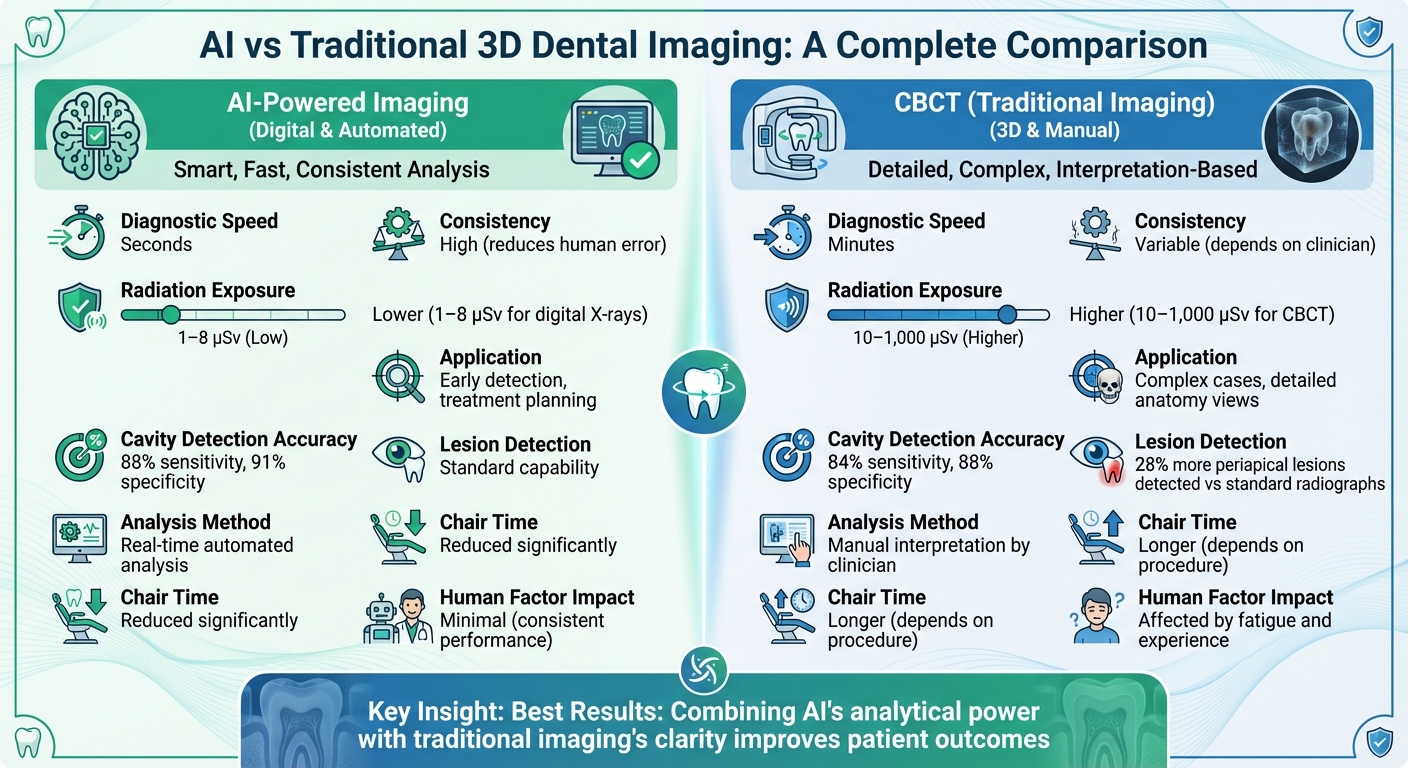
Quick Comparison:
| Feature | AI-Powered Imaging | CBCT (Traditional Imaging) |
|---|---|---|
| Diagnostic Speed | Seconds | Minutes |
| Consistency | High (reduces human error) | Variable (depends on clinician) |
| Radiation Exposure | Lower (1–8 µSv for digital X-rays) | Higher (10–1,000 µSv for CBCT) |
| Application | Early detection, treatment planning | Complex cases, detailed anatomy views |
AI and CBCT work best together, blending advanced analysis with reliable imaging for better care.
AI vs Traditional 3D Dental Imaging: Complete Feature Comparison
Accuracy: AI vs Traditional 3D Imaging
Detection of Dental Conditions
This section shifts focus to how well AI and traditional methods perform in diagnosing dental issues. AI-powered systems excel at analysing large volumes of dental data, including X-rays, images, and patient records. These systems can spot even the smallest abnormalities – often in the early stages of disease – where human clinicians might overlook them [9]. While traditional techniques like periapical and panoramic radiography are still widely used, they come with limitations that can affect how accurately they identify dental conditions [4].
One standout strength of AI is its ability to pinpoint conditions such as cavities, gum disease, and oral cancer long before they become severe. This early detection opens the door to timely interventions, which can help prevent more serious health issues [9]. Additionally, AI enhances imaging, making it easier to detect subtle changes in bone density, tumours, and other pathologies that might escape notice using traditional methods.
By contrast, traditional approaches are more susceptible to human factors like fatigue, which can influence how accurately panoramic radiographs are interpreted [8]. AI, on the other hand, provides consistent performance regardless of external factors like workload or time of day. However, clinical validation is still crucial to ensure AI operates effectively in real-world settings [5]. This reliability highlights AI’s potential to reduce diagnostic errors significantly.
Reducing Diagnostic Errors
AI’s ability to reduce false positives and negatives is another game-changer. Through automated anomaly detection and image segmentation, AI minimises the inconsistencies that often arise from human interpretation, especially when dealing with large sets of images [4].
That said, AI should be seen as an advanced diagnostic tool rather than a replacement for professional judgement. As Nature.com points out, "AI may enhance diagnostic accuracy, but final interpretation must remain with the dentist" [5]. Dentists retain the ultimate responsibility for maintaining accurate records and making clinical decisions. AI serves as a powerful assistant, supporting – but never replacing – the expertise and accountability of dental professionals.
Efficiency and Workflow Differences
Image Analysis Speed
AI-powered systems can analyse dental images in mere seconds, a stark contrast to traditional methods that might take several minutes per scan. With digital impressions, dentists can instantly view 3D models, bypassing delays caused by laboratory processing or re-impressions [9][10]. These advanced algorithms can quickly identify common issues like cavities, periodontal diseases, and impacted teeth in radiographs, automating what used to be a laborious manual process [9]. This speed not only accelerates diagnoses but also creates a more seamless experience for patients.
Automation and Patient Experience
AI-driven automation has transformed dental practice workflows by cutting down on scan and chair times. Take the iTero Lumina scanner as an example – it reduces the time patients spend in the chair while also lowering the likelihood of remakes [7]. In fact, 94% of surveyed doctors noted that Invisalign case submissions have become faster and easier thanks to the iTero Element 5D imaging system [7].
"The iTero Lumina scanner has the ability to decrease the chair time that we spend with the patient. Scans take less time and we have a lower remake percentage." – Dr Josh Austin, DDS [7]
AI doesn’t just improve clinical processes; it also simplifies back-office tasks like appointment scheduling, record-keeping, and documentation [5]. Together, these advancements lead to shorter appointments and smoother interactions, elevating the overall patient experience while allowing dental practices to operate more efficiently.
Radiation Exposure Levels
AI imaging systems not only enhance efficiency but also improve safety by reducing radiation exposure. Modern digital X-ray technology, which underpins AI systems, uses less energy and narrower beams, keeping patient exposure levels between 1–8 microsieverts – well below the 17 microsieverts of daily background radiation [13][14]. While CBCT scans range from 10 to 1,000 µSv, they still deliver lower doses compared to medical CT scans [12]. However, it’s worth noting that CBCT can involve higher radiation levels compared to traditional intraoral and panoramic radiography, which typically range between 1–8 µSv [12].
"Preserving the quality of the images is the best way we have of protecting our patients." – Hugo Campos, Associate Professor and Director of Oral and Maxillofacial Radiology, Tufts University School of Dental Medicine [14]
To further minimise radiation exposure, dental professionals are encouraged to use the smallest field of view necessary for the imaging objective and to apply dose-sparing techniques. This is particularly important for younger patients, adhering to the ALARA (As Low As Reasonably Achievable) principle [12].
Clinical Applications and Patient Outcomes
Uses in Diagnosis and Treatment Planning
AI is making waves in diagnosis and treatment planning by combining speed and accuracy. In dentistry, AI-powered 3D imaging is revolutionising implant placement and orthodontic procedures. These systems analyse CBCT scans and panoramic radiographs with incredible precision, identifying critical anatomical landmarks like the inferior alveolar nerve and maxillary sinus – areas where traditional methods often rely on a clinician’s interpretive skills [15].
"AI’s integration into implant dentistry has transformed diagnosis and treatment planning. Traditional methods depend on the clinician’s expertise, which can vary. In contrast, AI uses data from imaging systems like cone-beam computed tomography (CBCT) scans and panoramic radiographs to process and interpret diagnostic images with unparalleled precision." – Abdulrahman Ahmed Aseri, Department of Preventive Dental Sciences, Najran University [15]
AI doesn’t stop at diagnosis – it also evaluates bone quality and volume, flagging areas that may need augmentation. By processing patient-specific data, the technology suggests the best implant placement and angulation. This automated approach allows clinicians to visualise potential treatment outcomes before surgery even begins, reducing uncertainty and improving planning [15]. Emerging reviews highlight AI’s role in streamlining implant planning, paving the way for better patient care.
Effects on Patient Outcomes
AI’s precision is reshaping surgical success and long-term care outcomes. Tools like AI-enhanced robotic systems and dynamic navigation provide real-time guidance during surgery, ensuring implants are placed with exceptional accuracy. This level of precision reduces deviations from planned trajectories, minimising complications often linked to manual techniques, where results can vary based on a clinician’s experience [15].
Beyond surgery, AI models analyse patient-specific factors like bone density and overall health to predict risks associated with implants [15]. This predictive ability helps clinicians detect potential issues – such as peri-implantitis – early on, enabling timely interventions and more personalised care. Additionally, AI-driven imaging ensures consistent and reliable diagnoses across practitioners. This is especially crucial in complex cases, where traditional imaging might lead to varying interpretations [16][17].
sbb-itb-2be92ed
Future Trends in AI Dental Imaging
New Technologies in AI Dental Imaging
AI is not just refining dental imaging – it’s redefining it. By automating image analysis and offering predictive insights, AI is reshaping how dentists diagnose and plan treatments. Over the next decade, we can expect integrated systems capable of providing real-time diagnostics and treatment recommendations. Imagine a system that doesn’t just take an X-ray but instantly analyses it, flags potential concerns, and suggests treatment options based on extensive datasets – all in a matter of seconds. This shift from reactive to proactive care could revolutionise patient outcomes and dental workflows [18][9].
Barriers to AI Adoption
Despite its promise, AI adoption in Australian dental practices faces significant hurdles. For starters, robust clinical validation and clear regulatory frameworks are still works in progress [5]. Clinicians remain legally and ethically accountable for AI-generated recommendations, meaning they must critically evaluate AI outputs before acting on them [5].
There are also pressing concerns around data protection, patient consent, and compliance with regulations when using AI for clinical tasks or patient communication [5][9]. A key question looms: who is liable if a treatment plan, influenced by AI, goes wrong? Right now, the answer remains murky. Additionally, fairness and bias in AI systems lack proper oversight, creating uncertainty for practitioners [11].
Financial barriers also play a role. High initial costs and limited insurance coverage make it challenging for many practices to invest in these systems [19]. And while AI excels at processing data, it lacks human qualities like empathy and creativity – traits essential for ethical decision-making in healthcare [11]. Overcoming these challenges is crucial to unlocking AI’s potential in dentistry.
How Dental Clinics Can Lead Change
For dental clinics, the key to embracing AI lies in integration – not replacement. Clinics need to approach AI as a tool that complements, rather than substitutes, the expertise of dental professionals. This requires clear protocols, ongoing staff training, and a commitment to maintaining the clinician’s role as the ultimate decision-maker [5][11].
Australian clinics have an opportunity to lead by example. Investing in staff education, establishing robust protocols for AI-assisted diagnostics, and ensuring stringent quality control can set the standard for successful adoption. Addressing usability issues in new AI technologies [11] will also make these tools more accessible and effective. The practices that thrive will be those that strike a balance – leveraging cutting-edge technology while keeping patient-centred care at the forefront. By ensuring AI enhances the human element of dentistry, clinics can navigate this transformative era with confidence.
Conclusion: Selecting the Right 3D Imaging Approach
Key Points for Patients and Professionals
Choosing between AI-powered and traditional 3D imaging means understanding the strengths and limitations of both. AI brings advanced diagnostic capabilities by integrating intelligent software into digital imaging, offering faster and more consistent insights [1]. For instance, a 2024 randomised controlled trial revealed that AI achieved 88% sensitivity and 91% specificity in detecting cavities, outperforming human dentists who achieved 84% sensitivity and 88% specificity [2].
But AI isn’t without its challenges. In one study, the agreement between an AI system and clinical assessments for detecting cavities was only 19.9%, dropping to 11% for premolars [20]. AI also showed better performance with younger patients, with agreement rates at 25.53% for those aged 18–34, compared to just 13.04% for patients aged 55–68 [20]. Traditional 3D imaging techniques, such as CBCT, remain critical, especially for complex cases, as they detect 28% more periapical lesions compared to standard radiographs [6].
The best outcomes come from combining AI’s efficiency with the expertise of clinicians [2]. For example, practices using platforms like Overjet – recognised as the first dental AI to receive FDA clearance for caries detection and bone level quantification – report a 10–20% increase in case acceptance due to improved patient communication [1]. However, clinicians retain full responsibility for diagnostic decisions, regardless of AI input [5].
Looking ahead, integrating these tools will continue to shape the future of dental imaging.
The Future of Dental Imaging in Australia
AI is transforming efficiency, while traditional imaging methods ensure detailed and reliable results. This balance is shaping the future of dental care. In Australia, the dental imaging landscape is evolving steadily. Back in 2014, the ratio of panoramic radiography to CBCT machines in the country was about 7:1 [21]. However, the adoption of advanced imaging technologies has been growing since then. AI in dental radiography is expected to expand further, with future systems potentially predicting disease risks, simulating treatment outcomes, and tailoring treatment plans for individual patients [2][3].
As explored, both AI and traditional methods bring unique strengths to diagnostic precision and treatment planning. Australian clinics are well-positioned to benefit by integrating both approaches. AI excels in analysing images and modelling predictions [5], while traditional 3D imaging provides the detailed clarity essential for complex procedures. By combining these technologies, clinics can deliver better care and achieve higher patient satisfaction. The practices that succeed will be those that use AI to streamline and enhance their processes while relying on clinical expertise to guide final decisions. Together, these tools promise a brighter future for patient care across Australia.
AI Driven Digital Workflows: Integrating CBCT & IOS for Predictable Outcomes with Jordan Reiss.
FAQs
How does AI improve dental imaging accuracy compared to traditional methods?
AI is transforming dental imaging by leveraging advanced algorithms to detect abnormalities, sharpen 3D images, and minimise noise. Traditional approaches often rely on human interpretation, which can vary. In contrast, AI uses deep learning to provide consistent and highly accurate results.
This technology lowers the chances of missing critical details, enabling dentists to spot potential issues earlier. Early detection means more effective treatment plans and improved outcomes for patients. Additionally, the precision of AI-powered imaging cuts down on the need for repeat scans, boosting efficiency while enhancing patient comfort.
What are the limitations of using AI alone for 3D dental imaging?
AI-powered 3D dental imaging has brought remarkable progress to the field, but it’s not without its challenges. One key issue is that many AI systems are trained on limited datasets. This can lead to gaps in addressing the diverse needs of patients, potentially impacting the accuracy of diagnoses. Another concern lies in the "black box" nature of AI algorithms – how they reach their conclusions is often unclear, which can create doubts about accountability and trust.
For these reasons, it’s essential to pair AI with clinical validation and the expertise of qualified dental professionals. This ensures that diagnoses remain both accurate and safe. Moreover, privacy and data security are paramount. Sensitive patient information must be safeguarded at all times when incorporating AI technologies into dental practices.
How can dental clinics combine AI and traditional 3D imaging to improve patient care?
AI-powered 3D imaging is transforming traditional dental practices by speeding up the identification of key issues like cavities or bone loss and even creating treatment simulations. That said, traditional imaging methods, such as cone-beam computed tomography (CBCT), still play a crucial role in providing the detailed raw data that professionals rely on. The most effective strategy is to use AI as a supportive tool – helping to flag potential problems for dentists to review, ensuring accuracy in diagnosis.
Dental clinics can refine their workflows by:
- Choosing AI software that complies with Australian clinical standards.
- Training staff to interpret AI-generated insights while knowing when manual checks are required.
- Leveraging AI for routine tasks like measurements or producing patient-friendly visuals, allowing clinicians to focus on more complex decisions.
By combining AI technology with the expertise of clinicians, practices like Complete Smiles Bella Vista can streamline operations without compromising quality. This thoughtful integration ensures adherence to Australian regulations while delivering safe, evidence-backed care to patients.
Related Blog Posts
- AI vs. Traditional Methods: Impacted Teeth Detection
- AI-Powered Radiology: What Dentists Need to Know
- AI vs Radiographs: Caries Detection Accuracy
- AI and Cone-Beam CT: A Diagnostic Revolution
Important Notice: Any surgical or invasive procedure carries risks. Before proceeding, you should seek a second opinion from an appropriately qualified health practitioner.
Individual results may vary. The information provided in this article is for educational purposes only and does not constitute medical advice.
Checkout Related Blogs




Get in touch with us
For more information, call us now to start feeling better. Or fill the form below to make appointment
The Latest News from Complete Smiles
How to Clean Clear Plastic Retainers
Checklist for Choosing Wearable Dental Devices
Checklist for Choosing Cloud AI Platforms in Dentistry
Complete Smiles Bella VistaAccepts All Major Health Funds, Including