





AI in Oral Cancer Detection: How It Works
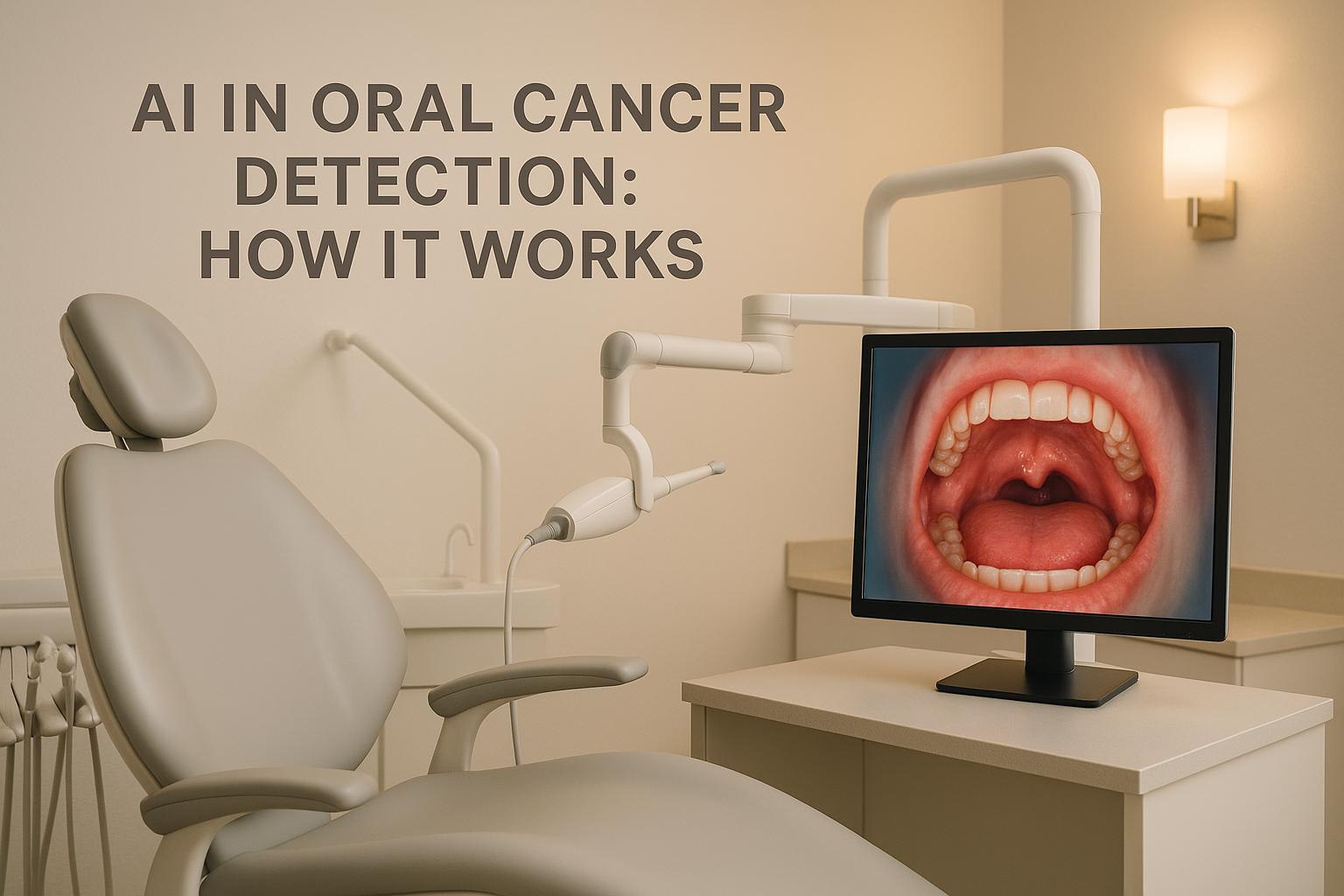
AI is changing how oral cancer is detected by identifying early signs that may be missed during routine dental exams. Traditional methods often rely on visual inspections and biopsies, which can overlook subtle changes or delay diagnosis, especially in remote areas. AI systems use advanced imaging tools like intraoral scanners, autofluorescence imaging, and optical coherence tomography to analyse tissue with precision. They provide real-time risk assessments by combining patient history with image analysis, helping dental professionals make informed decisions.
Key points:
- Why it matters: Early detection improves survival rates and reduces the need for complex treatments.
- Challenges in current methods: Visual exams can miss early signs, and biopsies are invasive and time-consuming.
- How AI works: AI uses machine learning and deep learning to analyse images, detect abnormalities, and assign risk scores.
- Limitations: AI depends on quality data, reliable infrastructure, and compliance with Australian regulations.
- Future potential: Real-time analysis and smartphone-based tools could improve access to care, especially in rural areas.
AI complements clinical expertise, offering more precise and earlier detection, which could lead to better patient outcomes across Australia.
Recent Advances in Oral Squamous Cell Carcinoma #oralpathology360
Technologies Behind AI Oral Cancer Detection
AI oral cancer detection combines cutting-edge computing power with advanced imaging tools to improve traditional diagnostic methods.
Machine Learning and Deep Learning
The backbone of AI oral cancer detection lies in machine learning, which allows computers to identify patterns in extensive clinical datasets without needing explicit instructions. By analysing numerous examples, these systems learn to differentiate between healthy tissue and tissue that may show early signs of cancer.
Deep learning takes this a step further, using artificial neural networks to process information across multiple layers. The initial layers focus on basic features like colour and texture, while deeper layers detect more complex patterns linked to cellular changes. The training process involves feeding these systems large, expertly labelled datasets of oral tissue images. With more labelled data, the system becomes better at spotting subtle abnormalities that might otherwise go unnoticed during routine exams.
Imaging and Data Collection Tools
Advanced imaging technologies play a key role in building the datasets AI systems rely on:
- Intraoral Scanners: These devices capture high-resolution 3D images of oral tissues, highlighting surface irregularities and changes that may indicate early issues.
- Autofluorescence Imaging: By using specific light wavelengths, this technique causes tissues to fluoresce. Differences in fluorescence can signal metabolic changes in cells, pointing to areas that need closer examination.
- Digital Photography: High-quality photographs can highlight details like vascular patterns and subtle discolourations, adding another layer of information to the diagnostic process.
- Optical Coherence Tomography (OCT): Operating similarly to ultrasound but using light waves, OCT generates cross-sectional images of oral tissues. This method provides a view beneath the surface, complementing external imaging.
Together, these imaging tools create detailed datasets that AI systems use to detect early signs of abnormal tissue changes, offering a more comprehensive diagnostic approach.
AI Integration in Dental Software
AI systems are seamlessly integrated into dental practice software, supporting routine examinations and enhancing diagnostic capabilities.
- Clinical Decision Support: AI tools embedded in dental software can process images captured during exams in real-time, flagging areas of concern immediately for further evaluation.
- Electronic Health Record (EHR) Integration: By connecting with EHR systems, AI can access a patient’s complete medical and dental history, including risk factors like smoking or past oral lesions, to provide more tailored assessments.
- Workflow Support: Beyond diagnostics, AI software can simplify administrative tasks, such as scheduling follow-up appointments or generating referrals to specialists when additional testing is needed.
- Cloud-Based Processing: Cloud solutions enable dental practices, regardless of their size, to access advanced AI tools without requiring extensive in-house computing resources. Data is securely analysed in the cloud and returned quickly to aid clinical decision-making.
These integrations empower dental professionals by offering enhanced diagnostic insights, complementing their clinical expertise. By combining advanced imaging with AI-powered tools, practitioners can detect potential oral cancer earlier, improving patient outcomes. This sets the stage for the next discussion on the step-by-step AI diagnostic process.
How AI Detects Oral Cancer
AI systems have become an integral part of dental diagnostics, particularly in identifying oral cancer. By combining advanced imaging techniques with clinical expertise, these systems provide precise and actionable insights.
Step-by-Step Process of AI Diagnosis
During a routine dental exam, images of the oral cavity are captured and processed to enhance their quality. This involves adjusting lighting, standardising formats, and ensuring clarity. These optimised images are then analysed by deep learning algorithms, which examine each pixel and compare it against a database of known patterns to identify any abnormalities.
Once potential issues are identified, the system assigns risk scores to these abnormalities. This helps prioritise areas that need immediate attention versus those that can be monitored over time. The risk scores are based on visual tissue characteristics combined with patient-specific risk factors.
The AI then generates a detailed diagnostic report, seamlessly integrated into the dental practice’s software. This report highlights areas of concern, provides probability assessments for potential malignancies, and suggests follow-up actions – ranging from continued monitoring to specialist referrals. To refine the diagnosis further, the AI focuses on specific tissue markers that might indicate more serious conditions.
What AI Looks For in Oral Tissues
AI systems are trained to detect distinct visual markers that signal malignant or premalignant changes in oral tissues. Some of the key indicators include:
- Colour changes: AI identifies subtle shifts in tissue colour, such as white patches (leukoplakia), red patches (erythroplakia), or mixed red and white lesions. These changes might be too subtle for the human eye during an initial examination.
- Texture irregularities: Surface texture is another critical factor. The AI flags areas where the tissue appears rougher, smoother, or otherwise different from the surrounding healthy tissue. These texture changes often precede visible colour variations.
- Vascular patterns: Abnormal blood vessel distribution, density, or appearance can signal increased metabolic activity linked to abnormal cell growth. Irregular vascular patterns are often associated with early-stage oral cancers.
- Lesion borders: AI evaluates whether lesion edges are well-defined or irregular. Malignant lesions typically have uneven, less distinct borders compared to benign conditions.
- Tissue thickness and elevation: The system assesses three-dimensional changes, such as raised or depressed areas, which may indicate underlying cellular abnormalities requiring further attention.
Risk Assessment and Prediction
AI systems go beyond just visual analysis by incorporating patient-specific risk factors, making the diagnostic process even more precise.
- Medical history: The AI considers a patient’s previous oral health issues, family history of cancer, and other relevant conditions. For example, patients with a history of oral lesions or a genetic predisposition are flagged as higher risk.
- Environmental and geographic factors: In Australia, exposure to ultraviolet radiation is a significant risk factor, particularly for lip cancers. The AI integrates such environmental risks into its analysis, tailoring predictions to the patient’s location and lifestyle.
By combining these factors with its visual analysis, the AI generates personalised risk scores. These scores help dental professionals decide whether a patient requires immediate intervention or can be monitored over time. This data-driven approach improves decision-making and ensures that high-risk patients receive timely care, while low-risk individuals avoid unnecessary procedures.
AI’s ability to integrate complex data and provide tailored insights represents a leap forward in oral cancer diagnostics, empowering dental professionals with tools to improve patient outcomes.
sbb-itb-2be92ed
AI vs Current Detection Methods
The use of artificial intelligence in oral cancer detection represents a major shift from traditional approaches. By comparing AI-assisted techniques with conventional methods, dental professionals can better understand how these advancements might influence oral health outcomes.
Accuracy, Speed, and Detection Rates
Traditional screening methods often rely on visual inspections, which can sometimes miss early and subtle changes in tissue. AI-powered systems, however, take a different approach by analysing digital images with remarkable consistency. Trained on extensive datasets, these systems can identify subtle patterns in tissue that might go unnoticed by the human eye. Instead of delivering a simple yes-or-no result, many AI tools provide detailed risk assessments, helping clinicians make more informed decisions about monitoring and referrals. That said, these systems are not without their challenges.
Limitations and Challenges
While AI offers exciting possibilities, there are hurdles to its widespread adoption in oral cancer detection. One key issue is the lack of diversity in the datasets used to train many AI systems. For a country like Australia, with its varied demographics, this could impact the accuracy of results.
Another challenge lies in the dependence on high-quality imaging and reliable digital infrastructure. Technical issues, such as poor image quality or system faults, could disrupt the diagnostic process. Additionally, AI should be seen as a supportive tool, not a replacement for clinical judgment.
Cost is another factor to consider. Smaller practices may find the initial investment in advanced imaging equipment, cloud-based platforms, and software maintenance to be a financial burden. On top of this, navigating the regulatory environment is essential. AI systems must comply with Australian healthcare standards, and addressing concerns like false positives requires ongoing attention and refinement.
Overcoming these challenges will be crucial for successfully integrating AI into everyday clinical practice.
AI in Australian Dental Practices: Current and Future Use
Artificial intelligence is steadily making its mark in Australian dental practices, particularly in the area of oral cancer detection. Let’s take a closer look at how AI is currently being used and what the future holds for its role in improving dental care across the country.
Current Use in Australian Dental Clinics
Many dental clinics in Australia are now incorporating AI-powered tools to assist with tasks like analysing radiographic images and refining digital imaging processes. These tools are especially valuable for identifying irregularities that might not be immediately apparent during traditional examinations. However, the extent of AI adoption varies, with clinics in metropolitan areas often having better access to the technical resources and infrastructure needed to support these advancements compared to those in regional or rural locations.
Dental professionals are also being trained to interpret AI-generated risk assessments alongside their clinical examinations. Importantly, these tools are not designed to replace professional judgement but to complement it, offering an additional layer of insight. As AI use becomes more widespread, ensuring ethical practices and regulatory compliance is critical.
Ethical and Regulatory Requirements
The implementation of AI in dental diagnostics in Australia is guided by strict regulations from bodies like the Australian Health Practitioner Regulation Agency (AHPRA) and the Dental Board of Australia. These regulations ensure that AI remains a tool to support, not substitute, the expertise of dental practitioners.
Key considerations include:
- Informed Consent: Patients must be made aware that AI provides preliminary evaluations and that final diagnoses are based on clinical examinations.
- Data Privacy: Patient data must be handled securely, in line with the Australian Privacy Act, whether stored locally or processed via cloud systems.
- Ongoing Validation: AI tools require regular performance checks, and practitioners must stay updated through training to ensure these technologies remain accurate and reliable.
These measures are essential for maintaining trust, protecting patient data, and ensuring that AI enhances rather than undermines clinical decision-making.
Future Developments in AI for Oral Cancer Detection
Looking ahead, AI has the potential to transform early detection of oral cancer even further. Some of the exciting advancements on the horizon include:
- Real-time analysis during dental examinations, which could be particularly useful for integrating with telehealth services to improve access to care in rural and remote areas.
- Smartphone-based screening apps that could offer preliminary assessments in community health settings, making early detection more accessible.
- Personalised risk assessment algorithms that take into account a patient’s genetic background, lifestyle factors, and environmental exposures.
Collaboration among researchers, industry experts, and dental practitioners will be key to driving these innovations, ensuring they are tailored to the needs of Australian communities. As these technologies advance, dental training programmes are expected to adapt, equipping both new and experienced practitioners with the skills needed to use AI effectively.
While the use of AI in oral cancer detection is still in its early stages in Australia, ongoing research and technological improvements suggest it could play a vital role in improving early detection rates and enhancing patient outcomes in the years to come.
Conclusion
AI is reshaping how oral cancer is detected, offering earlier and more precise identification of malignancies compared to traditional methods. By merging machine learning algorithms with advanced imaging technologies, AI can examine oral tissues with a level of detail that goes beyond human vision, picking up subtle cancerous changes that might be missed during routine examinations.
Rather than replacing clinical judgement, AI complements it by analysing cellular patterns, tissue anomalies, and colour variations in real time. This partnership between cutting-edge technology and human expertise marks a new era in preventive dental care.
For dental practices across Australia, incorporating AI solutions means better patient outcomes, particularly by catching oral cancer in its early stages when treatment is most effective. Strict ethical and regulatory measures ensure that AI serves as a supportive tool, safeguarding patient privacy while maintaining the critical role of clinical expertise. With these safeguards in place, advancements in AI continue to enhance diagnostic capabilities.
Looking ahead, innovations like real-time analysis, smartphone-based screening tools, and personalised risk assessments are set to broaden AI’s reach, especially in rural communities where access to specialist dental care can be limited. As AI technology progresses, maintaining rigorous validation and strong ethical standards will be key to unlocking its full potential in improving oral cancer detection.
FAQs
How does artificial intelligence improve the detection of oral cancer compared to traditional methods?
Artificial intelligence (AI) is reshaping the way oral cancer is detected, offering improvements in both accuracy and speed. Advanced AI systems, such as deep learning algorithms, have shown impressive precision in analysing medical images, with some studies reporting accuracy rates exceeding 94%. These tools excel at spotting subtle patterns in histopathological images – details that might be overlooked during traditional visual exams or biopsies.
Beyond accuracy, AI significantly accelerates the diagnostic process. By quickly processing large volumes of data, it reduces the chances of human error and fatigue. In some instances, AI-powered tools can even deliver real-time analysis using basic imaging devices, making early detection more accessible to a broader audience. Since early diagnosis is crucial for successful treatment, these advancements are making detection more reliable and efficient.
What challenges and limitations exist in using AI for detecting oral cancer in Australia?
The application of AI in detecting oral cancer in Australia comes with its fair share of challenges. One major obstacle is the requirement for large, varied datasets to train AI systems effectively, which aren’t always easy to access. On top of that, AI technology can sometimes struggle to pinpoint subtle or early-stage lesions, making extensive testing and validation crucial to ensure it delivers consistent and reliable results.
Australia’s healthcare system and stringent data privacy laws add another layer of complexity. These regulations, while essential for protecting patient information, can slow down the development and rollout of AI diagnostic tools. Although AI offers exciting possibilities, these challenges emphasise the need to pair advanced technology with the expertise of clinicians to achieve the best outcomes for patients.
How could AI improve dental care access in rural and remote areas?
AI is reshaping dental care in rural and remote areas, helping to bridge the gap caused by geographical challenges. With AI-powered imaging technology, dentists can now assess oral health conditions with improved precision, even from afar. This means issues like oral cancer can be detected earlier, potentially leading to better treatment results.
On top of that, virtual consultations and AI-driven teledentistry tools are making it simpler for people in underserved regions to connect with dental professionals without the hassle of long-distance travel. These tools also play a role in ongoing care, offering personalised oral health tips and reminders to help patients maintain their dental hygiene.
These advancements are opening up opportunities for more accessible and efficient dental care across Australia, particularly benefiting communities that have long struggled to access specialist services.
Related Blog Posts
- AI Research in Oral Disease Detection: Key Findings
- AI vs. Traditional Methods: Impacted Teeth Detection
- AI-Powered Dental Imaging: Future Trends
- AI in Dentistry: Benefits of Personalised Oral Health Insights
Important Notice: Any surgical or invasive procedure carries risks. Before proceeding, you should seek a second opinion from an appropriately qualified health practitioner.
Individual results may vary. The information provided in this article is for educational purposes only and does not constitute medical advice.
Checkout Related Blogs




Get in touch with us
For more information, call us now to start feeling better. Or fill the form below to make appointment
The Latest News from Complete Smiles
How to Clean Clear Plastic Retainers
Checklist for Choosing Wearable Dental Devices
Checklist for Choosing Cloud AI Platforms in Dentistry

Complete Smiles Bella VistaAccepts All Major Health Funds, Including





