





Elastic Modulus vs. Flexural Strength in Restorations
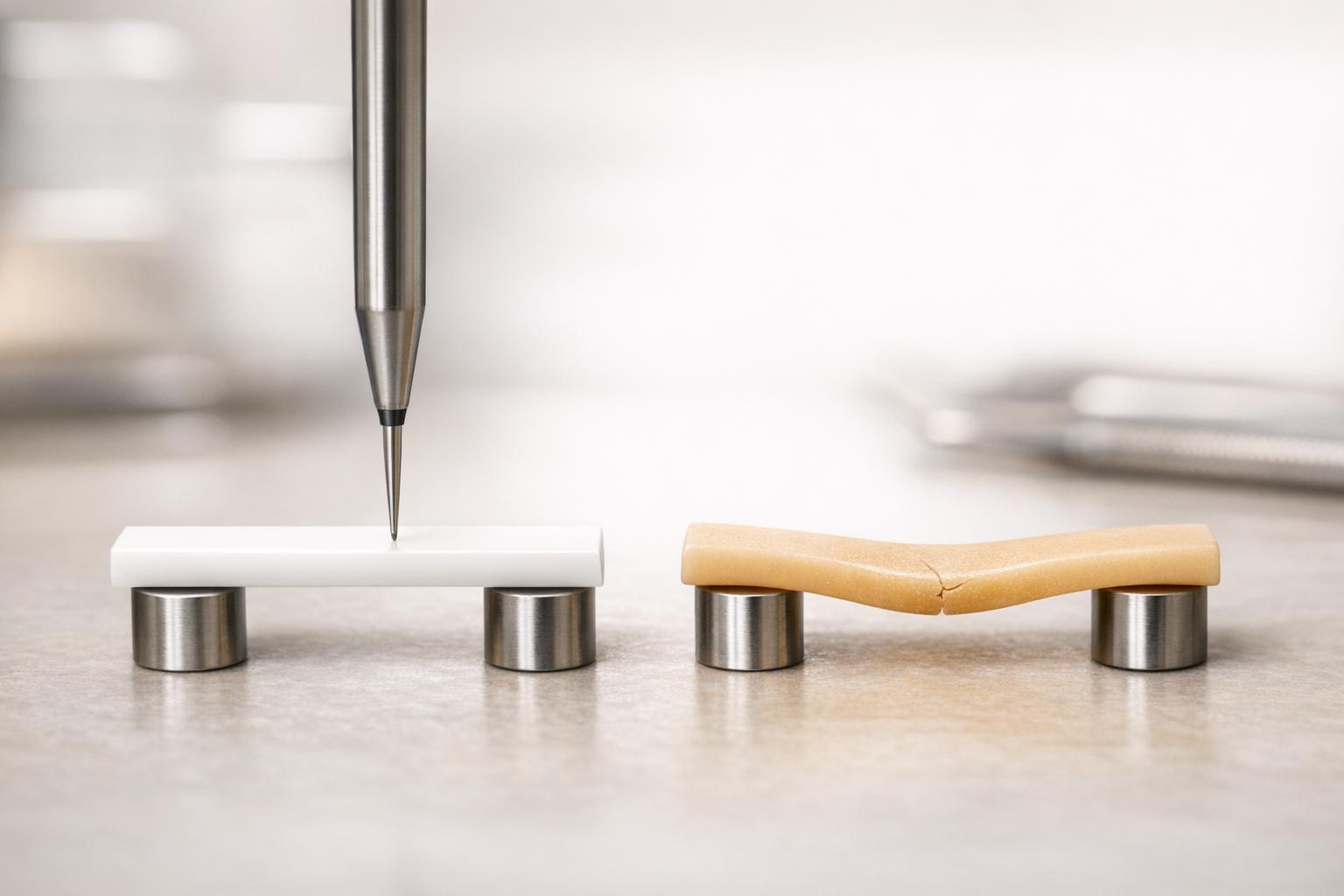
Elastic modulus and flexural strength are two key properties that determine how dental restorations perform under daily chewing forces. Elastic modulus measures a material’s stiffness – how much it resists bending – while flexural strength indicates the maximum stress a material can handle before breaking. Together, these properties ensure restorations are durable and functional.
Key Points:
- Elastic Modulus: Higher values mean stiffer materials (e.g., milled PMMA is stiffer than 3D-printed resins). This helps prevent excessive flexing but may transfer stress to surrounding teeth.
- Flexural Strength: Determines how much force a material can endure before fracturing. Milled materials often exceed ISO standards, while some 3D-printed resins may fall short if not properly processed.
- Clinical Relevance: Matching these properties to natural teeth reduces fracture risk and improves restoration longevity. For example, stiffer materials like milled PMMA are ideal for high-stress applications like long-span bridges.
Quick Insights:
- Milled PMMA offers higher strength and stiffness compared to conventional or 3D-printed options, making it better for high-load scenarios.
- 3D-printed resins, while improving, may still be more suited for short-term restorations unless optimally processed.
- Proper material selection ensures restorations can withstand chewing forces without deforming or breaking.
Understanding these differences helps dentists choose the right material for each patient, balancing strength and flexibility for long-lasting results.
Prosthodontics | Mechanical Properties | INBDE, ADAT
sbb-itb-2be92ed
What is Elastic Modulus?
Elastic modulus, often referred to as Young’s modulus or modulus of elasticity, measures how stiff a material is. It’s calculated as the ratio of elastic stress to elastic strain[6]. Essentially, it represents the slope of the linear portion of a stress–strain graph, which corresponds to the material’s reversible elastic deformation. Below the proportional limit of a material, this deformation is entirely reversible, making it particularly important in dental restorations.
Stiffness varies depending on the elastic modulus: materials with a higher modulus are stiffer, while those with a lower modulus are more flexible. In dentistry, this property is typically measured in MPa or GPa, where 1 MPa equals 1 N/mm². For example, 3D‑printed resin samples show elastic moduli ranging from 2.4 ± 0.02 GPa to 2.6 ± 0.18 GPa, compared to conventional resins, which average around 1.3 GPa[3]. This difference in stiffness plays a crucial role in how well restorations resist bending under functional loads.
Understanding and utilising this property is critical in clinical practice, as it directly influences the durability and functionality of dental restorations.
Clinical Relevance of Elastic Modulus
In clinical settings, matching the elastic modulus of restorative materials to that of natural dentin helps to reduce stress concentrations and minimise the risk of fractures[6]. When materials with vastly different stiffness levels are combined, stress is not evenly distributed, leading to weak points that increase the likelihood of fractures, especially in long-span restorations[2].
For instance, the higher elastic modulus found in some 3D‑printed resins provides enhanced stability for complex prostheses under chewing forces[3]. This added rigidity prevents flexing, which can otherwise lead to fractures during mastication, making these materials particularly useful for demanding dental applications[2].
What is Flexural Strength?
Flexural strength refers to the maximum stress a material can handle before it gives way or fractures during a bending test [7][8]. While the elastic modulus tells us how stiff a material is, flexural strength focuses on the breaking point – the maximum force a material can endure before failing. This property reflects how well a material resists compressive, tensile, and shear stresses combined [7][8]. For example, when you bite down, these stresses act together, testing a dental restoration’s flexural strength.
"Flexural strength is the combination of compressive, tensile, and shear stress and is defined as the maximum stress that a material experiences at its yielding point."
- Alessio Casucci, Department of Prosthodontics, University of Siena [4]
This property is especially important for restorations that face heavy functional loads, like long-span bridges or denture bases. During normal chewing, dental restorations can experience up to 300,000 flexures annually [8], so their ability to resist fractures under repeated bending is key to their durability. According to ISO 20795-1:2013, denture base polymers must have a minimum flexural strength of 65 MPa [7], though many newer materials surpass this requirement. Because of its importance, standardised tests are used to evaluate flexural strength.
Testing Flexural Strength in Dental Materials
The three-point bending test is the gold standard for measuring flexural strength in dental polymers [7]. In this test, a rectangular beam is supported at both ends, and a load is applied at the centre. The stress is then calculated using the formula:
σ = 3Pl / 2bd²
Here, P is the applied load, l is the span length, b is the specimen’s width, and d is its thickness [7][8].
Other methods include the four-point bending test, which spreads the load more evenly to minimise localised stress [8], and the biaxial flexure test, often used for brittle materials like zirconia and ceramics. One common configuration for the latter is the "piston-on-three-ball" method [3][9]. These tests are standardised under ISO 20795-1 for denture bases and ISO 4049 for resin-based materials. They help clinicians evaluate how dental materials perform under static loads, guiding them in choosing materials that can handle everyday stresses.
Key Differences Between Elastic Modulus and Flexural Strength
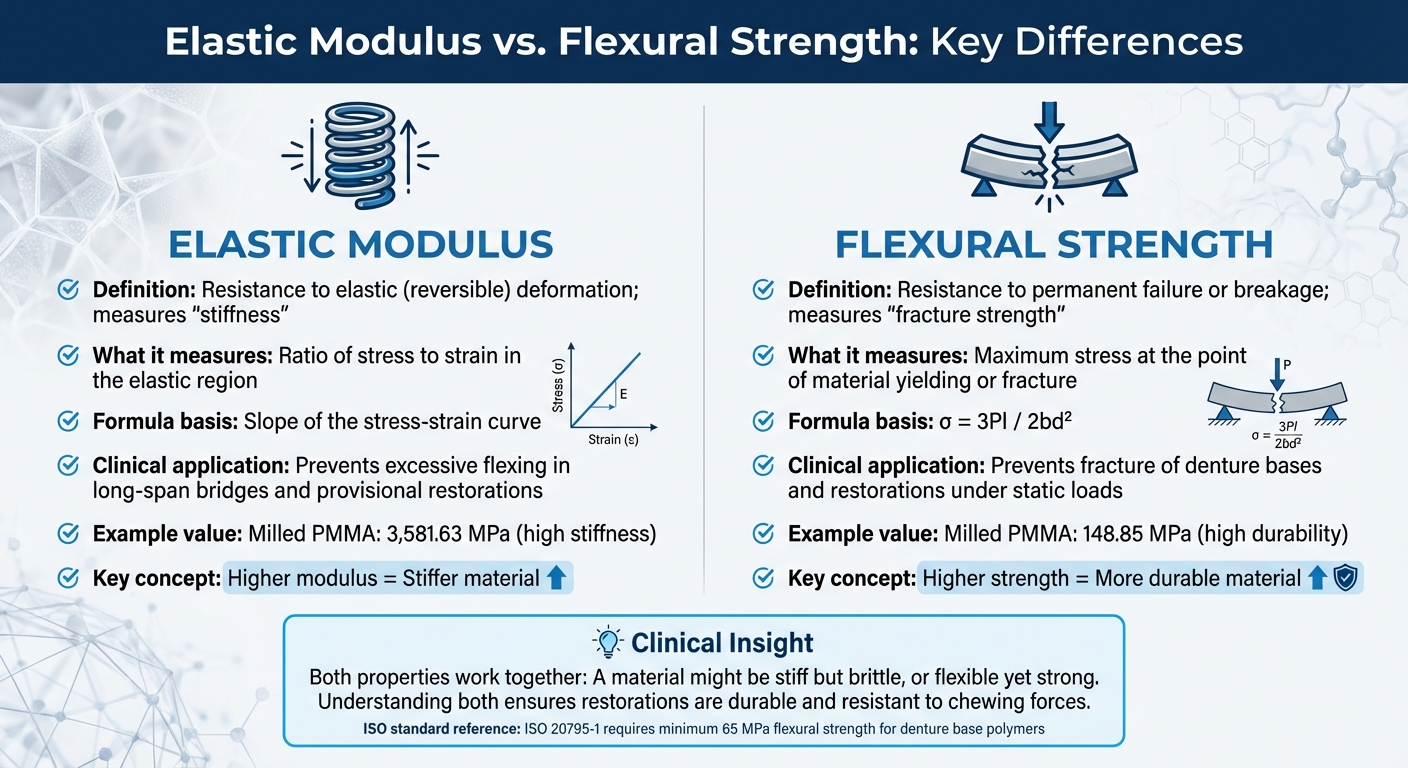
Elastic Modulus vs Flexural Strength in Dental Restorations Comparison
Building on the earlier definitions, let’s explore how elastic modulus and flexural strength differ and how these differences influence restoration performance.
Although both are assessed using bending tests, they highlight distinct material behaviours. Elastic modulus measures a material’s stiffness during reversible deformation, while flexural strength indicates the maximum stress a material can endure before breaking. The elastic modulus is derived from the slope of the stress–strain curve during the elastic phase, whereas flexural strength reflects the material’s capacity to resist fracture under bending.
"An elastic modulus is a quantity that describes an object’s or substance’s resistance to being deformed elastically (i.e., non-permanently) when a stress is applied to it."
- Wikipedia [1]
In clinical practice, elastic modulus determines how much a restoration flexes during use, which is critical for avoiding problems like cement seal failure in long-span bridges[2]. On the other hand, flexural strength predicts whether a restoration can handle repetitive biting forces without breaking[7]. This distinction is essential for selecting materials suited to specific restorative needs. A material might be stiff but brittle or flexible yet strong, so understanding both properties ensures restorations are durable and resistant to chewing forces. The table below provides a clear comparison of these two properties.
Comparison Table: Elastic Modulus vs. Flexural Strength
| Feature | Elastic Modulus | Flexural Strength |
|---|---|---|
| Core Definition | Resistance to elastic (reversible) deformation; "stiffness"[1] | Resistance to permanent failure or breakage; "fracture strength"[7] |
| Property Measured | Ratio of stress to strain in the elastic region[1] | Maximum stress at the point of material yielding or fracture[7] |
| Formula Basis | Slope of the stress–strain curve[1] | σ = 3Pl / 2bd² (where P is the maximum load)[7] |
| Clinical Application | Prevents excessive flexing in long-span bridges and provisional restorations[2] | Prevents fracture of denture bases and restorations under static loads[7] |
| Material Example | High modulus = stiff (e.g., milled PMMA at 3,581.63 MPa)[12] | High strength = durable (e.g., milled PMMA at 148.85 MPa)[12] |
How They Affect Dental Restorations
Flexural strength and elastic modulus are key factors in determining how well a dental restoration can handle daily activities like chewing and speaking, as well as occasional impacts. Flexural strength measures how well a material resists forces like tension, shear, and compression [4][5]. For example, when a person repeatedly chews, restorations with high flexural strength are less likely to crack or develop fractures over time [5].
Elastic modulus, on the other hand, indicates how much a material bends under pressure and whether it can return to its original shape. While a stiffer material offers better stability, it can also transfer too much stress to the surrounding tooth structure. Conversely, a material that’s too flexible might permanently deform or create gaps at the edges of the restoration. Interestingly, research shows that elastic modulus isn’t a strong predictor of how well a material resists long-term fatigue from repeated use (r² = 0.679) [2][13].
These properties work together, especially when tailoring restorations for specific needs. For instance, using materials with higher flexural strength allows thinner designs, like reduced palatal plates in dentures, which can improve comfort without compromising durability. Impact strength, calculated as σ²/E [10], depends on both flexural strength and elastic modulus, further highlighting their interconnected roles.
The oral environment adds another layer of complexity. Methyl methacrylate-based resins, for example, can lose flexural strength over time when exposed to artificial saliva due to water-induced plasticisation [11]. On the flip side, some bioactive materials, such as BioCoat (flexural strength: 94.4 ± 9.7 MPa, elastic modulus: 5.2 ± 0.5 GPa), may actually harden over time by releasing and reabsorbing calcium and phosphate ions [14]. This underscores why both flexural strength and elastic modulus should be carefully considered when selecting materials.
Choosing the Right Material for Specific Restorations
To optimise the performance of dental restorations, it’s essential to choose materials that match the demands of the specific clinical situation. For high-stress applications like posterior restorations or long-span bridges, materials must meet stringent standards. For example, ISO 4049 mandates that polymer-based materials for occlusal surfaces have a flexural strength of at least 80 MPa, while ISO 1567 requires a minimum of 65 MPa for denture base polymers [5][14].
Milled CAD/CAM PMMA, with an average flexural strength of 120.61 MPa, has become a popular choice for high-load scenarios such as cases involving bruxism or overdentures [5]. This material, produced through subtractive manufacturing, achieves higher density and fewer internal flaws compared to conventional heat-polymerised PMMA, which averages 92.16 MPa [5]. When making adjustments, such as burnishing metal margins or bending clasps, clinicians must consider the ‘spring back’ effect. This is governed by the elastic modulus, which determines whether deformation is permanent or temporary [6].
3D-printed resins present another option, though their performance can vary significantly. Standard 3D-printed materials can have flexural strength as low as 54.07 MPa if not properly polymerised, falling below ISO standards and limiting their use to short-term restorations [4]. However, newer composite-reinforced 3D resins, when optimally post-cured, can achieve flexural strength around 102.96 MPa, making them comparable to milled materials and suitable for longer-term provisional restorations [4]. Following manufacturer-recommended curing protocols – such as extending curing times from 20 to 40 minutes – can greatly improve their strength [4].
For patients with high functional loads or a history of recurrent fractures, milled PMMA is often the best choice. Its high-pressure, high-temperature fabrication process reduces porosity and enhances durability [5]. In cases like three-unit bridges, tensile stress tends to concentrate on the gingival side, whereas cantilever bridges experience more stress on the occlusal surface. These factors highlight the importance of carefully planning material placement and restoration thickness to ensure long-term success [6].
Performance in CAD/CAM Restorative Materials
When it comes to mechanical properties, CAD/CAM-milled resins stand out significantly compared to conventional heat-polymerised and 3D-printed materials. These resins are crafted from industrially pre-polymerised pucks under high pressure and temperature, resulting in a denser material with fewer voids and a higher degree of monomer conversion than other fabrication methods [5][15][16].
For example, milled PMMA denture bases exhibit an average flexural strength of 120.61 MPa, outperforming conventional heat-polymerised versions at 92.16 MPa. Additionally, their elastic modulus reaches an impressive 3,240.06 MPa, whereas some 3D-printed resins measure as low as 576.65 MPa [5][15]. This higher stiffness makes milled materials better at withstanding the functional loads associated with chewing and bruxism. The performance advantage of milled materials is further highlighted by comparative studies.
"Milled denture base resins showed the lowest surface roughness, and highest hardness and elastic modulus among the three groups." – Ahmed Abd El-latif Zeidan, Department of Prosthodontics, Badr University [15]
On the other hand, 3D-printed resins face limitations due to the printing process itself. To maintain the liquid consistency necessary for printing, they typically contain only about 33% filler by weight, compared to the 70–80% found in milled blocks [17]. This reduced filler content leads to lower strength and stiffness. For instance, a study conducted at King Abdulaziz University compared definitive crown materials and found that milled Grandio Blocs (VOCO GmbH) achieved a flexural strength of 244.5 MPa and a flexural modulus of 11,650 MPa. In contrast, the 3D-printed VarseoSmile Crown Plus (BEGO) demonstrated only 128 MPa flexural strength and 2,901 MPa flexural modulus. While the 3D-printed material met minimum standards, the study emphasised that milled composites are better suited for high-load applications [17].
For restorations subjected to heavy loads, CAD/CAM-milled materials remain the go-to option. Their superior mechanical properties allow for thinner denture bases without sacrificing durability, which can enhance patient comfort and improve speech [5]. However, when using 3D-printed resins, strictly adhering to the manufacturer’s post-curing protocols is essential. Extending the curing time from 20 to 40 minutes can significantly boost flexural strength, though these materials are often more appropriate for provisional or short-term use [7].
Comparison Table: CAD/CAM vs. Conventional and 3D-Printed Resins
| Material Type | Fabrication Method | Flexural Strength (MPa) | Elastic Modulus (MPa) | Surface Hardness |
|---|---|---|---|---|
| Denture Base PMMA | CAD/CAM-Milled | 120.61 [5] | 3,240.06 [15] | 29.18 VHN [15] |
| Denture Base PMMA | Conventional (Heat-Cured) | 92.16 [5] | 3,017.16 [15] | 22.44 VHN [15] |
| Denture Base Resin | 3D-Printed | 54.07–102.96 [7] | 576.65 [15] | 2.64 VHN [15] |
| Definitive Crown | CAD/CAM-Milled | 155.0–244.5 [17] | 6,142–11,650 [17] | 67.2–119.1 HV [17] |
| Definitive Crown | 3D-Printed | 128.0–143.6 [17] | 2,901–3,217 [17] | 29.5–30.3 HV [17] |
Conclusion
Understanding elastic modulus and flexural strength is crucial when selecting materials for dental restorations. Flexural strength refers to the maximum stress a material can handle before breaking, while elastic modulus reflects its stiffness. Together, these properties ensure restorations can withstand the daily forces of chewing and biting [12].
"Flexural strength is defined as the transverse strength or modulus of rupture, that is obtained by supporting a bar or beam at each end and loading it in the middle." – Ala’A Abou-Obaid, King Saud University [12]
This highlights the importance of finding a balance between strength and stiffness. For restorations to succeed clinically over the long term, they must possess enough flexural strength to resist fractures and an elastic modulus that maintains both marginal integrity and aesthetics [12]. If either property is lacking, complications such as breakage or tooth drifting may occur, particularly in high-stress situations like full-mouth rehabilitations, long-span prostheses, or among patients with bruxism [12][11].
Given these requirements, careful material selection becomes essential. As previously discussed, CAD/CAM milled materials consistently meet these demands, outperforming 3D-printed and conventional options in both flexural strength and stiffness [12]. According to the International Standards Organisation (ISO 1567), denture base polymers must have a minimum flexural strength of 65 MPa [5]. Choosing materials that exceed this benchmark – while also offering suitable stiffness – ensures better durability and reduces the likelihood of premature restoration failure. This is particularly important when considering wear-resistant materials that maintain surface integrity over time.
The key to successful restorations lies in aligning material properties with the specific needs of each patient. This approach ensures not only functional success but also long-term clinical reliability.
FAQs
Which matters more for my restoration: stiffness or strength?
The significance of stiffness (elastic modulus) compared to strength (flexural strength) varies based on the clinical situation. Elastic modulus reflects a material’s ability to resist deformation, which helps distribute stress evenly. On the other hand, flexural strength measures how much bending force a material can endure before it fractures. Both qualities are essential: strength ensures the restoration can handle loads without breaking, while stiffness supports better integration with the natural biomechanics of teeth.
Can a material be stiff but still crack easily?
Yes, a material can have a high elastic modulus (making it stiff and resistant to bending or deformation) but still crack easily if its flexural strength is low. This means that while the material resists bending, it may fracture when subjected to stress. Elastic modulus and flexural strength are separate properties, and both are critical in assessing the durability and performance of dental restorative materials.
How does 3D-print post-curing change strength?
3D-print post-curing boosts the flexural strength of resin materials by furthering polymerisation and improving their mechanical properties. Research shows that post-curing plays a key role in increasing the durability and overall performance of these materials.
Related Blog Posts
- Fatigue Resistance of CAD/CAM Dental Materials
- Porcelain vs Lithium Disilicate: Flexural Strength Explained
- Stress Distribution: Ceramic vs Composite
- Ceramic vs. Resin: Toughness in CAD/CAM Restorations
Important Notice: Any surgical or invasive procedure carries risks. Before proceeding, you should seek a second opinion from an appropriately qualified health practitioner.
Individual results may vary. The information provided in this article is for educational purposes only and does not constitute medical advice.
Checkout Related Blogs




Get in touch with us
For more information, call us now to start feeling better. Or fill the form below to make appointment
The Latest News from Complete Smiles
How to Clean Clear Plastic Retainers
Checklist for Choosing Wearable Dental Devices
Checklist for Choosing Cloud AI Platforms in Dentistry

Complete Smiles Bella VistaAccepts All Major Health Funds, Including





