




Stress Distribution: Ceramic vs Composite

When it comes to dental restorations, the material you choose – ceramic or composite – directly impacts durability and stress distribution. Ceramics are rigid and absorb stress internally, protecting the tooth but risking brittle fractures. Composites, on the other hand, are flexible, transferring stress to the tooth, which may increase the chance of tooth or adhesive failure. Here’s what you need to know:
- Ceramics: High stiffness (65–250 GPa), ideal for strength-focused applications like posterior crowns. However, they are brittle and prone to cracks.
- Composites: Lower stiffness (8–21 GPa), better for shock absorption and fatigue resistance, but they transfer more stress to the tooth and are sensitive to lateral forces.
Quick Comparison
| Feature | Ceramic (e.g., Zirconia, Lithium Disilicate) | Composite (e.g., Resin Nano-Ceramic) |
|---|---|---|
| Elastic Modulus | High (65–250 GPa) | Low (8–21 GPa) |
| Stress in Restoration | High (absorbs stress internally) | Low (deforms under stress) |
| Stress on Tooth | Low (shields tooth) | High (transfers stress to tooth) |
| Failure Risk | Brittle fractures | Debonding or tooth failure |
| Fatigue Resistance | Moderate to high | High |
| Applications | High-load areas like molars | Smaller defects, anterior teeth |
Choosing the right material depends on factors like tooth condition, occlusal forces, and patient-specific needs. Ceramics are better for strength and longevity, while composites offer flexibility and easier repairs.
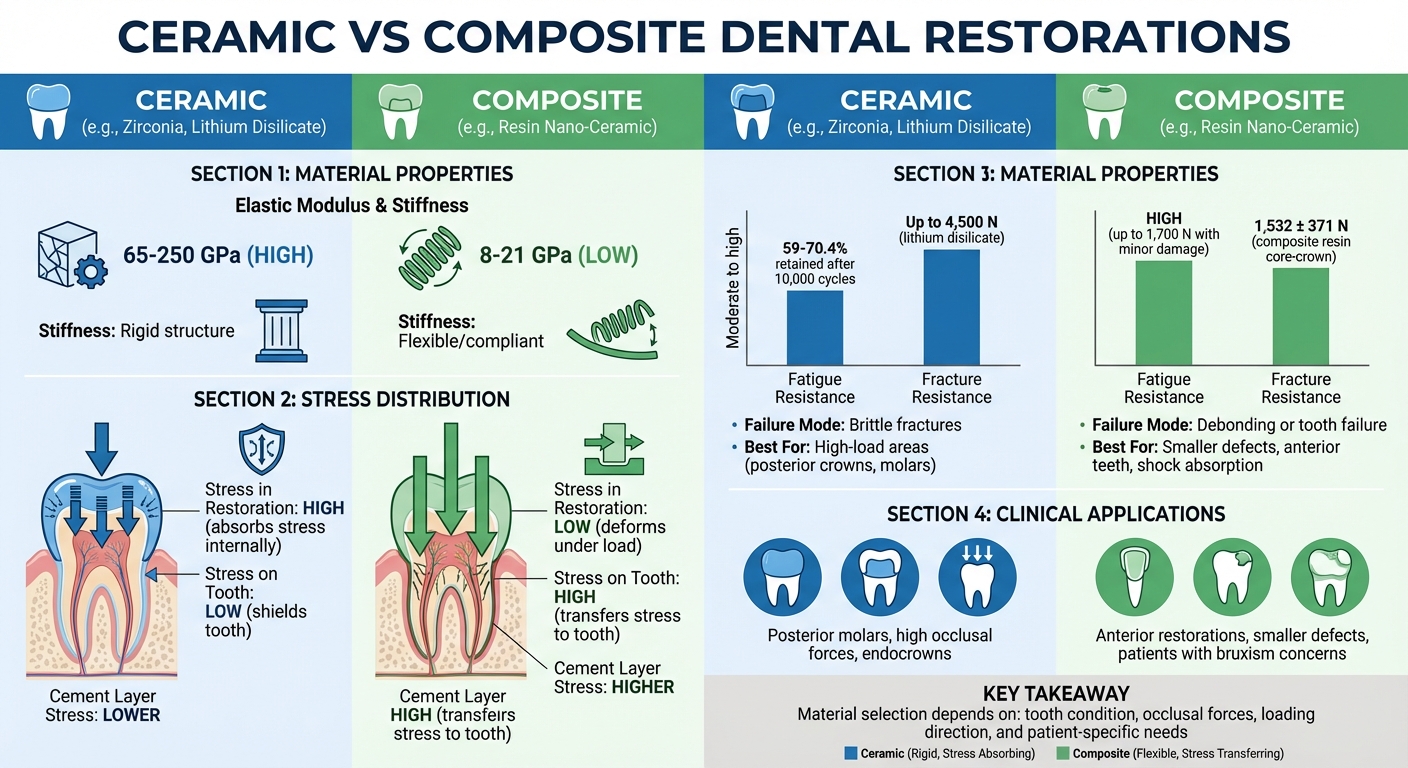
Ceramic vs Composite Dental Restorations: Stress Distribution and Material Properties Comparison
Ceramic Materials in CAD/CAM Restorations
Types of Ceramic Materials
Ceramics used in CAD/CAM restorations are typically grouped into three main categories.
First, there are glass-rich ceramics, such as feldspathic and leucite-reinforced materials. These are commonly chosen for inlays, onlays, and veneers because of their outstanding aesthetic qualities. However, their mechanical strength is on the lower side, generally ranging between 70 and 130 MPa [4].
Next, lithium disilicate glass-ceramics offer a balance between strength and translucency. A well-known example is IPS e.max CAD, which consists of about 70% lithium disilicate crystals embedded in a glassy matrix [1]. This composition delivers both durability and a natural appearance. A more recent addition to this category is zirconia-reinforced lithium silicate (ZLS). By incorporating roughly 10% dissolved zirconia into the glass matrix, ZLS enhances strength while retaining the aesthetic appeal of glass-ceramics [9].
Finally, there’s zirconia, often referred to as "ceramic steel" because of its exceptional mechanical properties [2]. This polycrystalline material is ideal for high-strength applications, such as copings and monolithic posterior crowns, where durability is paramount.
Each of these materials has unique characteristics that influence their mechanical performance, which will be explored in the next section.
Material Properties of Ceramics
The stiffness of dental ceramics plays a critical role in how they handle and transfer stress. For instance, zirconia boasts an elastic modulus of about 250 GPa, making it nearly four times stiffer than feldspathic ceramics, which measure around 65 GPa [4]. This high stiffness allows ceramics to absorb and concentrate stress within the restoration itself, offering better protection for the underlying tooth structure compared to more flexible materials.
However, ceramics have a shared drawback: brittleness. As Professor Richard van Noort explains:
"A major disadvantage of dental ceramic materials relates to their brittle nature owing to their atomic bonds that inhibits the atomic planes to slide apart when subjected to load" [7].
This inherent brittleness makes ceramics susceptible to flaws and microcracks, which can rapidly propagate under stress. While ceramics like zirconia demonstrate impressive strength – achieving fracture resistance up to 1,000 N compared to 772.3 N for feldspathic ceramics [7] – they are still prone to sudden failure if flaws are present. This balance between strength and vulnerability is a crucial consideration when selecting materials for dental restorations.
Composite Materials in CAD/CAM Restorations
Types of Composite Materials
CAD/CAM composites come in various types, including nanofilled/nanohybrid, polymer-infiltrated ceramic network (PICN), and resin nano-ceramic (RNC) materials.
Nanofilled and nanohybrid composites, like Lava Ultimate, are made of silica and zirconia nanoparticle clusters embedded in a polymer matrix [3]. These materials stand out for their toughness and ability to resist impact, making them ideal for anterior restorations where shock absorption is crucial [12].
Polymer-infiltrated ceramic network (PICN) materials, such as VITA Enamic, have a distinctive dual-network structure. They are composed of about 86% inorganic ceramic and 14% polymers by weight [9]. This combination provides the wear resistance of ceramics with the elasticity of polymers, offering excellent resistance to sliding-contact fatigue [3].
Resin nano-ceramics (RNC), like Cerasmart, feature a high filler content, with silica and barium glass nanoparticles making up to 71% of their weight [9]. This composition enhances mechanical durability while retaining the flexibility that composites are known for.
One notable advantage of CAD/CAM composite blocks is their higher filler volume and superior degree of cure compared to traditional chairside composites [1][3]. These properties directly affect how stress is transferred and loads are borne in restorations.
Material Properties of Composites
Composites differ significantly from ceramics in terms of modulus. While ceramics have moduli ranging between 65–250 GPa, composites are much lower, between 8–21 GPa [4][10]. This lower modulus results in unique load transfer characteristics. Composite restorations generate less internal stress but transfer more of the occlusal load to the underlying tooth structure due to their flexibility [1][5][11]. On the other hand, stiffer ceramics absorb more stress within the restoration itself, offering better protection for the tooth.
Stress concentration patterns also vary. Polymer-matrix composite crowns primarily show stress on the occlusal surface, whereas glass-ceramic crowns experience stress on both the occlusal and cemented surfaces [1].
Despite transferring more stress to the tooth, composites excel in fatigue resistance. In mouth-motion step-stress tests, monolithic Lava Ultimate crowns withstood loads up to 1,700 N with only minor occlusal damage. In contrast, glass-ceramic crowns began fracturing at loads around 450 N [3]. This demonstrates a fatigue tolerance 3 to 4 times greater than leucite-reinforced glass-ceramics [3].
Another practical benefit of composite blocks is their milling damage tolerance. Unlike brittle ceramics, composites can be milled into a full-contour crown in as little as six minutes, without the need for post-milling firing [3]. They are also easy to adjust and repair chairside [1].
How Ceramics and Composites Distribute Stress
Stress Transfer Patterns
The way a material handles stress is heavily influenced by its elastic modulus, which determines how stress is distributed between the tooth and the restoration. Ceramics, for example, are designed to absorb and distribute occlusal loads internally. This means they reduce stress on the tooth itself, offering a protective benefit, especially for compromised teeth. By minimising stress at crack tips, ceramics can even help prevent cracks from spreading further [6][13].
Composites, on the other hand, manage stress differently. Instead of resisting stress rigidly, they deform to accommodate it. For instance, polymer-matrix composite (PMC) crowns show lower maximum stress compared to glass–ceramic crowns. However, they are more sensitive to lateral forces, which can cause greater stress concentration [1]. Unlike ceramics, PMC crowns tend to focus stress on the occlusal surface and transmit more of the load to the surrounding tooth walls [1][5].
The cement layer also plays a significant role in stress distribution. Materials with higher stiffness, like ceramics, reduce tensile and shear stresses in the luting cement. This also leads to a decrease in stress at the cement–tooth interface [10].
These differences set the stage for a closer look at how ceramics and composites handle stress in restorative applications.
Comparison Table: Ceramic vs Composite Stress Behaviour
Here’s a quick breakdown of how ceramics and composites differ in stress management:
| Property | Ceramic (e.g., Lithium Disilicate, Zirconia) | Composite (e.g., Resin Nano-Ceramic, PMC) |
|---|---|---|
| Elastic Modulus | High (rigid structure) | Low (flexible/compliant) |
| Stress in Restoration | High – material absorbs most of the load [5][10] | Low – material deforms under load [1][5] |
| Stress in Tooth Substrate | Lower – shields the tooth from stress [5][6] | Higher – transfers stress to the tooth [5][6] |
| Cement Layer Stress | Lower tensile and shear stresses [10] | Higher contact stresses at adhesive interface [10] |
| Peak Stress Location | Occlusal and cemented surfaces [1] | Primarily occlusal surface [1] |
| Lateral Loading Sensitivity | More resistant to lateral forces [1] | More affected by lateral forces [1][12] |
| Failure Risk | Brittle fracture of ceramic material [2][10] | Debonding or tooth structure failure [1][5] |
Research into occlusal veneers highlights these differences even further. Lithium disilicate restorations, for instance, experience the highest stress within the veneer itself. However, they impose the least stress on the underlying tooth, which reduces the likelihood of system failure. In contrast, resin nano-ceramic restorations exhibit lower stress within the veneer but transfer more stress to the tooth substrate, increasing the overall risk of failure [5].
sbb-itb-2be92ed
Material Selection for Clinical Use
Factors That Influence Material Choice
Selecting between ceramic and composite materials isn’t a one-size-fits-all decision – it depends on the specific needs of each case. For example, posterior molars endure much greater occlusal forces than anterior teeth. Because of this, materials like lithium disilicate and zirconia are often chosen for these high-stress areas, as they offer excellent load-bearing capacity. On the other hand, composites may work well for smaller defects in less demanding positions [8][9].
The way teeth are prepared also plays a big role. Flat, conservative occlusal preparations are known to improve fracture resistance and reduce stress on the restoration [7][8]. For molars that are significantly damaged and have undergone root canal treatment, endocrowns can provide a minimally invasive solution by using the pulp chamber for retention [14].
Patient-specific factors are equally critical. For individuals with bruxism or high bite forces, the stiffness and energy absorption properties of lithium disilicate make it an ideal choice [8]. Meanwhile, if preserving the enamel of opposing teeth is a concern, composites are a gentler option, as they result in less wear on antagonists compared to ceramics [1]. The direction of the bite forces also matters – lateral and oblique forces can create higher stress levels, and polymer-matrix composites are more vulnerable to these stresses than glass-ceramics [1][12].
Even the type of cement used impacts the outcome. High elastic modulus resin cements, like Panavia F 2.0, are particularly effective when paired with anatomic preparation designs, helping to optimise the longevity of all-ceramic crowns [7]. All these considerations come together to determine the durability and long-term success of dental restorations.
Restoration Durability and Performance
The materials used in a restoration have a direct impact on how long it lasts and how well it performs under daily conditions. Lithium disilicate, for instance, is known for its durability in high-stress situations, with fracture resistance exceeding 4,500 N – well above typical occlusal loads [8]. A 2024 study on 80 permanent mandibular first molars found that natural teeth had the highest fracture strength at 1,830 ± 277 N, while composite resin core-crown combinations recorded the lowest at 1,532 ± 371 N [14].
Fatigue resistance is another key factor, and it varies significantly among materials. After 10,000 loading cycles, lithium disilicate and zirconia retained 59%–70.4% of their flexural strength, while some composites lost as much as 62% [4]. Resin composites, however, tend to outperform glass-rich ceramics like feldspathic porcelain during cyclic flexural loading, making them a good choice for inlays in small to medium-sized posterior defects [4].
Failure modes also differ between materials. Ceramic restorations are prone to cohesive bulk fractures, which can sometimes damage the tooth so severely that it becomes unrestorable [8][15]. In contrast, composite restorations are more likely to fail at the adhesive interface, which generally preserves the remaining tooth structure [1][5]. Veneered zirconia restorations, though strong, have been reported to have chipping rates ranging from 3% to 36% for fixed prostheses and up to 53% for implant-supported versions [2].
For implant-supported restorations, a June 2021 study comparing four CAD/CAM materials highlighted the advantages of lithium disilicate. It showed the highest fracture resistance – 1,137.33 N on natural teeth and 1,346.60 N on titanium abutments. In contrast, resin nano-ceramic had the lowest resistance on titanium at 334.39 N, reinforcing the benefits of using lithium disilicate and zirconia-reinforced lithium silicate in these applications [9].
"Resin composite restorations may be used as an equivalent alternative to glass‐rich‐ceramic inlays regarding mechanical performance." – Renan Belli, Department of Operative Dentistry and Periodontology, University of Erlangen‐Nuremberg [4]
Long-term survival rates further support the importance of informed material selection. Ceramic inlays, such as Vita Mark II, have shown survival rates of 90.6% after 8 years and between 85.7% and 89% after 10 years [16].
Enamel Replacement: Ceramic vs Composite
Choosing the Right Material for CAD/CAM Restorations
When it comes to selecting materials for CAD/CAM restorations, there’s no one-size-fits-all answer. The choice between ceramic and composite materials hinges on tailoring their properties to meet specific clinical requirements. Ceramics, known for their rigidity, concentrate stress within the restoration itself, effectively shielding the underlying tooth structure. On the other hand, composites are more flexible, distributing stress to the tooth and cement layer instead [4].
For patients with high occlusal forces or bruxism, fatigue resistance becomes a key consideration. Nanohybrid composite crowns, like Lava Ultimate, can handle fatigue loads of up to 1,700 N with only minor damage. However, ceramics, with their superior stiffness, tend to perform better in thin-walled restorations where low-modulus composites might risk debonding [1][3].
Another factor to consider is the type and direction of loading forces. Lateral or oblique forces can create more pronounced stress in polymer-matrix composite crowns. While composites have the advantage of causing less wear on the opposing enamel, this can sometimes lead to increased stress on the tooth itself [1]. These nuances in load direction highlight the importance of selecting materials based on the specific demands of each case.
Ultimately, choosing the right material requires a professional evaluation that takes multiple factors into account – such as the remaining tooth structure, occlusal patterns, aesthetic needs, and the patient’s ability to care for the restoration. Matching material properties to clinical variables is critical for achieving long-lasting and effective restorations.
FAQs
What are the differences in stress distribution between ceramic and composite materials used in dental restorations?
Ceramic materials are prized for their ability to evenly distribute stress, especially under vertical (axial) loads. This characteristic gives them exceptional resistance to failure, even in areas subjected to intense pressure. Their rigidity and strength make them an excellent choice for durable, load-bearing restorations.
Composites, by contrast, are more elastic and handle stress differently. Their flexibility allows them to absorb stress, which can result in lower stress concentrations. However, this same flexibility can lead to distinct failure patterns compared to ceramics. This makes composites a better option for applications where adaptability and flexibility are more beneficial.
Each material offers its own set of advantages, and the decision between ceramics and composites ultimately depends on the specific demands of the dental restoration and the individual needs of the patient.
What should I consider when deciding between ceramic and composite materials for a dental restoration?
When deciding between ceramic and composite materials for a dental restoration, several factors come into play, including stress distribution, elasticity, fracture strength, and fatigue resistance. These characteristics determine how well the material can withstand daily biting forces and its overall longevity.
Ceramic materials are celebrated for their durability, resistance to wear, and lifelike appearance. This makes them a popular choice for restorations in areas that endure heavy chewing or are highly visible. On the flip side, composite materials are more flexible and often come at a lower cost. They’re a practical option for smaller restorations or spots that experience less pressure.
Ultimately, the best choice depends on factors like the location of the restoration, your bite, and your long-term dental goals. Your dentist can guide you in selecting the material that aligns with your specific needs.
Why are ceramic materials often chosen over composites for molars in dental restorations?
Ceramic materials are a popular choice for molars in dental restorations due to their strength and long-lasting durability. They are highly resistant to fractures and can endure the constant chewing forces typical in high-pressure areas like the back teeth.
On the other hand, composites, though versatile and visually appealing, tend to be less resilient under intense pressure. Given the significant biting force exerted on molars, ceramics offer a more dependable and enduring option, ensuring the restoration holds up well against daily use.
Related Blog Posts
- Wear-Resistant Materials in Dental Restorations
- Fatigue Resistance of CAD/CAM Dental Materials
- Material Options for Chairside CAD/CAM Restorations
- Porcelain vs. Ceramic: Strength and Fracture Resistance
Important Notice: Any surgical or invasive procedure carries risks. Before proceeding, you should seek a second opinion from an appropriately qualified health practitioner.
Individual results may vary. The information provided in this article is for educational purposes only and does not constitute medical advice.
Checkout Related Blogs



Get in touch with us
For more information, call us now to start feeling better. Or fill the form below to make appointment
The Latest News from Complete Smiles
How to Clean Clear Plastic Retainers
Checklist for Choosing Wearable Dental Devices
Checklist for Choosing Cloud AI Platforms in Dentistry
Complete Smiles Bella VistaAccepts All Major Health Funds, Including