





Durability of 3D Printed Dentures vs Traditional Materials

3D-printed dentures and conventional heat-cured PMMA dentures differ in materials, manufacturing processes, and durability. Here’s what you need to know:
- 3D-Printed Dentures: Made from light-cured resins, they often exceed ISO strength standards, absorb less water, and provide a precise fit due to digital workflows. However, their durability can vary based on print orientation, and they may be more prone to surface damage if not properly finished.
- Conventional Dentures: Crafted from heat-cured PMMA, they are robust and reliable, with a predictable lifespan of 10–15 years when well-maintained. They may absorb more water, leading to warping over time, but are easier to repair locally.
- Key Factors to Consider: Chewing forces, oral anatomy, repair options, and access to digital services. While 3D-printed options offer faster production and advanced designs, traditional dentures remain a reliable choice for long-term use.
3D Printed Dentures: Strength, Color Stability & Aging Effects Revealed!
Quick Comparison
| Feature | 3D-Printed Dentures | Conventional Dentures |
|---|---|---|
| Material | Light-cured resins | Heat-cured PMMA |
| Flexural Strength | Often exceeds ISO standards | Meets ISO standards |
| Water Absorption | Lower | Moderate to high |
| Fit and Stability | Precise initial fit | May require adjustments over time |
| Service Life | 3–5 years (varies by resin) | 10–15 years |
| Repair Options | Reprinted from digital files | Local repairs possible |
| Surface Wear Resistance | Higher microhardness; needs care | Moderate; may scratch over time |
Choosing the right option depends on your needs, habits, and access to digital workflows. Consult with your dentist to weigh the pros and cons for your situation.
Denture Materials and Durability Basics
Traditional Denture Materials
The backbone of traditional denture creation is heat-cured PMMA (polymethyl methacrylate) acrylic. This material is built with densely packed, long polymer chains that provide strength and resistance to fractures [1]. In Australia, many prosthodontists enhance this durability by incorporating metal-reinforced bases, typically using cobalt–chromium frameworks combined with acrylic flanges. These additions increase rigidity in high-stress areas, reducing the likelihood of midline fractures [1].
Standard acrylic dentures generally last between 5 and 10 years, but those with metal-reinforced bases often perform better in areas prone to wear and tear [6][7]. High-quality acrylic or milled PMMA dentures can extend their lifespan to 10–15 years with proper care. However, regular check-ups and relines are essential, as the oral tissues supporting the dentures naturally change over time [7]. Many Australian clinics, such as Complete Smiles Bella Vista, emphasise the importance of periodic assessments and eventual remakes, treating dentures as semi-permanent rather than permanent solutions.
On the other hand, digital fabrication introduces new resin formulations and processing methods that differ from these traditional materials.
3D-Printed Denture Materials
3D-printed dentures primarily use light-cured methacrylate-based resins (photopolymers) instead of the heat-cured powders and monomers found in traditional methods [1][2]. These resins are cured layer by layer under UV or visible light, forming a cross-linked network. Some are enhanced with nano-ceramic fillers or rubber-modified matrices, which improve impact resistance and hardness [1][2]. These advancements aim to meet, or even surpass, the durability of conventional materials.
Laboratory studies reveal that some high-performance 3D-printed resins exceed the ISO flexural strength requirements (outlined below) and demonstrate higher microhardness than traditional PMMA. This indicates better wear resistance, provided the materials are printed with the correct orientation and undergo extended post-curing [1][2]. However, unlike bulk-polymerised PMMA, 3D-printed materials can be anisotropic, meaning their strength depends on the print orientation due to the layered structure [1]. Post-curing, which typically takes about 20 minutes, significantly enhances their properties, bringing them closer to those of traditional materials [2].
Durability Measurement Standards
Both traditional and 3D-printed denture materials are rigorously tested to ensure they meet performance benchmarks. The primary standard for these evaluations is ISO 20795-1, which sets specific criteria for denture base polymers.
This standard requires a minimum flexural strength of 65 MPa, ensuring materials can withstand biting forces without midline fractures. Flexural strength is measured through three-point bending tests and reported in megapascals (MPa), making it a critical factor for long-term performance in prosthodontics [1][2]. Another key property is fracture toughness, which gauges how well a material resists cracks and damage from stress or accidental drops [1].
Water sorption, expressed in micrograms per cubic millimetre, is another important metric. Excessive water absorption can lead to dimensional changes, softening, and even odour or staining [1][2]. Additionally, wear resistance and surface hardness are tested using methods like Vickers hardness and simulated chewing protocols. These tests assess how well the material resists surface scratches, plaque buildup, and the loss of occlusal shape during everyday use [1][2].
For Australian dentists, ensuring compliance with ISO 20795-1 is straightforward – technical data sheets provided by manufacturers can confirm whether a product meets these standards before use.
How Traditional Denture Materials Perform
Strength and Fracture Resistance
Heat-cured PMMA bases are known to meet or even surpass the ISO 20795-1 flexural strength standard of 65 MPa. However, their brittleness often leads to fatigue cracking in areas prone to stress, such as the palatal midline, flanges, tooth–base interfaces, and thinner sections. This is particularly common in patients with heavy occlusal loads, bruxism, or a prominent torus palatinus [1][3]. Cracks usually start at weak points, like notches near frenal areas or air bubbles trapped in the acrylic, and propagate over time due to repeated chewing and thermal fluctuations [1][2]. To address these issues, high-impact PMMA formulations, proper design with sufficient thickness and rounded internal corners, and even metal reinforcements are often employed. These strategies can extend the lifespan of dentures to around 7–10 years [1][7][6]. Beyond physical strength, how these materials interact with oral fluids also plays a key role in their overall performance.
Water Absorption and Fit Stability
Conventional heat-cured PMMA has hygroscopic properties, meaning it absorbs small amounts of water. This water absorption can cause slight expansion, which initially offsets polymerisation shrinkage and improves the fit [1][2]. However, over the years, repeated cycles of absorbing and releasing water can lead to dimensional changes and internal stresses, particularly in thinner areas like the palatal region and flanges. This reduces the stability and adaptation of the dentures [1]. Research comparing conventional PMMA to 3D-printed alternatives shows that traditional materials tend to absorb more water and have higher solubility. This contributes to greater long-term dimensional changes and potential weakening of the material [2]. Excess water absorption can also allow saliva, dietary pigments, and microorganisms to seep into surface micropores, leading to odour, staining, and gradual colour changes. These issues highlight the importance of non-abrasive cleaning and periodic professional polishing [1][2]. Additionally, the material’s resistance to wear under chewing forces is critical for maintaining its function over time.
Wear Resistance and Surface Durability
Traditional acrylic denture teeth tend to wear down under chewing forces, especially when opposing natural enamel or porcelain. Over time, this results in flattened cusps, reduced bite height, and decreased chewing efficiency [3][5]. Compared to newer high-cross-link or nanofilled resins, traditional materials have lower microhardness and wear resistance. This wear causes occlusal surfaces to become smooth and shiny, often leading to the loss of anterior guidance [2][5]. While PMMA bases themselves are more resistant, they can still develop surface roughness from abrasive toothpaste or hard-bristled brushes, which promotes plaque build-up and staining [1]. Clinically, excessive wear can result in a collapsed bite, wrinkles around the mouth, altered speech, and sore spots due to instability, often requiring a reline or remake of the denture. Evidence from both in vitro and clinical studies backs the use of non-abrasive cleaning routines to maintain surface smoothness and minimise wear [1][2]. Regular professional check-ups are also essential, allowing dental teams to polish minor scratches, adjust occlusion, and recommend timely maintenance like relines. These steps help traditional dentures retain their function and appearance for years [1][3].
sbb-itb-2be92ed
How 3D-Printed Denture Materials Perform
Strength and Fracture Behaviour
Modern 3D-printed denture bases have proven to be stronger than traditional PMMA in both flexural and compressive strength (p < 0.001) [2]. Most current dental resins comfortably exceed the ISO 20795-1 minimum flexural strength requirement of 65 MPa, ensuring they can handle everyday chewing forces [1]. However, the layered nature of 3D printing introduces anisotropy, meaning the material’s strength can vary depending on the direction of the applied force. While earlier versions were prone to impact fractures, today’s formulations – enhanced with nano-ceramic fillers or rubber toughening – now rival high-impact acrylics in fracture toughness [1]. Extending the post-curing process (around 20 minutes) further enhances their physical and mechanical properties, often matching or even surpassing those of conventional heat-cured materials [2]. Despite these advancements, layer interfaces remain a potential weak spot, especially under repeated thermal cycling or low-level loading. This makes factors like build angle and optimised post-curing critical for durability [1][2]. With these mechanical properties in mind, attention turns to water absorption and fit stability.
Water Absorption and Fit Stability
3D-printed denture materials stand out for their lower water absorption and solubility compared to conventional PMMA bases. Studies show significantly lower mean water absorption values, with notable differences in both absorption (p < 0.001) and solubility (p = 0.003) favouring printed materials [2]. This reduced water uptake helps maintain better dimensional stability over time, ensuring the denture retains its shape and fit in the oral environment. The precision of the CAD-CAM workflow, combined with minimal processing shrinkage, results in an excellent initial fit. However, absorbed water can act as a plasticiser, slightly softening the material. Therefore, using high-quality resins with low water sorption values is crucial for long-term performance [1][2]. With this in mind, the next area of focus is the surface properties of these materials.
Surface Hardness and Wear Resistance
Laboratory tests reveal that the microhardness of 3D-printed denture base materials can surpass that of conventional PMMA (p < 0.001), indicating stronger resistance to surface wear [2]. Greater microhardness often translates to better wear resistance, which helps extend the lifespan of dentures while maintaining smoother surfaces that resist plaque build-up and staining. This contributes to both aesthetics and oral hygiene over time [2]. However, some printed resins show increased surface roughness after exposure to denture cleansers if finishing protocols are not carefully followed [1]. These findings underscore the importance of choosing the right materials and using proper polishing techniques. Well-polished 3D-printed dentures can achieve smooth, durable surfaces, but improper grinding or the use of harsh cleansers can lead to roughness, microcracking, and faster wear, which may encourage plaque retention [1][2].
Direct Comparison: 3D-Printed vs Traditional Dentures
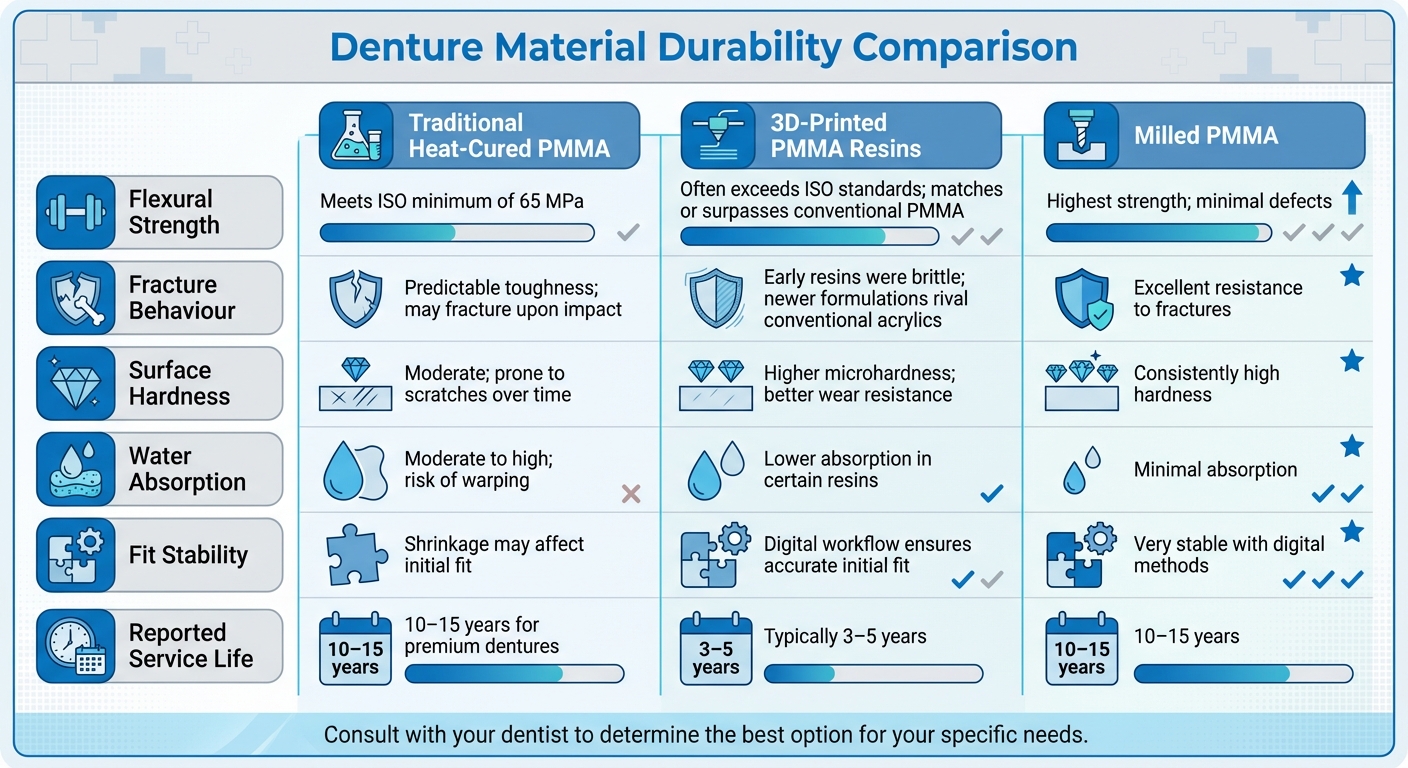
3D-Printed vs Traditional vs Milled Dentures: Durability Comparison Chart
Strength and Fracture Resistance
When comparing 3D-printed dentures to traditional ones, there are some notable differences in performance. Tests indicate that modern 3D-printed PMMA resins can achieve higher flexural and compressive strength than conventional PMMA materials [2]. However, because 3D-printed dentures are created layer by layer, their strength can vary depending on the build orientation and the direction of the applied force. On the other hand, traditional heat-cured PMMA benefits from dense, long polymer chains, which provide consistent toughness throughout the material [1].
Earlier versions of printed resins were more prone to impact fractures, but new high-impact formulations now rival the fracture toughness of traditional acrylics [1]. Even with these advancements, many Australian dental labs and clinicians observe that high-quality milled or traditional dentures often last longer in daily use. While laboratory results provide a baseline, real-world longevity is influenced by additional factors, with commercial assessments suggesting that milled and traditional dentures generally have longer service lives [7][6].
Wear Resistance and Surface Quality
Lab tests show that some 3D-printed denture bases have higher microhardness than conventional PMMA, which could mean better resistance to surface wear and staining [2]. However, real-world performance can vary. For example, certain printed resins are more sensitive to harsh cleansers, which can increase surface roughness [1]. This highlights the importance of proper finishing and polishing in achieving smooth, durable surfaces for 3D-printed dentures. If finishing is done poorly or harsh cleansers are used, roughness, microcracking, and accelerated wear may occur [1][2]. Traditional PMMA, while moderately hard, can also become scratched or rough over time if not maintained properly [1][2]. Meanwhile, milled PMMA bases stand out due to their high flexural strength and minimal internal flaws, as they are manufactured from industrially cured blocks [4].
Beyond mechanical properties, water absorption plays a significant role in material performance.
Water Absorption and Fit Stability
Recent experiments reveal that some 3D-printed PMMA bases absorb less water and have lower solubility compared to traditional heat-cured PMMA. This contributes to better long-term dimensional stability and biocompatibility [2]. Reduced water absorption helps the denture maintain its shape and decreases the risk of warping.
Clinical studies also suggest that 3D-printed dentures can offer comparable, if not better, retention and comfort than traditional ones over periods of up to six months [3]. The digital CAD-CAM workflow minimises polymerisation shrinkage, which is common in traditional heat-polymerised PMMA, resulting in a more precise initial fit and better retention [3]. Many studies report no significant differences in retention between printed and conventional dentures at baseline and during follow-ups at three and six months [3]. For patients in Australia, these findings support the viability of 3D-printed dentures as a reliable option for fit and comfort, provided that the design, printing process, and post-processing steps are carefully managed.
The table below summarises the durability comparisons across key factors:
| Durability Factor | Traditional Heat-Cured PMMA | 3D-Printed PMMA Resins | Milled PMMA |
|---|---|---|---|
| Flexural Strength | Meets ISO minimum of 65 MPa | Often exceeds ISO standards; matches or surpasses conventional PMMA | Highest strength; minimal defects |
| Fracture Behaviour | Predictable toughness; may fracture upon impact | Early resins were brittle; newer formulations rival conventional acrylics | Excellent resistance to fractures |
| Surface Hardness | Moderate; prone to scratches over time | Higher microhardness; better wear resistance | Consistently high hardness |
| Water Absorption | Moderate to high; risk of warping | Lower absorption in certain resins | Minimal absorption |
| Fit Stability | Shrinkage may affect initial fit | Digital workflow ensures accurate initial fit | Very stable with digital methods |
| Reported Service Life | Around 10–15 years for premium dentures | Typically 3–5 years based on some assessments | Around 10–15 years |
What Australian Patients Should Consider
Factors That Influence Material Selection
Deciding between 3D-printed and traditional dentures comes down to your specific oral health needs and lifestyle. One of the key factors is chewing forces. If you have strong biting forces or suffer from nocturnal bruxism, 3D-printed resins may provide greater durability [2]. On the other hand, if you’ve experienced frequent denture fractures, traditional heat-cured PMMA or milled dentures might offer more reliable toughness [7][6].
Your oral anatomy also plays a significant role. For those with irregular ridge shapes or severe bone resorption, digital scanning for 3D-printed dentures can result in a better initial fit with fewer adjustments [3]. However, patients in regional areas, where access to advanced digital labs might be limited, may find traditional dentures more practical due to their ease of repair [1]. Meanwhile, patients in cities with clinics offering advanced digital workflows, like Complete Smiles Bella Vista, can benefit from fewer visits, thanks to in-house scanning and printing capabilities [5].
Maintenance and Repair Options
Once you’ve considered the material, it’s essential to think about how each option is maintained and repaired. Traditional dentures require nightly soaking and annual relining due to water absorption. Repairs are straightforward and can often be done locally, making them a convenient choice for those who prefer easy, accessible fixes.
3D-printed dentures, however, have their own care requirements. Some resins absorb less water and are more resistant to staining and plaque build-up, but they can be sensitive to harsh cleansers, which may damage the surface between printed layers [1][2]. If a 3D-printed denture breaks, many clinics now reprint the entire denture from stored digital files, offering a quicker turnaround – though this may involve additional costs [1][5]. Extended post-curing (around 20 minutes) significantly enhances the physical strength of these dentures, often bringing them on par with, or even exceeding, traditional materials [2].
Digital Workflows in Denture Fabrication
Digital workflows offer further advantages, especially when it comes to the fabrication process. These workflows integrate intraoral scanning, CAD software design, and 3D printing or milling, reducing the polymerisation shrinkage commonly seen in traditional heat-cured PMMA. This results in a more precise initial fit and improved retention [3]. Clinical studies have shown that 3D-printed dentures maintain comparable or better retention and comfort over six months, with no major differences noted at baseline, three-month, or six-month intervals [3].
For Australian patients, digital workflows can cut down the number of appointments significantly – often requiring just 1–2 visits instead of the usual 4–6 [3][5]. This is especially beneficial for elderly patients who might find traditional impression trays uncomfortable or for those in regional areas with limited mobility. However, it’s crucial to ensure your clinician is AHPRA-accredited for digital dentistry and uses ISO-compliant materials with a flexural strength of at least 65 MPa [1][2].
Conclusion
When it comes to durability, both 3D-printed and traditional dentures can deliver reliable function and comfort, but the choice isn’t as straightforward as picking one over the other. Research shows that modern 3D-printed PMMA can rival or even outperform conventional heat-cured acrylic in areas like flexural strength, microhardness, and water resistance [1][2]. That said, long-term clinical data is still limited, and some sources in the industry point to differences in service life when proper care is considered [7][6]. These variations often stem from differences in resin formulations, printer settings, and post-curing methods.
Beyond the technical details, the right choice ultimately depends on individual needs. For patients in Australia, there isn’t a one-size-fits-all solution. Your decision should be based on a thorough clinical evaluation, taking into account factors like your bite force, habits such as grinding or clenching, oral anatomy, hygiene practices, budget in AUD, and whether digital workflows are accessible to you. Clinics with expertise in both traditional and digital dentistry – such as Complete Smiles Bella Vista in New South Wales – can help weigh the pros and cons, review the latest evidence, and customise treatment to suit your specific requirements.
Digital workflows bring distinct advantages, including a precise initial fit, faster turnaround times, and the convenience of reprinting a denture from stored digital files if it’s lost or damaged [3][5]. However, the final outcome still heavily relies on the quality of the equipment, materials, lab processes, and the expertise of the operator.
FAQs
Are 3D-printed dentures as durable as traditional dentures?
Recent studies reveal that 3D-printed dentures can match traditional dentures in terms of durability and resistance to wear. That said, some research indicates they might show a slightly lower resistance to fractures and wear over prolonged use. Thanks to ongoing advancements in 3D printing technology, their long-term performance continues to improve, offering a dependable solution for many patients.
What should I consider when deciding between 3D-printed dentures and traditional ones?
When deciding between 3D-printed dentures and traditional dentures, it’s worth weighing aspects like durability, wear resistance, and how they hold up over time. 3D-printed options are known for their precision and quicker production times, while traditional dentures boast a long history of reliable use.
You’ll also want to think about factors like comfort, fit, and whether the materials used align with your specific requirements. Since costs can differ significantly, having a conversation with your dentist can provide clarity and help you choose the option that best suits your needs and budget.
Do 3D-printed dentures absorb less water than traditional dentures?
Research indicates that 3D-printed dentures tend to have water absorption properties comparable to traditional dentures. Interestingly, they may even absorb slightly less water in some cases, which could make them more durable and comfortable for patients over time.
Lower water absorption can help these dentures retain their structural integrity and reduce the chance of unpleasant odours, making them a dependable choice for extended use.
Related Blog Posts
- Wear-Resistant Materials in Dental Restorations
- Wear Resistance of Polymer-Based Restoratives
- Fatigue Resistance of CAD/CAM Dental Materials
- Porcelain vs Lithium Disilicate: Flexural Strength Explained
Important Notice: Any surgical or invasive procedure carries risks. Before proceeding, you should seek a second opinion from an appropriately qualified health practitioner.
Individual results may vary. The information provided in this article is for educational purposes only and does not constitute medical advice.
Checkout Related Blogs




Get in touch with us
For more information, call us now to start feeling better. Or fill the form below to make appointment
The Latest News from Complete Smiles
How to Clean Clear Plastic Retainers
Checklist for Choosing Wearable Dental Devices
Checklist for Choosing Cloud AI Platforms in Dentistry

Complete Smiles Bella VistaAccepts All Major Health Funds, Including





