




Wear Resistance of Polymer-Based Restoratives
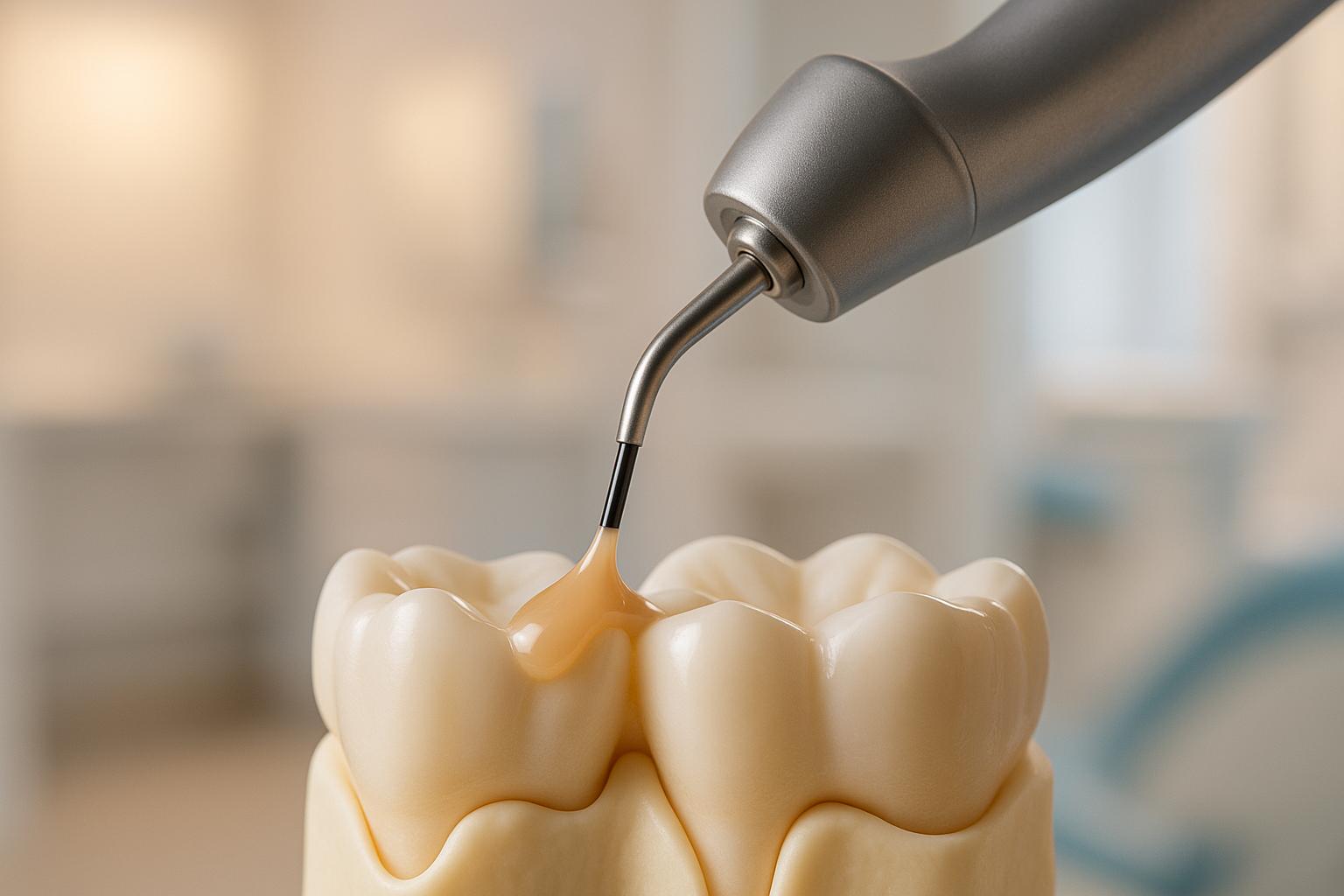
Polymer-based dental restoratives are designed to mimic the wear rate of natural enamel, which erodes at about 0.02–0.04 mm annually. These materials are critical for long-term dental health, especially in posterior teeth restorations, where durability and resistance to wear are essential. Here’s what you need to know:
- Main Types of Wear:
- Attrition: Tooth-to-tooth contact causing surface wear.
- Abrasion: External substances like brushing wear down the surface.
- Erosion: Chemical degradation reduces material integrity.
- Advancements in Materials:
- Nanofillers: Boost strength and durability (e.g., graphene-CNT improves tensile strength by 188%).
- Bulk-Fill Composites: Allow thicker layering with reduced shrinkage and comparable wear resistance.
- Self-Bonding Materials: Simplify procedures for smaller restorations.
- Wear Testing:
- ISO 14569‐2 Standards: Methods like two-body and three-body wear tests simulate real-life conditions.
- Measurement Tools: Advanced technologies like 3D profilometers and electron microscopy provide precise wear data.
- Challenges: Bruxism (teeth grinding) and secondary caries remain key factors affecting restoration longevity.
- Future Innovations: Self-healing materials, like silanized microcapsules, aim to repair damage and extend the lifespan of restorations.
Quick Comparison of Advancements in Polymer-Based Restoratives:
| Material Type | Key Improvement | Clinical Impact |
|---|---|---|
| Nanofilled Composites | Increased strength and polishability | Enhanced wear resistance |
| Bulk-Fill Composites | Thicker layers, less shrinkage | Simplified application, durable wear |
| Self-Healing Materials | Microcrack repair | Longer restoration lifespan |
Wear resistance in dental restoratives has improved significantly, but personal factors like grinding habits still play a big role in durability. The future of dental materials lies in combining durability, self-repair, and bioactive properties for better patient outcomes.
Composite Resins: Composition and Classifications
New Polymer-Based Materials
Addressing the wear challenges previously discussed, advanced polymer formulations are now delivering better durability and performance. Recent developments have significantly improved the wear resistance of polymer-based dental materials.
Nanofillers in Composites
Nanofillers are transforming dental composites by boosting their strength and durability. These tiny particles enhance mechanical properties and improve surface characteristics, resulting in better overall performance. Here’s a look at how different nanofillers contribute:
| Nanofiller Type | Improvement in Properties | Performance Increase |
|---|---|---|
| Graphene-CNT (0.2 wt%) | Tensile strength | 188% |
| Nano clay particles | Flexural strength | 29% |
| Silver/Graphene oxide | Interfacial shear strength | 86.1% |
The large surface area of nanofillers strengthens the bond between fibres and the matrix, improving stress transfer efficiency [4]. Commonly used nanofillers include silica, hydroxyapatite, and titanium dioxide nanoparticles, each offering distinct benefits to dental restorations [3]. These advancements also support innovations like bulk-fill techniques.
Bulk-Fill Materials
Bulk-fill composites have changed the game in restorative dentistry by allowing placement in thicker layers – 4–5 mm at a time – compared to the traditional incremental layering approach [5]. Key features of bulk-fill materials include:
- Enhanced translucency for better light penetration.
- Reduced post-gel shrinkage, minimising stress on the restoration.
- Wear resistance comparable to traditional composites.
Clinical studies have shown mixed results regarding wear resistance. Some research suggests bulk-fill materials perform on par with conventional composites, while others indicate differences in wear patterns [6]. Beyond these advancements, self-bonding materials are further simplifying workflows in restorative procedures.
Self-Bonding Materials
Self-adhesive materials are a newer innovation designed to make clinical procedures more efficient while maintaining durability. These materials are particularly suited for smaller restorations, such as:
- Small pit and fissure lesions
- Limited Class I and II restorations
- Select Class V restorations [7]
Research shows that self-adhesive materials create an interaction zone of approximately 200 nm with the tooth structure [7]. This is achieved through acidic functionalities that promote surface etching and chemical bonding. While promising, these materials come with limitations, particularly for non-carious cervical lesions. Current studies suggest they are most effective in reducing dental hypersensitivity, though more research is needed to fully understand their potential [7].
Wear Testing Methods
Understanding how polymer-based dental materials stand up to wear involves conducting standardised tests that mimic the conditions inside the mouth.
Testing Standards
Laboratory wear testing offers a quicker and more controlled way to evaluate materials. The International Organization for Standardization’s ISO 14569‐2 provides guidelines for two main testing methods [9]:
| Test Type | Description | Key Characteristics |
|---|---|---|
| Two-body wear (2BW) | Direct contact between the material and its opposing surface | Mimics direct occlusal (biting) contact |
| Three-body wear (3BW) | Involves a third substance, like a slurry, between surfaces | Closer to real-life oral conditions |
A standout tool in this field is the Rub&Roll device. It offers a balance of sensitivity, flexibility in parameters, and cost-efficiency while maintaining reproducibility [8]. Interestingly, even with standardised methods, variability in results can range from 30–70% when testing identical materials [8]. Refining these protocols is essential for setting clinical benchmarks for material performance.
These controlled conditions pave the way for precise wear measurement with advanced tools.
Measurement Tools
Modern tools, when paired with standardised testing, provide highly accurate wear data:
- Profilometry Systems
Non-contact 3D optical profilometers, like the Contour GT‐I from Bruker (Germany), deliver detailed volumetric wear measurements [12]. - Microscopy Technologies
Microscopic analysis allows for a deeper understanding of wear patterns:- SEM (Scanning Electron Microscopy): Examines surface details.
- TEM (Transmission Electron Microscopy): Investigates internal structures.
- FIB Milling (Focused Ion Beam): Provides cross-sectional views.
- EDX (Energy Dispersive X-ray): Detects chemical composition changes.
By combining these measurement techniques, researchers can achieve a more comprehensive view of wear patterns and material degradation [11].
Given the complex nature of the oral environment – where both physical and chemical interactions occur – reliable wear testing is indispensable. These evaluations bridge the gap between lab-based findings and real-world dental applications, guiding both material innovation and clinical decision-making [10].
sbb-itb-2be92ed
Clinical Results
Laboratory wear tests provide important insights, but it’s the clinical studies that truly highlight how materials hold up in real-life scenarios.
Multi-Year Studies
A comprehensive analysis of 2,816 restorations reveals annual failure rates ranging between 1–3% for posterior composites [13]. The main culprits behind these failures are secondary caries and material fractures:
| Failure Type | Contributing Factors | Risk Mitigation |
|---|---|---|
| Secondary Caries | High/medium caries risk (2–3× higher failure rate) | Regular dental check-ups and better oral hygiene |
| Material Fractures | Multiple restored surfaces and excessive bite force | Conservative techniques and proper material choice |
In a 15-year study on direct resin composite restorations, the findings showed a cumulative success rate of 62.0% (AFR 2.79%) and a survival rate of 74.7% (AFR 1.70%) [13].
"Longevity of posterior composite restorations: not only a matter of materials." [13]
While these results demonstrate promising material performance, individual patient factors – like teeth grinding – can significantly impact the lifespan of restorations.
Teeth Grinding Effects
Bruxism, or teeth grinding, is a major factor that compromises restoration durability. It affects 8–10% of adults and as many as 40% of children [15]. Different types of bruxism leave distinct wear patterns on restorations:
| Bruxism Type | Prevalence | Impact on Restoratives |
|---|---|---|
| Sleep Bruxism | 8–10% (adults) | Increased nocturnal wear patterns |
| Awake Bruxism | 22.1–31% | Localised wear in specific areas |
For patients with bruxism, material selection becomes even more critical. Studies show that hard acrylic-resin stabilisation splints are more effective than soft splints, which may unintentionally encourage clenching [15]. Surface tests under grinding conditions reveal that materials like Evetric biocomposite tend to develop rougher surfaces compared to alternatives such as Filtek Z550 when exposed to similar forces [14].
To manage the effects of bruxism, clinicians should:
- Monitor wear patterns closely during follow-ups
- Recommend protective measures like custom-fitted night guards
- Choose materials with higher wear resistance
- Tailor treatment plans to the patient’s grinding habits
These findings highlight the importance of combining material durability with a personalised approach to ensure long-lasting restorative outcomes.
Next Steps in Material Development
Polymer-based restorative materials are advancing with the exciting potential to repair wear and damage on their own. These innovations are building on earlier breakthroughs in durability, aiming to address long-standing clinical challenges.
Self-Healing Materials
Self-healing dental composites (SHDCs) are a new class of materials designed to repair microcracks, significantly extending the lifespan of restorations – well beyond the usual 10-year replacement cycle [17]. This represents a leap forward in dental restorative technology.
Recent research has highlighted two promising systems:
| Technology | Healing Efficiency | Key Features |
|---|---|---|
| Silanized PUF Microcapsules | 49–77% recovery | Stronger matrix bonding and improved structural integrity |
| TEGDMA/DMAM System | 77–94% toughness recovery | Reversible bonding and enhanced crack resistance |
For example, a study in the Journal of the Mechanical Behavior of Biomedical Materials found that surface silanisation of poly (urea-formaldehyde) microcapsules significantly improved healing performance when compared to traditional materials [16].
Current Problems
While these innovations are promising, there are still hurdles to overcome. Water damage and mechanical stress remain major concerns, particularly for posterior restorations where durability is critical.
Here are some of the main challenges and ongoing research efforts:
| Challenge | Current Research Focus | Potential Solution |
|---|---|---|
| Water Damage | Hydrophobic nanogels | Lower water absorption and better hydrolytic stability |
| Mechanical Stress | Addition-fragmentation monomers | Stress relief through bond reformation |
| Biofilm Formation | Multifunctional materials | Combining self-healing with antibacterial properties |
One promising development comes from Oregon Health & Science University, where TEOS/MPTMS-functionalised microcapsules have achieved up to 35% toughness recovery in lab tests [17]. Researchers are now working on materials that can remain stable across varying pH levels and enzymatic conditions, while also boosting mechanical performance. Cutting-edge technologies like CAD/CAM-milled PEEK are also being explored due to their strength, precision, and potential for improved osseointegration. However, further refinement of surface properties is still required [18].
Summary
Polymer-based dental restoratives have made impressive strides in wear resistance. Both laboratory and clinical studies back these advancements, highlighting the importance of continuous innovation in dental materials.
Key improvements in material performance are evident:
| Material Type | Key Improvements | Clinical Impact |
|---|---|---|
| Nanofilled Composites | Better polishability | Enhanced wear resistance [19] |
| CAD/CAM Composites | Lower wear rates | Reduced abrasion on opposing teeth [2] |
| Self-Healing Materials | Microcrack repair ability | Increased material lifespan [19] |
Clinical data further supports these innovations, showing survival rates of 91.7% at 6 years and 81.6% at 12 years [20]. These results pave the way for materials that better replicate the natural wear of teeth.
"While the wear resistance of dental composite restoratives is no longer considered to be a major concern for most restorations, the relatively limited information available suggests that it may still be a concern for very large restorations in direct occlusal contact, or for those patients with bruxing and clenching behavior." [1]
Looking ahead, research is set to explore bioactive composites capable of preventing caries and managing biofilms [21]. Building on current progress, advancements in nanotechnology and polymer chemistry aim to further align material properties with natural tooth tissues [2]. CAD/CAM materials already show improved wear resistance compared to direct restoration composites, while innovations in self-healing and bioactive features continue to push the boundaries of polymer-based restorative technology [2].
FAQs
What role do nanofillers play in enhancing the wear resistance of polymer-based dental restoratives?
Nanofillers are key to boosting the wear resistance of polymer-based dental restoratives. By reinforcing mechanical properties like durability and resilience, they create a denser microstructure. This structure not only reduces wear but also extends the longevity of dental restorations.
What’s more, nanofillers improve the surface smoothness of the material, helping it retain its polish over time. This reduces wear from chewing forces. Studies repeatedly highlight that polymer-based restoratives containing nanofillers outperform those with traditional fillers when it comes to wear resistance and overall effectiveness.
What are the advantages and challenges of using bulk-fill composites in dental restorations?
Bulk-fill composites have become a go-to choice in dental restorations, mainly because they save time during application. Unlike traditional composites, which require multiple layers, bulk-fill materials can be applied in a single step. This not only speeds up the procedure but also reduces the chance of voids forming. On top of that, they offer reliable strength and pleasing aesthetics, making them a solid option for both front and back teeth.
That said, they’re not without challenges. One concern is polymerisation shrinkage stress, which can lead to marginal gaps if not handled correctly. Another issue is ensuring proper curing in deeper cavities, which can sometimes compromise their long-term reliability. While advancements in polymer technology have improved their resistance to wear, factors like the type of filler used and the density of crosslinking still play a big role in how well they hold up under chewing forces.
When applied correctly, bulk-fill composites strike a balance between efficiency and performance, making them a practical choice for a wide range of restorative treatments.
What are self-healing dental materials, and how do they improve the durability of restorations?
Self-healing dental materials are cutting-edge composites designed to fix minor damage, like microcracks, all on their own – no dentist needed. These materials are equipped with microcapsules or networks filled with a healing agent. When a crack appears, the agent is released, reacts, and hardens, sealing the crack and restoring the material’s strength.
This technology is a game-changer for extending the life of dental restorations, as it helps them withstand daily wear and tear as well as mechanical stress. Recent developments have focused on enhancing how the healing agents interact with the resin matrix, aiming to boost their performance and durability in the demanding environment of the mouth.
Related Blog Posts
- 5 Essential Tips for Maintaining Porcelain Veneers
- Guide to Choosing the Right Cosmetic Dental Treatment
- What Are Biocompatible Dental Materials?
- Advances in Dental Adhesives: What to Know
Important Notice: Any surgical or invasive procedure carries risks. Before proceeding, you should seek a second opinion from an appropriately qualified health practitioner.
Individual results may vary. The information provided in this article is for educational purposes only and does not constitute medical advice.
Checkout Related Blogs



Get in touch with us
For more information, call us now to start feeling better. Or fill the form below to make appointment
The Latest News from Complete Smiles
How to Clean Clear Plastic Retainers
Checklist for Choosing Wearable Dental Devices
Checklist for Choosing Cloud AI Platforms in Dentistry
Complete Smiles Bella VistaAccepts All Major Health Funds, Including