





Advances in Dental Adhesives: What to Know
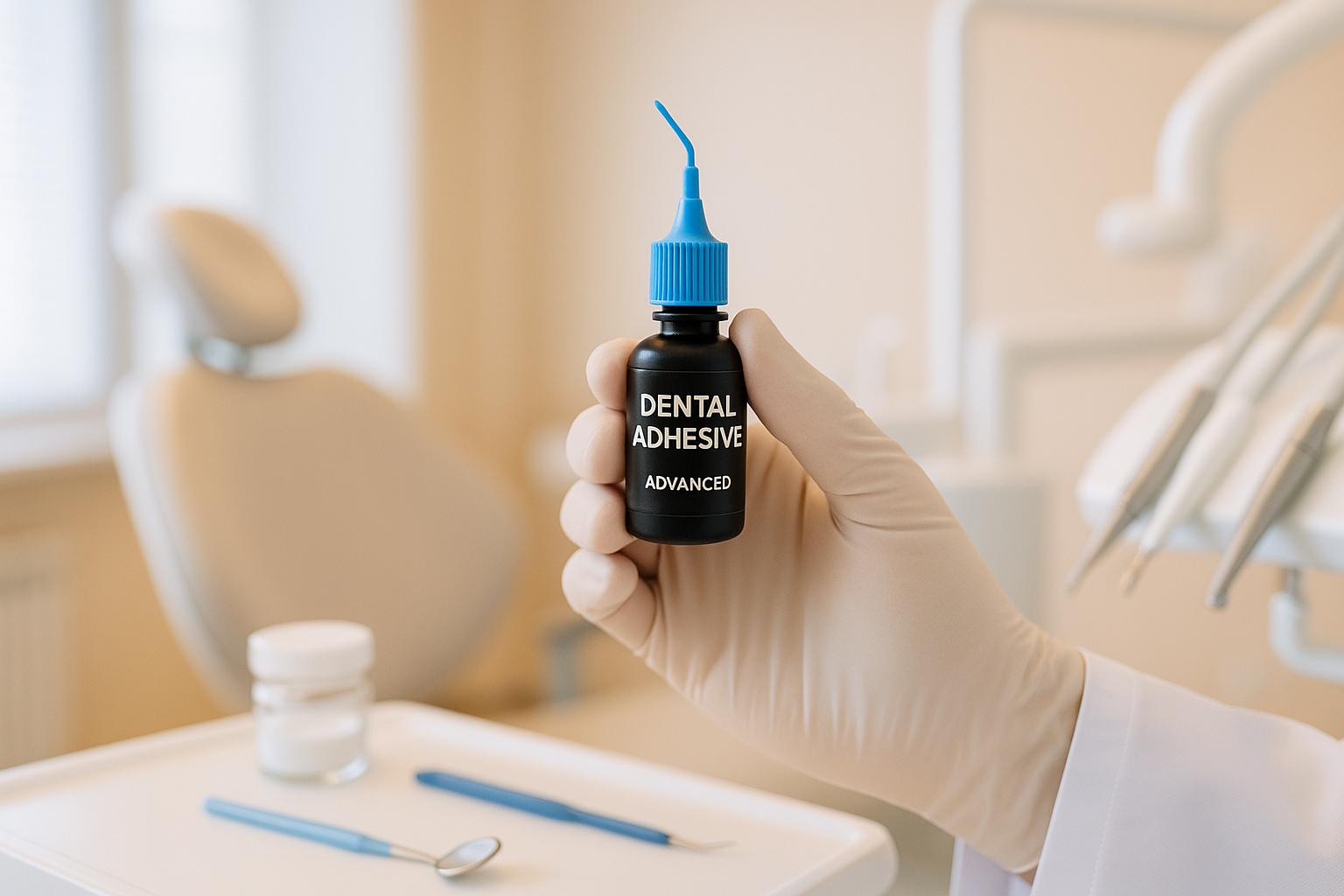
Dental adhesives are transforming dentistry by improving bond strength, reducing treatment complexity, and preserving natural teeth. Here’s what you need to know:
- What They Do: Dental adhesives bond restorative materials to tooth structures using chemical and mechanical interactions.
- Key Benefits:
- Faster procedures with universal adhesives.
- Long-lasting restorations with bond strengths exceeding 30 MPa.
- New features like antibacterial and remineralising properties.
- Types:
- Etch-and-Rinse: Best for strong enamel bonds.
- Self-Etch: Simplifies bonding for sensitive dentine.
- Universal: Works with multiple techniques and materials.
- Latest Innovations:
- Remineralising Adhesives: Rebuild tooth structure and release essential ions.
- Antibacterial Adhesives: Prevent bacterial growth with quaternary ammonium compounds and nanoparticles.
- Smart Adhesives: pH-responsive materials and tissue-healing adhesives.
- 3D-Printed Adhesives: Custom solutions for precision and efficiency.
Quick Comparison:
| Adhesive Type | Key Feature | Best Use Case |
|---|---|---|
| Etch-and-Rinse | Strong enamel bonds | High-strength bonding to enamel |
| Self-Etch | Simplified application | Sensitive dentine cases |
| Universal | Versatility across techniques | General-purpose adhesive needs |
Modern adhesives are making treatments faster, stronger, and more protective of natural teeth. These advancements are shaping the future of minimally invasive dentistry.
Dentin Bonding Agents (Etch & Rinse / Self Etch / Universal Adhesives) – Which one is the BEST???
Types and Development of Dental Adhesives
The journey of dental adhesives reflects a series of technological advancements aimed at improving their effectiveness and clinical use.
Progress Through Adhesive Generations
Dental adhesives have come a long way since their introduction. The first-generation adhesives, which emerged in the late 1960s, offered minimal bond strengths of just 1–3 MPa [1]. These early formulations left much to be desired, prompting the development of more effective solutions in subsequent generations.
A significant leap occurred with fourth-generation adhesives, which achieved bond strengths in the low- to mid-20 MPa range [1]. These systems set a benchmark for reliability, excelling in bonding to both enamel and dentine. They remain a reference point for evaluating newer adhesives.
"At this time we feel that because evidence of this nature has not been previously reported, the reasons for the increased adhesion are less important than the finding that the adhesive bond attained on treated (ie. acid-treated) as compared to untreated (ie. control), surfaces survived oral conditions for relatively long periods of time" – Buonocore [5]
The latest, eighth-generation adhesives now boast tensile bond strengths exceeding 30 MPa, surpassing their sixth- and seventh-generation predecessors [4]. These advancements reflect the ongoing pursuit of stronger and more durable adhesive systems.
| Generation | Clinical Steps | Bond Strength (MPa) | Key Innovation |
|---|---|---|---|
| 4th | 3 | 25 | Total-etch technique |
| 6th | 1 | 20 | Self-etch adhesives |
| 7th | 1 | 25 | All-in-one systems |
| 8th | 1 | >30 | Enhanced molecular bonding |
This progression has paved the way for the classification of modern adhesives into specific categories.
Current Adhesive Categories
Building on the improvements of earlier generations, today’s dental adhesives fall into three main types: etch-and-rinse (ER), self-etch (SE), and universal systems. Each type offers distinct benefits tailored to various clinical needs.
Etch-and-rinse adhesives rely on phosphoric acid, typically at concentrations between 30% and 40%, with a pH of 0.1 to 0.4 [3]. These systems are particularly effective for bonding to enamel, as the acid creates microporosities that allow resin to penetrate deeply.
Self-etch adhesives, such as Clearfil SE Bond by Kuraray Noritake Dental, use acidic monomers like 10-MDP (10-methacryloyloxydecyl dihydrogen phosphate) to etch and prime the tooth surface in one step. This approach forms a chemical bond with calcium, simplifying the bonding process [2].
Universal adhesives represent the latest step forward. They are highly adaptable, allowing for various application techniques and compatibility with different etching strategies. These adhesives typically have a pH between 1.5 and 3.2 [3].
The choice between these systems depends on the specific clinical situation:
- Etch-and-rinse systems: Best for achieving strong enamel bonds.
- Self-etch systems: Suited for cases involving sensitive dentine and for simplifying procedures.
- Universal systems: Flexible enough to work with multiple substrates and techniques.
Recent advancements have also introduced bioactive materials and smart adhesive technologies. These innovations aim to improve bond durability over time while offering therapeutic benefits to the tooth structure.
Latest Developments in Adhesive Technology
The world of adhesives is evolving, with new materials not only providing stronger bonds but also offering therapeutic benefits. These cutting-edge adhesives are designed to ensure durability while actively promoting oral health.
Remineralising Adhesives
Remineralising adhesives represent a leap forward in protective dental materials. These adhesives are infused with bioactive components that help rebuild tooth structure while maintaining robust bonds. They release essential ions – calcium, phosphate, and fluoride – that integrate into the tooth structure, enhancing resistance to acid. This is especially useful in restoration sites where the bond between the tooth and the restoration might not be perfect.
Traditional glass ionomer cements have long been valued for their remineralising properties. However, studies show their effectiveness can drop by 45–96% when covered with resin coatings [6].
"The remineralisation process is a natural repair mechanism to restore the minerals again, in ionic forms, to the hydroxyapatite (HAP) crystal lattice." – Mando K Arifa [7]
To achieve the best results, these adhesives maintain a calcium/phosphate ratio of 1.6 [6]. Beyond mineral restoration, these advancements are paving the way for adhesives that also tackle bacterial challenges.
Bacteria-Fighting Properties
Antibacterial adhesives are designed to prevent secondary caries by actively inhibiting bacterial growth at the tooth–restoration interface. These adhesives incorporate antimicrobial agents, which include:
- Quaternary Ammonium Compounds: Known for their broad-spectrum antimicrobial activity, they are effective against both Gram-positive and Gram-negative bacteria.
- Metallic Nanoparticles: These particles eliminate bacteria on contact and benefit from an enhanced surface-to-volume ratio.
- Chlorhexidine: Offers sustained antimicrobial action through controlled release.
Research shows that adhesives containing quaternary ammonium compounds can reduce bacterial counts by over 99%, meeting commercial standards [8]. These antibacterial properties are further enhanced by advancements in nanoparticle technology.
Nanoparticle Technology
Nanoparticles, ranging from 1 to 100 nanometres in size, are revolutionising adhesive technology. Their small size allows for better penetration into dental substrates, improving bond strength. When combined with agents like silver or copper oxide, these nanoparticles also deliver antimicrobial effects.
For instance, adhesives containing 0.2% amorphous calcium phosphate–polydopamine–silver nanoparticles have shown bond strengths of 11.89 ± 1.27 MPa, far exceeding the clinical minimum of 7.8 MPa [9]. This fusion of mechanical strength and therapeutic benefits highlights the potential of nanoparticle technology to reshape dental adhesive performance.
sbb-itb-2be92ed
Current Uses in Dental Practice
Recent advancements in adhesive materials have transformed restorative dentistry, making treatments more effective and less invasive. These cutting-edge adhesives not only improve bonding strength but also streamline routine dental procedures.
Stronger Dental Restorations
Modern dental adhesives create a robust bond between restorations and the tooth structure, enhancing durability and minimising sensitivity.
"The development of modern, adhesively retained restorations has enabled clinicians to provide patients a long‐lasting solution that is not only a more conservative option for addressing diseased and/or structurally damaged teeth, but a more esthetic one." – Clinton D. Stevens, DDS [11]
For optimal results, it’s crucial to follow manufacturer instructions, including proper phosphoric acid etching and drying times. Universal adhesives have further simplified procedures by reducing technique sensitivity and the risk of microleakage. These improvements support more conservative approaches, focusing on preserving as much of the natural tooth as possible.
Tooth-Preserving Techniques
Advanced adhesive systems have paved the way for more conservative dentistry, reducing the need for extensive removal of tooth structure. This approach not only preserves natural dental tissue but also ensures the longevity and effectiveness of restorations. In biomimetic dentistry, these adhesives have demonstrated impressive benefits:
- Reduced need for root canals by up to 80% [10]
- Precise bonding with the natural tooth [12]
- Preservation of the tooth’s natural biomechanical properties [12]
These techniques allow restorations to integrate seamlessly with the tooth, maintaining both strength and appearance.
Adhesive and Cement Systems
To complement these tooth-preserving methods, adhesive and cement systems offer tailored solutions to meet various clinical demands. Here’s a quick overview of some commonly used luting agents and their applications:
| Luting Agent | Key Benefits | Best Applications |
|---|---|---|
| Glass Ionomer Cement (GIC) | Biocompatibility, fluoride release | Routine restorations requiring moderate retention |
| Resin-Modified Glass Ionomer (RMGIC) | Balanced strength and protection | Versatile applications with good moisture control |
| Adhesive Resin Cement | High bond strength, superior aesthetics | Cases requiring maximum adhesion and aesthetic appeal |
| Universal Self-Adhesive Resin | Simplified application, reliable strength | General-purpose, time-sensitive procedures |
"Understanding these key considerations is vital for dental professionals to provide reliable and long‐lasting restorations that meet the unique needs of each patient", – Dr Castillo [13]
Choosing the right adhesive system depends on factors like the required bond strength, moisture control, aesthetic goals, material compatibility, and the specific clinical situation.
Self-adhesive resin cements have gained popularity by simplifying the cementation process while maintaining excellent bonding performance. Recent innovations have focused on reducing sensitivity to technique and cutting down on manipulation time [1], making these systems a go-to choice for many dental practitioners.
Next Steps in Adhesive Development
Building on recent advancements, the future of adhesives is moving towards greater precision and expanded functionality, offering exciting possibilities for dental care.
pH-Responsive Materials
pH-responsive adhesives are designed to detect and respond to changes in pH levels, specifically targeting carious lesions. These materials react when the pH drops from a neutral range of 6.8–7.4 to as low as 4.5, a condition often caused by acid-producing cariogenic bacteria [14]. Early research into tertiary amine–modified resin adhesives (TA@RAs) has shown promising results. These adhesives can reduce bacterial viability to below 20% in acidic environments, while maintaining over 70% bacterial viability in neutral pH conditions [15]. This dual functionality offers both therapeutic and protective benefits.
Tissue-Healing Adhesives
Tissue-healing adhesives go beyond bonding, promoting faster tissue repair alongside strong adhesion. For instance, citric acid–enhanced formulations have demonstrated adhesion levels up to 11 times stronger than traditional fibrin sealants [16]. These adhesives not only secure dental structures but also support wound healing and tissue regeneration, making them a valuable tool in restorative dentistry.
3D-Printed Custom Adhesives
The integration of 3D printing technology into adhesive development is unlocking new possibilities for personalised dental care. Custom-formulated adhesives benefit from the precision and efficiency of 3D printing. Clinical studies highlight the advantages, with 3D-printed surgical guides achieving an average entrance deviation of just 0.9 mm, compared to 2.1 mm for conventional guides [18]. This level of accuracy represents a significant leap forward in dental procedures.
Recent trials have outlined the current and potential impacts of 3D-printed adhesives:
| Advancement Type | Current Impact | Future Potential |
|---|---|---|
| Precision | 0.9 mm average deviation in surgical guides | Further refinement for even greater accuracy |
| Production Speed | Same-day production possible in some cases | Faster turnarounds with improved processes |
| Material Options | Photopolymerisation dominates with 53% market share | Expansion to more biocompatible and durable materials |
| Cost Efficiency | Reduced material waste lowers costs | Further cost savings through streamlined workflows |
These innovations point to a future where adhesives do more than bond – they actively contribute to better dental health, aligning perfectly with the goals of minimally invasive dentistry.
Summary
Dental adhesives have transformed modern dentistry by improving treatment outcomes and helping to preserve natural tooth tissue. The market for these adhesives is anticipated to grow steadily, reaching $2,587.3 million by 2030, with an annual growth rate of 5.9% from 2024 to 2030 [20].
Advancements in dental adhesives have introduced multifunctional benefits. For instance, bioactive adhesives not only strengthen bonds but also promote remineralisation and inhibit bacterial growth, thanks to components like calcium phosphate, fluoride, and antimicrobial agents [17]. Research shows these materials can reduce biofilm formation and enhance bonding strength, particularly when combined with magnetic field applications [21].
Another leap forward is glass hybrid technology. Clinical trials have demonstrated that Glass Hybrid (EQUIA Forte) performs as well as nanohybrid resin composites in moderate to large two-surface class II restorations over a four-year period. These adhesives provide better flexural strength and greater resistance to abrasion [19].
| Advancement Type | Key Benefits | Clinical Impact |
|---|---|---|
| Bioactive Adhesives | Remineralisation and bacterial control | Lowers risk of secondary caries |
| Glass Hybrids | Improved durability and strength | Comparable to traditional composites |
| Universal Self-adhesive Cements | Simplified application process | Makes clinical procedures more efficient |
"Cementation is typically used when your preparations allow mechanical retention. Bonding is typically used when extra adhesion is required or when aesthetics are of the utmost importance" [13].
These innovations are not just technological milestones – they are reshaping preventive and minimally invasive dental care. Long-term studies show that composite resin restorations have survival rates of 80%–95% over 5–10 years [22], reflecting a shift toward treatments that prioritise conserving natural tooth structure while promoting better oral health.
FAQs
How do the latest dental adhesives with remineralising and antibacterial properties benefit oral health?
The newest dental adhesives with remineralising and antibacterial features are reshaping oral health care by tackling two major issues: tooth decay and bacterial infections. These advanced formulations release bioactive compounds, such as calcium phosphate and fluoride, which work to strengthen enamel and dentin while addressing early signs of decay. This not only fortifies the tooth structure but also helps lower the chances of developing future cavities.
On top of that, their antibacterial properties actively prevent bacterial growth and biofilm formation, reducing the risk of infections following dental treatments. This combination of benefits supports faster healing, better oral health, and longer-lasting results – showcasing how modern dentistry continues to focus on patient well-being and effective treatment outcomes.
What should you consider when selecting between etch-and-rinse, self-etch, and universal dental adhesives?
Choosing the right dental adhesive involves weighing several important factors. One of the main considerations is bonding strength. Self-etch systems typically form stronger bonds with dentine, while etch-and-rinse adhesives tend to perform better when bonding to enamel.
Another factor to keep in mind is technique sensitivity. Etch-and-rinse systems require precise application of phosphoric acid, followed by thorough rinsing, which can make them more technique-dependent. On the other hand, self-etch systems combine steps, simplifying the process. However, this convenience may come at the cost of less effective enamel bonding in certain situations.
The clinical situation also plays a critical role in the decision. Things like the type of restoration, the condition of the tooth, and the location being treated should influence your choice. Universal adhesives offer flexibility, as they work with different techniques and are suitable for a variety of procedures. For the best outcome, it’s always a good idea to consult with your dentist to determine the adhesive system that suits your specific needs.
How is 3D printing technology shaping the future of dental adhesives?
Advances in 3D printing are shaking up the world of dental adhesives, offering a new level of precision and personalisation in dental care. With this technology, dental models and prosthetics can be crafted with incredible accuracy to match the unique needs of each patient. This exact fit enhances the bonding surface, leading to stronger adhesion and restorations that last longer.
What’s more, the materials used in 3D printing, like UV-cured resins, have paved the way for adhesives specifically designed to work hand-in-hand with these components. This compatibility streamlines the bonding process and boosts treatment results, making dental procedures not only more efficient but also more effective in today’s practices.
Related Blog Posts
- 5 Essential Tips for Maintaining Porcelain Veneers
- Guide to Choosing the Right Cosmetic Dental Treatment
- What Are Biocompatible Dental Materials?
- Wear-Resistant Materials in Dental Restorations
Important Notice: Any surgical or invasive procedure carries risks. Before proceeding, you should seek a second opinion from an appropriately qualified health practitioner.
Individual results may vary. The information provided in this article is for educational purposes only and does not constitute medical advice.
Checkout Related Blogs




Get in touch with us
For more information, call us now to start feeling better. Or fill the form below to make appointment
The Latest News from Complete Smiles
How to Clean Clear Plastic Retainers
Checklist for Choosing Wearable Dental Devices
Checklist for Choosing Cloud AI Platforms in Dentistry

Complete Smiles Bella VistaAccepts All Major Health Funds, Including





