





Ceramic vs. Resin: Toughness in CAD/CAM Restorations
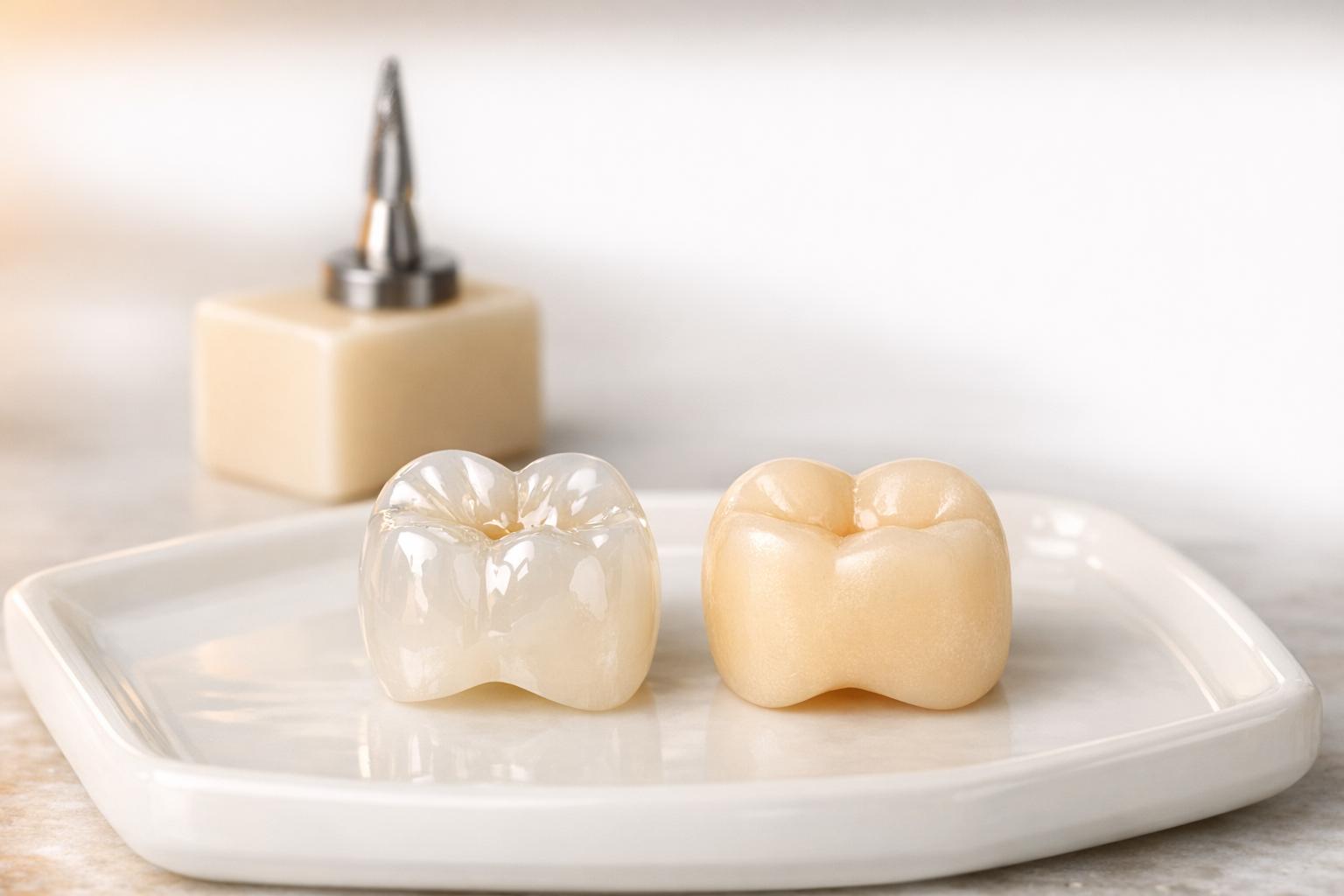
When choosing between ceramic and resin for CAD/CAM dental restorations, the decision comes down to durability, flexibility, and application needs. Here’s the short version:
- Ceramics: Stronger, more rigid, and ideal for high-stress areas like molars. They resist wear and maintain aesthetics over time but can be brittle and prone to sudden fractures.
- Resins: More flexible, absorb stress better, and are easier to mill and adjust. They work well for low-stress or temporary restorations but wear faster and may stain or degrade over time.
Quick Comparison
| Feature | Ceramic Materials | Resin-Based Materials |
|---|---|---|
| Strength | High (e.g., zirconia: 5–7 MPa√m) | Moderate (1–2 MPa√m) |
| Flexibility | Stiff (65–250 GPa) | Flexible (8–15 GPa) |
| Durability | Long-lasting | Shorter lifespan, prone to wear |
| Aesthetic Stability | Excellent | Prone to staining |
| Processing | Requires heat treatment | No firing needed |
| Failure Mode | Sudden fractures | Gradual wear |
Ceramics are ideal for permanent, high-load restorations, while resins are better for temporary or stress-absorbing applications. The right choice depends on the specific clinical scenario and patient needs.
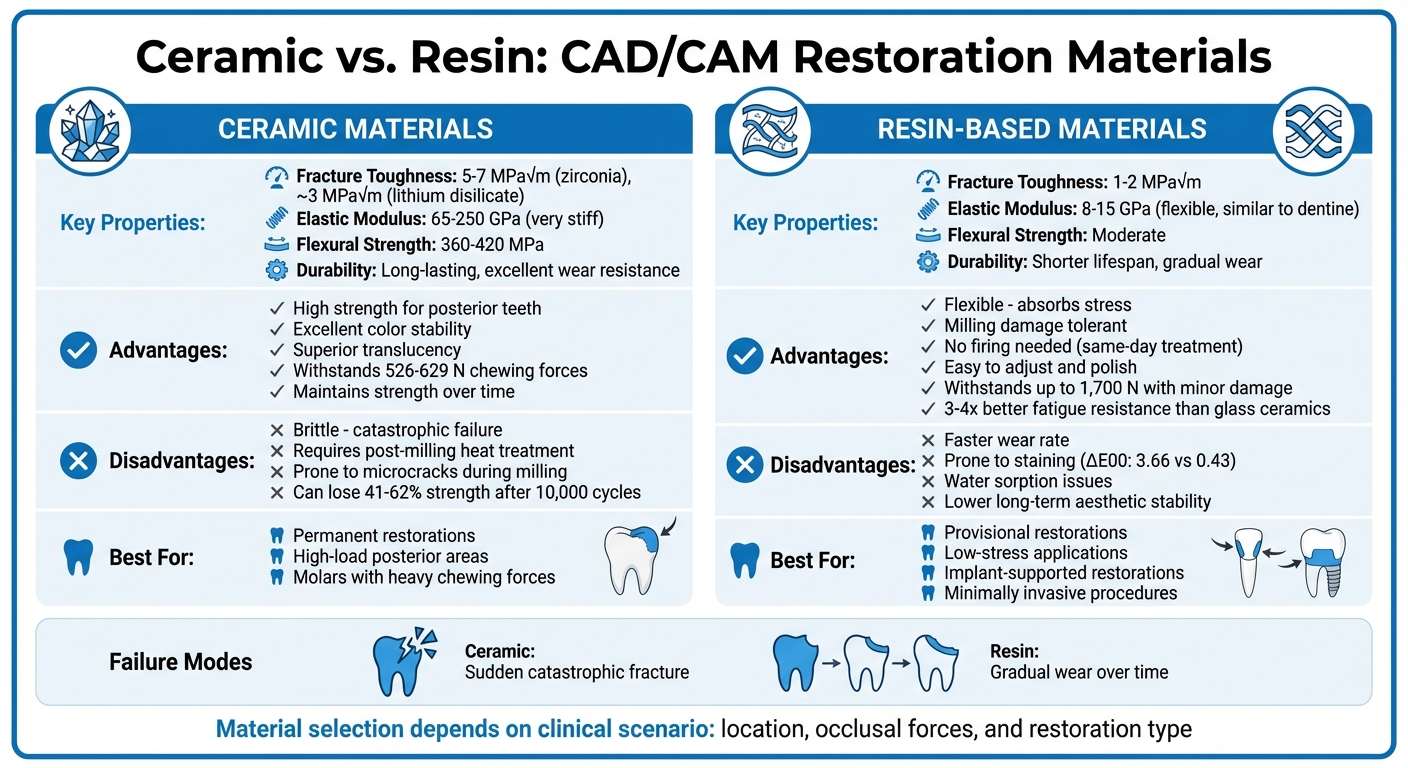
Ceramic vs Resin CAD/CAM Dental Restorations Comparison Chart
All About the Blocks: Materials Critical to Achieving CAD/CAM Success
Ceramic Materials in CAD/CAM Restorations
Ceramic materials are widely chosen for dental restorations because they combine aesthetic appeal with impressive mechanical strength. Within CAD/CAM dentistry, several categories of ceramics are used, each suited to specific clinical needs. Below, we explore the main types of ceramics, their mechanical properties, and the challenges they present.
Types of Ceramic Materials
Lithium Disilicate (LDS) is among the most commonly used CAD/CAM ceramics, with IPS e.max CAD being a well-known example. This material is initially provided in a pre-crystallised state to make milling easier. After milling, it undergoes a secondary firing process at 850°C, which significantly boosts its flexural strength from around 130 MPa to approximately 360 MPa [4].
Zirconia-Reinforced Lithium Silicate (ZRLS) represents a newer advancement. Products like VITA Suprinity and Celtra Duo incorporate 8–12% zirconium dioxide into the glass matrix. This addition improves mechanical strength while maintaining translucency, with some ZRLS materials achieving flexural strengths as high as 420 MPa [4][5]. Unlike the needle-shaped crystals in lithium disilicate, which help bridge cracks, ZRLS relies on zirconia particles to reinforce its structure.
Other traditional ceramic options include leucite-reinforced ceramics (e.g., IPS Empress CAD) and feldspathic ceramics. Leucite-based ceramics typically achieve moderate strength levels of 157–160 MPa [6][7], while feldspathic ceramics are prized for their superior aesthetics, making them ideal for veneers and inlays in low-stress areas.
Fracture Toughness of Ceramics
Ceramics are known for their ability to perform under high-stress conditions. Lithium disilicate, for instance, has a fracture toughness of about 3 MPa√m, which is considerably higher than the 0.7–1.5 MPa√m range seen in glass-rich ceramics [3]. When bonded to dentin, lithium disilicate can achieve fracture resistance values as high as 4,588.6 MPa in static compression tests [5].
Their stiffness also sets them apart. Elastic moduli range from around 65 GPa for feldspathic ceramics to approximately 250 GPa for zirconia [3]. This rigidity allows ceramics to endure masticatory forces, which generally fall between 500 and 600 N but can reach 900–1,000 N in individuals with bruxism [5]. However, despite these strengths, ceramics have some inherent drawbacks that can limit their clinical durability.
Limitations of Ceramic Materials
While ceramics excel in compression, they are inherently brittle and weaker under tension. This brittleness makes them prone to microcrack formation during milling, with surface flaws quickly becoming stress points that lead to failure.
The milling process itself can introduce additional challenges. Diamond burs used in CAD/CAM systems create high strain, potentially causing microcracks and subsurface residual cracks extending up to 50 μm into the material [9]. Over time, ceramic materials may lose between 41% and 62% of their flexural strength after just 10,000 loading cycles [3]. Unlike hybrid materials that show signs of surface indentation before failure, glass-ceramics often experience sudden, catastrophic fractures without warning [5][2]. Research highlights that surface flaws play a major role in damage accumulation and the reduced lifespan of ceramic restorations [3].
To address these issues, careful handling during preparation and placement is essential. For instance, edge chipping during milling can compromise the marginal integrity of a restoration, while manual adjustments post-milling can further reduce fracture resistance [9]. Proper polishing or glazing is critical to minimise surface roughness and eliminate flaws that could act as starting points for cracks.
Resin-Based Materials in CAD/CAM Restorations
When it comes to CAD/CAM restorations, resin-based materials stand out as a versatile alternative to ceramics. Unlike ceramics, which can be brittle, resins are known for their ability to absorb energy and tolerate damage. They also fail in a more gradual manner, making wear easier to detect before significant issues arise. These materials combine a polymer matrix with fillers, creating restorations that respond differently to stress compared to ceramics.
Types of Resin-Based Materials
Resin-based materials come in distinct types, each with its unique composition and properties:
- Resin-based composites (RBCs) are the cornerstone of this category. Products like Grandio Blocs, Tetric CAD, and Brilliant Crios are made from a polymer matrix – usually UDMA or Bis-GMA – reinforced with inorganic fillers like silica and zirconia. Filler content varies by product, with Grandio Blocs containing 86% by weight and Brilliant Crios at 70.7% [1].
- Nanoceramic composites are an advanced version of RBCs. Lava Ultimate, for example, incorporates nanoclusters of silica and zirconia into its resin matrix, improving both mechanical properties and polishability. These materials generally have around 80% filler content [8].
- Polymer-infiltrated ceramic networks (PICNs), such as Vita Enamic, combine a porous ceramic scaffold with a polymer network. This dual structure results in a harder, more brittle material compared to standard RBCs, with about 86% ceramic content by weight [1].
Resin-based materials also share a key similarity with human dentine: their elastic modulus, which typically ranges from 8 to 15 GPa [3]. This alignment allows them to absorb energy effectively and handle occlusal forces without excessive stress.
Fracture Toughness of Resins
Resin composites typically have fracture toughness values between 1 and 2 MPa√m [3]. While this falls between the range of glass-rich ceramics (0.7–1.5 MPa√m) and lithium disilicate (~3 MPa√m), the real advantage lies in how resins behave under stress. Rather than shattering suddenly, they exhibit a more progressive failure mode.
Research backs up their durability. A March 2024 study revealed that Grandio Blocs, Tetric CAD, and Brilliant Crios could withstand forces exceeding typical human chewing pressures, with Grandio Blocs reaching 4.32 kN and Vita Enamic 3.01 kN [1]. Similarly, an April 2016 study from New York University showed that monolithic Lava Ultimate crowns tolerated loads up to 1,700 N with minor damage, whereas glass-ceramic crowns began fracturing at just 450 N [8]. This highlights their superior fatigue resistance, often lasting three to four times longer under repeated stress.
"Monolithic CAD/CAM resin composite restorations have several advantages over their ceramic counterparts: Resin composite blocks are milling damage tolerant… No post-milling firing is needed. Indirect resin composite restorations can be easily polished and adjusted." – Hui Tong [8]
Another benefit of resin materials is their failure behaviour. Instead of catastrophic fractures, they show gradual surface indentation, providing an early warning of potential issues.
Limitations of Resin Materials
Despite their strengths, resin-based materials come with some drawbacks that can’t be ignored:
- Wear resistance is a common concern. Resins wear down faster than ceramics and often experience fatigue-related wear rather than the abrasive wear typical of glass-ceramics [3][8].
- Colour stability poses challenges, especially for aesthetics. For instance, resin nanoceramics exposed to substances like coffee have shown a colour change (ΔE00) of 3.66, far exceeding the 0.43 seen in lithium disilicate. This level of discolouration may require earlier replacements for aesthetic reasons [3].
- Water sorption and hydrolytic degradation are also problematic. Resins, particularly those containing Bis-GMA, can absorb water, leading to expansion and gradual breakdown of the polymer network [3]. Ceramic crowns, by comparison, show significantly less microleakage regardless of the luting cement used [8].
- Polishing challenges arise due to the differing responses of the polymer matrix and filler particles. While resins allow for easy chairside adjustments, achieving and maintaining a smooth, stain-resistant surface requires careful technique. Over time, surface irregularities can accumulate stains more readily than the uniform surfaces of glazed ceramics.
While resin-based CAD/CAM materials excel in damage tolerance and ease of handling, they often fall short in long-term durability and aesthetic stability when compared to ceramic options.
sbb-itb-2be92ed
Ceramic vs. Resin: Direct Comparison
Building on the earlier discussion of individual material properties, let’s dive into a direct comparison of how ceramics and resins perform under challenging stress conditions.
Fracture Toughness: Ceramics vs. Resins
Fracture toughness provides a clear picture of the differences between these materials. Resin composites typically range from 1 to 2 MPa√m, surpassing glass-rich ceramics, which fall between 0.7 and 1.5 MPa√m. However, high-strength ceramics like lithium disilicate (~3 MPa√m) and zirconia (5–7 MPa√m) significantly outperform resins in this category [3].
A study conducted by the New York University College of Dentistry tested monolithic resin composite crowns made with Lava Ultimate. These crowns withstood loads up to 1,700 N, sustaining only superficial damage. In contrast, leucite-reinforced glass-ceramic crowns (IPS Empress CAD) began to fracture at about 450 N [8]. Researcher Hui Tong highlighted this performance difference:
"Monolithic CAD/CAM resin composite crowns endure, with only superficial damage, fatigue loads 3–4 times higher than those causing catastrophic failure in glass-ceramic CAD crowns." [8]
Further fatigue testing on tooth abutments revealed that high-strength ceramics maintain superior fracture loads compared to resin nano ceramics [2]. Lithium disilicate and zirconia-based materials demonstrated excellent fracture resistance, even after 10,000 thermal cycles, which simulates roughly a year of clinical use [2].
This stark difference in toughness underlines the unique behaviours of ceramics and resins when it comes to crack propagation.
Resistance to Crack Propagation
Ceramics are inherently brittle and fail catastrophically once their stress threshold is exceeded. During CAD/CAM grinding, machining damage creates subsurface defects that can extend at least 50 μm from the surface. These defects act as starting points for cracks, which is why post-milling heat treatments – such as glazing or firing – are essential to heal surface damage and enhance the material’s strength [9].
Resin-based materials, on the other hand, are far more forgiving. They are described as "milling damage tolerant", which allows for faster production without the microcracking issues common in ceramics [8]. Their lower elastic modulus (8 to 15 GPa), compared to ceramics’ 65 to 250 GPa, enables them to absorb and distribute stress more effectively [3]. Supporting this, research from the University of Erlangen-Nuremberg observed:
"Resin composite materials used for direct restorations are more fatigue resistant than glass-rich ceramics used for indirect restorations in cyclic flexural loading." [3]
While ceramics, especially when glazed, offer smooth and stain-resistant surfaces, resins tend to wear more quickly and fail gradually over time [8]. This trade-off between durability and surface resilience highlights the importance of choosing the right material for specific clinical needs.
Clinical Considerations for Material Selection
Choosing the right CAD/CAM material means aligning material properties with specific clinical needs.
Ceramics for High-Stress Applications
When it comes to permanent restorations in high-load areas, ceramics like lithium disilicate and zirconia stand out. These materials are built to handle intense pressure. For instance, fracture testing on tooth abutments showed lithium disilicate achieving a mean fracture load of 1,137 N, while zirconia-reinforced lithium silicate reached 976 N – both comfortably exceeding typical chewing forces[2].
Ceramics also maintain their strength over time. After simulating a year of clinical use, zirconia retained a flexural fatigue strength of 440 MPa[3]. Additionally, monolithic zirconia crowns can be milled with an occlusal thickness as thin as 0.5 mm, yet still endure the heavy loads found in molar regions[10].
On the other hand, resin-based materials are better suited for situations where energy absorption takes precedence over raw strength.
Resins for Low-Stress or Provisional Restorations
Resin-based materials shine in cases where flexibility and stress absorption are key. With an elastic modulus ranging from 8 to 15 GPa – similar to natural dentine – these materials can flex under pressure, acting as shock absorbers. This is particularly valuable in implant-supported restorations, where the absence of a periodontal ligament eliminates natural cushioning for the bone-implant interface[1].
In studies, nanohybrid resin composites like Grandio Blocs demonstrated mean fracture strengths of 4.32 kN in implant-supported crowns[1]. Beyond their mechanical properties, resin-based materials are quick to mill, producing smoother margins with minimal chipping. They are also resistant to defects caused during milling, enabling faster production times – around 6 minutes for a full contour crown[8].
Advantages and Disadvantages Summary
The table below outlines the key differences between ceramic and resin materials, helping to clarify their respective strengths and limitations:
| Feature | Ceramic Materials | Resin-Based Materials |
|---|---|---|
| Best suited for | Permanent, high-load posterior restorations | Provisional, low-stress, or implant-supported restorations |
| Fracture toughness | High (Zirconia: 5–7 MPa√m; Lithium disilicate: ~3 MPa√m)[3] | Moderate (1–2 MPa√m)[3] |
| Flexibility | Very stiff (65–250 GPa); transfers stress[3] | Flexible (8–15 GPa); absorbs stress[3] |
| Long-term stability | Excellent colour stability and translucency | Prone to water sorption and staining from coffee[3] |
| Processing | Requires post-milling heat treatment; risk of chipping[9] | No firing needed; resistant to milling-induced defects[1] |
| Failure mode | Catastrophic fracture when threshold is exceeded | Gradual wear over time[8] |
Conclusion: Choosing the Right CAD/CAM Material
Selecting the best CAD/CAM material comes down to aligning its properties with the specific clinical needs of each case. Every restoration is unique, influenced by factors like location in the mouth, the forces it will endure, and the underlying support structure.
For restorations in high-stress areas, such as the posterior teeth (which can experience loads of 526–629 N), high-strength ceramics like zirconia and lithium disilicate are the go-to options. These materials shine in terms of fracture toughness and resistance to crack propagation, making them ideal for long-term durability under heavy chewing forces.
On the other hand, resin-based materials are better suited for cases where stress absorption is key. With an elastic modulus similar to natural dentine, these materials are particularly beneficial for implant-supported restorations, helping to protect the bone-implant interface. They’re also a great choice for provisional restorations or minimally invasive procedures, thanks to their flexibility and adaptability.
One major advantage of resin-based materials is their efficiency in processing. They don’t require firing, which means treatments can often be completed in a single day. However, they do have some drawbacks, including a higher susceptibility to water absorption and staining over time. Ceramics, by contrast, offer superior colour stability and translucency, making them a better choice for long-term aesthetics.
Ultimately, successful material selection is about balancing the mechanical and aesthetic needs of the restoration with the patient’s specific situation. Whether you need maximum strength, stress absorption, or quicker processing, choosing the right material ensures not just functionality but also long-term success in dental restorations.
FAQs
What is the difference between ceramic and resin materials in dental restorations?
Ceramic and resin materials each bring unique properties to the table, influencing their use in dental restorations. Ceramic materials, particularly those crafted through CAD/CAM systems, are celebrated for their impressive fracture resistance and their ability to resist crack propagation. These qualities make ceramics a strong contender for restorations in areas that endure heavy chewing forces, like molars. That said, ceramics do have their limitations, as they can be brittle and may not perform well under extreme stress.
On the other hand, resin-based materials offer a different set of advantages. They’re more flexible and easier to repair, making them a practical choice for restorations in less demanding areas or in cases where future repairs might be necessary. While resins aren’t as resistant to fractures and can be more prone to cracking over time, their flexibility and ease of use make them suitable for certain clinical scenarios.
Ultimately, the choice between ceramic and resin materials should be tailored to the patient’s specific needs and the location of the restoration. Consulting with your dentist will help determine the best material to support your oral health.
What are the advantages of using resin instead of ceramic in dental restorations?
Resin materials are often chosen over ceramic for certain dental restorations because they offer better resistance to fractures and greater flexibility. These qualities allow resin to handle stress more effectively, reducing the likelihood of cracking or chipping under pressure.
Another advantage is resin’s ability to withstand fatigue, which is particularly useful in areas of the mouth exposed to high bite forces. This durability helps reduce the risk of cracks developing over time, making resin a sensible option when strength and stress absorption are critical factors.
What’s the difference in fracture toughness between ceramic and resin materials in CAD/CAM restorations?
Ceramic materials used in CAD/CAM restorations are known for their strong resistance to fractures. Their ability to withstand crack propagation makes them a reliable option for restorations that need to last over time. That said, resin nano-ceramics have made strides in durability, offering a more adaptable and flexible alternative in certain scenarios.
Deciding between ceramic and resin materials often boils down to the specific requirements of the restoration. Factors like where the restoration is located, how it needs to look, and how much stress it will endure all play a role. It’s always a good idea to consult with your dentist to find the material that best suits your needs.
Related Blog Posts
- Wear-Resistant Materials in Dental Restorations
- Material Options for Chairside CAD/CAM Restorations
- Porcelain vs. Ceramic: Strength and Fracture Resistance
- Stress Distribution: Ceramic vs Composite
Important Notice: Any surgical or invasive procedure carries risks. Before proceeding, you should seek a second opinion from an appropriately qualified health practitioner.
Individual results may vary. The information provided in this article is for educational purposes only and does not constitute medical advice.
Checkout Related Blogs




Get in touch with us
For more information, call us now to start feeling better. Or fill the form below to make appointment
The Latest News from Complete Smiles
How to Clean Clear Plastic Retainers
Checklist for Choosing Wearable Dental Devices
Checklist for Choosing Cloud AI Platforms in Dentistry

Complete Smiles Bella VistaAccepts All Major Health Funds, Including





