





3D Printing in Restorative Dentistry for Cracked Teeth
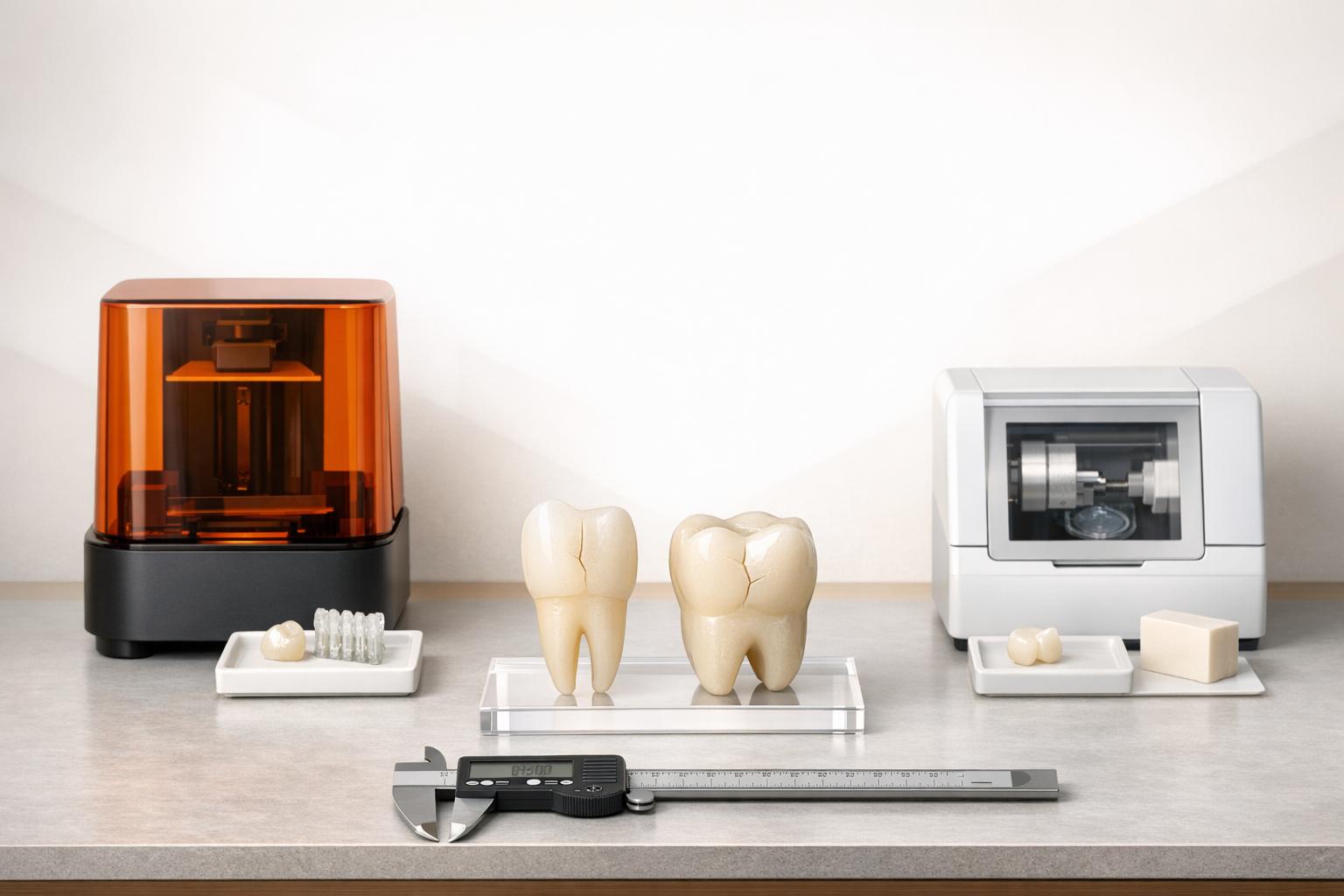
Cracked teeth are a common dental issue, affecting up to 70% of patients. Treatment aims to stabilise the tooth and prevent further damage, with options ranging from fillings to chairside CAD/CAM restorations. Modern dentistry increasingly uses digital manufacturing – specifically 3D printing and CAD/CAM milling – to create precise, durable restorations.
Key Insights:
- 3D Printing builds restorations layer by layer, offering design flexibility and efficient material usage. It’s ideal for anterior teeth or intricate designs but has lower strength compared to milling.
- CAD/CAM Milling carves restorations from solid blocks, providing higher strength and durability, making it better for molars under heavy chewing forces. This durability is largely due to the superior fatigue resistance of CAD/CAM dental materials used in the milling process.
- Material Strength: Milled crowns withstand higher forces (1,817.50 N vs 1,189.50 N for 3D-printed crowns).
- Precision: Milling achieves a tighter fit (15–25 μm) compared to 3D printing (40–50 μm).
- Time & Cost: 3D printing is faster and reduces waste, while milling incurs higher material costs due to waste.
Quick Comparison:
| Feature | 3D Printing | CAD/CAM Milling |
|---|---|---|
| Fabrication Time | <30 min + post-processing | Rapid for single units |
| Material Strength | Lower (1,189.50 N) | Higher (1,817.50 N) |
| Precision | 40–50 μm | 15–25 μm |
| Material Waste | Minimal | High |
| Cost | Lower | Higher |
For molars and high-stress areas, milling is preferred. For anterior teeth or quick, cost-effective restorations, 3D printing works well. Dentists often combine both methods for optimal results.
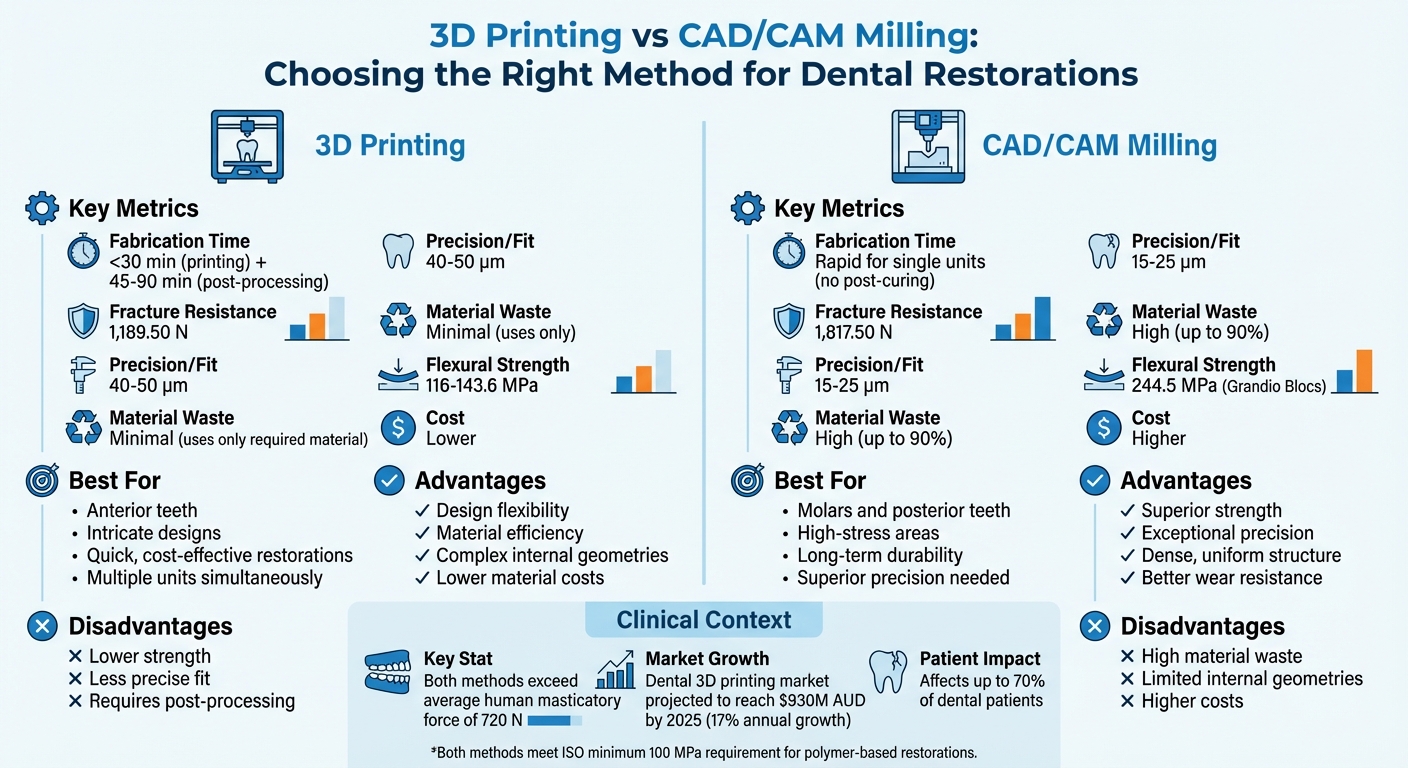
3D Printing vs CAD/CAM Milling for Dental Restorations Comparison
3D Printed Crown!
sbb-itb-2be92ed
1. 3D Printing for Cracked Tooth Restorations
The rise of digital manufacturing is reshaping restorative dentistry, with 3D printing standing out as a game-changer. This technique builds restorations layer by layer, making it highly effective for addressing cracked teeth. By using advanced materials like ceramic-reinforced composites and hybrid nanoceramic resins, it enables the creation of custom crowns, onlays, and overlays. Some commonly used materials include SprintRay Ceramic Crown, Bego VarseoSmile Crown Plus, and Formlabs Permanent Crown Resin.
Precision and Fit
One of 3D printing’s most impressive features is its ability to achieve micron-level accuracy. Unlike traditional milling, which is constrained by the size of cutting tools, 3D printing can create intricate geometries, including sharp internal angles. As Dr Russell Taylor, DDS, puts it:
"3D printing offers a solution to these limitations. By adding material we can make it almost any shape we want from a paper‐thin veneer to a deep molar grove" [8].
This level of precision is especially valuable for cracked tooth restorations, where the anatomy can be quite complex. For instance, 3D printing allows for the fabrication of custom posts that perfectly match a tooth’s root canal anatomy. A study highlighted that 3D-printed restorations had a restorable failure rate of 85.7%, compared to a non-restorable failure rate of 57.1% for milled restorations [9]. Additionally, proper curing of printed resins can achieve up to 95% polymerisation, far exceeding the roughly 50% seen in traditional direct resins [11].
Material Strength and Durability
While 3D-printed materials currently have lower mechanical strength compared to milled blocks, they still perform impressively in clinical settings. For example, the flexural strength of printed resins ranges from 116 to 143.6 MPa, whereas milled blocks like Grandio Blocs reach around 244.5 MPa [5]. Printed resins also contain about 33% inorganic filler by weight, significantly less than the 70–80% found in milled blocks [5][13].
Despite these differences, durability remains strong when proper finishing and bonding techniques are applied. Dr Wally Rene from The MOD Institute reported on over 1,000 3D-printed restorations placed over 28 months, with only two fractures and no debonds during that period [11].
Fabrication Time
Speed is another area where 3D printing excels. It can produce intricate restorations in less than 30 minutes, making it ideal for in-office workflows [6]. While single units may take slightly longer than milling (by about 5–10 minutes), the ability to print multiple restorations simultaneously – such as 10 veneers in just 10 minutes – boosts efficiency [11]. This capability aligns well with same-day restoration workflows when paired with intraoral scanners vs. traditional impressions [10][12].
Cost-Effectiveness
3D printing is also highly resource-efficient. Unlike subtractive milling, which carves restorations from larger blocks and produces waste, 3D printing uses only the material needed for each piece [10]. This efficiency can translate to cost savings. For instance, some dentists report offering 3D-printed veneers at about half the cost of traditional ceramic veneers, thanks to reduced lab fees and quicker production times [11]. The dental 3D printing market is expected to grow significantly, reaching A$930 million by 2025, with an annual growth rate of 17% [10].
To ensure maximum strength and precision, essential post-processing steps – such as cleaning with isopropyl alcohol and UV curing – are required [10][13]. For permanent restorations, using ceramic-filled hybrid resins like VarseoSmile Crown Plus is recommended to handle the forces of chewing effectively [9][13]. These advancements highlight 3D printing’s growing role in modern restorative dentistry.
2. CAD/CAM Milling Methods
CAD/CAM milling is a cornerstone in digital dentistry, creating restorations by carving them from solid blocks. It’s a go-to method for reliably treating cracked teeth, holding its ground in areas where 3D printing still can’t compete.
Precision and Fit
Milling technology stands out for its exceptional accuracy in both marginal and internal adaptation. For example, milled zirconia achieves RMS values of 15–25 μm, compared to 40–50 μm for 3D-printed alternatives [14]. Similarly, milled PMMA has a coefficient of variation of just 3.2%, while 3D-printed PMMA ranges from 16.2% to 30.9% [4]. This precision is crucial, as it reduces the risk of further damage when restoring cracked teeth.
However, milling does have its limitations. The diameter of the milling bur restricts the ability to create complex internal geometries [15][1].
Material Strength and Durability
Milling doesn’t just offer a precise fit – it also delivers superior material strength. Milled molar crowns, for example, have an average fracture force of 1,817.50 N, far exceeding the 1,189.50 N of 3D-printed crowns [6]. In cases like ultra-thin occlusal veneers (0.8 mm thickness), milled resin-based ceramics withstand up to 1,650 N, while the weakest 3D-printed group manages only 610 N [7]. This strength advantage comes from the dense, uniform microstructure of milled materials, which contain fewer voids and flaws compared to the layer-built nature of 3D printing [16][14].
Ahmed Othman from the Research Centre for Digital Technologies in Dentistry highlights this strength:
"Milled molar crowns show significantly higher fracture strengths than 3D printed crowns… making them safe for clinical use" [6].
Cost-Effectiveness
Milling also offers long-term cost benefits. While the initial investment in equipment and training can be steep [6], milled restorations often prove more economical over time due to their durability and lower failure rates. The main recurring costs are replacement milling burs and bars, which naturally wear out with use [6].
That said, material waste is a significant downside. Up to 90% of the original block may be discarded during the milling process [2][7]. Despite this inefficiency, the strength and longevity of milled restorations – especially for high-stress posterior teeth – often justify the waste. Additionally, milled restorations show better wear resistance. For instance, 3D-printed ceramic-reinforced composites experience up to 67% more wear than lithium disilicate and other glass-ceramics over six months [3].
Advantages and Disadvantages
This section highlights the key pros and cons of 3D printing and CAD/CAM milling, focusing on their application in treating cracked teeth. Each method offers distinct benefits, and understanding their trade-offs can help determine their best use cases.
3D Printing
3D printing stands out for its material efficiency and design flexibility. By using only the necessary material, it reduces waste and is often more cost-effective than milling [2][14]. Its layer-by-layer approach allows for the creation of intricate internal geometries that milling tools can’t replicate [2][4]. Additionally, 3D printing is fast, producing restorations in under 30 minutes. However, post-processing steps like alcohol washing and UV curing can add 45–90 minutes to the overall process [4][1].
On the downside, 3D-printed crowns tend to have lower mechanical strength and fracture resistance compared to milled restorations [6]. They also show less precise marginal adaptation, which can impact the fit of the restoration [14].
CAD/CAM Milling
CAD/CAM milling excels in strength and precision. According to Martin Ortega:
"Milling procedures produced stronger implant-supported temporary crowns than the additive manufacturing methods tested" [4].
The dense, uniform structure of milled restorations ensures durability, making them particularly suitable for posterior teeth that endure heavy chewing forces. For example, milled PMMA demonstrates exceptional consistency, with a coefficient of variation as low as 3.2%, compared to the 16.2%–30.9% range seen in 3D-printed PMMA [4].
However, milling isn’t without its drawbacks. It generates up to 90% material waste, as the process involves carving restorations from solid blocks [15]. Additionally, milling struggles with complex internal geometries due to limitations in bur size [15][1].
Comparison Table
| Feature | 3D Printing | CAD/CAM Milling |
|---|---|---|
| Fabrication Time | Fast printing (<20 min); post-processing adds 45–90 min [4][1] | Rapid for single units; no post-curing needed [1] |
| Material Strength | Lower (approx. 1,189.5 N fracture resistance) [6] | Higher (approx. 1,817.50 N fracture resistance) [6] |
| Precision/Fit | 40–50 μm marginal adaptation [14] | 15–25 μm marginal adaptation [14] |
| Material Waste | Minimal; uses only required material [4][14] | High; significant waste from solid blocks [4][15] |
| Cost | Lower material cost and reduced waste [4][5] | Higher due to waste and tool wear [4][15] |
Clinical Considerations
Despite their lower strength, most 3D-printed resins exceed the ISO minimum requirement of 100 MPa for polymer-based restorations, making them suitable for many clinical applications [5][1]. Additionally, both methods produce restorations that withstand forces well above the average human masticatory force of approximately 720 N [2]. These insights allow dental professionals to choose the most appropriate method based on specific clinical needs and priorities, such as strength, precision, or cost.
Conclusion
Milled restorations offer excellent fracture resistance, making them ideal for high-stress dental applications. On the other hand, 3D printing stands out for its precision, material efficiency, and ability to create intricate designs. Each method shines in meeting specific clinical needs.
The decision between these technologies depends heavily on the requirements of the case. As Cristian Abad-Coronel from Universidad de Cuenca explains:
"The restorations from the milled-derived group showed higher average fracture resistance than the provisional restorations obtained from the printed groups. However, the results demonstrated that all three materials analyzed in single-unit restorations are capable of withstanding the average masticatory forces" [2].
For molars and other areas subjected to heavy chewing forces, CAD/CAM milling is the preferred choice due to its durability. In contrast, 3D printing is well-suited for anterior teeth, temporary restorations, or situations that demand intricate internal detailing. Its ability to produce restorations in less than 30 minutes while conserving material makes it an appealing option for same-day treatments.
By combining these methods, clinicians can harness the strengths of both technologies. Advances in resin chemistry may soon bridge the performance gap further, offering even more versatility. Ultimately, the choice should be guided by factors like the tooth’s position, the load it will bear, and the complexity of the case.
As digital manufacturing continues to evolve, the integration of milling and 3D printing is set to revolutionise dental restorations. This synergy ensures precise, efficient care for patients, reflecting the dynamic progress in restorative dentistry across Australia.
FAQs
Will a 3D-printed crown last as long as a milled crown?
Research indicates that 3D-printed crowns may fall short in durability compared to milled crowns, largely due to differences in fracture resistance and overall strength. Milled crowns tend to outperform their 3D-printed counterparts in several key areas, including higher fracture strength, better marginal fit, and greater mechanical stability. These factors make them a more reliable choice for long-term dental restorations.
While 3D printing offers advantages like faster production and more flexible designs, milled crowns continue to stand out as the sturdier option for patients seeking lasting results.
Which option is better for back teeth with heavy chewing forces?
For teeth at the back of the mouth that endure heavy chewing forces, traditional restorations such as porcelain crowns or inlays are typically the go-to choice. These options are built to last and can withstand the significant pressure exerted during chewing.
Although 3D printing excels in delivering precision and customisation, the materials available today may lack the fracture resistance required for molars and other back teeth in high-stress areas. For now, traditional techniques continue to offer better strength and durability in these cases.
Can I get a same-day restoration for a cracked tooth?
Thanks to advancements in 3D printing technology, same-day restorations for cracked teeth are now a reality. This cutting-edge approach enables dentists to design and produce highly accurate, custom-fit restorations during a single appointment. It’s a faster and more convenient solution compared to traditional methods, which often require multiple visits and waiting periods.
Related Blog Posts
- Wear-Resistant Materials in Dental Restorations
- 3D Printing in Implants: Cost vs Benefits
- Ceramic vs. Resin: Toughness in CAD/CAM Restorations
- Emerging Trends in 3D-Printed Dental Prosthetics
Important Notice: Any surgical or invasive procedure carries risks. Before proceeding, you should seek a second opinion from an appropriately qualified health practitioner.
Individual results may vary. The information provided in this article is for educational purposes only and does not constitute medical advice.
Checkout Related Blogs




Get in touch with us
For more information, call us now to start feeling better. Or fill the form below to make appointment
The Latest News from Complete Smiles
How to Clean Clear Plastic Retainers
Checklist for Choosing Wearable Dental Devices
Checklist for Choosing Cloud AI Platforms in Dentistry

Complete Smiles Bella VistaAccepts All Major Health Funds, Including





