





3D Printing in Implants: Cost vs Benefits

3D-printed dental implants are reshaping how dentists approach tooth replacement. Unlike standard implants, which require bone modifications to fit, 3D-printed options are custom-designed to match a patient’s anatomy. This results in faster procedures, fewer appointments, and better early healing. However, the upfront costs for 3D-printed implants are higher, and they lack decades of clinical data compared to conventional methods.
Key Points:
- Cost: Conventional implants cost $3,000–$5,500 per tooth, while 3D-printed implants average $5,536.
- Customisation: 3D printing offers patient-specific designs; conventional implants are standardised.
- Healing: Early-stage bone integration is better with 3D-printed implants (57.55% vs 38.60% at 2 weeks).
- Durability: Both options show similar long-term outcomes, but conventional implants have over 30 years of proven reliability.
Quick Comparison:
| Feature | 3D-Printed Implants | Conventional Implants |
|---|---|---|
| Average Cost | AU$5,536 per tooth | AU$3,000–AU$5,500 |
| Surgery Time | ~30 minutes | ~100 minutes |
| Appointments | ~3 visits | 5–7 visits |
| Custom Fit | Yes | No |
| Proven History | Limited | 30+ years |
For complex cases or those needing immediate placement, 3D-printed implants may offer a better solution. Simpler cases, however, may benefit from the lower cost and reliability of conventional options.
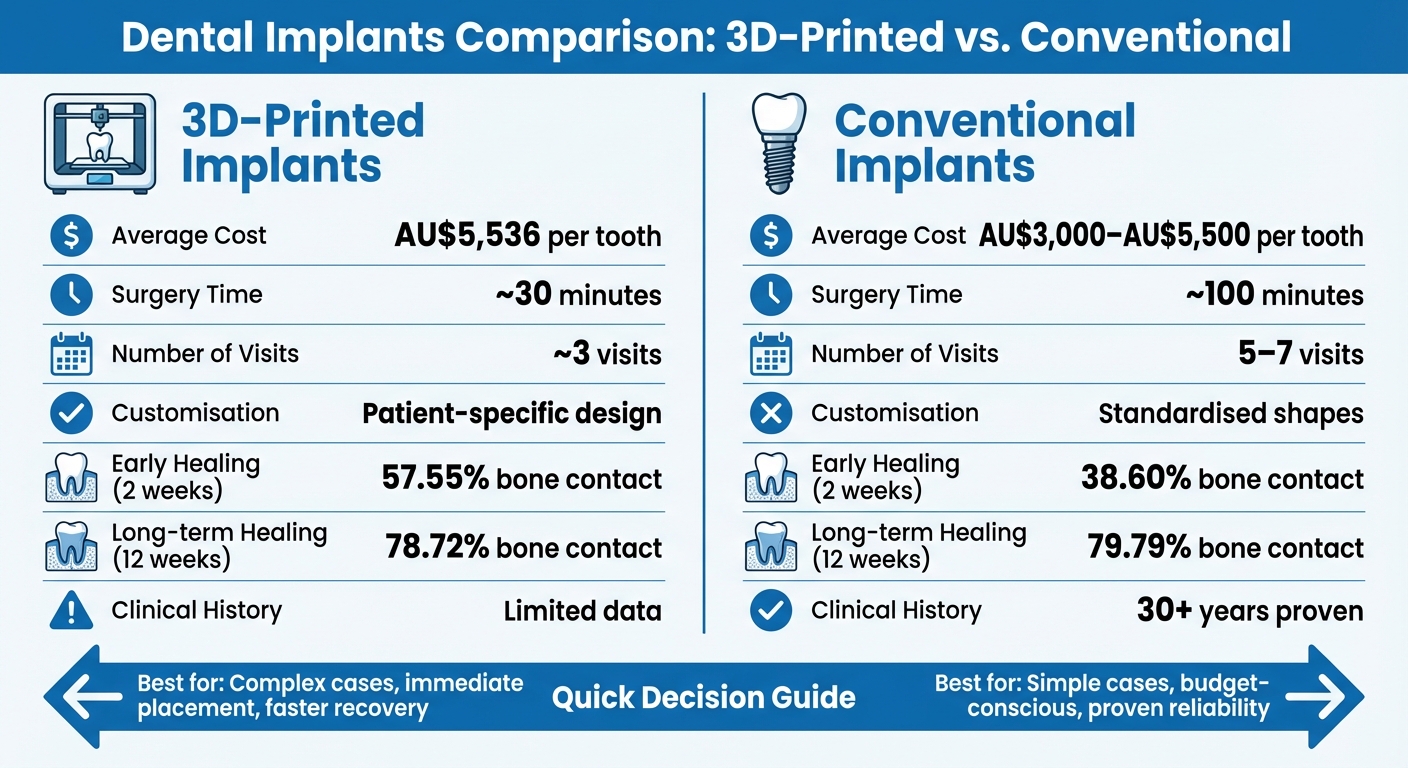
3D-Printed vs Conventional Dental Implants: Cost, Time, and Performance Comparison
1. 3D-Printed Dental Implants
Cost
When it comes to cost, 3D-printed dental implants offer a more complex picture than a simple price tag. While the implants themselves might not always be less expensive upfront, the digital workflow vs conventional techniques they rely on brings down overall treatment costs in several key ways. For starters, digital workflows cut lab fees and significantly reduce the time spent in the dentist’s chair compared to traditional methods [6]. This efficiency often means fewer appointments – just 2 to 4 sessions instead of the usual 5 – saving patients time, workdays, and even travel expenses.
Another cost-saving aspect is how additive manufacturing minimises material waste, unlike traditional milling techniques [3]. That said, dental practices face a steep initial investment to adopt these technologies, ranging from USD $28,750 to $81,075 [5]. Despite this, the precision and customisation afforded by digital workflows make these systems an attractive option for many practices.
Precision and Customisation
One of the standout benefits of 3D-printed implants is their ability to perfectly match a patient’s unique anatomy. Using CBCT scans as a blueprint, these implants can be designed to fit the precise shape of a tooth root or extraction socket. This approach eliminates the need to force the surrounding bone to adapt to a standard cylindrical implant shape [3]. The result? A better anatomical fit that improves both efficiency and clinical outcomes. In fact, this precision often allows for immediate placement into an extraction socket, bypassing the lengthy bone regeneration process required for conventional implants.
Additionally, 3D printing enables advanced design features, such as implants with a dense, strong core and a porous outer layer that mimics natural bone [3]. This structure encourages bone cells to grow into the implant. Research shows that after just two weeks, 3D-printed implants achieve significantly higher bone-to-implant contact (57.55% ± 7.08%) compared to conventional implants (38.60% ± 17.98%) [3].
Durability and Patient Outcomes
In terms of durability, 3D-printed implants hold their own against traditional options. By 12 weeks post-placement, both types of implants achieve nearly identical bone-to-implant contact rates – 78.72% for 3D-printed implants versus 79.79% for conventional ones [3]. However, the custom fit of 3D-printed implants often reduces the need for additional procedures like bone grafting, which can help lower overall treatment costs [4]. While the early advantage in bone integration may not guarantee better long-term outcomes, it does seem to support faster initial healing.
The digital workflow also offers practical advantages. For instance, securely stored digital patient records make it easier and more affordable to replace an implant or prosthetic component if it gets damaged years down the line. This added convenience can be a significant benefit for both patients and practitioners.
sbb-itb-2be92ed
2. Conventional Dental Implants
Cost
The price of conventional dental implants typically falls between $3,000 and $5,500 per tooth, though complications can push this up to $11,500. For full-arch solutions, costs can range from $18,000 to $38,000 [1][2][7]. When factoring in consultations, X-rays, and fittings, the total cost for a single implant often lands between $6,000 and $8,000 [7].
The process takes around 3 to 6 months, largely due to osseointegration – this is the critical period when the titanium post bonds with the jawbone [1][7].
It’s worth noting that the manufacturing method plays a significant role in the implant’s design and fit.
Precision and Customisation
Conventional implants are created using subtractive machining, which produces standard, cylindrical shapes [3]. While this method is reliable, it offers limited options for customisation. Unlike 3D-printed implants, these are not tailored to accommodate individual anatomical differences. Instead, the patient’s anatomy must adjust to the implant [3].
Despite their limitations in design flexibility, conventional implants have earned a reputation as the "gold standard" for tooth replacement. With over 30 years of proven clinical use, they are trusted for their predictability and effectiveness [1][3].
Durability and Patient Outcomes
Conventional titanium implants are built to last a lifetime and often come with long-term warranties [8]. However, the prosthetic crown or bridge typically requires replacement every 5 to 15 years, and implant failure rates are relatively low, ranging from 2% to 4% [1][4][7].
One of their key benefits is the prevention of jawbone resorption. Without a tooth root to stimulate the bone, up to 25% of bone mass can be lost within the first year [1]. By mimicking natural tooth roots, conventional implants help maintain both bone density and facial structure over time. Studies have shown that at 6- and 12-week healing intervals, there is no significant difference in bone-to-implant contact between conventional and 3D-printed implants [3]. This suggests that both options offer comparable long-term integration, despite differences in how they are manufactured.
3D Printing in Action: Immediate Dental Temporaries and Implant Restorations
Advantages and Disadvantages
Each type of implant comes with its own set of pros and cons, making the choice dependent on individual needs and circumstances.
3D-printed implants stand out for their high level of personalisation and efficiency. Designed using patient scans, they ensure a more natural and precise fit [3]. The surgical procedure is significantly faster, taking about 30 minutes compared to the 100 minutes required for conventional implants [9]. Additionally, these implants show improved early healing, with 57.55% bone-to-implant contact after two weeks, compared to 38.60% for their conventional counterparts [3]. However, one downside is the lack of long-term clinical data to assess their performance over decades [10].
On the other hand, conventional implants have a long-established reputation for reliability, backed by more than 30 years of clinical use [1]. They are generally more affordable, with costs ranging from AU$3,000 to AU$5,500 per tooth [1]. Their standardised manufacturing processes ensure consistent success rates of 90–95% [9]. However, they require longer surgery times, more appointments (typically 5–7 visits), and a recovery period that lasts several weeks [9].
Here’s a quick comparison of the two options:
| Feature | 3D-Printed Implants | Conventional Implants |
|---|---|---|
| Average Cost | AU$5,536 per tooth [9] | AU$3,000–AU$5,500 per tooth [1] |
| Surgery Duration | ~30 minutes [9] | ~100 minutes [9] |
| Number of Visits | ~3 visits [9] | 5–7 visits [9] |
| Customisation | Tailored to the patient [3] | Standard cylindrical shapes [3] |
| Early Healing (2 weeks) | 57.55% bone contact [3] | 38.60% bone contact [3] |
| Long-term Data | Limited clinical history [10] | Proven over 30+ years [1] |
Ultimately, cost plays a significant role in determining the most suitable implant type, alongside factors like recovery time, durability, and personalisation.
Conclusion
The role of 3D-printed implants in dentistry largely depends on specific clinical needs and expected outcomes over time. While the upfront costs of 3D printing can be significant, the advantages it offers in particular scenarios often make it a worthwhile investment.
For patients requiring immediate post-extraction implant placement, 3D-printed implants bring notable benefits. Research highlights their ability to achieve better early-stage osseointegration, which can mean fewer surgical procedures, shorter treatment times, and a faster return to everyday activities [3].
Customised implants also address delays caused by extended bone regeneration, offering a smoother path to recovery. Interestingly, by the 12-week mark, clinical outcomes for both 3D-printed and traditional implants tend to even out. This makes conventional implants a dependable and cost-effective option for simpler cases.
In Australia, dental professionals may lean towards 3D-printed implants for complex cases where rapid integration and customisation are crucial. For patients, the appeal lies in reduced treatment time and fewer appointments. Ultimately, the choice comes down to weighing the higher initial investment against the clear benefits of a tailored fit and quicker healing.
FAQs
What makes 3D-printed dental implants better for early healing compared to traditional implants?
3D-printed dental implants are making waves in dentistry by delivering an incredibly precise micron-level fit. This level of accuracy allows the implants to integrate seamlessly with the surrounding bone. Research shows that within the first two weeks, these implants achieve noticeably higher bone-to-implant contact and an increase in bone volume compared to traditional options.
This snug fit plays a key role in speeding up early osseointegration – the critical process where the implant bonds with the bone. Faster integration not only shortens healing times but also improves overall outcomes for patients. By customising the implant to match the patient’s unique anatomy, 3D printing offers a more personalised and effective approach to dental restoration.
How do the costs of 3D-printed dental implants compare to traditional ones?
3D-printed dental implants are making waves for their potential to cut material costs compared to traditional methods. For instance, a 3D-printed implant can cost as little as $13 AUD in materials, whereas a titanium implant made through conventional manufacturing might set you back $225 AUD. Beyond savings on materials, 3D printing shines in its speed. Production times can shrink from weeks to less than 24 hours, which can significantly reduce labour expenses.
That said, diving into 3D printing isn’t cheap. The upfront investment for equipment – like scanners, CAD/CAM software, and 3D printers – can range between $43,000 and $122,000 AUD, depending on the setup. For practices handling a high volume of implants, these initial costs may be offset over time by the savings in materials and labour, making the technology a more economical option in the long run.
While the initial outlay is steep, the combination of lower material costs and quicker production times positions 3D-printed implants as a promising choice for dental practices and their patients.
Do 3D-printed dental implants last as long as traditional implants?
Research into the long-term durability of 3D-printed dental implants is still in its early stages. A three-year multicentre study focusing on titanium 3D-printed implants has delivered encouraging results, particularly in terms of durability and overall performance. However, data from longer-term studies – spanning more than five years – is currently limited, leaving questions about their longevity unanswered.
Traditional implants, on the other hand, come with decades of research supporting their reliability. Despite this, 3D-printed implants bring potential benefits to the table, such as greater precision and the ability to customise implants for individual patients. As ongoing studies progress, they are expected to shed more light on how these newer implants perform over extended periods and their broader advantages for dental care.
Related Blog Posts
- Titanium vs. Biodegradable Implants: Comparison
- Checklist: Evaluating Cost-Effectiveness of Dental Implants
- What Is Digital Guided Implant Surgery?
- 3D Printing in Dental Implant Prototyping: How It Works
Important Notice: Any surgical or invasive procedure carries risks. Before proceeding, you should seek a second opinion from an appropriately qualified health practitioner.
Individual results may vary. The information provided in this article is for educational purposes only and does not constitute medical advice.
Checkout Related Blogs




Get in touch with us
For more information, call us now to start feeling better. Or fill the form below to make appointment
The Latest News from Complete Smiles
How to Clean Clear Plastic Retainers
Checklist for Choosing Wearable Dental Devices
Checklist for Choosing Cloud AI Platforms in Dentistry

Complete Smiles Bella VistaAccepts All Major Health Funds, Including





