





Emerging Trends in 3D-Printed Dental Prosthetics
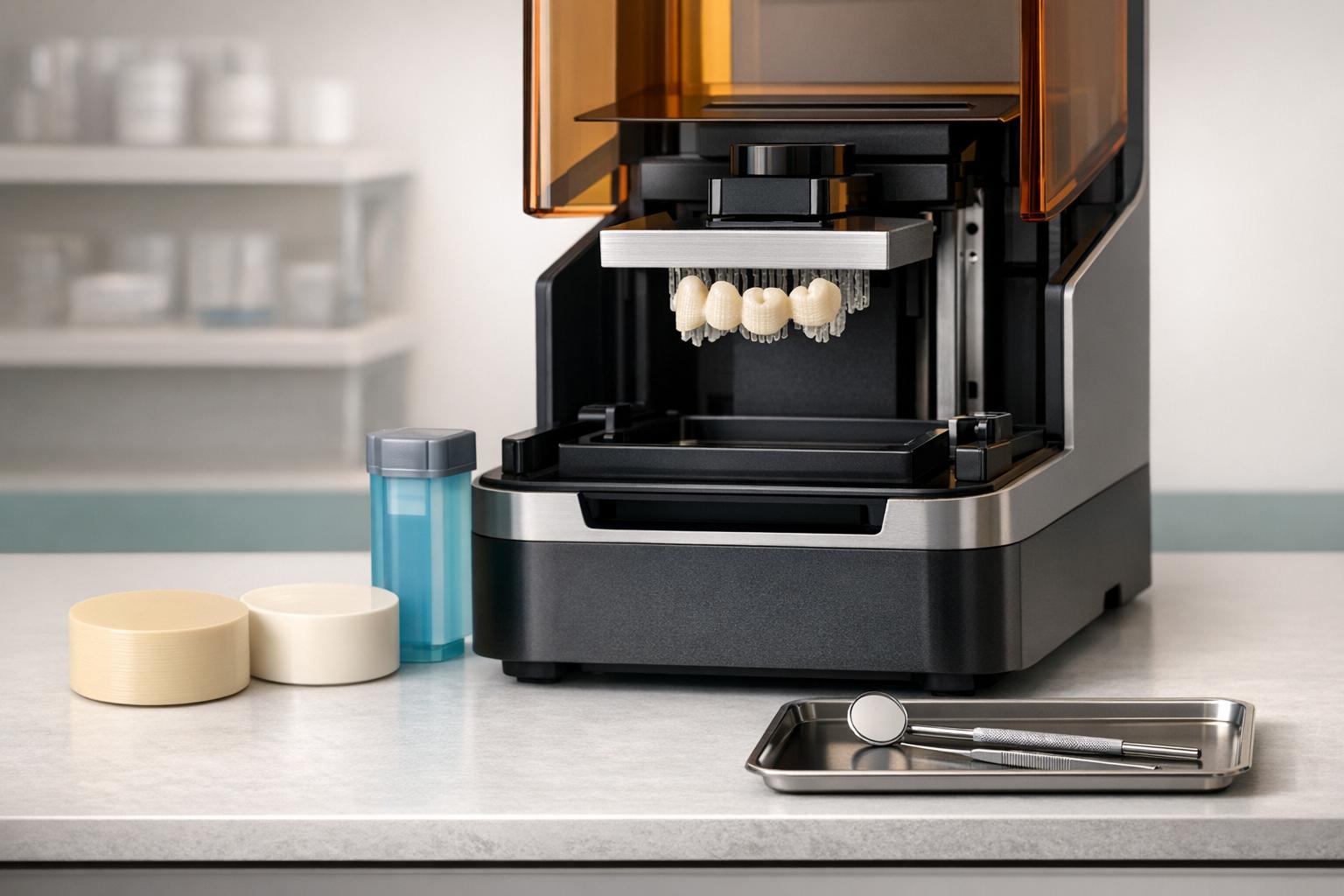
3D printing is changing how dental prosthetics are made by offering faster production, better precision, and improved materials. Using digital workflows, this method eliminates traditional moulds and manual processes, saving time and reducing discomfort for patients. Here’s what you need to know:
- Applications: Used for crowns, bridges, dentures, and complex prostheses.
- Techniques: SLA and DLP for resins; SLS for metals.
- Materials: Advanced options like PEEK, ceramic-reinforced composites, and antibacterial resins.
- Benefits for Patients: Faster treatments, fewer visits, and better-fitting prosthetics.
- Efficiency: Reduces waste and costs with streamlined production.
New developments, like AI vs. traditional prosthetic designs and 4D printing materials, are pushing this technology even further. Dentists and labs adopting these methods are seeing reduced costs, faster turnaround times, and improved patient outcomes. Read on to explore how this technology is shaping the future of dental care.
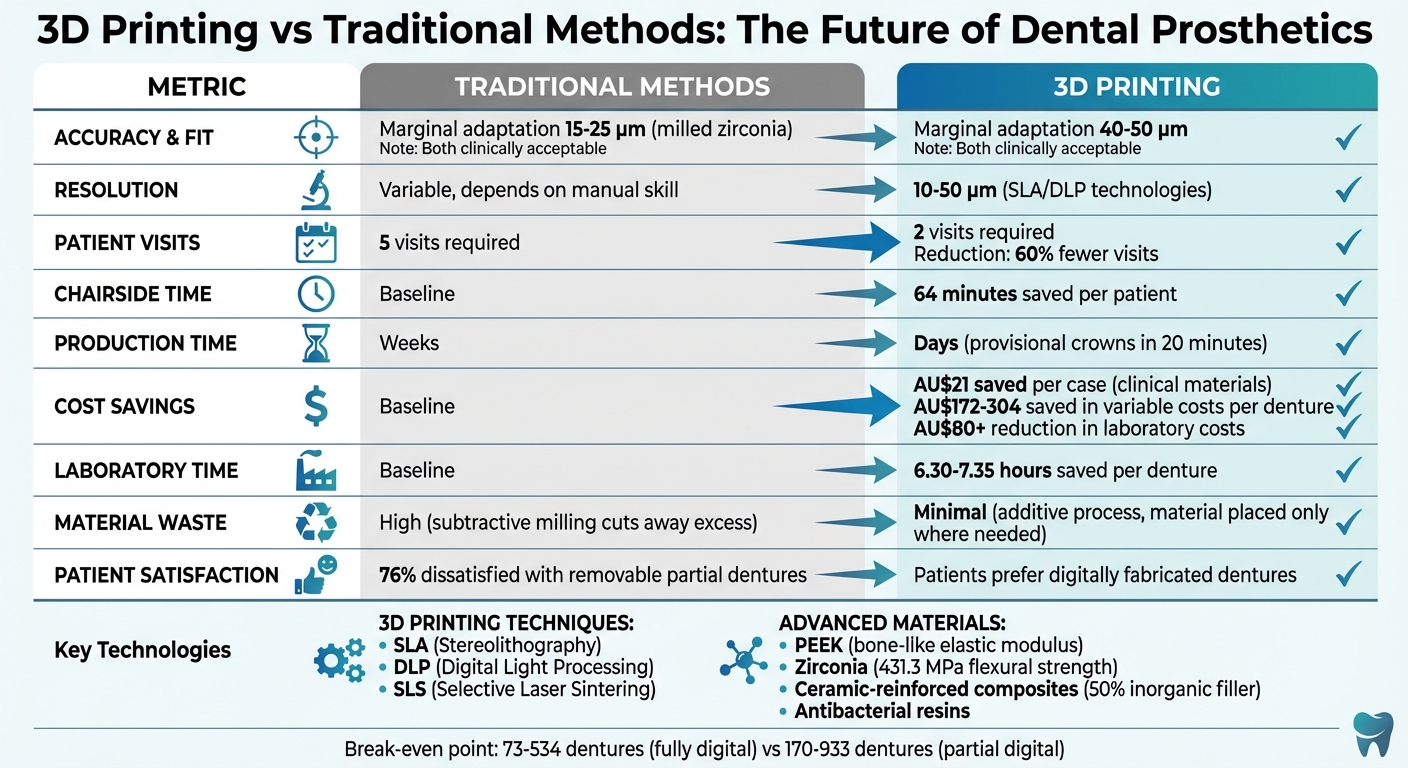
3D Printing vs Traditional Methods in Dental Prosthetics: Accuracy, Time, and Cost Comparison
How I 3D Print: Aligners, Crowns & Digital Dentures
sbb-itb-2be92ed
New Materials for 3D-Printed Dental Prosthetics
The development of new materials is driving progress in 3D printing for prosthodontics. Today’s 3D-printed dental prosthetics utilise advanced composites and ceramics that match or even surpass traditional materials. These options are designed for biocompatibility, durability, and aesthetics, all while benefiting from the precision of additive manufacturing.
Biocompatible Polymers and Composites
One standout material is Polyether ether ketone (PEEK), which has proven to be a reliable choice for dental frameworks and implants. Its elastic modulus is similar to natural bone, offering excellent chemical resistance and mechanical strength [1][3][7]. While PEEK is bioinert and doesn’t always encourage osseointegration, it remains a strong candidate for load-bearing applications, especially where metals may not be suitable [10][1].
Ceramic-reinforced composites (CRCs) are another exciting development. These materials blend resin matrices with inorganic fillers like silica, zirconia, or glass to create nanohybrid composites. For example, SprintRay’s “Ceramic Crown” resin contains about 50% inorganic filler (silica and ytterbium oxide), while Bego’s “VarseoSmile Crown Plus” uses 19–24% glass fillers [7]. These composites aim to strike a balance between traditional composite materials and ceramics, delivering enhanced durability for single-unit crowns and inlays [5][7].
There’s also been progress in tackling bacterial adhesion, a long-standing issue in dentistry. Recent research has integrated antibacterial properties directly into 3D-printed resins. For instance, bioresource-derived monomers like niacin-derived QANMA and betulin derivatives (M1Bet/M2Bet) have been added to printable materials [2]. These innovations are a step forward in creating prosthetics that resist bacterial build-up over time.
These advancements in polymers and composites are shaping the future of dental resins and ceramics, making them more suitable for long-term restorations.
High-Resolution Resins and Ceramics
Modern high-resolution resins, such as Formlabs Permanent Crown Resin, are designed to resist ageing, discolouration, and plaque accumulation [3]. These ceramic-infused resins also offer excellent colour stability, with colour change values (ΔE) remaining below the clinically acceptable threshold of 3.3 after simulated ageing [6].
In ceramics, 3D-printed zirconia (3Y-TZP) has achieved flexural strength on par with traditionally milled zirconia [8]. Similarly, 3D-printed lithium disilicate provides a flexural strength of 431.3 MPa when printed with a 25 μm layer thickness and properly polished [8]. These materials allow for intricate geometries that traditional milling techniques cannot replicate, all while maintaining the biocompatibility and aesthetic appeal patients expect [8][9].
However, as Sillas Duarte Jr from the University of Southern California points out:
"The first generation of 3D-printed CRCs offers customisation advantages but is still in early development and exhibits lower mechanical strength and higher wear rates than CAD-CAM CRCs and traditional ceramics" [7].
While challenges remain, these materials are opening new possibilities for 3D-printed dental prosthetics, offering solutions that are both functional and visually appealing.
Accuracy and Customisation with CAD/CAM Technology
The integration of 3D printing with CAD/CAM technology has completely changed how dental prosthetics are designed and produced. Starting with intraoral scanning, this fully digital approach eliminates the measurement errors of manual impressions like gypsum casting [1]. The result? Better initial fits and fewer adjustments.
The precision of 3D printing is impressive. Technologies like Stereolithography (SLA) and Digital Light Processing (DLP) can achieve lateral resolutions of 10–50 μm [2]. To put this into perspective, milled zirconia restorations typically achieve internal and marginal adaptation values of 15–25 μm, while 3D-printed restorations range from 40–50 μm – both well within clinically acceptable limits [9]. Researcher Xiaoxu Liang and colleagues highlight the benefits:
"The digital workflow introduces substantial procedural innovations, dramatically reducing fabrication time while simultaneously achieving superior marginal adaptation and internal architectural precision" [2].
Additionally, 3D printing allows for the creation of complex geometries that aren’t possible with traditional milling techniques, enabling highly precise, patient-specific designs [9][1]. These advancements not only improve the fabrication of crowns, bridges, and orthodontic devices but also build on earlier innovations in materials, further advancing personalised prosthodontics.
Better Fit for Crowns and Bridges
The accuracy of 3D-printed crowns and bridges depends heavily on manufacturing settings. Studies show that horizontal or 90° printing orientations consistently deliver better marginal fit and mechanical strength compared to other angles [9][2]. Incorporating hybrid scanning, which captures an extra ~30 mm² of surface area, further enhances the fit for intricate restorations [11]. This approach simplifies clinical workflows while maintaining high standards of fit and function.
Patient-Specific Orthodontic Devices
Customised orthodontic devices also benefit greatly from CAD/CAM precision. For example, direct 3D printing of aligners offers precise control over material thickness, enabling more accurate tooth movements, better anchorage control, and improved staging compared to traditional thermoformed appliances [12]. The British Dental Journal underscores this advantage:
"3D printing aligners allows for control over material thickness, potentially providing increased precision in tooth movement, both in anchorage control and staging of tooth movements" [12].
For paediatric patients, the benefits extend even further. Devices like space maintainers can be quickly designed and printed using digital workflows. A 2025 study led by Tamburrino evaluated 3D-printed space maintainers made with DLP-based technology and "OD-Clear MF Bio monomer free" resin using DentalCAD (exocad GmbH). These 3D-printed devices showed superior fit precision and faster production compared to conventional band-and-loop maintainers [1]. By conforming exactly to a child’s dental anatomy, these devices reduce the need for manual adjustments, shorten chair time, and improve outcomes – especially important for young patients who may struggle with lengthy appointments.
3D Printing for Removable Dentures
3D printing has made a big impact on fixed prostheses, but its influence on removable dentures is just as transformative. Studies reveal that around 76% of patients with traditional removable partial dentures experience dissatisfaction due to poor fit [14]. Digital workflows are helping tackle this issue by addressing common problems like acrylic shrinkage and casting distortions [11].
This technology excels in creating custom trays, record bases, and interim or immediate dentures [13]. By using hybrid scanning techniques, it achieves better accuracy in mapping the denture-bearing area, leading to improved initial fit and retention. This focus on precision results in dentures – both complete and partial – that offer better stability and fit.
For partial dentures, 3D printing provides unmatched precision in crafting intricate components like clasps and connectors. This accuracy reduces the likelihood of periodontal damage caused by poorly fitting frames [14]. Clinically, a gap between 50 μm and 310 μm between the denture material and tissue is acceptable, while anything over 310 μm is considered a misfit [14].
Accuracy in Complete and Partial Dentures
Digital scanning and 3D printing not only improve the fit but also enhance the precision of denture components. A multi-centre clinical trial found that clinicians preferred 3D-printed jaw registration rims over traditional shellac ones in 13 out of 16 cases. The reasons? Better stability and retention during bite-recording stages [11]. Cecilie Osnes from the University of Leeds remarked:
"3D‐printing technology can potentially offer advantages of good surface detail, low cost, speed, repeatability and lower material waste" [11].
Research also indicates that patients favour digitally fabricated partial dentures over conventional ones [14]. These dentures feature baseplates that fit more precisely to individual anatomy, cutting down on chairside adjustments and improving comfort.
Reduced Production Times
Digital workflows have dramatically shortened the process of creating dentures. Patient visits have dropped from five to two, chairside time has been cut by over an hour, and production timelines have shrunk from weeks to just days [16][17][20]. A study conducted between September 2022 and September 2023 by Marco Ferrari at the University of Siena observed a reduction in chairside time by about 64 minutes per patient. Additionally, laboratory costs were reduced by over AU$80 when compared to traditional methods [20].
Mariya Dimitrova from the Medical University of Plovdiv highlighted another key benefit:
"The digital process has significantly accelerated production timelines and offers the advantage of retaining design data in cases involving prosthesis loss or fracture" [15].
This ability to digitally archive designs means lost or broken dentures can be reprinted immediately without needing new impressions [16][18][19]. These advancements not only streamline the clinical workflow but also provide a better overall experience for patients.
Efficiency and Environmental Considerations
3D printing stands out for its precision and ability to reduce waste, offering a stark contrast to traditional milling methods that involve cutting away excess material from solid blocks. By depositing material only where needed, this additive manufacturing process drastically reduces waste while maintaining high accuracy [1][22].
The process also eliminates the need for physical impressions and gypsum casting, which are common in traditional workflows. This means less waste from stone models and impression materials. Shilthia Monalisa, a Graduate Research Assistant at Louisiana State University, highlights this advantage:
"Additive manufacturing fabricates dental items incrementally from digital models, minimizing material waste and production duration while enabling intricate geometries." [1]
Reduced Material Waste
Traditional milling methods generate significant waste by carving out material from solid blocks. In contrast, 3D printing uses resin more efficiently, placing it exactly where it’s needed [22][11]. By optimising the build orientation, even the use of support materials and resin can be minimised further [21].
Digital workflows also eliminate the need for storing physical stone models. Instead, design files are stored electronically, which not only saves physical space but also reduces the environmental impact associated with shipping and archiving [21]. Many laboratories are now shifting towards more sustainable practices, such as using recycled materials and eco-friendly resin formulations [1].
This focus on resource efficiency not only benefits the environment but also translates into considerable cost savings, making scalable digital workflows more accessible.
Cost Reduction and Scalability
The efficiency of digital workflows extends beyond material savings to significant cost and time reductions. For instance, a fully digital workflow can save around AU$21 per case in clinical materials compared to partially digital methods [23]. Additionally, these workflows can reduce laboratory time by 6.30 to 7.35 hours per denture, while cutting variable costs by AU$172 to AU$304 [23].
For dental laboratories, this means quicker returns on investment. Labs adopting fully digital workflows can break even after producing between 73 and 534 dentures, compared to 170 to 933 units for those using partial digital methods [23]. Even smaller practices can benefit, as high-speed resin printers enhance productivity by producing six dental models in just five minutes or six ceramic crowns in under 15 minutes [4].
This combination of efficiency, cost-effectiveness, and scalability makes 3D printing an increasingly attractive option for dental practices and labs alike.
Conclusion
The progress in materials, precision, and digital workflows outlined above highlights how 3D printing has transitioned from an experimental tool to a key player in prosthodontics. The evolution from basic polymers to advanced materials like zirconia-filled resins and PEEK has unlocked opportunities for both temporary and permanent restorations. For instance, provisional crowns can now be printed in as little as 20 minutes [2].
Technologies like SLA and DLP now provide patient-specific geometries with a level of precision that surpasses traditional methods [1][2]. This enhanced accuracy directly leads to better-fitting crowns, bridges, and dentures, improving outcomes across a wide range of applications.
Looking to the future, new advancements promise to reshape prosthodontics even further. The integration of artificial intelligence for automated prosthesis design and the potential of 3D bioprinting and 4D printing with shape-adaptive biomaterials suggest exciting developments on the horizon [1]. As Shilthia Monalisa from Louisiana State University states, 3D printing has become "firmly established as the backbone of next-generation dental care" [1]. Its ability to minimise waste, lower costs, and enhance patient outcomes cements its role as a cornerstone of modern dentistry.
For dental professionals, embracing digital training and staying updated on material innovations will be critical to improving care. For patients, these advancements translate to faster treatments, better-fitting prosthetics, and more accessible dental solutions.
FAQs
Are 3D-printed crowns and dentures as strong as traditional ones?
3D-printed dental prosthetics, like crowns and dentures, are proving to have mechanical properties that stack up well against traditional alternatives. Factors like the materials and printing techniques play a big role in determining their strength and durability. Researchers are still digging into how these prosthetics hold up over time, but the results so far are encouraging. That said, there’s still work to be done to ensure they consistently meet the rigorous standards set by conventional methods.
Is 3D printing safe for long-term dental prosthetics materials?
Research into the long-term safety of materials used in 3D-printed dental prosthetics is still in progress. While recent developments look encouraging, studies are focusing on critical aspects such as durability, precise fit, and mechanical strength. Preliminary results indicate these materials could be effective, but more extensive research is required to determine if they are appropriate for permanent applications. Ensuring a balance between cutting-edge innovation and patient safety is key as clinical trials continue to evaluate their long-term reliability.
How many appointments do 3D-printed dentures usually take?
3D-printed dentures typically require just one or two appointments. In some cases, everything – digital impressions, design, and fitting – can be completed in a single visit. However, other workflows might involve an extra appointment to make adjustments. The total number of visits largely depends on the process used and the patient’s specific requirements.
Related Blog Posts
- Wear-Resistant Materials in Dental Restorations
- 3D Printing in Dental Implant Prototyping: How It Works
- Durability of 3D Printed Dentures vs Traditional Materials
- 3D Printing in Implants: Cost vs Benefits
Important Notice: Any surgical or invasive procedure carries risks. Before proceeding, you should seek a second opinion from an appropriately qualified health practitioner.
Individual results may vary. The information provided in this article is for educational purposes only and does not constitute medical advice.
Checkout Related Blogs




Get in touch with us
For more information, call us now to start feeling better. Or fill the form below to make appointment
The Latest News from Complete Smiles
How to Clean Clear Plastic Retainers
Checklist for Choosing Wearable Dental Devices
Checklist for Choosing Cloud AI Platforms in Dentistry

Complete Smiles Bella VistaAccepts All Major Health Funds, Including





