





Checklist for Choosing Biocompatible Implant Materials
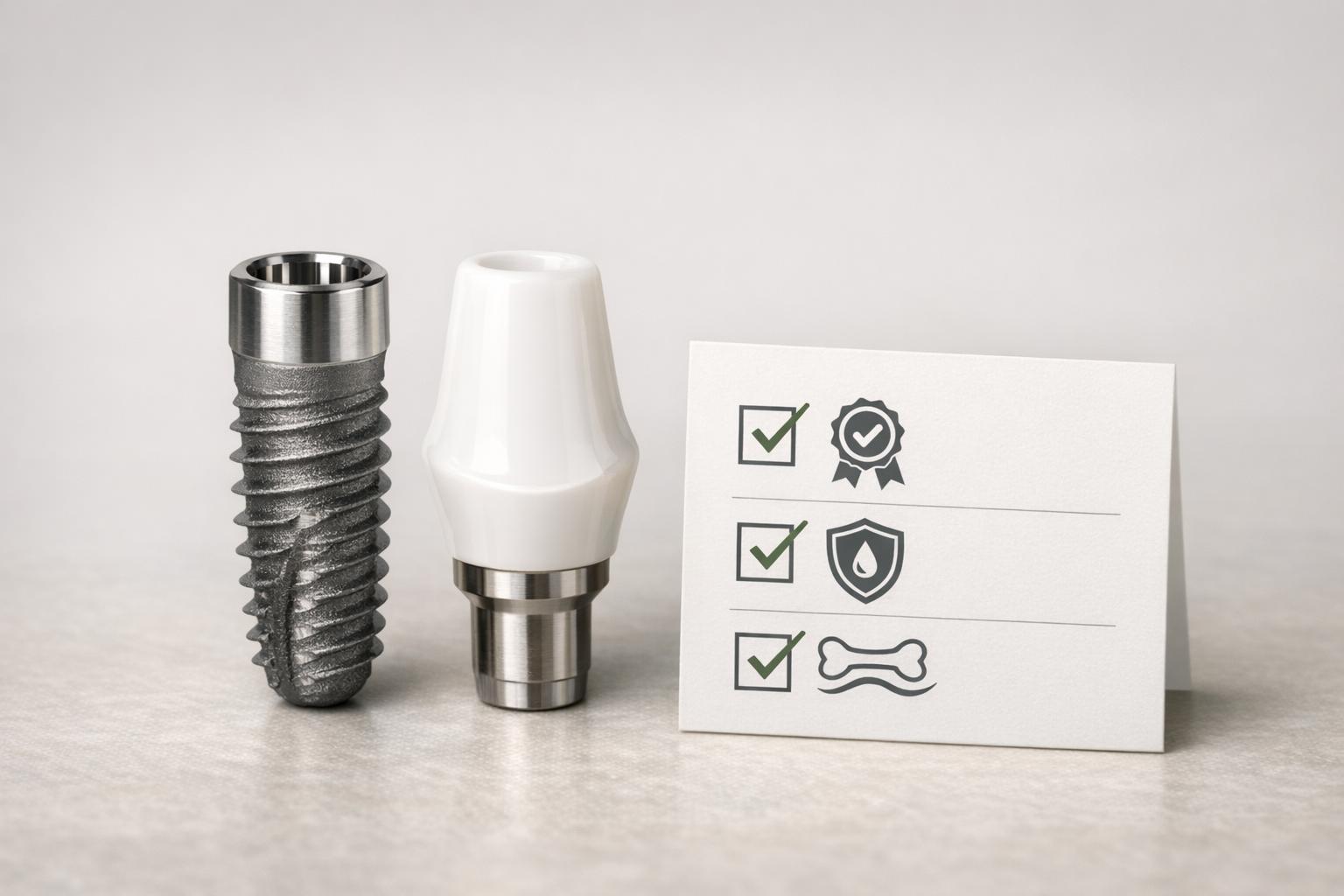
Biocompatibility is crucial when selecting implant materials. For dental implants, the material must integrate with bone (osseointegration) while being safe for the body. Titanium is the leading choice due to its corrosion resistance, biocompatibility, and high success rates (97–99% over 10 years). However, alternatives like titanium vs zirconia are becoming popular for patients with metal sensitivities or aesthetic concerns.
Key factors to consider when choosing implant materials include:
- Certifications: Look for compliance with ISO 10993 and ISO 7405 standards for biocompatibility.
- Material Properties: Non-toxicity, corrosion resistance, and mechanical strength are essential. Titanium’s oxide layer protects against corrosion, while newer alloys like TNTZ reduce stress shielding.
- Allergy Risks: Titanium is generally safe, but vanadium-free or zirconia options may suit sensitive individuals.
- Bone Compatibility: The implant’s stiffness should align with bone to prevent bone loss.
Discuss your medical history and treatment goals with your dentist to ensure the implant material suits your needs.
Titanium is the Most Biocompatible Material! #implantdentistry #dentalprocedure #podcast
sbb-itb-2be92ed
Material Certifications and Standards
Checking certifications is a key step when choosing biocompatible dental materials. These certifications ensure that the materials used in dental implants meet strict safety standards. They provide a clear guide for both dental professionals and patients to determine whether an implant adheres to recognised safety criteria.
ISO 10993 and ISO 7405 Compliance
ISO 10993 stands as the global standard for assessing the biocompatibility of medical devices. The ISO 10993-1 framework, last updated in 2018, takes a risk-based approach to testing[7][8]. Importantly, it focuses on testing the finished device rather than its individual raw materials.
"The Agency makes a clearance or approval decision for a medical device as it is supplied in its final finished form. The Agency does not clear or approve individual materials that are used in the fabrication of medical devices." – FDA [8]
For permanent dental implants, testing spans up to 10 biological endpoints, including cytotoxicity, sensitisation, genotoxicity, and carcinogenicity[6][9]. ISO 7405 complements ISO 10993 by focusing specifically on the biocompatibility of dental devices, considering the unique challenges of the oral environment.
These international standards act as a foundation for local regulatory frameworks.
FDA Guidelines for Implant Materials
In Australia, the Therapeutic Goods Administration (TGA) requires all implantable devices to be listed on the Australian Register of Therapeutic Goods (ARTG) before they can be legally supplied[10]. Manufacturers must also comply with the Essential Principles for device safety and performance.
On 30 June 2025, the TGA introduced stricter regulations to better address and manage device safety concerns[10]. Patients are encouraged to verify that their implants are registered on the ARTG and to request patient information materials that explain the materials’ safety and associated risks. Checking the TGA’s "Latest Alerts" or "Market Actions" can also highlight any ongoing safety issues. For instance, in July 2025, the TGA issued market actions for the Philips A30 and A40 series BiPAP devices due to unresolved safety concerns[10].
While Australia acknowledges international standards like ISO 10993, sponsors must also ensure compliance with local requirements. This dual approach provides multiple layers of safety assurance.
Properties of Biocompatible Implant Materials
The physical and chemical characteristics of implant materials play a crucial role in ensuring their safety and compatibility with body tissues. Understanding these properties is key to making informed decisions about implant materials in clinical settings.
Non-Toxicity and Allergy Prevention
Implants must avoid releasing harmful substances into surrounding tissues. Titanium, for instance, forms a protective oxide layer within just 30 milliseconds of exposure to air or moisture [11][14]. This ultra-thin layer – measuring only 1 to 5 nanometres – acts as a shield, preventing the release of toxic ions and protecting the metal from bodily fluids [11][14].
However, not all titanium alloys are equally safe. For example, the widely used Ti-6Al-4V alloy contains vanadium, which raises concerns about cytotoxicity. Similarly, nickel-containing alloys may trigger allergic reactions in sensitive individuals [5][13]. To address these issues, newer beta-type alloys like TNTZ (Titanium–Niobium–Tantalum–Zirconium) have been developed. These alloys incorporate non-toxic elements such as niobium and tantalum, making them a safer option for patients with known metal sensitivities [5][11].
Corrosion Resistance and Mechanical Strength
Chemical stability and mechanical durability are equally important. Titanium’s self-healing oxide layer provides rapid protection against corrosion in environments like saliva and blood, effectively preventing ion release and reducing the risk of aseptic loosening [12][14]. Its mechanical strength is well-suited to withstand daily forces, such as chewing, with implant fractures being rare (0–6%). Dental implants specifically require at least 8% ductility to perform effectively [1][4]. Comparing zirconia and ceramic options shows that zirconia offers even greater flexural strength (800–1,000 MPa), making it a robust choice for dental applications [4].
Bone Integration and Immune Response
The stiffness of an implant plays a pivotal role in osseointegration. Human cortical bone has a Young’s modulus of 10–30 GPa, whereas Ti-6Al-4V exhibits a significantly higher modulus of 110 GPa [5][14]. This disparity can lead to stress shielding, where the implant absorbs the majority of the load, leaving the bone underutilised and potentially causing bone atrophy.
"A low elastic modulus is desirable in implants because it helps to avoid stress shielding and the associated bone resorption." – Alfred T. Sidambe, University of Sheffield [13]
Research backs this up. A 2009 study on Japanese white rabbits found that low-modulus TNTZ plates delayed cortical bone thinning from 7 to 10 weeks, encouraging the formation of a double-wall structure of new bone [5]. Beta-type titanium alloys, with a reduced elastic modulus of 55–60 GPa, help minimise the risk of bone resorption [5][11].
The immune system also plays a critical role in the long-term success of implants. While titanium is generally considered bio-inert, corrosion can release metal ions or particles that may trigger Type I or IV hypersensitivity reactions [16]. Chronic immune responses, such as aseptic osteolysis, are a leading cause of implant failure [16]. Zirconia offers a promising alternative here, as it is less likely to provoke immune responses and boasts superior resistance to corrosion [16].
These material properties form the foundation for selecting titanium implants, as outlined in the checklist steps to follow.
Titanium Alloys Compared to Other Materials
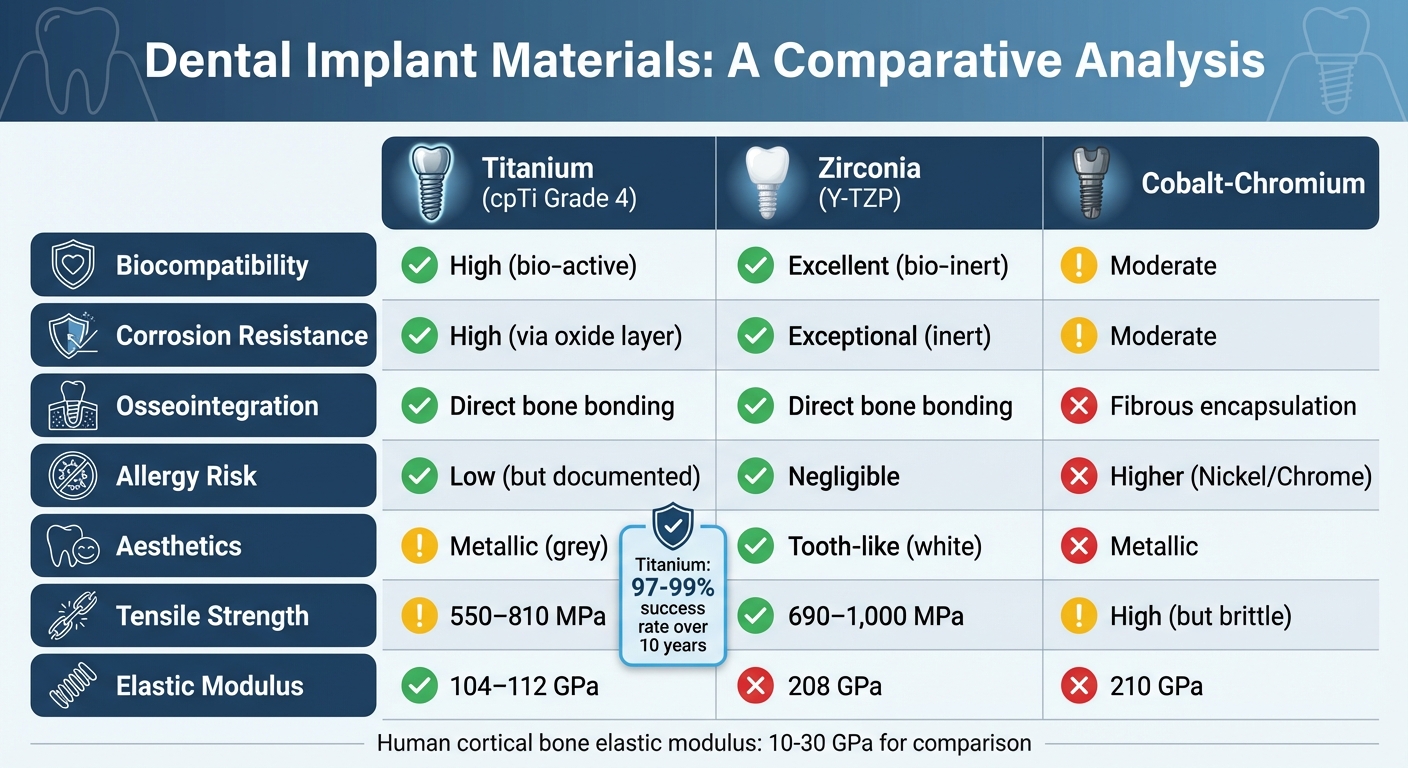
Titanium vs Zirconia vs Cobalt-Chromium Dental Implant Materials Comparison
When it comes to implant materials, titanium stands out, but it’s essential to compare it with other options like zirconia and cobalt–chromium. Titanium implants boast an impressive 97–99% survival rate over 10 years and form a direct bond with bone (a process called osseointegration), unlike stainless steel or cobalt–chromium, which tend to develop fibrous tissue around them instead [3][20]. That said, titanium isn’t perfect – it has a metallic grey colour that can sometimes be visible through thin gingival tissue, and although rare, cases of metal hypersensitivity have been reported [4].
Zirconia presents a strong alternative, particularly for patients prioritising aesthetics or those with sensitivities to metals. This ceramic material is bio-inert, meaning it releases minimal ions and eliminates corrosion risks [17][16]. A nine-year follow-up study found no cases of peri-implantitis with zirconia implants, and nearly 80% of patients preferred zirconia over titanium [17]. However, zirconia’s brittleness and vulnerability to low-temperature degradation (LTD) – a process where moisture exposure leads to surface roughening and microcracking – remain challenges [4].
"Zirconia’s lower bacterial adhesion, reduced risk of ion release, and minimal inflammatory response make it an increasingly preferred choice for patients with metal sensitivities or high aesthetic demands."
- Tobias Steinherr, DDS, Specialist for Prosthodontic Dentistry & Biomaterials [17]
Material Comparison Table: Titanium vs. Alternatives
| Property | Titanium (cpTi Grade 4) | Zirconia (Y-TZP) | Cobalt–Chromium |
|---|---|---|---|
| Biocompatibility | High (bio-active) | Excellent (bio-inert) | Moderate |
| Corrosion Resistance | High (via oxide layer) | Exceptional (inert) | Moderate |
| Osseointegration | Direct bone bonding | Direct bone bonding | Fibrous encapsulation |
| Allergy Risk | Low (but documented) | Negligible | Higher (Nickel/Chrome) |
| Aesthetics | Metallic (grey) | Tooth-like (white) | Metallic |
| Tensile Strength | 550–810 MPa [2][18] | 690–1,000 MPa [4][18] | High (but brittle) |
| Elastic Modulus | 104–112 GPa [2][18] | 208 GPa [18] | 210 GPa [19] |
Specialised titanium alloys, such as Ti-6Al-4V, take titanium’s performance further with tensile strengths reaching around 810 MPa, making them ideal for complex prosthetic designs [3][18]. Additionally, titanium–zirconium alloys like Roxolid push tensile strengths even higher, up to 953 MPa. This makes them particularly effective for narrow-diameter implants where space is limited , similar to advances in short implant techniques used for limited bone height [1][4].
These differences between materials play a crucial role in determining the most suitable titanium implant for each case.
Checklist for Selecting Titanium Implants
Use these steps to help narrow down your choice of titanium implant. These build on the material properties and certifications discussed earlier.
Step 1: Check Alloy Composition
Verify the titanium grade and alloy type. Commercially pure titanium (CP-Ti) comes in four grades, with Grade 4 being the most common for dental implants due to its higher mechanical strength[3][4]. However, Grade 5 (Ti-6Al-4V) includes vanadium and aluminium, which may be cytotoxic and could interfere with bone mineralisation[3][4].
If you have sensitivities to metals, ask about vanadium-free options like Ti-6Al-7Nb or Ti-5Al-2.5Fe[2][4]. Additionally, newer β-phase alloys containing elements like niobium, tantalum, or zirconium offer a lower elastic modulus (around 55–80 GPa compared to standard titanium’s 110 GPa). This closer match to human bone (15–30 GPa) can reduce the risk of stress shielding[15][21].
Ensure ASTM compliance. Look for standards such as F67 for CP-Ti, F136 for Ti-6Al-4V ELI, or F3001 for implants made via additive manufacturing[2][4]. For narrow-diameter implants, high-strength alloys like Ti-Zr (e.g., Roxolid) may offer better mechanical resistance than Grade 4 CP-Ti[4][21].
Step 2: Review Corrosion and Wear Data
After confirming the alloy type, examine electrochemical test results to assess the stability of the titanium dioxide (TiO₂) layer. Important indicators include passive current density (lower values indicate better resistance) and breakdown potential (higher values suggest greater stability)[15]. Also, review tribocorrosion tests conducted in simulated body fluids like Phosphate Buffered Saline to understand how the implant resists combined wear and corrosion[15][16].
Check how the implant performs in challenging conditions, such as acidic environments, high fluoride levels, or exposure to bacterial by-products[22][16]. Studies have reported titanium particle concentrations in peri-implant tissues ranging from 100 to 300 ppm[16]. You should also look into surface treatments like Plasma Electrolytic Oxidation (PEO) or electrochemical anodisation, which create thicker, more durable oxide layers. These treatments can enhance both corrosion resistance and bone integration[23].
Step 3: Consult Your Dental Practitioner
Arrange a detailed consultation to review your medical history, as certain systemic conditions may impact implant success. Your dentist will assess bone density and volume to recommend an implant with an elastic modulus that minimises stress shielding. This is crucial to prevent bone loss caused by insufficient mechanical stimulation.
"Metal allergy testing would be advantageous for choosing an appropriate implant material to minimise potential adverse effects on cellular functions of local and diffuse tissues."
- International Journal of Implant Dentistry[16]
Discuss risks like bruxism (teeth grinding), which can lead to fatigue failure or screw loosening. Also, mention your oral hygiene routine, as products with high fluoride levels can lower pH and increase titanium corrosion risk[16]. If you already have metallic restorations, your dentist should check for galvanic corrosion, which can accelerate ion release.
For those with metal sensitivities, consider allergy testing as part of your evaluation. Titanium implants generally have clinical success rates of 97% to 99% over a decade[3], but identifying possible Type I or IV hypersensitivity reactions in advance can help avoid complications. Your dentist can then guide you on whether commercially pure titanium or a specific alloy is the better choice for your needs.
Conclusion
Following a well-rounded checklist can help ensure your dental implant choice meets safety standards while addressing your specific clinical needs. When selecting implant materials, it’s essential to consider factors like certifications, corrosion resistance, mechanical compatibility, and personal health requirements. Titanium alloys continue to be the gold standard for dental implants, boasting clinical success rates of 97% to 99% over a decade when chosen and maintained properly [3].
"The alloys cpTi and Ti-6Al-4V are highly satisfactory materials, and there is little scope for improvement as far as dentistry is concerned" – John W. Nicholson, Bluefield Centre for Biomaterials [3]
Titanium’s natural self-healing oxide layer, along with advancements like beta-type alloys, provides excellent biocompatibility and a structure that closely mimics natural bone. However, the success of implants also depends on factors like bone volume, adequate blood supply, and consistent oral hygiene.
A skilled dental practitioner plays a crucial role in tailoring implant choices to your individual needs – whether that involves commercially pure titanium, high-strength alloys, or alternative materials to address concerns like stress shielding or metal sensitivities. They can guide you through the decision-making process, ensuring your implant aligns with your clinical requirements and aesthetic preferences.
If you’re thinking about getting dental implants, it’s a good idea to schedule a detailed consultation. Discuss your medical history, lifestyle, and treatment goals with your dentist. This proactive approach not only increases the likelihood of implant success but also promotes better overall oral health. Working closely with your dental practitioner ensures a personalised plan that supports long-term outcomes.
FAQs
How do I check if an implant is ISO 10993/ISO 7405 tested?
To determine whether an implant meets ISO 10993 or ISO 7405 standards, start by examining the manufacturer’s documentation. Specifically, check for evidence of biocompatibility testing. Look for references to ISO 10993-1 (which covers general biocompatibility) or ISO 10993-6 (focused on local effects).
If the documentation lacks clarity or isn’t provided, reach out to the manufacturer directly. Ask them to supply proof of testing and compliance with these standards.
Should I get allergy testing before choosing titanium or zirconia?
Allergy testing is generally not required when deciding between titanium or zirconia implants. True allergies to titanium are exceedingly rare, though some people might experience sensitivities. For those who are sensitive to metals, zirconia could be a viable option as it is often considered a non-metal alternative. If you’re worried about potential reactions, it’s best to discuss your concerns with your dentist for tailored guidance.
What does “stress shielding” mean for my jawbone long term?
Stress shielding happens when an implant takes on too much of the natural stress that would typically be placed on the jawbone. This can result in a gradual loss of bone density, a condition called bone atrophy. Over time, this weakening of the bone might jeopardise the implant’s stability, potentially causing it to loosen. Being aware of this risk is crucial when choosing implant materials to help maintain both the bone’s strength and the implant’s long-term effectiveness.
Related Blog Posts
- What Are Biocompatible Dental Materials?
- Emerging Titanium Alloys for Dental Implants
- CP Titanium vs Titanium Alloys: Key Differences
- How Implant Materials Impact Longevity
Important Notice: Any surgical or invasive procedure carries risks. Before proceeding, you should seek a second opinion from an appropriately qualified health practitioner.
Individual results may vary. The information provided in this article is for educational purposes only and does not constitute medical advice.
Checkout Related Blogs




Get in touch with us
For more information, call us now to start feeling better. Or fill the form below to make appointment
The Latest News from Complete Smiles
How to Clean Clear Plastic Retainers
Checklist for Choosing Wearable Dental Devices
Checklist for Choosing Cloud AI Platforms in Dentistry

Complete Smiles Bella VistaAccepts All Major Health Funds, Including





