





CP Titanium vs Titanium Alloys: Key Differences

What’s the difference between CP Titanium and Titanium Alloys? It boils down to strength, composition, and application. CP Titanium (Commercially Pure) is nearly 99% pure titanium, offering excellent biocompatibility and corrosion resistance. It’s ideal for standard dental implants but lacks the strength needed for high-stress situations. Titanium Alloys, like Ti-6Al-4V (Grade 5), are stronger and more fatigue-resistant, making them suitable for narrow-diameter implants and heavy chewing forces, though they contain alloying elements like aluminium and vanadium.
Key Points:
- CP Titanium: Pure, highly biocompatible, lower strength, best for routine dental implants.
- Titanium Alloys: Stronger, better fatigue resistance, ideal for demanding conditions but includes alloying elements.
Quick Comparison:
| Property | CP Titanium (Grade 4) | Titanium Alloys (Ti-6Al-4V) |
|---|---|---|
| Composition | ~99% Titanium | ~90% Titanium, 6% Al, 4% V |
| Tensile Strength | ~550 MPa | ~900 MPa |
| Yield Strength | ~480 MPa | ~850 MPa |
| Fatigue Resistance | Moderate | High |
| Biocompatibility | High | High (but alloy-dependent) |
Choosing the right material depends on factors like the implant’s size, location, and the patient’s needs. CP Titanium suits standard cases, while Titanium Alloys handle higher stress scenarios.
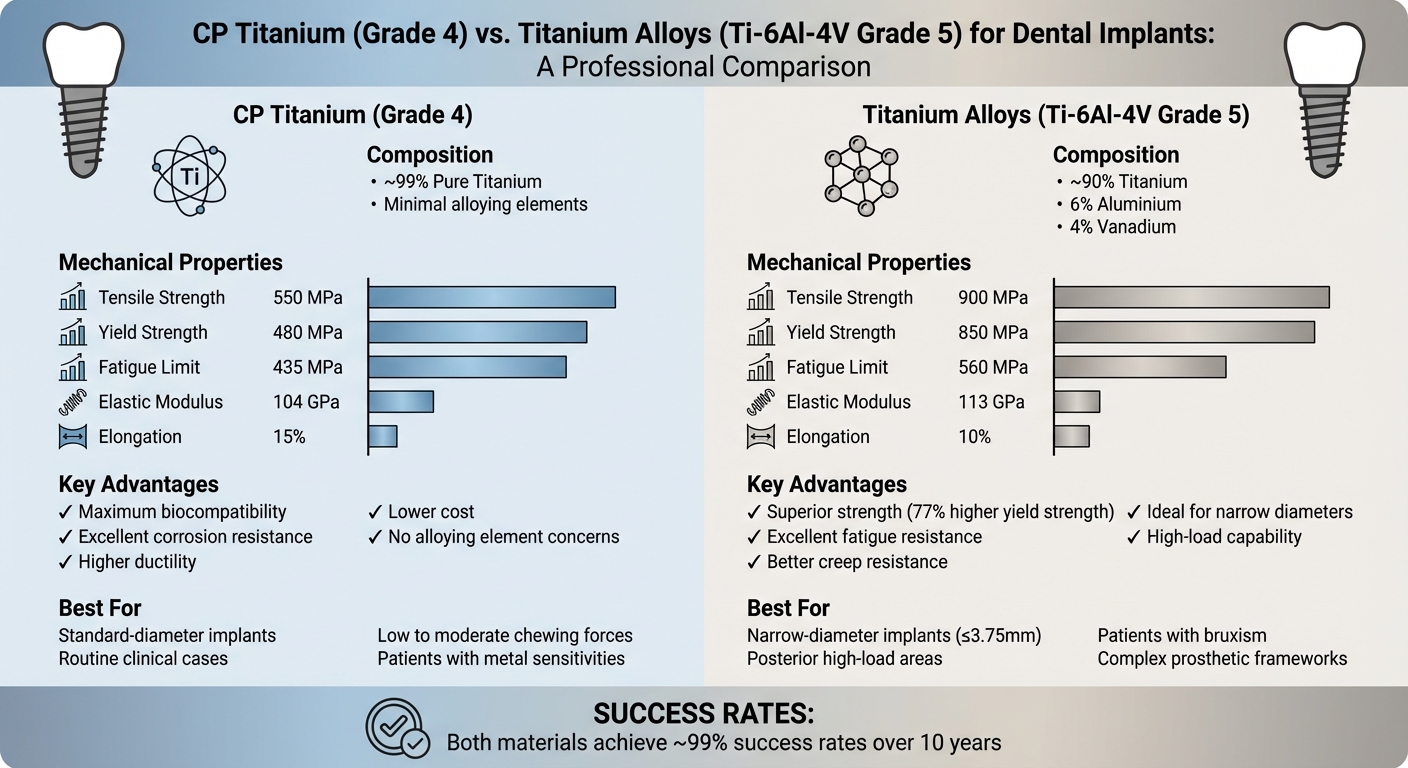
CP Titanium vs Titanium Alloys Comparison Chart for Dental Implants
What is Commercially Pure (CP) Titanium?
Commercially Pure Titanium, or CP Titanium, is a transition metal with a purity level of around 99% titanium [2]. Unlike titanium alloys like Ti-6Al-4V – composed of approximately 90% titanium, 6% aluminium, and 4% vanadium – CP Titanium doesn’t include significant alloying elements [2]. This high level of purity makes it an excellent choice for dental applications, where biocompatibility is crucial.
CP Titanium is classified into four grades (1 through 4), determined by the levels of trace elements such as oxygen and iron [8][9]. These elements influence the material’s strength and ductility. For example, Grade 1 has about 0.18% oxygen, offering the highest ductility (25% elongation), while Grade 4 has approximately 0.40% oxygen and delivers the highest strength (550 MPa tensile strength) [2][9]. This range allows clinicians to choose the grade that best suits specific clinical needs.
The microstructure of CP Titanium is made up entirely of the α (alpha) phase, which has a hexagonal close-packed crystal lattice. This structure remains stable at temperatures below 883°C [9]. Additionally, CP Titanium naturally forms an oxide layer that enhances its corrosion resistance and supports osseointegration by absorbing calcium and phosphate ions from the surrounding bone [9].
Properties of CP Titanium
Among the pure grades, Grade 4 CP Titanium is the most commonly used for dental implants due to its excellent mechanical properties. As John W. Nicholson from Queen Mary University of London states, "Grade 4 cp-Ti, with the highest oxygen content (around 0.4%) and best overall mechanical strength… is most widely used for dental implants" [2]. Below is a summary of the mechanical properties across all four grades:
| Property | Grade 1 | Grade 2 | Grade 3 | Grade 4 |
|---|---|---|---|---|
| Oxygen Content (max) | 0.18% | 0.25% | 0.35% | 0.40% |
| Tensile Strength (MPa) | 240 | 340 | 450 | 550 |
| Yield Strength (MPa) | 170 | 275 | 380 | 480 |
| Elongation (%) | 25% | 20% | 18% | 15% |
The elastic modulus of CP Titanium falls between 102 and 104 GPa, which is much closer to human bone (10–30 GPa) compared to materials like stainless steel [2][9]. This helps reduce stress shielding, though the difference in modulus can still pose challenges in load distribution. CP Titanium also boasts exceptional corrosion resistance, with Grade 1 performing best due to its higher purity. However, all grades exhibit excellent durability in the oral environment [9].
These properties make CP Titanium a preferred material for various dental applications.
Uses in Dental Practice
Grade 4 CP Titanium is widely used for standard dental implants designed to handle low to moderate chewing forces [2][8]. Its combination of strength and biocompatibility makes it suitable for single-tooth replacements and multi-unit restorations in routine clinical cases. Additionally, CP Titanium is commonly employed for abutments (which connect implants and crowns), frameworks for fixed prostheses, and maxillofacial reconstruction plates [11][4].
Grades 1, 2, and 3, on the other hand, are generally too soft for most intraoral applications due to their lower mechanical strength and fatigue resistance [7]. However, Grade 4 strikes a balance between durability and ease of machining, making it a practical choice for standard implant manufacturing [7]. That said, its limitations become evident in scenarios requiring extreme wear resistance or in small-diameter implants, where higher strength-to-volume ratios are necessary [10].
What are Titanium Alloys?
Titanium alloys are created by blending titanium with other elements to improve its mechanical properties. In dentistry, the most commonly used alloy is Ti-6Al-4V (Grade 5), which consists of approximately 90% titanium, 6% aluminium, and 4% vanadium. These added elements alter the alloy’s crystal structure, enhancing its ability to handle stress.
Each element in the alloy plays a specific role. Aluminium acts as an α-stabiliser, boosting strength while keeping the material lightweight. Vanadium, on the other hand, is a β-stabiliser that helps form a dual-phase microstructure (α+β). This combination delivers a balance of strength, flexibility, and resistance to fatigue that surpasses commercially pure (CP) titanium [8][10]. Another variation, Grade 23 ELI (Extra Low Interstitial), is a purer form of Ti-6Al-4V with stricter limits on elements like oxygen, carbon, nitrogen, and hydrogen [8]. This refined version offers improved ductility and fracture toughness while maintaining the high strength of Grade 5. These qualities make titanium alloys a standout choice for demanding applications.
Properties of Titanium Alloys
The unique composition of titanium alloys directly contributes to their impressive mechanical properties. For instance, Ti-6Al-4V (Grade 5) has a yield strength of about 850 MPa – nearly double the 480 MPa of Grade 4 CP titanium [2][8]. Its ultimate tensile strength is around 900 MPa, compared to 550 MPa for Grade 4 CP titanium [2][5]. This makes it ideal for situations where CP titanium might fail under pressure.
Fatigue resistance is another major benefit. Grade 5 titanium has a fatigue endurance limit of approximately 560 MPa, significantly higher than the 435 MPa of Grade 4 CP titanium [10]. This is particularly important for dental implants, which endure millions of chewing cycles throughout their lifetime. Additionally, its excellent creep resistance ensures long-term stability in implant-abutment connections [8].
"Titanium alloy grade 5 provides greater strength than CP-Ti grade 4, and the selection of implants fabricated from this metal over those implants made of CP-Ti should be considered a clinical improvement."
- Gregori M. Kurtzman, DDS [8]
The elastic modulus of Ti-6Al-4V is around 110–113 GPa, which is significantly lower than materials like stainless steel (about 180 GPa) or cobalt–chromium alloys (approximately 210 GPa) [2][11]. While this alloy sacrifices some ductility – showing an elongation at failure of around 10% compared to 15% for Grade 4 CP titanium [2] – its other strengths more than compensate for this trade-off.
Here’s a quick comparison of key properties between CP Titanium (Grade 4) and Ti-6Al-4V (Grade 5):
| Property | CP Ti (Grade 4) | Ti-6Al-4V (Grade 5) |
|---|---|---|
| Titanium Content | ~99% | ~90% |
| Yield Strength | 480 MPa | 850 MPa |
| Tensile Strength | 550 MPa | 900 MPa |
| Fatigue Limit | 435 MPa | 560 MPa |
| Elastic Modulus | 104 GPa | 113 GPa |
| Elongation at Failure | 15% | 10% |
These superior mechanical properties make titanium alloys a preferred choice for applications requiring high strength and fatigue resistance.
Uses in Dental Practice
Titanium alloys excel in clinical scenarios where mechanical performance is critical. They are often the material of choice for narrow-diameter implants, as CP titanium may be more prone to fractures under such conditions [8]. For patients with heavy occlusal loads – like those with bruxism or requiring long-span bridges – the added strength of Grade 5 titanium offers an extra layer of safety against implant failure [8][10].
The alloy’s resistance to creep is another advantage, ensuring the implant-abutment connection remains stable over time. This reduces the risk of loosening or micro-movement, which could compromise the restoration [8]. Titanium alloys are also commonly used for complex prosthetic frameworks and in the posterior regions of the mouth, where chewing forces are highest [2][8].
Clinical studies show that implants made from Ti-6Al-4V achieve success rates of up to 99% over 10 years, similar to those of CP titanium [2]. While the alloy releases trace amounts of aluminium and vanadium, these levels are well below toxic thresholds and do not interfere with osseointegration [2]. This combination of mechanical strength and biocompatibility makes titanium alloys indispensable for demanding dental applications where CP titanium might fall short.
CP Titanium vs Titanium Alloys: Direct Comparison
This section compares the key characteristics of CP titanium and titanium alloys, focusing on their mechanical properties, biological performance, and durability in clinical settings.
Mechanical Properties Comparison
CP titanium and titanium alloys like Ti-6Al-4V (Grade 5) show notable differences in mechanical strength. For instance, Ti-6Al-4V boasts a yield strength of approximately 828 MPa, significantly higher than CP titanium Grade 4’s 483 MPa. Similarly, its tensile strength reaches around 895 MPa, compared to 550 MPa for CP titanium[2][5]. This increased strength makes Ti-6Al-4V particularly suited for implants subjected to heavy occlusal forces.
Here’s a breakdown of their mechanical properties:
| Property | CP Titanium (Grade 4) | Ti-6Al-4V (Grade 5) | Grade 23 ELI |
|---|---|---|---|
| Tensile Strength | ~550 MPa | ~895 MPa | ~860 MPa |
| Yield Strength | ~485 MPa | ~795 MPa | ~795 MPa |
| Elongation | ~15% | ~10% | ~15% |
| Elastic Modulus | ~105 GPa | ~114 GPa | ~114 GPa |
| Fatigue Resistance | Moderate | High | High |
While CP titanium offers better ductility, Ti-6Al-4V outperforms it in fatigue resistance. For example, the fatigue endurance limit of Ti-6Al-4V is around 560 MPa, compared to 435 MPa for CP titanium. These differences play a crucial role in applications requiring long-term durability under stress.
Biocompatibility and Bone Integration
Both materials excel in biological performance, achieving similar levels of osseointegration. Clinical studies report success rates of nearly 99% over a decade for both CP titanium and Ti-6Al-4V implants[2]. When surface treatments are equivalent, the bone’s response – measured by bone-to-implant contact and biomechanical anchorage – is nearly identical for both materials[5].
"Both alloys are biocompatible in contact with bone and the gingival tissues, and are capable of undergoing osseointegration." – John W. Nicholson, Bluefield Centre for Biomaterials[2]
The key difference lies in their composition. CP titanium, being about 99% pure titanium, is free from alloying elements, while Ti-6Al-4V includes small amounts of aluminium and vanadium. Although concerns exist about aluminium’s potential neurotoxicity and vanadium’s cytotoxic or allergic effects, the levels released from implants are well below harmful thresholds[10][2]. CP titanium is often the material of choice for patients requiring maximum biocompatibility, particularly those with sensitivities.
Corrosion Resistance and Longevity
Corrosion resistance is another critical factor for implant longevity. Both materials form a protective titanium dioxide (TiO₂) layer, providing excellent resistance against corrosion. However, CP titanium’s single-phase structure gives it a slight edge over the dual-phase structure of Ti-6Al-4V, which can be more susceptible to micro-galvanic corrosion[2][4].
The oral environment, with its low pH, fluoride exposure from dental products, and potential contact with other metals, presents challenges for both materials[6][4]. Ti-6Al-4V’s superior strength, however, enhances its resistance to fatigue and fracture, particularly in narrow-diameter implants or high-load scenarios[10][2]. On the other hand, CP titanium is more prone to creep – permanent deformation under prolonged stress – which may lead to issues like abutment loosening, especially in external hex connections[8].
Despite these differences, both materials show exceptional long-term performance, with survival rates exceeding 98% over 10 years under typical conditions[2]. These attributes underline their reliability in high-load clinical applications.
sbb-itb-2be92ed
Choosing the Right Material for Dental Implants
Picking between CP titanium and titanium alloys for dental implants isn’t a one-size-fits-all decision. It depends on factors like the patient’s bone density and the specific demands of the implant site. Each material has its strengths, and understanding these can help match the right option to each clinical scenario. Let’s dive into what sets these materials apart.
CP Titanium: Pros and Cons
CP titanium, especially Grade 4, is often the go-to choice for dental implants. Why? Its nearly pure titanium composition makes it highly biocompatible, significantly reducing the risk of releasing alloying elements like aluminium or vanadium [10][3]. It’s also known for its ductility, with about 15% elongation [5], and it’s generally more budget-friendly than titanium alloys – perfect for standard implant cases.
But CP titanium isn’t without its downsides. Its lower tensile strength means it’s not ideal for high-stress areas or narrow-diameter implants [5][10]. If the implant diameter is 3.75 mm or less, there’s a higher chance of fatigue fractures [3][10].
Titanium Alloys: Pros and Cons
Titanium alloys, such as Ti-6Al-4V (Grade 5) and Ti-15Zr (Roxolid), are built for strength. With tensile strengths ranging from 895 to 1,000 MPa, these materials excel in fatigue resistance [10][2]. This makes them a great choice for narrow-diameter implants, high-load posterior areas, or specialised components [7][1]. Their strength also allows for more conservative designs when space is limited.
However, titanium alloys come with a few trade-offs. While biocompatibility remains high, the presence of aluminium and vanadium raises minor concerns, even though the release levels are well below harmful thresholds [10][2]. Some patients may experience type IV hypersensitivity reactions, such as eczema or dermatitis [6][3]. Cost is another factor – titanium alloys are pricier than CP titanium, which might influence treatment decisions.
What Dentists Should Keep in Mind
Beyond the material properties, clinical factors play a big role in choosing the right implant. The implant’s location and the forces it will endure are critical considerations. For standard-sized implants in areas with moderate chewing forces, CP titanium Grade 4 is a reliable option, boasting success rates of nearly 99% over 10 years [2]. On the other hand, for posterior molars or narrow-diameter implants, high-strength alloys like Ti-6Al-4V or Ti-15Zr are better suited to minimise the risk of fractures [7][1].
Patient history is another key factor. Screening for metal sensitivities is important, especially when considering alloys containing aluminium or vanadium. While titanium hypersensitivity is rare, it’s still worth evaluating. For patients with known sensitivities, CP titanium or newer Ti-Zr alloys may be safer choices [1][3].
Environmental factors also matter. High fluoride exposure or acidic oral conditions can speed up corrosion [6][12]. In these cases, CP titanium’s single-phase structure offers slightly better corrosion resistance compared to the dual-phase structure of Ti-6Al-4V [2][4].
"There is no single ‘best’ grade of titanium for all clinical scenarios. Biological outcomes are more influenced by surface treatment, surgical protocol, and patient-specific risk factors than by small differences in alloy content." – MSDI Dental [7]
Anatomical constraints further guide material selection. Patients with narrow ridges needing small-diameter implants benefit from the superior mechanical strength of titanium alloys, which maintain durability even with reduced cross-sections [1]. Meanwhile, patients with thin gingival biotypes might experience a greyish tint around titanium implants, prompting the use of ceramic-coated abutments for better aesthetics [1].
Lastly, cost is always a consideration. While titanium implants are generally more affordable than ceramic ones (around $300 less per implant), titanium alloys do come at a premium over CP titanium. Balancing the clinical benefits with the cost is crucial – investing in a stronger alloy may save on complications down the line in high-risk areas.
Conclusion
Choosing between CP titanium and titanium alloys involves weighing their strength and biocompatibility. CP titanium, especially Grade 4, stands out in standard cases due to its nearly pure composition and proven long-term reliability [2]. Its purity eliminates concerns about releasing alloying elements like aluminium or vanadium, making it a dependable option.
On the other hand, titanium alloys such as Ti-6Al-4V and Ti-Zr excel in scenarios that demand higher strength. With tensile strengths reaching approximately 900 MPa compared to CP titanium’s 550 MPa [2], these alloys are ideal for narrow-diameter implants and high-load posterior areas where fracture risks are higher. However, this added strength comes with a slight compromise in biocompatibility.
"The alloys cpTi and Ti-6Al-4V are highly satisfactory materials, and there is little scope for improvement as far as dentistry is concerned." – John W. Nicholson, Dental Materials Unit, Queen Mary University of London [2]
Ultimately, the choice of material depends on the specific clinical requirements.
Key Takeaways
Both CP titanium and titanium alloys deliver excellent results when used in the right context. CP titanium Grade 4 is best for standard implant cases, offering outstanding corrosion resistance. Titanium alloys, however, are crucial for small-diameter implants (3.75 mm or less), patients with parafunctional habits like bruxism, or posterior sites that endure heavy chewing forces.
Patient-specific factors are equally important. Screening for metal sensitivities is essential, especially when using alloys with aluminium or vanadium. Additionally, environmental factors such as fluoride exposure or acidic oral conditions can impact the protective titanium dioxide layer. In the end, the success of an implant relies on a combination of material choice, surface treatment, surgical precision, and patient-specific considerations.
FAQs
What makes CP Titanium a good choice for dental implants?
Commercially Pure (CP) Titanium is widely used in dental implants because it works incredibly well with natural bone tissue. Its ability to bond with bone, known as biocompatibility, makes it a standout choice for long-term success in dental procedures.
One of its key advantages is its resistance to corrosion, which comes from a protective titanium oxide layer. This layer shields the material from environmental damage, ensuring implants remain durable over time.
On top of that, CP Titanium boasts a high strength-to-weight ratio. This means it’s both lightweight and strong, providing the mechanical stability needed for dental implants without adding unnecessary weight. These qualities make it a dependable option for creating implants designed to meet specific patient requirements.
What are the advantages of titanium alloys compared to commercially pure (CP) titanium in dental implants?
Titanium alloys, like Ti‑6Al‑4V, are often chosen for dental applications because of their superior strength and fatigue resistance. These qualities make them especially suitable for high-stress areas, such as molars, or for narrower implants where durability is essential. While they typically cost more than CP titanium, their mechanical advantages often make them a worthwhile investment for long-term use.
On the other hand, CP titanium is softer and more pliable, making it a better fit for applications that don’t demand as much strength. Deciding between the two depends on the specific needs of the implant and the patient. It’s always best to discuss options with your dental professional to find the material that’s right for your treatment.
Can the elements in titanium alloys pose any health risks?
Titanium alloys are often praised for their biocompatibility, making them a popular choice in medical and dental fields. However, some alloying elements, such as aluminium and vanadium, can gradually release ions. For a small number of people, this might lead to allergic reactions or minor cytotoxic effects.
If you’re concerned about how materials might interact with your body, it’s worth discussing alternatives with your dental professional. One option could be commercially pure titanium, which is free from alloying elements and might be a better fit for certain individuals.
Related Blog Posts
- How Titanium Grades Affect Implant Surface Modifications
- Ti-6Al-4V Alloy: Composition and Implant Use
- Emerging Titanium Alloys for Dental Implants
- Titanium vs Zirconia: Wear Resistance Comparison
Important Notice: Any surgical or invasive procedure carries risks. Before proceeding, you should seek a second opinion from an appropriately qualified health practitioner.
Individual results may vary. The information provided in this article is for educational purposes only and does not constitute medical advice.
Checkout Related Blogs




Get in touch with us
For more information, call us now to start feeling better. Or fill the form below to make appointment
The Latest News from Complete Smiles
How to Clean Clear Plastic Retainers
Checklist for Choosing Wearable Dental Devices
Checklist for Choosing Cloud AI Platforms in Dentistry

Complete Smiles Bella VistaAccepts All Major Health Funds, Including





