





How AI Optimises Invisalign Treatment Plans

AI is transforming Invisalign treatment planning by improving accuracy, reducing treatment times, and enabling remote monitoring. Here’s a quick summary of how it works:
- Precision: AI analyses millions of cases to predict tooth movements with up to 93.94% accuracy, outperforming manual methods.
- Efficiency: Treatment durations are shortened by an average of 4.3 months, with 20% fewer aligners needed.
- Remote Monitoring: AI-powered apps let you track progress from home, cutting unscheduled visits by 28%.
- Customisation: Aligners are tailored to your unique dental structure, using advanced 3D scans and simulations.
Clinics like Complete Smiles Bella Vista use AI tools like ClinCheck and smartphone apps to offer more accurate treatment plans and better patient experiences. Costs range from $3,500 to $9,500 AUD, depending on case complexity. AI doesn’t replace orthodontists but enhances their ability to deliver precise, efficient care.
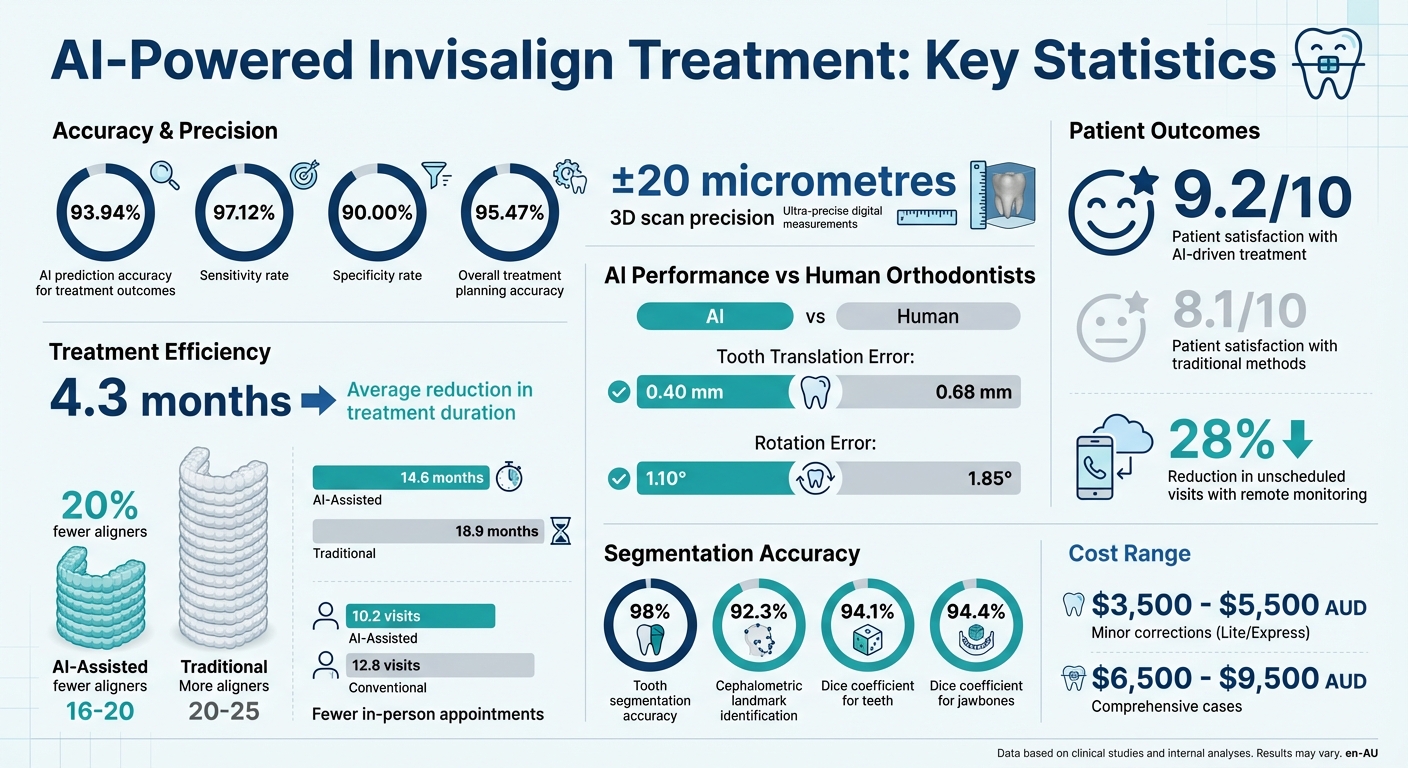
AI-Powered Invisalign Treatment Benefits: Key Statistics and Outcomes
How AI Analyses 3D Dental Scans
Moving from Traditional Impressions to Digital Scanning
The days of traditional physical dental impressions are quickly fading. Modern intraoral scanners, like the iTero Lumina and iTero Element 5D, can capture detailed 3D images of your teeth in just minutes. This shift not only cuts down on the discomfort and gagging often associated with older methods but also provides highly accurate data – up to ±20 micrometres of precision. Such accuracy ensures fewer repeat scans and a better fit for aligners, giving AI the exact data it needs to create a precise baseline model [6].
These scanners go beyond just surface-level imaging. Advanced systems combine data from multiple sources, including intraoral scans, cone-beam CT (CBCT), and 3D facial images, to produce a complete digital model of your oral anatomy [1]. This comprehensive approach surpasses the limitations of traditional 2D X-rays by offering a detailed view of both tooth crowns and roots. For orthodontists, this means a clearer understanding of your unique dental structure before any treatment begins.
Building Accurate Baseline Models
After capturing the scan, AI algorithms get to work, segmenting individual teeth and jawbones from the digital data. Tools like iMeshSegNet achieve impressive results, with 98% accuracy in tooth segmentation and a 92.3% success rate for identifying cephalometric landmarks within a 2-millimetre margin of error. The Dice coefficients – 94.1% for teeth and 94.4% for jawbones – highlight the precision of these models [1] [3]. This level of accuracy eliminates the inconsistencies that can arise with manual tracing.
The baseline model created from the 3D mesh data becomes the foundation for simulating tooth movements. Invisalign’s ClinCheck software uses this detailed reference to calculate the optimal force required for each tooth adjustment, tailoring the treatment to your specific dental anatomy [6]. With data from over 18 million smiles worldwide, the software is trained to recognise a wide range of tooth shapes, bite patterns, and jaw movements. This allows orthodontists to plan even the smallest adjustments, reducing the chances of complications and cutting down on the need for mid-treatment corrections.
sbb-itb-2be92ed
AI Simulations for Predicting Tooth Movements
Comparing Multiple Treatment Paths
Machine learning is transforming orthodontics by analysing data from a staggering 12.8 million cases to identify patterns that align with your unique dental profile [8]. By examining factors like tooth shape, bite alignment, jaw movement, and crowding, these algorithms match your case to similar ones with proven outcomes.
The system goes a step further by integrating data from multiple sources – 3D intraoral scans, cone-beam CT imaging, and facial photographs. This ensures that planned tooth movements complement your overall facial structure [5]. To make things even more precise, the technology assigns a complexity score to your case, flagging any severe bite or crowding issues that might need extra attention or extend the treatment timeline [2]. For instance, a study of 657 patient records showed that the XGBoost machine learning model could predict Invisalign treatment outcomes with 93.94% accuracy. It also achieved a sensitivity of 97.12% and a specificity of 90.00% – numbers that highlight just how reliable these predictions are [4].
Showing Results with Predictive Modelling
Predictive modelling turns all that data into visual simulations that make your treatment plan easy to understand. Tools like the Invisalign Outcome Simulator Pro, introduced in May 2022 for iTero Element Plus scanners, bring your treatment to life by combining a 3D simulation of your teeth with an actual photograph of your face [8].
These simulations don’t just stop at showing how your teeth will look – they also predict key facial parameters like philtrum height, smile width, commissure height, and buccal corridors [7]. Interestingly, clinical studies reveal that post-treatment results can sometimes surpass the AI’s initial predictions, delivering even better smile arcs and tooth display [7]. On top of that, the software estimates how long your treatment will take by comparing your case to similar ones already completed. This gives you a clear idea of what to expect before your first aligner is even made [2]. These visualisations play a crucial role in fine-tuning aligner sequences, ensuring your treatment plan is as efficient and effective as possible.
How AI Optimises Aligner Sequences
Customising Each Aligner Configuration
AI transforms the way aligners are designed by tailoring each one in your treatment plan. It uses a compensation protocol that recalibrates the aligner’s design based on simulated tooth movements. For example, if a planned movement is 0.25 mm but the actual movement is 0.19 mm, the AI adjusts accordingly [9].
Through Finite Element Method simulations, the system models how teeth respond to forces, allowing precise adjustments to mechanical pressure. This ensures gradual tooth movement while minimising side effects like tipping or extrusion. Studies show this method can limit unintended tooth tipping to 1° or less, compared to over 6° with traditional planning techniques [9][10].
The software also takes into account your specific dental features – like bone density, tooth shape, and crowding levels – to optimise the placement of attachments, precision cuts, and interproximal reduction. Additionally, Artificial Neural Networks predict the likelihood of pain (87.7%) and anxiety (93.4%) based on the aligner’s design [11][12].
Shortening Treatment Duration
AI-driven aligner sequences are designed to significantly cut down treatment time. Research indicates that AI-assisted planning reduces the overall treatment by an average of 4.3 months and decreases the number of aligners needed by 20% [10][12].
The secret lies in maintaining consistent movement efficiency throughout the treatment. Unlike traditional methods, which often lose efficiency (dropping to around 12% accuracy) in later stages, AI systems adapt continuously to ensure high performance [9]. This consistency also reduces the need for refinement scans, which can otherwise extend treatment by an average of 5.1 months [9].
This adaptive approach not only shortens treatment time but also sets the stage for improved real-time monitoring and adjustments.
Real-Time Monitoring and Adjustments with AI
Remote Progress Tracking with AI
Tracking Invisalign progress between appointments is now more precise, thanks to AI-powered monitoring tools. With the My Invisalign App and the Invisalign Lens attachment, you can capture clear images every time you switch aligners [13][14]. The AI analyses these images, measuring the "aligner spaces" – the gaps between your teeth and the aligner – to confirm whether your treatment is on track [13][15].
Within about an hour of submitting your photos, the system provides automated feedback, letting you know if you can move to the next aligner, need to stay on the current one, or should consult your orthodontist [13][14]. This streamlined process ensures accurate monitoring of your treatment, even remotely [13][15]. For instance, in September 2022, Dr. David R. Boschken from Los Altos, California, used the Virtual Care AI platform to monitor over 1,000 Invisalign patients. This allowed him to focus on cases with flagged issues rather than routine updates [13].
"Virtual Care AI provides [patients] the opportunity to become more active participants in their treatment journeys and allows them to visualise first-hand how their teeth are tracking." – Dr. Regina Blevins, Orthodontist at Minnesota Orthodontics [14]
These timely updates help ensure that any necessary adjustments are made without delay.
Updating Plans as Treatment Progresses
AI doesn’t just monitor progress – it also identifies when your treatment needs intervention. By setting custom thresholds (e.g., aligner spaces under 0.75 mm as good, over 1.5 mm as poor), the system can flag deviations that require attention [15]. When irregularities are detected, these "tracking exceptions" are highlighted for review, allowing your orthodontist to address potential issues before they lead to significant delays [13][15].
This proactive approach means your orthodontist can adjust your aligner schedule or recommend an unscheduled visit to keep your treatment on track. These real-time updates work hand-in-hand with earlier AI simulations, creating a treatment plan that evolves based on how your teeth are actually moving. It’s a flexible system designed to adapt to your unique progress, ensuring smoother and more efficient results.
Main Benefits of AI in Invisalign Treatment Planning
Better Accuracy and Predictability
AI has brought a new level of precision to Invisalign treatment planning. With accuracy reaching an impressive 95.47%, AI systems achieve this by analysing millions of cases [10]. A 2025 study comparing AI predictions with those of board-certified orthodontists revealed that AI consistently outperformed human predictions. For instance, AI had an error rate of just 0.40 mm for tooth translation, compared to 0.68 mm for humans, and 1.10° for rotation, versus 1.85° for human estimates [17]. Accuracy also varies by tooth type, with incisors achieving the best results at 92.3%, followed by premolars (90.5%), canines (89.7%), and molars (88.1%) [17].
By combining 3D imaging, X-rays, and CBCT data, AI creates a highly detailed digital replica of your teeth. This approach enables earlier and more accurate detection of potential issues, such as external root resorption or periodontal complications, ensuring safer and more predictable treatment outcomes [1].
Personalised and Efficient Treatment Plans
AI tailors treatment plans to each patient by simulating how their teeth will respond based on factors like bone density and structure [1][10]. This level of personalisation translates into real-world time savings. AI-assisted treatments typically take 14.6 months, compared to 18.9 months for traditional methods. Additionally, patients require roughly 20% fewer aligners, making the process more efficient [10].
AI also leverages historical data to predict the complexity of a case and flag potential refinements early on [2]. This reduces the likelihood of unexpected adjustments, streamlining the journey to the final result. The end result? A smoother, more efficient treatment process that benefits both patients and clinicians.
Better Patient Experience
AI doesn’t just improve clinical outcomes; it enhances the overall patient experience. Those undergoing AI-driven treatment report satisfaction scores of 9.2 out of 10, compared to 8.1 for those using traditional methods [10]. Patients also spend less time in the dental chair, with AI-assisted cases requiring an average of 10.2 visits, compared to 12.8 visits for conventional treatments [10].
Convenience is another major advantage. With remote monitoring tools, patients can track their progress from home using smartphone apps. Features like Invisalign SmileView allow users to visualise their potential results before starting treatment, which can be a powerful motivator and helps set realistic expectations [2][16].
"AI acts as an intelligent clinical assistant… which can reduce treatment time, optimise outcomes, and minimise human error in clinical decision-making. This ultimately enhances the overall efficiency of orthodontic workflows… and improves patient satisfaction." – Xuanchi Guo and Yuhan Shao, Frontiers in Dental Medicine [1]
New AI technologies that will improve how you use Invisalign clear aligners
How Complete Smiles Bella Vista Uses AI for Invisalign

Complete Smiles Bella Vista, under the guidance of Dr. James Hanna, has embraced a forward-thinking, digital-first approach by incorporating AI technology into every stage of the Invisalign process. The clinic uses cutting-edge digital scanners to create detailed 3D images of patients’ teeth in just minutes, eliminating the need for old-fashioned putty impressions. These highly accurate scans serve as the foundation for AI-driven treatment planning.
Once the digital scans are complete, the clinic employs advanced AI software to design personalised treatment plans. A key tool in this process is the ClinCheck software, which taps into a global database of 18 million smiles to simulate potential outcomes using orthodontic simulators like the Outcome Simulator Pro. This AI-generated preview not only helps patients visualise their results but also provides a clear treatment plan for both the patient and the dentist.
To make the process even more convenient, the clinic uses AI to support ongoing monitoring. Patients can submit weekly scans of their teeth using a smartphone app, reducing the need for frequent in-office visits. The AI system compares these scans to the original 3D plan, identifying any alignment issues or oral hygiene concerns. This is particularly beneficial for busy individuals in Bella Vista, as it ensures consistent and precise care while saving time. Real-time feedback from the AI system allows for quick adjustments, seamlessly integrating with the clinic’s adaptive treatment model.
This AI-driven approach has led to impressive outcomes, including enhanced accuracy, streamlined treatment, and improved patient engagement. The clinic’s success is reflected in its 4.9 out of 5 rating on Google Reviews, with patients often highlighting the "high-tech approach" and "efficient treatment times." Costs for Invisalign treatments at Complete Smiles Bella Vista typically range from $3,500 to $5,500 AUD for minor corrections (Invisalign Lite/Express) and $6,500 to $9,500 AUD for more extensive cases.
For patients looking to make the most of this advanced approach, it’s recommended to request an AI-generated outcome simulation during the initial consultation. Additionally, committing to weekly photo uploads through the monitoring app ensures the AI system can maintain optimal tracking, speeding up the treatment process and allowing the clinic to step in promptly if adjustments are required.
Conclusion
AI has reshaped Invisalign treatment, turning it into a dynamic, data-informed process that adapts to how your teeth respond over time. By analysing millions of cases, AI can predict tooth movements with impressive precision, flag potential issues like root resorption early, and minimise unnecessary follow-ups. This approach, often called "Adaptive Orthodontics", ensures that your treatment plan evolves in real time, tailored to how your teeth are actually shifting.
These advancements deliver real benefits to your daily care. AI-powered apps enable remote monitoring, comparing in-office vs. remote monitoring to cut down on frequent clinic visits while still keeping your treatment on track. They can even detect early signs of gum inflammation, highlighting AI’s ability to enhance diagnostic accuracy. As Xuanchi Guo from Shandong University’s Department of Dental Medicine explains:
"AI will promote orthodontic diagnosis and treatment in the direction of more accuracy and personalisation and ultimately realise the dual innovation of clinical decision-making mode and patient management strategy" [1].
If you’re considering Invisalign, look for clinics that use adaptive AI systems for real-time adjustments. Practices offering AI-driven outcome simulators can help you visualise your results before starting, and those with remote monitoring tools provide added convenience. These technologies not only estimate treatment timelines more accurately but also support compliance through automated reminders – essential, as wearing aligners for 20–22 hours daily is key to success.
While AI plays a transformative role, your orthodontist remains indispensable. Rather than replacing their expertise, AI acts as a powerful assistant, enhancing clinical decisions and improving outcomes. This combination of cutting-edge technology and professional care sets a new benchmark in orthodontics, offering a treatment experience that’s more precise, efficient, and tailored to your needs.
FAQs
Is AI in Invisalign safe and reliable?
AI plays a critical role in Invisalign treatment planning, offering greater precision, predictability, and tailored solutions through data-driven approaches. These advancements enhance the overall treatment process, making it more efficient and customised to individual needs. However, to maintain its effectiveness and build trust, continuous clinical validation and open communication about its use are essential.
How does AI remote monitoring work at home?
AI-powered remote monitoring lets patients use a smartphone app to capture scans or photos of their teeth. The AI analyses these images to monitor treatment progress, while orthodontists review the results. This approach allows for timely adjustments, minimises the need for in-office visits, and facilitates regular virtual check-ins, making Invisalign treatment more convenient and streamlined.
Will AI reduce my treatment time and number of aligners?
AI has the potential to streamline Invisalign treatment by cutting down both the overall treatment time and the number of aligners needed. By enhancing the precision of treatment planning, AI allows for dynamic adjustments and more accurate progress tracking. This means orthodontic care can become more efficient and tailored to each individual’s needs.
Related Blog Posts
- Benefits of AI in Orthodontic Progress Tracking
- 5 Ways AI Shortens Orthodontic Treatment Time
- AI-Powered Aligners: Planning and Management
- Top 3 AI Innovations in Orthodontics
Important Notice: Any surgical or invasive procedure carries risks. Before proceeding, you should seek a second opinion from an appropriately qualified health practitioner.
Individual results may vary. The information provided in this article is for educational purposes only and does not constitute medical advice.
Checkout Related Blogs




Get in touch with us
For more information, call us now to start feeling better. Or fill the form below to make appointment
The Latest News from Complete Smiles
How to Clean Clear Plastic Retainers
Checklist for Choosing Wearable Dental Devices
Checklist for Choosing Cloud AI Platforms in Dentistry

Complete Smiles Bella VistaAccepts All Major Health Funds, Including





