





AI-Powered Aligners: Planning and Management
AI is transforming orthodontics by making aligner treatments faster, more precise, and less reliant on manual processes. Here’s what you need to know:
- Speed: AI-based tooth segmentation achieves 98% accuracy in under 7 seconds, compared to over 400 seconds for manual methods.
- Accuracy: Models predict paediatric mandibular growth with 85% accuracy, outperforming junior orthodontists at 54.2%.
- Efficiency: AI-powered remote monitoring reduces unscheduled visits by 28% and cuts in-office appointments by 33.1%.
- Customisation: AI combines CBCT scans, intraoral scans, and 3D imaging to create detailed treatment plans, reducing errors like root resorption or bone complications.
While AI reduces planning time and improves outcomes, challenges like high costs, data privacy concerns, and the need for clinician oversight remain. Dentists must balance AI outputs with professional judgement to ensure safe, effective care.
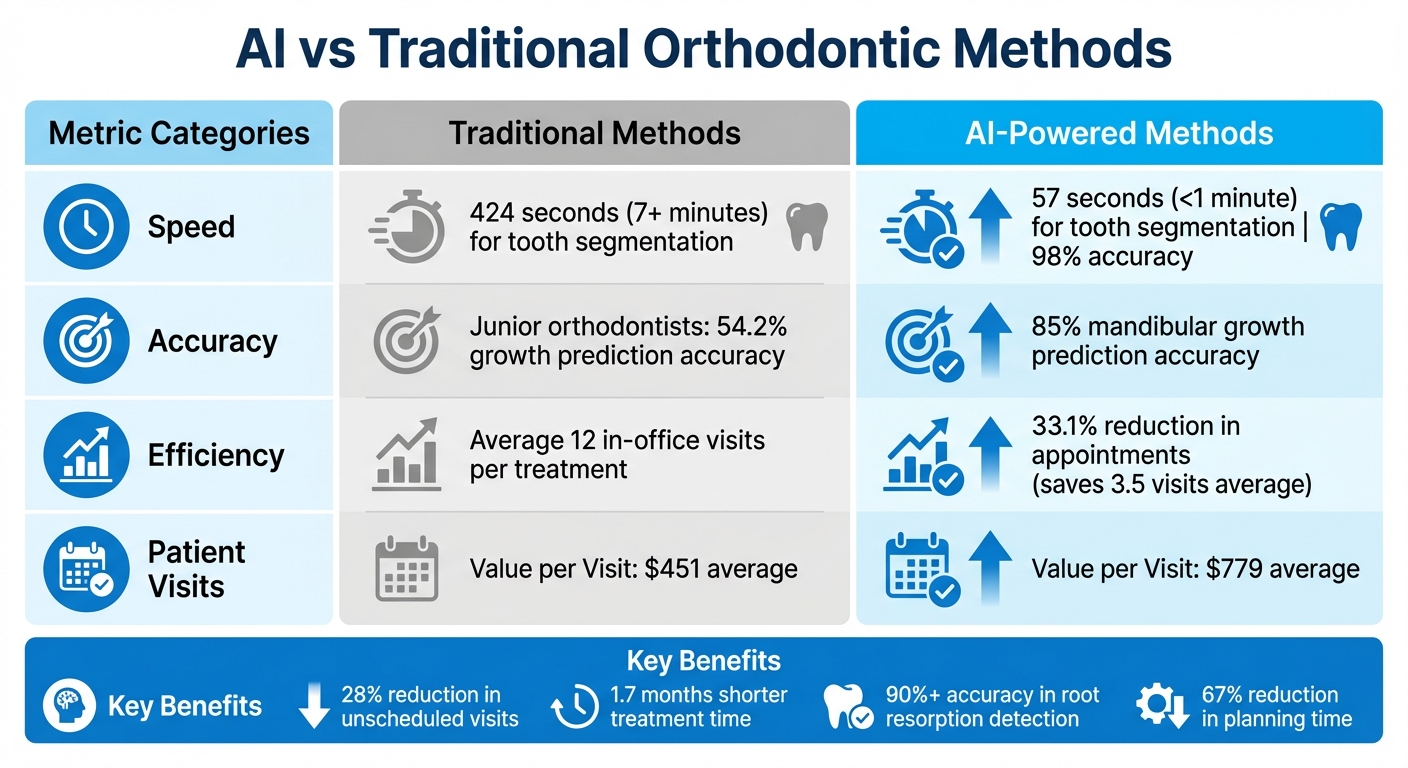
AI vs Traditional Orthodontic Methods: Speed, Accuracy, and Efficiency Comparison
How AI Is Revolutionizing Orthodontics: The Truth About AI and Braces
Problems with Traditional Clear Aligner Planning
Clear aligners boast an 80–90% success rate for mild to moderate cases [1]. However, the traditional planning process has several shortcomings that can affect treatment results. The main issue lies in manual landmark identification, which is not only labor-intensive but also prone to human error and variability among practitioners [5]. As highlighted in the Journal of Dentistry:
"Orthodontists still have to rely on their knowledge to identify cephalometric landmarks, which is time consuming, prone to human error and carries a high risk of observer variability." [5]
These limitations underscore the importance of precision at every stage, from initial planning to mid-treatment adjustments.
Treatment Planning Errors
One major flaw in traditional planning is the reliance on intraoral scans without integrating CBCT data. This omission leaves clinicians planning tooth movements without a clear view of root positioning within the alveolar bone [4]. The result? Potential complications like bone fenestration or dehiscence when roots are moved beyond safe boundaries.
Biomechanical errors further complicate matters. For instance, anterior retraction often leads to unintended lingual tipping of incisors or deepening of the bite [4]. Similarly, posterior teeth used as anchorage can experience mesial tipping, throwing off the entire treatment plan [4]. Another issue arises when aligners are designed for excessive movement in one stage – this can cause the plastic to deform, rendering it ineffective at applying the necessary orthodontic force [4].
Such errors don’t just affect outcomes; they also prolong the planning process.
Lengthy Planning Procedures
Traditional segmentation is a time drain, averaging 424.17 seconds, compared to just 57.73 seconds with AI-assisted methods [1][5]. However, the real bottleneck lies in the frequent need for plan refinements. Traditional methods often fail to account for biological variability or mechanical inefficiencies, leading to repeated scans and new aligner sets during treatment [2]. Movements like rotation and extrusion are particularly unpredictable, increasing the chances of teeth deviating from their programmed paths [4]. For example, while molar distalisation achieves about 88% predictability, off-tracking is still common enough to extend treatment timelines [4].
Difficulties with Monitoring and Adjustments
Traditional monitoring approaches are reactive, which means they often identify problems only after they’ve escalated. Issues like root resorption, for instance, may go unnoticed until significant damage has occurred [2]. With periodic assessments scheduled every 6–8 weeks, gradual deviations between appointments can snowball, derailing treatment progress [2].
This inefficiency impacts both patients and practitioners. Patients typically require an average of 12 in-office visits during aligner treatment [6], many of which could be avoided with better monitoring tools. For clinicians, these frequent visits offer less value per appointment – averaging $451 for traditional monitoring compared to $779 with AI-driven models [6]. Even more concerning is the risk of irreversible complications: external root resorption affects up to 66% of orthodontic patients [2], and limited monitoring capabilities often mean these issues go undetected until it’s too late.
AI Solutions for Aligner Planning and Design
AI-powered platforms are transforming traditional orthodontic workflows by automating tedious tasks and seamlessly integrating diverse data sources. This digital approach significantly reduces manual planning errors and provides a comprehensive view of dental structures. By combining CBCT (cone-beam computed tomography) and IOS (intraoral scans), these systems create detailed digital models of crowns and roots, allowing clinicians to visualise teeth in relation to the alveolar bone [1][2]. Below, we explore how AI is advancing root-based treatment planning and fully automated aligner design.
Interestingly, deep learning models have achieved a 92.3% success rate in placing cephalometric landmarks within a 2 mm error margin [2]. This level of precision helps minimise the variability often seen with manual methods.
Root-Based Treatment Planning with AI
AI has taken treatment planning to the next level by enabling root-level precision. TruRoot AI, for example, merges CBCT and IOS data to accurately map root movements [2][4]. This capability allows orthodontists to predict how roots will shift during treatment, reducing risks like bone fenestration. AI also excels at detecting root resorption, with over 90% accuracy, identifying subtle changes that might escape human detection. Additionally, it tracks jawbone remodelling over time without the need for repeated radiation exposure [2].
Automated Aligner Design Systems
Once root mapping provides the foundation for treatment planning, AI-driven design systems streamline the production of aligners. Advanced platforms automate the entire workflow, from correcting scans to exporting files for 3D printing [1][9]. A notable example is Invisalign Virtual Care AI, introduced by Align Technology in September 2022. This system integrates automated assessments and notifications directly into the Invisalign Doctor Site, harnessing data from 18 million smiles worldwide. It calculates the precise force needed for each tooth movement, stages these movements automatically, and places attachments to ensure an optimal sequence [7][8].
sbb-itb-2be92ed
AI-Powered Monitoring and Treatment Management
Once the aligner design is finalised, AI steps in to dynamically manage the treatment process. These platforms use data-driven methods to personalise treatment for each patient.
Real-Time Scanning and Progress Tracking
AI-driven monitoring leverages patient-submitted photos to keep tabs on tooth movement between in-person visits. Patients capture images of their teeth using compatible devices, and advanced deep learning algorithms analyse these images in about an hour [11][8]. The system then compares the photos to the original 3D digital treatment plan – often referred to as a "digital twin" – to confirm whether the teeth are shifting as planned [2][8].
A key part of this process involves measuring "aligner spaces", which helps evaluate how well the aligners fit. Dr David R. Boschken highlights this as a critical indicator of treatment progress [8]. Based on the analysis, patients receive automated updates advising them to either move to the next aligner, stay on their current one, or contact their orthodontist [11][8].
This method supports an "appointment-when-needed" model, where in-office visits are reserved for specific clinical needs rather than routine check-ins. Studies reveal that AI-powered remote monitoring can cut in-office appointments by 33.1%, saving patients an average of 3.5 visits [6]. These real-time insights also allow for immediate treatment adjustments when necessary.
Automated Adjustments to Reduce Treatment Time
Building on the real-time monitoring capabilities, AI facilitates treatment adjustments that respond to how the patient’s teeth are actually moving. Instead of following a rigid schedule, aligner changes are determined by progress. Machine learning helps predict when teeth might go off track, reducing unscheduled visits by 28% and shortening treatment times by an average of 1.7 months [2][6].
For example, Dr Audrey Chokron managed a challenging 22-month aligner case for a 35-year-old patient using 90 remote scans and AI-generated alerts. The system quickly identified issues like aligner unseating, enabling timely interventions and limiting in-office visits to just seven [6].
Benefits and Limitations of AI-Powered Aligners
Advantages of AI Integration
The integration of AI into aligner therapy is transforming the field by tackling longstanding inefficiencies. For instance, AI algorithms have achieved 98% accuracy in tooth segmentation and 97.3% cephalometric accuracy within 2mm, drastically reducing clinical variability [1][5]. These technological advancements also save a significant amount of time – automated tooth segmentation can now be completed in under 60 seconds, and overall treatment planning time is cut by 67% compared to manual approaches [1][5].
AI doesn’t just improve efficiency; it also enhances patient care by enabling early detection of complications like external root resorption and gingivitis, allowing for timely interventions [2].
Xuanchi Guo from Shandong University highlights the broader potential of AI in orthodontics:
"AI will promote orthodontic diagnosis and treatment in the direction of more accuracy and personalisation and ultimately realise the dual innovation of clinical decision-making mode and patient management strategy" [2].
For patients, the benefits are equally compelling. AI-powered aligners can reduce the need for frequent in-office visits, saving time and cutting down on travel costs. This efficiency also allows practitioners to handle larger caseloads without sacrificing the quality of care. Together, these improvements address many operational hurdles that have previously challenged the adoption of AI.
Challenges and Barriers to Adoption
While the advantages are clear, adopting AI-powered aligners comes with its share of challenges, both practical and regulatory. One of the biggest hurdles is the high upfront cost of AI-integrated scanners and software licences, which can be a barrier for smaller clinics [1][14]. Additionally, stringent data privacy requirements, such as compliance with the Privacy Act 1988 and the 13 Australian Privacy Principles, add to the administrative workload [1][14].
Another obstacle is the need for continuous staff training. Practitioners must stay updated on how to interpret AI outputs and understand the limitations of these tools [13][14]. The “black box” nature of some AI algorithms – where the decision-making process is not fully transparent – further complicates clinical verification [2]. Over-reliance on AI is another risk; practitioners must ensure they apply their clinical judgement to AI-generated recommendations. The Dental Board of Australia underscores this responsibility:
"The practitioner remains responsible for delivering safe and quality care and for ensuring their own practice meets the professional obligations set out in their Code of Conduct. Practitioners must apply human judgement to any output of AI" [14].
Here’s a summary of the main challenges faced by Australian practices:
| Challenge | Impact on Practice |
|---|---|
| High Initial Costs | Restricts access for smaller clinics; requires substantial financial investment [1] |
| Data Privacy & Compliance | Adds administrative complexity; requires adherence to Australian Privacy Principles and TGA regulations [14][10] |
| Training Requirements | Necessitates ongoing education and investment in staff development [14] |
| Algorithmic “Black Box” | Limits transparency and complicates clinical validation [2] |
| Over-Reliance on AI | Increases risk of errors if human judgement is not applied [14] |
Liability is another critical concern. Ultimately, the treating dentist – not the software provider – bears responsibility for the care delivered [15][14]. This highlights the importance of maintaining professional oversight and thoroughly verifying every AI-generated recommendation.
Conclusion and Future Outlook
AI is transforming orthodontic care by moving away from rigid, pre-planned methods to more flexible, responsive approaches that adapt in real time to patient-specific data. With tools now achieving up to 98% accuracy, tasks like segmentation, landmark detection, and treatment predictions have become far more efficient [1][2]. This progress is enabling a more proactive approach to care, identifying issues such as external root resorption early in the treatment process. These developments signal a new era in orthodontics, with exciting possibilities on the horizon.
The future of AI in orthodontics points towards integrating multiple data sources. By combining cone-beam CT, intraoral scanning, and 3D facial imaging, practitioners could create a comprehensive digital twin of each patient [2]. Additionally, deep reinforcement learning systems are expected to play a key role, enabling treatments to self-optimise by identifying deviations in tooth movement and suggesting real-time adjustments. Such advancements could lead to closed-loop systems that continuously refine care, potentially improving access to high-quality treatment in remote areas of Australia [12][14].
That said, there are hurdles to overcome. Issues like the lack of transparency in algorithms, the need to protect patient data, and the absence of standardised datasets remain significant barriers to widespread adoption [2][3][14].
The Dental Board of Australia underscores the importance of human oversight, stating that practitioners must apply their professional judgement to all AI-generated outputs and remain fully responsible for patient outcomes [14]. As AI continues to evolve, its integration into orthodontic care will require careful regulation to ensure that it enhances – rather than replaces – the clinical expertise that remains central to patient care. Striking this balance between innovation and accountability will be critical for the successful adoption of AI in everyday practice.
FAQs
How does AI enhance the precision of clear aligner treatment planning?
AI uses sophisticated deep-learning algorithms to process 3D scans, CBCT images, and facial data. By accurately predicting tooth movements and fine-tuning treatment stages, it helps design aligner plans that are precisely customised for each patient.
This technology simplifies the planning process, minimises errors, and boosts the efficiency of clear aligner treatments. It also enables dental professionals to achieve more consistent and personalised results, leading to better outcomes for patients.
What challenges come with using AI in orthodontics?
Adopting AI in orthodontics comes with its fair share of hurdles. One of the primary challenges is the issue of limited and non-generalisable training datasets. When AI systems are trained on restricted or overly specific data, their accuracy and reliability can take a hit, making them less effective in diverse clinical scenarios.
There’s also the matter of privacy and security concerns. Patient data is sensitive, and ensuring its protection while using AI tools is crucial. On top of that, a lack of transparency and accountability in algorithms can leave practitioners hesitant to rely on AI-driven recommendations, as the "why" behind the decisions isn’t always clear.
Another roadblock lies in the absence of standardised protocols for data collection and reporting. Without consistent methods, it’s tough to maintain uniformity across different practices. Finally, the need for more clinical trials stands out. To truly assess how these AI systems perform in practical, everyday use, rigorous testing is essential to meet the high standards required for patient care.
How does AI technology help reduce the need for frequent dental visits during aligner treatment?
AI-powered monitoring lets patients capture regular scans of their teeth from the comfort of home. These scans are analysed by advanced algorithms and reviewed by dental professionals, allowing dentists to monitor progress remotely and determine when an in-person visit is genuinely needed.
This method cuts down on routine check-ups, saving time for both patients and clinicians. It also ensures that any dental visits are targeted towards specific clinical concerns, making treatments more streamlined and convenient for patients.
Related Blog Posts
- Benefits of AI in Orthodontic Progress Tracking
- AI in Orthodontics: Diagnosis and Treatment Planning
- Ultimate Guide to Digital Orthodontic Systems
- AI in Orthodontics: What Patients Should Know
Important Notice: Any surgical or invasive procedure carries risks. Before proceeding, you should seek a second opinion from an appropriately qualified health practitioner.
Individual results may vary. The information provided in this article is for educational purposes only and does not constitute medical advice.
Checkout Related Blogs




Get in touch with us
For more information, call us now to start feeling better. Or fill the form below to make appointment
The Latest News from Complete Smiles
How to Clean Clear Plastic Retainers
Checklist for Choosing Wearable Dental Devices
Checklist for Choosing Cloud AI Platforms in Dentistry

Complete Smiles Bella VistaAccepts All Major Health Funds, Including





