





Ultimate Guide to Digital Orthodontic Systems

Looking for a better way to align teeth? Digital orthodontic systems are changing the game. By replacing manual methods with 3D scans, computer-guided treatment plans, and custom-made appliances, these systems make orthodontic care faster, more accurate, and more comfortable for patients. Key technologies include intraoral scanners, CBCT imaging, 3D treatment planning, and CAD/CAM systems for creating braces or aligners. Clinics in Australia, like Complete Smiles Bella Vista, are already using these tools to provide tailored care.
Highlights:
- Digital Scanning & Imaging: No more messy impressions – 3D scans are quick, precise, and easy to store.
- Virtual Treatment Planning: Simulate tooth movements and design appliances with millimetre-level precision.
- 3D Printing: Manufacture custom braces, aligners, and trays faster, often on-site.
- AI Monitoring: Track progress remotely using apps and AI for fewer in-person visits.
- Patient Benefits: Shorter treatment times, fewer appointments, and a more comfortable experience.
While these systems improve accuracy and efficiency, they require significant investment and rely on patient compliance. Not all cases are suitable, especially severe skeletal issues. However, for most, digital orthodontics offers a streamlined and precise approach to achieving a perfect smile.
Core Technologies in Digital Orthodontics
Digital Scanning and Imaging
In many Australian orthodontic practices, intraoral scanners have largely replaced the need for traditional alginate impressions. These scanners capture high-definition 3D models of teeth and gums in just minutes, eliminating the discomfort and gag reflex often associated with impression trays. The resulting digital models are not only detailed but also easy to store and retrieve, offering precise measurements for creating orthodontic appliances [2] [3]. Unlike physical moulds, these digital scans remain stable over time.
Cone beam computed tomography (CBCT) takes imaging a step further by producing volumetric 3D images of teeth, roots, jaws, temporomandibular joints, and even airways [1] [3] [4] [7]. This technology provides a level of detail that traditional 2D X-rays simply cannot match, revealing spatial relationships like root positions and bone thickness. CBCT is particularly useful for complex cases, such as impacted teeth, skeletal irregularities, or airway assessments. Modern CBCT protocols also ensure lower radiation exposure compared to conventional CT scans, making it a safer option.
3D facial imaging adds another layer by capturing soft-tissue contours, facial symmetry, and smile dynamics [1] [4]. When combined with dental scans and CBCT data, this imaging helps orthodontists create treatment plans that not only focus on tooth alignment but also consider facial aesthetics. In New South Wales, for instance, some clinics are integrating these digital tools to offer a combined orthodontic and cosmetic approach.
All these detailed digital records feed directly into advanced treatment planning systems, streamlining the entire process from diagnosis to execution.
Virtual Treatment Planning
Virtual treatment planning platforms bring together data from 3D scans, CBCT images, and facial imaging to create a comprehensive view of the patient’s dental and facial anatomy [1] [2] [3]. These systems allow clinicians to digitally segment individual teeth, simulate their movements in all directions, and plan treatment with precision. Computer-aided design (CAD) tools help manage critical elements like staging, anchorage, and attachment placement, all while ensuring that tooth movements stay within safe biological limits [1] [3].
Many platforms now incorporate AI-driven features that simplify the process. For example, they can automate tooth segmentation, recommend optimal arch forms, and provide treatment time estimates based on extensive datasets [1] [5] [6]. Visual simulations generated by the software not only aid in patient communication but also produce manufacturing files for creating appliances such as aligners, custom brackets, or indirect bonding trays.
A well-structured digital treatment plan details everything from initial and final tooth positions to the sequence and magnitude of movements. It also includes anchorage strategies, auxiliary components, and any necessary interproximal reduction or extractions. CBCT data ensures that factors like periodontal health and root proximity are accounted for, reducing the likelihood of mid-treatment adjustments and saving valuable chairside time [1] [2] [3] [4].
Once the plan is finalised, it transitions seamlessly into the next step: custom appliance fabrication through 3D printing.
3D Printing and Appliance Fabrication
After the digital treatment plan is complete, the designs are exported as printable files and sent to 3D printers. These printers construct appliances layer by layer using materials suited to orthodontic needs [1] [3]. In orthodontics, 3D printing is commonly used to create model casts for thermoforming clear aligners, direct-printed aligners using specialised resins, and indirect bonding trays for precise bracket placement. It’s also employed for fabricating custom occlusal splints, expanders, and other functional appliances. Some systems even have the capability to print brackets or bands.
This digital workflow offers several advantages. It significantly reduces turnaround times and supports in-house manufacturing, allowing practices to make quick revisions when needed. For Australian clinics, 3D printing can help manage laboratory expenses and simplify scheduling by enabling on-demand production. By integrating intraoral scanning with 3D printing, practices can minimise material waste and speed up production, ultimately delivering orthodontic appliances to patients more quickly and efficiently.
Advances in Fitting Techniques for Digital Braces
Digital Indirect Bonding
Digital indirect bonding has reshaped the way orthodontists place brackets on teeth. Rather than manually positioning each bracket, orthodontists now rely on digital models to virtually map out the exact height, angle, and rotation for each bracket. This method offers a level of precision that traditional techniques simply can’t match [2][3].
Once the bracket positions are set in the software, a 3D-printed transfer tray is created. During the bonding appointment, this tray is loaded with brackets, adhesive is applied, and the entire set is bonded to the teeth simultaneously [2][3]. This process ensures uniform placement across all teeth and significantly cuts down on chair time, as fewer adjustments are needed later. For Australian families balancing busy schedules, shorter appointments and fewer follow-ups can make orthodontic treatment much easier to manage. This precise placement also lays the groundwork for custom archwire adjustments tailored to each patient’s needs.
Custom Archwires and Robotic Bending
Once the digital treatment plan is finalised, its data is sent to a robotic bending system. These robots automatically shape archwires to match the planned arch form with incredible accuracy [1][3]. Every bend is carefully controlled, resulting in wires that deliver consistent forces, unlike those bent manually.
This pre-programmed wire design reduces the time needed for adjustments, allowing orthodontists to dedicate more time to diagnosis and monitoring [1][3]. For patients, this often translates to shorter review appointments and longer gaps between visits. This is particularly valuable for those living in regional or remote areas of Australia, where travelling to appointments can be a challenge. Combined with precise appliance designs, advancements like AI monitoring further optimise treatment by allowing progress to be tracked remotely.
AI-Enhanced Monitoring
AI technology is changing how patients monitor their orthodontic progress. Using a smartphone app, patients can upload images or videos of their teeth, which AI algorithms then analyse. These algorithms compare current tooth positions to the digital treatment plan and flag potential issues such as stalled movement, broken brackets, or poor elastic wear [5][6]. Based on this analysis, the software can determine whether an in-person visit is necessary or if the patient can safely move to the next stage.
This needs-based scheduling eliminates the rigid structure of fixed review intervals, ensuring patients are only called in when adjustments are genuinely required [5][6]. For Australian practices, this approach helps manage appointment schedules more efficiently and allows problems to be addressed earlier, avoiding delays that could arise between routine visits. Patients benefit from appointments that are more focused and often shorter, giving them the flexibility to fit treatment into their busy lives.
Together, these advancements improve treatment precision and reduce clinical time, highlighting how digital technology is transforming orthodontics today.
Next Generation Braces Are Here! Digital Custom Braces Explained by Dr. Robert Passamano
sbb-itb-2be92ed
Benefits, Limitations, and Patient Journey
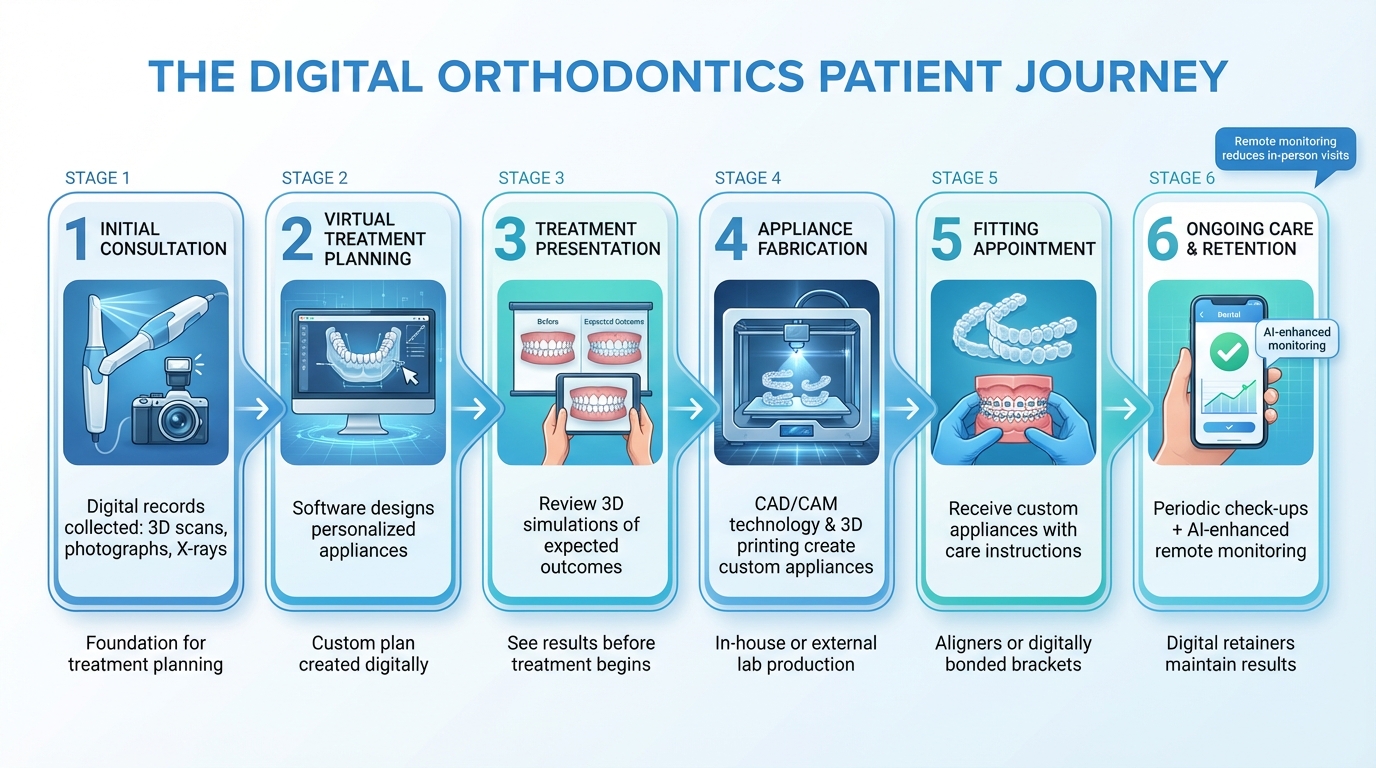
Digital Orthodontics Patient Journey: From Consultation to Retention
Benefits of Digital Orthodontic Systems
Digital orthodontic systems bring a host of advantages for both clinicians and patients. By leveraging advanced technology, these systems enable precise and predictable tooth movements. Customised brackets, aligners, and robotically bent archwires are designed specifically for each patient’s dental structure and treatment plan. This often translates to shorter treatment durations and more reliable outcomes [1] [3].
For patients, the experience is significantly improved. Messy impressions are replaced with intraoral scanners, making the process more comfortable. Custom appliances are designed to minimise discomfort and reduce the need for frequent adjustment visits [2] [3]. Additionally, patients can visualise their expected results through realistic digital simulations before treatment even begins. This not only enhances understanding but also boosts motivation. The overall experience is smoother, with fewer appointments and less disruption to daily life, whether at work or school.
Limitations and Considerations
Despite the many benefits, digital orthodontic systems are not without challenges. For practices, the initial investment in technology – such as scanners, CBCT units, software licences, and 3D printers – can be substantial. These costs may lead to higher treatment fees [1] [4] [5]. There’s also a learning curve for clinicians and staff, and the success of treatment still heavily depends on the orthodontist’s expertise in diagnosis and biomechanics [1] [4].
Not every case is suited for digital orthodontics. Severe skeletal discrepancies may require surgical solutions or traditional treatments, and aligners may struggle with issues like significant vertical discrepancies or severe tooth rotations [1]. Technical hiccups – like software glitches, scanner errors, or printer malfunctions – can delay the process. Furthermore, these systems rely heavily on patient compliance. For instance, aligners need to be worn as directed, and good oral hygiene is essential. Without patient cooperation, the effectiveness of these advanced tools can be compromised [3] [8].
Patient Journey with Digital Orthodontics
The journey typically begins with a consultation, where digital records – such as scans, photographs, and X-rays – are collected [1] [3] [4]. These records form the foundation for the virtual treatment planning phase, where specialised software designs personalised appliances tailored to the patient’s needs [1] [2] [3].
During a follow-up visit, the orthodontist presents the digital treatment plan, including 3D simulations of the expected outcomes. This allows patients to review the proposed results, treatment timeline, and costs before deciding to proceed [2] [4]. Once the plan is finalised, the appliances are fabricated using CAD/CAM technology and 3D printing, either in-house or through an external lab [1] [3]. At the fitting appointment, patients receive their custom appliances – whether it’s aligners or digitally bonded brackets – along with detailed instructions on how to use and care for them [2] [3].
Ongoing care involves periodic check-ups to monitor progress, often supplemented by remote monitoring tools like AI-enhanced apps. These tools help track treatment and make adjustments as needed [5] [6] [8]. When active treatment concludes, digital retainers are created from the final 3D models, and a retention plan is put in place to maintain the results [1] [3].
Future of Digital Orthodontic Systems
Emerging Technologies in Orthodontics
The field of digital orthodontics is advancing rapidly, with cutting-edge technologies such as AI-powered planning and monitoring, smart orthodontic devices with embedded sensors, and in-practice 3D printing leading the charge. AI and machine learning are now playing a pivotal role in streamlining orthodontic workflows. From automating tasks like landmark identification and cephalometric analysis to simulating treatment outcomes, these tools are reducing manual effort while maintaining consistency and accuracy [1][5]. Machine learning algorithms, trained on extensive datasets, can even recommend optimal tooth movement strategies, flag potential risks like root resorption or bone dehiscence, and assist clinicians in deciding between braces, aligners, or hybrid treatment options [1].
Smart braces and aligners equipped with sensors are another exciting development. These devices can monitor factors like wear time, usage patterns, bite force, and oral conditions, syncing this data with mobile apps [8]. Patients receive real-time feedback on their progress, ensuring they meet daily goals, while clinicians can verify compliance without solely relying on patient self-reports. This enhanced monitoring helps improve adherence, leading to shorter treatment durations [8].
Meanwhile, advancements in 3D printing technology are transforming orthodontic practices. Faster and more precise printers are enabling clinics to establish in-practice digital labs, where they can produce aligners, retainers, indirect bonding trays, and even some functional appliances on-site [1][3]. This shift significantly reduces the time between an initial scan and the delivery of appliances, sometimes to as little as a single appointment for simpler devices. By eliminating shipping delays and external lab fees, clinics can offer quicker and more cost-effective treatment options. For patients living in remote areas without access to nearby orthodontic labs, this means fewer visits, shorter overall treatment times, and more responsive care. Practices like Complete Smiles Bella Vista, which embrace advanced CAD/CAM and printing workflows, are setting a benchmark in delivering efficient, patient-centred care.
Impact on Patients and Practitioners
These advancements are reshaping the orthodontic experience for both patients and clinicians. Smart devices and companion apps are enhancing patient engagement by providing guidance on wear time, elastic usage, and oral hygiene [8]. Digital records enable the rapid fabrication of replacement retainers without requiring new impressions, while smart retainers may even track wear patterns to help minimise the risk of relapse [1].
For orthodontists, the shift to digital systems demands a new skill set. Clinicians will need to be proficient in digital diagnostics, software-based treatment planning, and data analysis, as well as familiar with workflows involving 3D scanners, printers, and AI tools [1][4]. Training programs are evolving to include modules on digital orthodontics at the university level, along with continuing professional development (CPD) courses focused on software platforms, scanning protocols, and patient data security. The traditional methods of analogue impressions and 2D planning are being replaced by integrated digital workflows that encompass scanning, CBCT imaging, virtual treatment setups, and appliance design within interconnected systems [1][5].
In Australia, it’s also critical for practices to ensure that AI tools and remote platforms act as clinical aids rather than substitutes for professional judgement. Clear documentation of treatment decisions and strict adherence to local privacy laws concerning the storage and transmission of patient data are essential [1][5]. These safeguards will help maintain trust and ensure that technology enhances, rather than compromises, the quality of care.
FAQs
How do digital orthodontic systems enhance the accuracy of treatments?
Digital orthodontic systems bring a new level of precision to dental treatment by using advanced 3D imaging and planning tools. These technologies make it possible to create personalised treatment plans that cater to the specific dental structure of each patient, ensuring teeth are moved and aligned with exceptional accuracy.
By minimising the errors often linked to traditional methods, digital systems enhance the reliability of treatment outcomes. They also allow for real-time adjustments throughout the process, delivering consistent and effective results that meet patients’ needs more efficiently.
Are there any limitations to using digital orthodontics for complex dental issues?
Digital orthodontics offers a sophisticated solution for a wide range of orthodontic issues. That said, it might not be the best fit for cases involving severe skeletal discrepancies, major bite misalignments, or complex dental irregularities. In these situations, traditional braces or even surgical procedures may be required to achieve the desired results.
Your orthodontist will take the time to evaluate your specific needs and determine whether digital orthodontics is the right option for you. This tailored approach ensures that each patient receives the most suitable and effective treatment plan.
How does AI improve remote monitoring in orthodontic treatments?
AI technology has transformed the way orthodontic treatments are monitored remotely. Using cutting-edge digital imaging and data analysis, it precisely tracks how teeth are moving, helping to keep treatments on the right path.
One of the biggest perks? Fewer in-person visits. AI allows orthodontists to spot and tackle potential issues in real time, making adjustments as needed. This means patients save time while enjoying a smoother, more efficient treatment process.
Related Blog Posts
- How 3D Imaging Improves Orthodontic Treatment Outcomes
- AI-Powered Orthodontics: Cost vs. Efficiency
- How Cloud Platforms Improve Orthodontic Planning
- Digital Orthodontics: CAD/CAM Workflow Explained
Important Notice: Any surgical or invasive procedure carries risks. Before proceeding, you should seek a second opinion from an appropriately qualified health practitioner.
Individual results may vary. The information provided in this article is for educational purposes only and does not constitute medical advice.
Checkout Related Blogs




Get in touch with us
For more information, call us now to start feeling better. Or fill the form below to make appointment
The Latest News from Complete Smiles
How to Clean Clear Plastic Retainers
Checklist for Choosing Wearable Dental Devices
Checklist for Choosing Cloud AI Platforms in Dentistry

Complete Smiles Bella VistaAccepts All Major Health Funds, Including





