





AI in Orthodontics: What Patients Should Know
AI is transforming orthodontic care, making diagnosis and treatment more precise, efficient, and tailored. From analysing X-rays to predicting tooth movement and designing custom aligners, AI tools enhance accuracy and streamline processes. Patients can even monitor progress remotely using smartphone apps that assess aligner fit and treatment effectiveness. However, AI is not a replacement for professional expertise – it supports orthodontists in delivering better outcomes while maintaining safety and oversight.
Key takeaways:
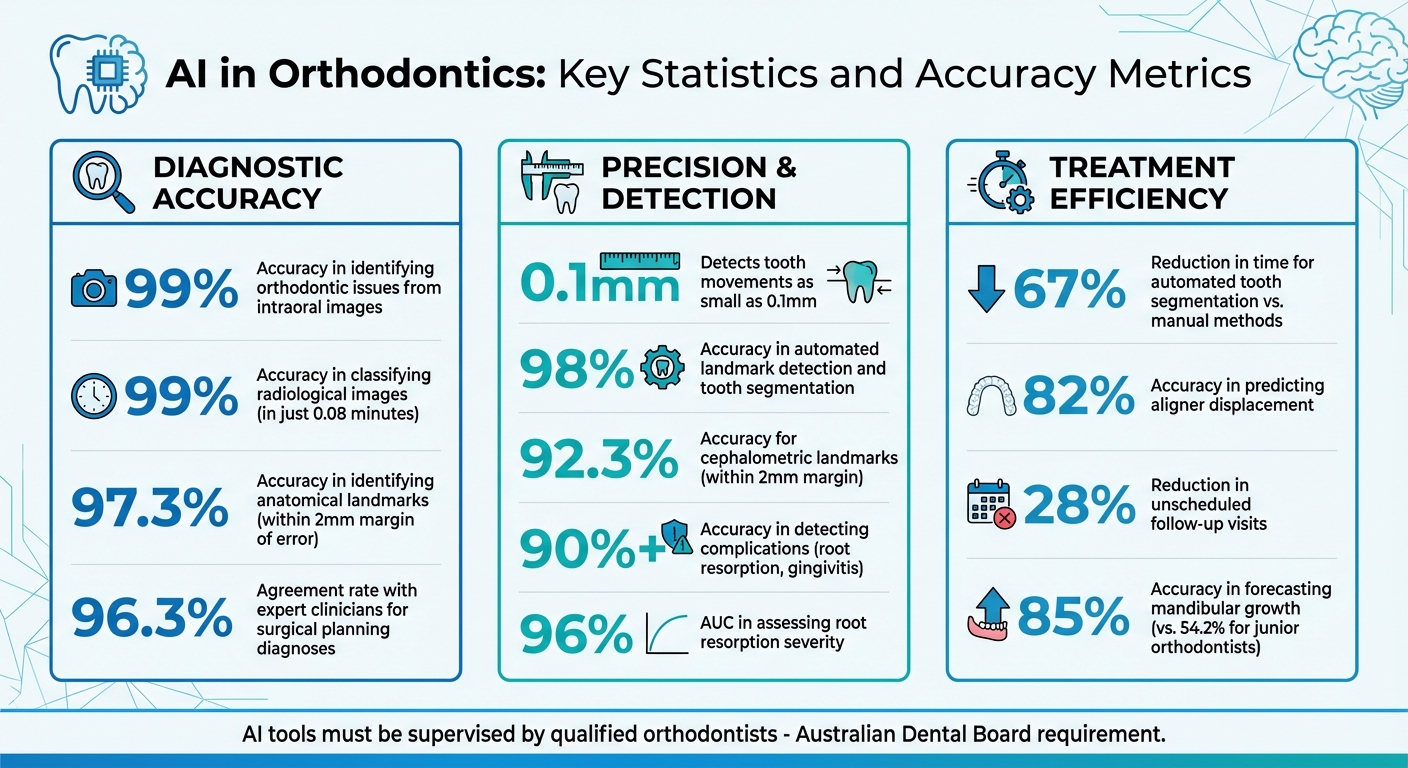
- AI detects tooth movements as small as 0.1mm and identifies orthodontic issues with up to 99% accuracy.
- Remote monitoring apps let patients upload images for AI analysis, reducing the need for in-person visits.
- AI tools like iTero and ClinCheck simulate treatment outcomes, improving planning precision.
- Safety and privacy are prioritised, with AI systems requiring orthodontist supervision and compliance with Australian regulations.
While AI improves care, final decisions remain with qualified professionals. It’s a tool to assist, not replace, human expertise.
AI in Orthodontics: Key Statistics and Accuracy Metrics
How AI is Reshaping Clinical Orthodontics | Pearl AI | Orthoforward Podcast
What is AI in Orthodontics?
Artificial Intelligence (AI), at its essence, refers to computer systems that can perform tasks typically requiring human intelligence – like recognising patterns, making decisions, or interpreting visual data [3][4]. In orthodontics, AI tools are used to analyse images, predict treatment outcomes, and plan procedures with a level of precision that surpasses traditional methods.
One of the most common forms of AI in orthodontics is Machine Learning (ML). ML processes large volumes of dental data to identify patterns, forecast tooth movement, and flag potential issues [3][6]. A more advanced branch of AI, Deep Learning (DL), employs neural networks – specifically Convolutional Neural Networks (CNNs) – to interpret complex clinical images like X-rays and 3D scans. These systems can classify and organise radiological images with an impressive 99% accuracy in just 0.08 minutes [6].
How AI Works in Orthodontic Care
AI systems are trained using thousands of cases to recognise anatomical patterns and create a digital twin – a virtual model of the patient’s oral structure. This allows orthodontists to simulate treatment options before applying any physical appliances [1]. For instance, when a digital scan or X-ray is taken, AI software can automatically identify anatomical landmarks – key points on teeth and bones – with a 97.3% accuracy rate and within a 2 millimetre margin of error [6].
Take the iTero scanner as an example. Its Outcome Simulator offers patients a 3D view of their current alignment alongside a predicted post-treatment result during their first consultation [4]. Similarly, software like ClinCheck maps out the number of aligners required and pinpoints when additional procedures, such as interproximal reduction (IPR), might be necessary [4].
"AI allows for improved accuracy and consistency in personalised care planning, especially when it comes to orthodontic treatment such as aligners." – Chrystal Sharp, Orthodontic Therapist [4]
This level of data-driven precision forms a strong foundation for diagnostics and treatment planning.
AI’s Role in Diagnosis and Treatment Planning
AI excels at diagnosing orthodontic issues like crowding, spacing, and bite misalignments. It achieves a 99% accuracy rate in identifying these problems through intraoral images [6]. Beyond that, AI systems can detect impacted teeth, evaluate root resorption, and even predict the need for extractions or orthognathic surgery. For surgical planning, AI-based tools have shown a 96.3% agreement rate with expert clinicians’ diagnoses [6].
AI also streamlines routine tasks. For instance, automated tooth segmentation reduces the time required by 67% compared to manual methods [6], freeing up orthodontists to focus on more complex aspects of patient care. In treatment planning, predictive AI uses historical data to estimate how teeth will respond to specific forces, enabling the design of custom appliances tailored to each patient’s unique anatomy [3].
That said, AI is not a replacement for professional expertise. As Chrystal Sharp points out, "AI should only be used as an assistive tool; it should in no way replace the requirement for a diagnosis by a qualified professional" [4]. The Dental Board of Australia echoes this sentiment, stressing that "practitioners must apply human judgement to any output of AI" [7].
Is AI Safe and Reliable in Orthodontics?
It’s natural for patients to wonder if AI-assisted orthodontic treatments can be trusted. While AI tools in dentistry come equipped with multiple safety mechanisms, they are never intended to function independently. As the Australian Dental Association emphasises, "Patient safety must be the primary consideration for any dental AI system" [3]. This is why every AI-generated result must be supervised, validated, and approved by a registered dental practitioner before treatment begins [3][8]. With these safety measures in place, let’s take a closer look at the specific features and diagnostic accuracy of AI tools in orthodontics.
Safety Features of AI Tools
Modern orthodontic AI systems are designed with safeguards to minimise risks and prioritise patient safety. These include rigorous data validation processes, secure data storage that complies with OAIC standards, and independent oversight [3]. For example, tools like Pearl AI use colour-coded alerts to highlight potential issues in radiographs, enabling early clinical intervention [4].
Another layer of safety comes from remote monitoring systems. Apps like Dental Monitoring assess aligner fit and tooth movement every 7–14 days, allowing orthodontists to step in promptly if progress deviates from the plan [4][2]. Dr. Oyku Dalci from Sydney Dental Hospital explains:
"The AI detects tooth movements as small as 0.1mm, which is not visible to the human eye. So, it tells us if the aligner has worked and if the patient can progress to the next stage" [2].
Accuracy and Reliability in Diagnoses
AI’s diagnostic capabilities further strengthen its role in orthodontics. These systems demonstrate impressive accuracy across a range of tasks. For instance, Convolutional Neural Networks have achieved 99% accuracy in analysing clinical and radiological images [6]. When it comes to diagnosing malocclusions or identifying anatomical landmarks, AI operates within clinically acceptable margins [6].
However, it’s important to remember that AI is a tool, not a replacement for professional expertise. The British Dental Journal notes, "AI may enhance diagnostic accuracy, but final interpretation must remain with the dentist" [8]. Similarly, the Dental Board of Australia underscores that practitioners must apply their professional judgement to all AI outputs and maintain full legal and ethical responsibility for treatment plans [7]. Patients should ensure their orthodontist reviews and approves any AI-generated recommendations before proceeding [3][8].
How Does AI Improve Treatment Outcomes?
AI is transforming orthodontics by reducing treatment times, improving precision, and identifying potential issues early. Xuanchi Guo and Yuhan Shao from Shandong University‘s Department of Dental Medicine highlight this shift:
"AI acts as an intelligent clinical assistant, helping orthodontists make patient-specific adjustments to the treatment plan, which can reduce treatment time, optimize outcomes, and minimize human error in clinical decision-making" [1].
Here’s how AI is making a difference in orthodontic care.
Shorter Treatment Times
AI-powered systems are helping to cut down the overall duration of treatment by streamlining both planning and monitoring. For instance, a 2025 study by Wafaie et al. analysed data from 1,200 patients and used machine learning to predict aligner displacement. The system achieved 82% accuracy in identifying tracking issues, leading to a 28% drop in unscheduled follow-up visits [1].
Tools like the iTero scanner’s "Invisalign Progress Scan" detect misalignments early, allowing for immediate adjustments [4]. Virtual debonding technology also speeds up the final stages of care by enabling clinicians to digitally remove braces from scans and prepare retainers in advance [4]. These advancements make treatment more efficient and well-coordinated.
Better Accuracy and Predictability
AI combines data from CBCT, intraoral, and 3D facial scans to create precise digital models, which orthodontists can use to test treatment scenarios before starting physical procedures [1]. This reduces the need for mid-course adjustments, saving time and improving outcomes.
Automated tools for landmark detection and tooth segmentation are reducing human error, achieving up to 98% accuracy [6][4]. AI also excels in predicting growth trends. For example, deep learning models can forecast mandibular growth in children with 85% accuracy, far surpassing junior orthodontists, who average 54.2% accuracy [1]. Systems like Ceph-Net can pinpoint cephalometric landmarks with 92.3% accuracy within a 2-millimetre margin of error [1][9]. These advancements allow orthodontists to create more predictable and personalised care plans while maintaining oversight.
Early Risk Detection
AI’s ability to identify risks early is another game-changer. It can detect complications like external root resorption and gingivitis with over 90% accuracy, ensuring timely intervention [1]. Hybrid AI models, for instance, achieve a 96% AUC in assessing root resorption severity, enabling orthodontists to adjust treatment forces before complications worsen.
Tools such as Pearl AI scan radiographs to flag early-stage issues like cavities or apical infections, which may need treatment before orthodontic care begins [4]. As Guo and Shao note:
"AI allows orthodontists to shift from a reactive approach to a proactive, preventive strategy" [1].
While AI enhances treatment outcomes significantly, final decisions always rest with the expertise and judgement of qualified orthodontists.
sbb-itb-2be92ed
Limitations and Risks of AI in Orthodontics
While AI has shown promise in orthodontics, it’s not without its challenges. Certain limitations and risks affect how this technology is applied and how patient data is safeguarded.
Over-Reliance on Technology
One major concern is the potential for practitioners to depend too heavily on AI-generated recommendations, possibly at the expense of their own clinical judgement. Rosalia Leonardi and Nikhillesh Vaiid from the International Dental Journal highlight the risks of blindly accepting AI outputs without careful evaluation [10].
The "black box" nature of many AI algorithms adds to this issue. Since these systems often operate in ways that are not easily understandable, orthodontists may struggle to explain treatment decisions to patients or identify errors in the system’s recommendations [10][5]. As noted by the British Dental Journal:
"The clinician remains accountable, for better or worse. As technology evolves, cautious optimism, combined with rigorous oversight, will be the key to unlocking its full potential" [8].
Another critical issue is algorithmic bias. If the data used to train an AI system doesn’t adequately represent diverse patient groups – such as different ages, genders, or ethnic backgrounds – the recommendations may be less accurate for under-represented populations [10][3]. This could lead to unfair or inappropriate treatment plans for certain demographics. These concerns naturally tie into broader issues of data security and ethical oversight.
Data Privacy Concerns
AI systems rely on vast amounts of sensitive data, including clinical photographs, 3D scans, and radiographs. Storing this information, particularly on offshore servers, increases the risk of data breaches and unauthorised access [10][5]. Even when steps are taken to de-identify clinical images, there’s still a chance that patient identities could be revealed [5].
In Australia, practices must adhere to the Privacy Act 1988 (Cth) and the 13 Australian Privacy Principles to ensure compliance with privacy laws [7][8]. For instance, Bendigo Orthodontic Specialists use a secure, locally-based AI tool that operates under the supervision of orthodontists and complies with Australian regulations [11]. The Australian Dental Association has also raised concerns:
"Any individual whose data may have been used to train, inform, or prompt an AI system, may have privacy and security concerns about the access and storage of their data" [3].
Patients are encouraged to ask their orthodontist how their data is stored, whether it’s transferred offshore, and what measures are in place to protect their information.
Regulatory and Ethical Considerations
In Australia, the Therapeutic Goods Administration (TGA) and the Dental Board of Australia require that AI tools in orthodontics be supervised by licensed practitioners, who remain fully accountable for treatment outcomes [3][7].
Questions around liability and accountability are also pressing. If an AI-generated treatment plan fails, who is responsible – the orthodontist, the software developer, or the manufacturer? The British Dental Journal raises this important issue:
"Where does liability lie if a machine-led or remote clinician plan fails?" [8].
The Australian Dental Association advises patients to avoid relying on generative AI tools like ChatGPT for self-diagnosis or treatment advice, as these systems can produce misleading or harmful information [3].
Transparency is another hurdle. The opaque nature of many AI algorithms makes it hard for orthodontists to fully explain how patient data is processed, complicating efforts to obtain informed consent [10][5]. Patients have a right to understand how AI is being used in their treatment and the potential risks involved.
Future Directions for AI in Orthodontic Care
The rise of AI tools is transforming orthodontics, bringing the possibility of continuous, real-time care into focus. Instead of waiting weeks or months for follow-ups, these technologies let orthodontists monitor treatment progress in real time, making adjustments as soon as they’re needed. This shift is paving the way for a new era in orthodontic innovation.
Real-Time Monitoring and Adjustments
AI-powered platforms for remote monitoring are already reshaping the way patients and orthodontists interact between appointments. Tools like Dental Monitoring and Align Virtual Care use smartphone imaging to capture detailed images of patients’ teeth every one to two weeks. These images are then analysed by AI to check if aligners are fitting correctly or if teeth are straying from the treatment plan [4].
Research supports the effectiveness of these systems in reducing unnecessary follow-ups. In a study led by Wafaie and colleagues, sensor data from 1,200 patients revealed that machine learning could predict aligner displacement with 82% accuracy. This led to a 28% reduction in unscheduled visits [1].
Beyond just monitoring, adaptive AI systems take things further by analysing sequential images and biomechanical responses. These advanced models detect subtle deviations caused by biological factors or compliance issues. They can simulate the impact of orthodontic forces in real time, predicting risks like treatment derailment or unexpected growth changes. When issues arise, clinicians are alerted to make timely adjustments [1]. As Xuanchi Guo from Shandong University explains:
"AI represents a paradigm shift in orthodontics, transitioning from static, pre-planned treatment strategies to dynamically evolving, real-time adjustments" [1].
Combining AI with Clinical Expertise
Even with these advancements, human expertise remains irreplaceable. AI works best as a supportive tool, assisting orthodontists rather than substituting their judgement. By automating routine tasks, AI enables clinicians to dedicate more time to personalised care and patient interaction.
Early trials highlight how AI can complement clinical decision-making without undermining the need for professional oversight. Orthodontic therapist Chrystal Sharp underscores this balance:
"AI should only be used as an assistive tool; it should in no way replace the requirement for a diagnosis by a qualified professional" [4].
The Australian Dental Association echoes this sentiment, stressing that AI applications in dental care must always be supervised and managed by a qualified practitioner, not left for patients to handle independently [3]. By blending AI’s analytical power with the expertise of trained professionals, orthodontic care can become more dynamic and tailored to individual needs.
Conclusion
Studies show that AI can accurately detect even the smallest tooth movements and perform precise segmentation. These advancements enable orthodontists to offer more predictable treatment plans and may even reduce the need for frequent in-office visits.
However, there are valid concerns about data privacy, algorithmic bias, and the opaque nature of some AI processes. Because of this, human oversight remains crucial. The Dental Board of Australia stresses that practitioners must exercise their professional judgement when interpreting AI-generated insights and remain fully accountable for ensuring safe and effective treatment outcomes [7]. AI should be viewed as a supportive tool, not a substitute for clinical diagnosis or expertise.
The future of orthodontics lies in blending AI’s analytical strengths with the expertise of skilled clinicians. Tools like real-time monitoring apps and digital simulators that help visualise potential treatment outcomes are designed to complement, not replace, a clinician’s role. These advancements hold promise but rely on ongoing collaboration between innovative technology and experienced professionals.
FAQs
How does AI enhance the accuracy of orthodontic treatments?
AI has become an essential tool in orthodontics, enhancing the precision of treatments by analysing detailed visuals like X-rays, intra-oral scans, and 3D facial models. By pinpointing critical anatomical landmarks and calculating exact measurements, it helps orthodontists design treatment plans that are customised for each individual.
What’s more, AI allows for real-time adjustments throughout the treatment process. This makes it easier to predict tooth movement and achieve the desired results with greater accuracy. By simplifying workflows and minimising the risk of human error, AI contributes to orthodontic care that is not only more efficient but also finely tuned to suit each patient’s unique needs.
Is my privacy protected when AI is used in orthodontics?
When it comes to using AI in orthodontics, privacy is a top priority. These systems often handle sensitive information like medical images and personal details, which makes secure storage and management absolutely critical. Protecting this data from unauthorised access or misuse isn’t just good practice – it’s also a legal requirement under Australian privacy laws.
If you’re ever unsure, don’t hesitate to ask your orthodontist about how your data is managed. They should be able to explain the measures in place to keep your information safe and confidential.
Can artificial intelligence take over an orthodontist’s role in treatment planning?
No, artificial intelligence (AI) cannot replace orthodontists when it comes to treatment planning. Although AI serves as a valuable tool, capable of analysing data and offering decision-making support, the ultimate clinical decisions need to rest in the hands of a qualified orthodontist.
Orthodontic care demands the specialised knowledge, experience, and personalised approach of a trained professional to achieve safe and effective results. AI can enhance the process significantly, but it functions best as a supportive aid, not as a replacement for human expertise.
Related Blog Posts
- Benefits of AI in Orthodontic Progress Tracking
- AI in Orthodontics: Diagnosis and Treatment Planning
- How AI Predicts Orthodontic Treatment Outcomes
- AI in Orthodontics: How Progress Monitoring Works
Important Notice: Any surgical or invasive procedure carries risks. Before proceeding, you should seek a second opinion from an appropriately qualified health practitioner.
Individual results may vary. The information provided in this article is for educational purposes only and does not constitute medical advice.
Checkout Related Blogs




Get in touch with us
For more information, call us now to start feeling better. Or fill the form below to make appointment
The Latest News from Complete Smiles
How to Clean Clear Plastic Retainers
Checklist for Choosing Wearable Dental Devices
Checklist for Choosing Cloud AI Platforms in Dentistry

Complete Smiles Bella VistaAccepts All Major Health Funds, Including





