





Top 3 AI Innovations in Orthodontics
AI is reshaping orthodontics by making processes faster, more accurate, and less prone to error. Here’s how it’s transforming the field:
- AI-powered diagnostics: Analyses X-rays and CBCT scans with up to 97.3% accuracy, significantly reducing variability and speeding up processes like cephalometric analysis by 80 times.
- Treatment planning and simulation: Automates repetitive tasks, predicts treatment needs with over 93% accuracy, and uses digital simulations to optimise outcomes.
- Predictive risk assessment: Identifies complications early, such as root resorption with 90% accuracy, enabling proactive care and reducing treatment disruptions.
In Australia, AI is improving access to care, especially in rural areas, through remote monitoring and automated workflows. However, clinicians remain responsible for overseeing AI systems, ensuring compliance with local regulations and patient privacy laws.
AI is not replacing orthodontists but providing tools to improve accuracy, efficiency, and patient outcomes.
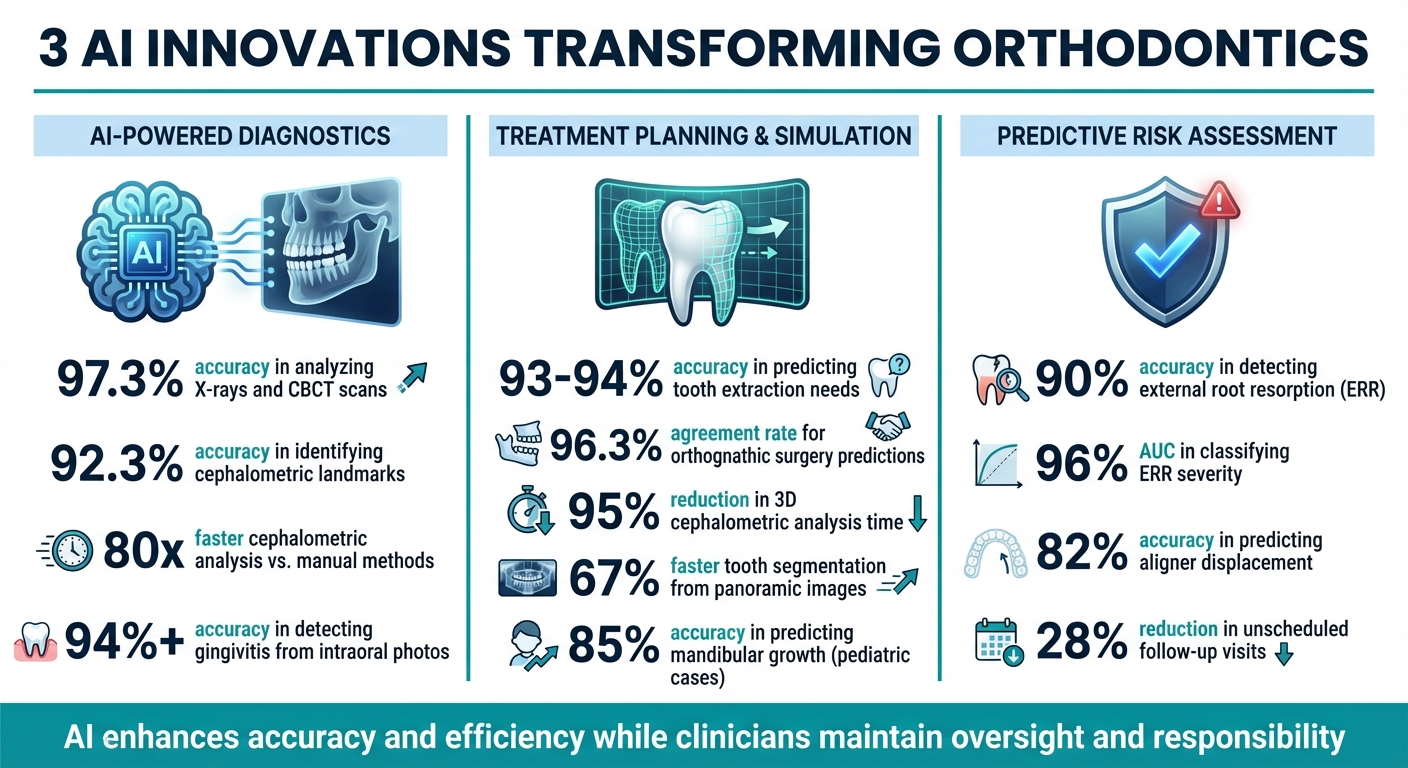
AI Innovations in Orthodontics: Accuracy and Efficiency Statistics
1. AI Analysis of Diagnostic Images
Accuracy and Precision in Diagnosis
AI-driven tools have transformed the analysis of X-rays, CBCT scans, and intraoral images, delivering a level of precision that significantly enhances diagnostic accuracy. For instance, Convolutional Neural Networks (CNNs) can pinpoint cephalometric landmarks with an impressive 92.3% accuracy within a 2 mm margin of error [5]. This minimises the inconsistencies often seen in manual tracing. Similarly, deep learning models have achieved 92.8% accuracy in identifying periapical lesions in CBCT images [3], while systems designed to analyse intraoral photographs for gingivitis boast over 94% accuracy [5]. Platforms like Diagnocat have proven their effectiveness in real-world clinical environments; one study revealed that AI-assisted evaluation of CBCT scans achieved a sensitivity score of 0.8537, outperforming unaided dentists, who scored 0.7672 [3].
Efficiency in Treatment Planning
After delivering precise diagnoses, AI takes efficiency in treatment planning to the next level. Tasks like cephalometric analysis, which used to take minutes of meticulous manual effort, are now completed in mere seconds. For 3D cephalometric analysis, AI models have slashed processing times by a staggering 95% compared to traditional manual annotation methods [6]. Web-based platforms such as CephX and WebCeph can generate detailed cephalometric reports almost instantaneously [3]. These tools not only save time but also serve as valuable resources for clinicians, particularly those with less experience, by providing a reliable second opinion to complement their clinical judgement.
Predictive Capabilities for Patient Outcomes
Beyond diagnostics and planning, AI excels at predicting patient outcomes with remarkable accuracy. For example, AI models can forecast the likelihood of a patient needing tooth extractions with 93–94% accuracy and predict the necessity of orthognathic surgery with a 96.3% agreement rate compared to expert assessments [1][6]. These predictive insights enable orthodontists to make well-informed decisions about the best treatment strategies and the timing of interventions.
"By eliminating much of the subjectivity inherent in orthodontic decision-making, deep learning refines treatment planning and enhances predictive precision." – Guo and Shao [5]
2. AI Treatment Planning and Simulation
Streamlining Treatment Planning
Building on the improved diagnostic accuracy discussed earlier, AI takes orthodontic treatment planning to a new level by automating repetitive tasks. Traditionally, planning relied heavily on manual tracing, 2D image comparisons, and subjective judgement, often leading to inconsistencies. With AI, these routine processes are automated, saving time and improving precision. For example, AI reduces the time needed for tooth segmentation from panoramic images by an impressive 67% [1].
AI also enhances decision-making by providing objective treatment recommendations. By analysing vast datasets, it can predict the need for procedures like tooth extractions or orthognathic surgery with remarkable accuracy. Studies show AI predicts extraction needs with 93–94% accuracy and aligns with expert treatment plans in deep bite cases 94.4% of the time [1]. This level of consistency minimises variability among clinicians, making treatment planning more reliable and efficient.
Predicting Patient Outcomes
Beyond planning, AI offers powerful tools for predicting patient-specific outcomes. It can anticipate how individual patients will respond to orthodontic treatments. For instance, in paediatric cases, AI predicts mandibular growth with 85% accuracy – outperforming junior orthodontists [5]. This insight helps clinicians determine the best timing for growth modification treatments, potentially reducing the need for invasive procedures later on.
AI’s predictive capabilities also extend to advanced simulation methods. Digital twin models powered by AI allow practitioners to test multiple treatment scenarios virtually. Finite Element Model simulations, for example, optimise force application and aligner sequencing, reducing the risk of complications [5]. Additionally, sensor data analysis predicts aligner displacement with 82% accuracy, cutting down unscheduled follow-up visits by 28% [5]. These tools not only improve patient outcomes but also enhance the overall efficiency of orthodontic practices.
"AI acts as an intelligent clinical assistant, helping orthodontists make patient-specific adjustments to the treatment plan, which can reduce treatment time, optimize outcomes, and minimize human error in clinical decision-making." – Xuanchi Guo, Department of Dental Medicine, Shandong University [5]
3. Predictive Analytics for Risk Assessment
Predictive Capabilities for Patient Outcomes
AI is not just about improving treatment plans – it’s also reshaping how we approach potential complications. Instead of waiting for problems to surface, AI leverages advanced analytics to flag early warning signs, enabling a proactive rather than reactive approach to care.
For instance, deep learning models can analyse CBCT scans and intraoral images to spot complications like external root resorption (ERR), which affects up to 66% of patients, with an impressive 90% accuracy[5]. On top of that, hybrid AI models classify the severity of ERR with an AUC of 96%[5]. Similarly, AI-powered computer vision systems identify gingivitis with over 94% accuracy[5]. These tools bridge the gap between precise diagnosis and effective risk management.
AI doesn’t stop there – it also predicts potential setbacks in treatments. By processing sensor data from aligners alongside sequential intraoral scans, algorithms can forecast displacement with 82% accuracy[5]. In paediatric cases, growth prediction models help orthodontists determine which children might benefit from early intervention, potentially addressing issues before they escalate.
"AI allows orthodontists to shift from a reactive approach to a proactive, preventive strategy." – Frontiers in Dental Medicine[5]
Another key advantage of AI is its ability to standardise assessments. By delivering consistent diagnostics, it ensures that patients across different practices receive care that is both reliable and based on solid evidence. This consistency not only improves patient outcomes but also enhances trust in the diagnostic process.
sbb-itb-2be92ed
What AI Means for Australian Orthodontic Practices
In Australia, AI is transforming orthodontic practices by streamlining workflows and improving access to care, particularly in rural areas. By combining AI with robotics, tasks like fabricating indirect bonding trays, producing aligners, and bending wires with precision are automated[4]. This reduces the need for manual lab work, giving clinicians more time to focus on their patients. Beyond these operational perks, AI is also making strides in remote patient management.
Take the MAD pilot study at Sydney Dental Hospital as an example. This initiative showcased how AI can support remote monitoring. Using a smartphone app and a specialised scan box, patients captured and uploaded photos of their teeth from home. The AI system then analysed these images, detecting tooth movements as small as 0.1mm – changes too subtle for the human eye. This allowed orthodontists to assess progress remotely, enabling patients in rural New South Wales to continue their aligner treatments without frequent trips to the clinic.
"The technology allows us to assess and treat patients remotely… Patients don’t need to travel, miss school." – Dr Oyku Dalci, Sydney Dental Hospital[8]
AI also brings consistency to orthodontic workflows. By automating tasks like charting and documentation[7][6], it reduces variability among clinicians and ensures more uniform processes. This efficiency means practices can manage higher patient volumes without sacrificing the quality of care. However, these advancements come with the critical need for clinical oversight.
Australian regulations require that clinicians oversee all AI systems. The Dental Board of Australia has made it clear that clinicians are legally responsible for outcomes, regardless of the technology employed[9]. Any AI-enhanced software used in orthodontics must be supervised by a registered dental practitioner and registered as a medical device with the Therapeutic Goods Administration (TGA)[9]. Additionally, protecting patient data is non-negotiable. Practices must comply with the Australian Privacy Act and clearly inform patients about how their data is stored and shared within AI systems[7][9].
Conclusion
The advancements in AI technology discussed earlier are reshaping orthodontic care in Australia. By accelerating diagnoses, improving treatment planning, and enabling more effective remote monitoring, these tools are transforming the way practitioners work. With streamlined workflows, orthodontists can now dedicate more time to complex clinical decisions and meaningful patient interactions.
Patients, especially those in regional areas, stand to gain significantly. AI-driven tools minimise the need for unnecessary travel and enhance the predictability of treatments. Digital simulations, for instance, allow patients to see potential outcomes, fostering greater confidence and engagement throughout their orthodontic journey.
That said, these advancements come with responsibilities. AI is a tool to assist, not replace, professional judgement. Clinicians must ensure they oversee and validate AI-generated recommendations, maintaining the essential human element in care. As Professor Ali Darendeliler from Sydney Dental Hospital aptly put it:
"This is an efficient way to provide comprehensive orthodontic care to patients, especially those in regional and rural areas. It has the capacity to revolutionise the provision of public orthodontic care not only in NSW but in Australia." [8]
The emergence of face-driven orthodontics – where AI aids in analysing facial symmetry and soft tissue changes [2] – marks a significant shift in treatment planning. For practices managing high patient volumes or serving remote communities, these technologies offer practical solutions to persistent challenges, all while preserving the personalised care that remains at the heart of orthodontics.
FAQs
How is AI enhancing orthodontic diagnosis and treatment planning?
Artificial intelligence is reshaping orthodontic care by bringing new levels of precision and efficiency to diagnosis and treatment planning. Using advanced algorithms, AI can process complex imaging like radiographs, cone-beam CT scans, and 3D facial photos with incredible accuracy. These systems can pick up on subtle skeletal or dental irregularities that might otherwise go unnoticed and ensure measurements are standardised, which helps minimise variability and boosts diagnostic consistency.
AI systems also learn from vast datasets, refining their ability to classify malocclusions, predict growth patterns, and evaluate risks for procedures such as extractions or orthognathic surgery. This data-driven method empowers clinicians to make well-informed decisions, flag unusual cases, and recommend treatments grounded in evidence. For orthodontic care across Australia, this means more reliable diagnoses, better communication with patients, and smoother, more efficient treatment planning.
How is AI improving orthodontic treatment planning and simulations?
AI is transforming orthodontics by processing intricate imaging and patient data to craft highly accurate, data-informed treatment plans. It even facilitates virtual simulations of tooth movements, giving clinicians the ability to predict outcomes with greater precision and speed.
This technology allows treatments to be customised to suit individual needs, enhancing both the consistency of results and the patient journey. By simplifying workflows, AI is helping to make orthodontic care more efficient and easier to access for patients across Australia and beyond.
How does AI help predict risks and outcomes in orthodontic treatments?
AI is making a big impact in orthodontics by processing and analysing complex data like cone-beam CT scans, intra-oral images, cephalograms, and 3D facial scans. With the help of advanced machine learning techniques, such as convolutional neural networks (CNNs) and support vector machines, AI can provide insights into potential risks, estimate treatment duration, predict the need for extractions or surgery, and even assess the long-term stability of results.
By leveraging this data-driven approach, orthodontists can deliver more precise, evidence-based care tailored to each individual. This not only improves treatment outcomes but also reduces risks, making orthodontic care more effective and efficient.
Related Blog Posts
- AI in Orthodontics: Risk Assessment Explained
- AI in Orthodontics: Diagnosis and Treatment Planning
- How AI Predicts Orthodontic Treatment Outcomes
- 5 Ways AI Shortens Orthodontic Treatment Time
Important Notice: Any surgical or invasive procedure carries risks. Before proceeding, you should seek a second opinion from an appropriately qualified health practitioner.
Individual results may vary. The information provided in this article is for educational purposes only and does not constitute medical advice.
Checkout Related Blogs




Get in touch with us
For more information, call us now to start feeling better. Or fill the form below to make appointment
The Latest News from Complete Smiles
How to Clean Clear Plastic Retainers
Checklist for Choosing Wearable Dental Devices
Checklist for Choosing Cloud AI Platforms in Dentistry

Complete Smiles Bella VistaAccepts All Major Health Funds, Including





