





AI in Clear Aligners: Research Highlights

AI is transforming orthodontics, making clear aligner treatments more accurate and efficient. Here’s what you need to know:
- AI-driven Precision: Analyses 3D scans, X-rays, and photos with up to 98% accuracy for tooth segmentation.
- Faster Planning: Cuts treatment planning time from 30 minutes to 10.
- Improved Monitoring: AI apps track progress remotely, identifying issues like aligner misfits as small as 0.20 mm.
- Challenges Remain: Movements like torque and extrusion still achieve less than 50% of planned outcomes.
- Advanced Techniques: AI optimises tools like power ridges and attachments for better root movement control.
How AI analyses orthodontic cases is reshaping clear aligner treatments but still requires clinical oversight to address limitations in complex tooth movements.
Unprecedented AI Automation Streamlines Aligner Case Design!
sbb-itb-2be92ed
AI Improvements in Treatment Planning
Advancements in AI are reshaping treatment planning by refining both the simulation of treatments and the design of aligners. The result? Digital plans that better reflect the complexities of real-world biomechanics.
Digital Simulations and Tooth Movement Predictions
AI has revolutionised how orthodontists predict tooth movement, introducing the concept of a "digital twin." This virtual replica of a patient’s craniofacial structure combines data from CBCT scans, intraoral imaging, and 3D facial models. It doesn’t just capture visible teeth but also includes hidden structures like roots and jawbone.
One of the key innovations is adaptive iterative simulation. Unlike traditional methods that assume 100% movement accuracy, AI recalibrates treatment stages based on actual biomechanical responses. For instance, research indicates that a planned 0.25 mm shift typically results in only 74.6% of the expected movement (0.19 mm) [3]. AI-driven Finite Element Method (FEM) simulations address this by adjusting each treatment stage to reflect the actual performance of the previous aligner.
"This iterative FEM approach allows for sequential protocol adjustments based on simulated biomechanical responses, transforming static treatment plans into adaptive, self-correcting systems." – Nature Scientific Reports [3]
This adaptive approach significantly reduces unintended tooth tipping, cutting it from over 6° to less than 1° [3]. By integrating CBCT data with sequential intraoral scans, AI can also track root movement and jawbone remodelling in 3D, offering insights into changes below the gumline without the need for additional radiation exposure.
These dynamic predictions allow AI to take treatment customisation a step further by tailoring aligner designs to suit each patient’s biomechanical needs.
Custom Aligners and Biomechanical Design
AI doesn’t just stop at simulations – it also plays a pivotal role in designing aligners. By analysing individual tooth movements, it applies compensatory forces to ensure greater precision. For example, in cases involving tooth extractions, AI can counteract tipping by applying specific anti-tipping rotations, such as 3.6°, to maintain alignment [3].
The efficiency benefits are striking. AI-generated treatment plans cut planning time from 30 minutes to just 10, all while keeping positional discrepancies within 1 mm [5]. In extraction cases, where traditional approaches often see movement success rates drop from 37% in the first step to below 12% by the final stages, AI compensation protocols maintain far higher success rates throughout the treatment process [3].
Tools like Dental Monitoring add another layer of precision by enabling real-time biomechanical tracking. Patients can submit smartphone scans, and AI analyses these to detect misfits as small as 0.20 mm. If gaps exceed 0.50 mm, the system can automatically adjust the aligner wear schedule. For instance, in one case involving a 23-year-old patient, 59 remote scans identified 16% significant misfits. These were resolved by simply extending aligner wear by five days, avoiding the need for an unscheduled visit [7].
AI’s role in orthodontics is not just about improving accuracy – it’s about making treatments more adaptive, efficient, and patient-focused.
Research Findings: Clinical Results and Limitations
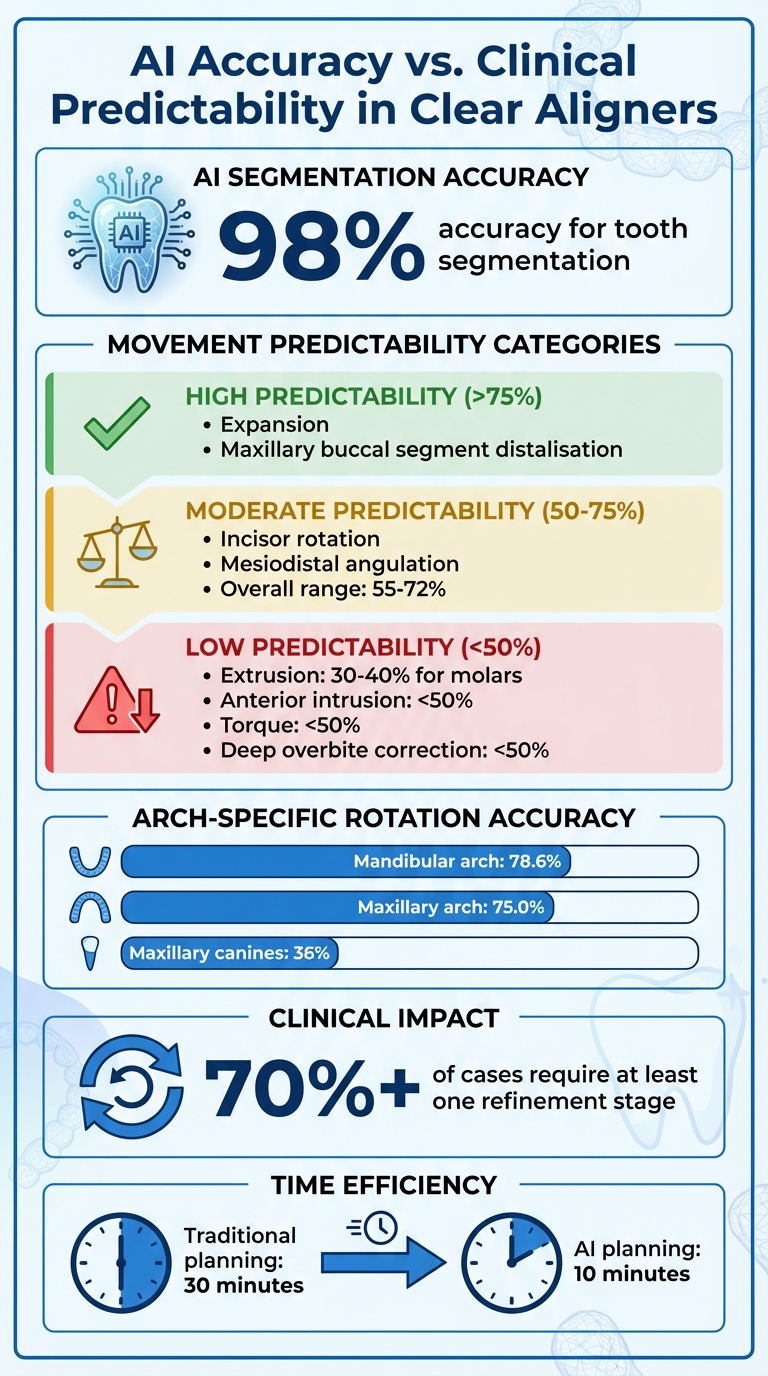
AI in Clear Aligners: Accuracy Rates and Treatment Predictability Statistics
Recent studies have revealed a noticeable gap between digital predictions and actual clinical outcomes in orthodontic treatments. This gap underscores the importance of managing patient expectations. Below, we explore the precision of tooth movement predictions and the ongoing challenges in achieving accurate torque control.
Accuracy of Tooth Movement Predictions
AI-powered tooth segmentation has achieved an impressive 98% accuracy in identifying and mapping individual teeth [1]. However, translating this digital precision into real-world tooth movement is far more challenging. The predictability of dental movements ranges between 55% and 72%, depending on the type of movement being attempted [9].
Movements planned by AI can be grouped into three categories based on their predictability:
- High predictability (>75%): Examples include expansion and maxillary buccal segment distalisation [8].
- Moderate predictability (50–75%): Includes movements like incisor rotation and mesiodistal angulation [8].
- Low predictability (<50%): Movements such as extrusion, anterior intrusion, and torque fall into this category [8].
"The difference between planned and achieved tooth movement, i.e. the predictability of orthodontic tooth movement, remains a challenge for all clear aligner systems." – Seminars in Orthodontics [8]
Rotational movements, especially for round-shaped teeth like canines and premolars, are particularly problematic. For instance, rotational accuracy for maxillary canines can drop as low as 36% [10]. On average, rotational movement predictability is 78.6% for the mandibular arch and 75.0% for the maxillary arch [9]. The thermoplastic material used in aligners often slips on these teeth due to their limited undercuts, making precise rotations difficult [9]. This limitation explains why over 70% of clear aligner cases require at least one refinement stage – additional sets of aligners – to achieve the desired results [11].
Torque Control Results and Gaps
Torque, which refers to the root angulation of teeth, remains one of the most challenging aspects of clear aligner planning. Studies consistently show that torque movements have low predictability, with success rates falling below 50% of what is digitally planned [8].
Vertical movements also tend to underperform. For example, molar extrusion achieves only 30–40% of planned outcomes, while deep overbite correction achieves less than 50% [13]. These shortfalls are partly due to the properties of aligner materials, such as their 0.75 mm thickness, which can cause unintended side effects like posterior tooth intrusion [6].
To address these challenges, machine learning models are being developed to predict cases that are more likely to require refinements. Algorithms such as XGBoost and regularised logistic regression have shown some promise, with an Area Under the Curve (AUC) of 0.67 in identifying risk factors like patient compliance issues and specific tooth rotations [12]. While these advancements mark progress, they also highlight the ongoing need for improvements in achieving consistent clinical outcomes across all types of tooth movements.
Torque Methods in AI-Assisted Planning
Recent advancements have introduced two primary methods for improving root movement control: power ridges and attachments. Both approaches cater to different clinical needs, offering orthodontists and AI developers tailored options for managing root angulation.
Power Ridges vs. Attachments
Power ridges are small indentations built into the aligner near the gingival margin. These ridges apply targeted pressure to create a moment for root torque without requiring any composite material bonded to the tooth surface [14][16]. In contrast, attachments are temporary composite structures bonded to the tooth. Acting like "handles", they allow aligners to grip the tooth more securely and deliver force in multiple directions [15]. Each technique has unique biomechanical benefits and clinical applications.
A study published in 2025 in the International Journal of Orthodontic Rehabilitation by Shifo Savio and colleagues used finite element modelling to compare these methods on maxillary central incisors. The research found that power ridges provided superior palatal crown and root displacement compared to rectangular attachments, with peak periodontal ligament stress measured at 19.62 MPa versus 14.67 MPa [16].
"Power ridges significantly enhance torque expression of maxillary central incisors and have significant biomechanical advantage and force transmission compared with rectangular attachments or no attachment designs" – Shifo Savio [16]
AI technology plays a crucial role in optimising these methods. For power ridges, AI software activates them automatically when root-lingual torque exceeds 3° [18]. The height of the ridge is adjusted based on the tooth’s initial inclination – for example, 0.7 mm for teeth with a normal inclination of 105°, and 0.4 mm for teeth inclined at 110° [17]. For attachments, AI customises the placement, shape, and size to suit the patient’s specific dental conditions [15].
"AI-powered treatment planning software can simulate and adjust force vectors based on patient-specific dental and periodontal conditions, offering a more personalised approach to attachment placement" – Artun Yangın, Afyonkarahisar Health Sciences University [15]
The choice between these methods depends on the tooth being treated and the type of movement required. Power ridges are ideal for managing torque in maxillary incisors during retraction, while attachments are better suited for controlling canine roots or handling complex movements like rotation in premolars and molars [15][18]. Power ridges also have an aesthetic advantage, as they don’t involve visible composite materials. However, they are limited to specific torque movements and cannot assist with retention or rotation [15]. To address these limitations, AI planning often incorporates overcorrection strategies [14].
These torque methods highlight how AI-assisted planning translates theoretical models into effective, patient-specific orthodontic solutions.
Future Developments for AI in Clear Aligner Treatment
Orthodontics is moving away from rigid, static treatment plans and embracing systems that can adapt in real time. With high refinement rates highlighting the need for greater precision, new AI-driven strategies are set to transform treatment outcomes.
AI-Based Overcorrection Methods
A study published in Nature Scientific Reports [3] explored an adaptive iterative Finite Element Method (FEM) simulation. This method recalibrates each aligner stage based on the actual movement achieved, rather than sticking to initial predictions. The results? Tipping angles stayed within ≤1° over eight treatment stages, while conventional methods saw tipping exceed 6°. Additionally, the mismatch between planned and actual crown movement was reduced by about 50%. This adaptive approach directly tackles the cumulative errors that have been observed in traditional protocols.
"By addressing cumulative errors through an adaptive compensation protocol, clinicians may reduce the number of refinements required, shorten treatment time, and improve the patient experience." – Nature Scientific Reports [3]
This method has proven particularly effective for transversal movements, where traditional planning achieves only about 45% efficiency [6]. By applying counter-rotational forces, AI models now automatically incorporate overcorrection strategies to ensure the root moves in sync with the crown.
Connection with Digital Platforms
Enhanced simulation and torque control are only part of the story. Digital platforms are now stepping up to further refine treatment accuracy by integrating AI capabilities. For instance, Long Short-Term Memory (LSTM) networks can predict potential treatment derailments with an accuracy of 82%. This enables real-time adjustments, reducing unscheduled follow-up visits by 28% [4].
"Adaptive AI represents a paradigm shift in orthodontics, transitioning from static, pre-planned treatment strategies to dynamically evolving, real-time adjustments." – Xuanchi Guo, Department of Dental Medicine, Shandong University [4]
Smartphone-based remote STL file generation has also improved significantly, with mean deviations as low as 0.015 to 0.028 mm compared to intraoral scanners vs. traditional impressions for accuracy [7]. These platforms now combine data from multiple sources – CBCT scans, intraoral imaging, and 3D facial models. This multimodal approach allows clinicians to track root movement and bone remodelling without repeated radiation exposure. Essentially, it creates a "digital twin" of the patient’s dentition, enabling detailed biomechanical simulations before treatment begins [4].
Conclusion
AI is reshaping the landscape of clear aligner treatments. With digital tooth segmentation reaching an impressive 98% accuracy [1], these systems have advanced to predict growth patterns, identify potential derailments early, and even cut down unscheduled visits by 28% [4]. By streamlining workflows, AI is redefining how orthodontic planning is approached.
However, some challenges remain. Complex movements like molar extrusion, root torque, and transverse expansion still fall short, achieving less than 50% of the planned movement [13]. This underscores the potential of adaptive AI systems that could adjust treatments in real time.
Recent studies highlight the strengths of AI, showing deep learning models outperforming junior clinicians in predicting skeletal growth and extraction needs. Additionally, in-office and remote monitoring tools are proving highly accurate in forecasting potential issues [4][2]. These advancements push us to critically evaluate both the benefits and limitations of AI in orthodontics.
"AI represents a paradigm shift in orthodontics, transitioning from static, pre-planned treatment strategies to dynamically evolving, real-time adjustments." – Xuanchi Guo, Department of Dental Medicine, Shandong University [4]
Despite these technological leaps, clinical oversight remains indispensable. While AI boosts precision and reduces variability, the clinician’s role in validating and finalising treatment decisions is irreplaceable [4][19]. As tools like multimodal data fusion and deep reinforcement learning advance, the priority should be on using AI to enhance outcomes – not to fully automate decision-making.
FAQs
Does AI make clear aligner results more predictable?
AI plays a key role in making clear aligner treatments more predictable by improving the precision of treatment planning and forecasting tooth movements. That said, some tooth movements – like extrusion and torque – continue to be less reliable, even with these advancements.
Why do some tooth movements still need refinements?
Plastic aligners can sometimes fall short when it comes to certain tooth movements, often requiring refinements along the way. Movements like rotation, extrusion, and torque control are especially tricky. Why? These aligners have biomechanical limits, making it harder to deliver the precise forces needed for these complex adjustments. Plus, issues with aligner fit can add to the challenge.
Is remote AI monitoring as reliable as in-clinic checks?
Remote AI monitoring offers a practical way to track tooth movement and aligner compliance, but its effectiveness hinges on the quality of the technology employed. Studies indicate that AI can pinpoint issues with aligner tracking and help cut down the need for frequent in-office visits. That said, patient compliance can vary, meaning this approach might not entirely replace in-clinic assessments for every situation.
Related Blog Posts
- Ultimate Guide to Digital Orthodontic Systems
- AI-Powered Aligners: Planning and Management
- Top 3 AI Innovations in Orthodontics
- How AI Optimises Invisalign Treatment Plans
Important Notice: Any surgical or invasive procedure carries risks. Before proceeding, you should seek a second opinion from an appropriately qualified health practitioner.
Individual results may vary. The information provided in this article is for educational purposes only and does not constitute medical advice.
Checkout Related Blogs




Get in touch with us
For more information, call us now to start feeling better. Or fill the form below to make appointment
The Latest News from Complete Smiles
How to Clean Clear Plastic Retainers
Checklist for Choosing Wearable Dental Devices
Checklist for Choosing Cloud AI Platforms in Dentistry

Complete Smiles Bella VistaAccepts All Major Health Funds, Including





