





Top 5 Trends in Crown Technology
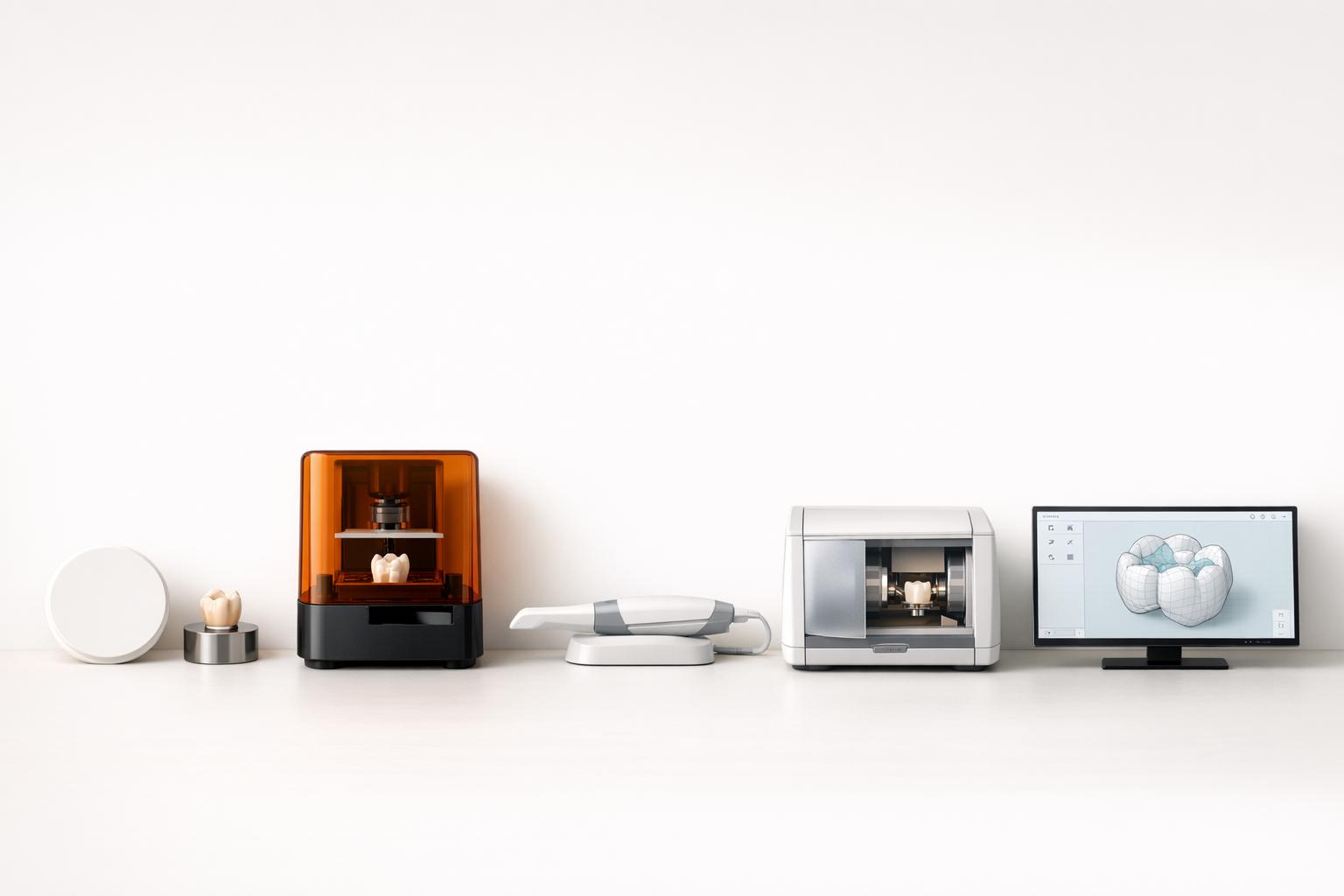
Dental crowns have evolved drastically in recent years, combining cutting-edge materials and digital workflows to offer faster, stronger, and more natural-looking solutions. Here’s what you need to know:
- Zirconia Advancements: Multi-layered zirconia mimics the natural look and strength of teeth, with graded translucency and durability up to 1,300 MPa.
- 3D Printing: AI-powered printers now produce crowns in under 20 minutes, cutting costs and reducing waste.
- Digital Scanning: Intraoral scanners eliminate messy impressions, achieving incredible precision (15 microns) for same-day crowns.
- Same-Day Crowns: Receive a permanent crown in just two hours, avoiding temporary crowns and repeat visits.
- AI-Assisted Design: Algorithms create highly accurate, personalised crowns with minimal manual adjustments.
These advancements save time, reduce patient discomfort, and deliver crowns that look and feel more like natural teeth. Whether it’s the eco-friendliness of 3D printing or the precision of AI-driven workflows, the future of dental care is smarter, faster, and more patient-focused.
Unlocking the Power of One-Hour Crowns with CAD/CAM Technology
sbb-itb-2be92ed
1. Multi-Layered Zirconia with Gradient Translucency
Recent advancements in dental crown fabrication now utilise multi-layered zirconia, designed to closely replicate the look and function of natural teeth.
Aesthetics and Natural Appearance
Multi-layered zirconia achieves a natural look by imitating how teeth transition from the opaque dentine at the base to the translucent enamel at the edges. This is made possible by incorporating different yttria concentrations (commonly 3Y, 4Y, and 5Y) into a single CAD/CAM block [7]. The outer layers, which contain higher levels of cubic zirconia, scatter light more effectively and eliminate the overly white, opaque appearance associated with older zirconia crowns [4][7].
The improvement in translucency is striking. Traditional 3Y-TZP zirconia has a Translucency Parameter (TP) of about 24.0, while the 5Y-PSZ used in the visible layers achieves a TP ranging from 29.7 to 34 [4][6]. The Contrast Ratio also drops from 0.48 to 0.37, producing a crown that looks far less opaque [6]. As the British Dental Journal highlights:
Improving aesthetics while preserving the superior inherent strength of material is a one-of-a-kind combination exhibited by monolithic zirconias [4].
These optical advancements not only enhance appearance but also contribute to better structural integrity.
Strength and Durability
Graded zirconia crowns combine a strong tetragonal zirconia base (with flexural strength between 900–1,300 MPa) with a cubic zirconia surface (providing 500–800 MPa) [7]. This structure allows for thinner crowns – down to just 0.5 mm – while still withstanding chewing forces of up to 900 N [4]. Additionally, graded zirconia is over 25 times more resistant to sliding contact fatigue compared to traditional veneered zirconia, effectively addressing the issue of porcelain chipping [4].
Biocompatibility and Patient Comfort
Beyond aesthetics and durability, graded zirconia offers important biological advantages. Its chemically inert nature and low plaque accumulation promote healthier gum tissue. The material’s strength also enables conservative tooth preparation, preserving more of the natural structure and reducing patient discomfort [7]. Moreover, highly polished zirconia surfaces are "antagonist-friendly", causing less wear on opposing enamel compared to glazed or veneered options [4][7]. Short-term studies on 3D-printed zirconia restorations (part of a broader digital workflow) have even reported a 100% survival rate without any periodontal complications [8].
2. 3D Printing for Crown Fabrication
Advancements in materials have paved the way for 3D printing to revolutionise dental crown production, making it faster and more efficient. This technology is shifting crown fabrication from external labs directly into dental surgeries. Systems like the SprintRay Midas use AI-guided processes and capsule-based resins to produce a crown in under 20 minutes, streamlining the entire workflow [1][3].
Efficiency and Time-Saving Capabilities
3D printing dramatically cuts down production time. The entire process, from preparation to final crown, typically takes 45–75 minutes, a stark contrast to the 2–3 weeks needed for traditional lab-based methods [5]. This allows clinicians to prepare a tooth, perform a scan, initiate printing, and attend to other treatments while the crown is being created [2]. According to Dominate Dental:
Digital crown manufacturing eliminates lab dependencies, reduces patient visits, and creates new revenue streams through same-day premium services. [5]
In terms of cost, material expenses range from $30 to $60 per unit, compared to the $120–$225 associated with traditional lab fees. Practices that adopt chairside 3D printing have reported a 15–25% rise in treatment acceptance rates [5]. Additionally, this technology reduces waste, aligns with eco-conscious dental practices, and eliminates the need for physical impressions versus digital scans, temporary crowns, or repeat anaesthetic injections [1][5].
Strength and Durability
3D-printed crowns aren’t just fast – they’re strong. Resin crowns produced through 3D printing boast flexural strengths of 60–90 MPa and fracture resistance between 1,000 and 1,200 N, rivaling or even surpassing some traditional methods [2]. Hybrid ceramics, which incorporate 40–70% ceramic fillers, offer even greater fracture resistance with less abrasive wear on natural teeth [11]. For instance, formulations reinforced with 10% glass silica microfillers can exceed fracture resistance levels of 2,300 N [12]. These crowns also provide better occlusal refinement and tighter margins, reducing the risk of decay [1]. However, it’s worth noting that 3D-printed resins tend to wear faster, with wear rates of approximately 29.1 µm over five years compared to 14.8 µm for CAD/CAM ceramic crowns [10].
Aesthetics and Natural Appearance
3D printing constructs crowns in ultra-thin layers – sometimes as thin as 50 microns – resulting in highly detailed and smooth surfaces [1][3]. This method allows for precise control over translucency and colour grading, enabling clinicians to match the crown’s shade seamlessly with surrounding teeth [1]. The technology supports the demand for lifelike crowns, with fifth-generation translucent zirconia (5Y-TZP) resins offering a fracture strength of 1,000 MPa and enamel-like translucency. These advancements eliminate the chalky look of older materials [1][3]. As Access Dental Care highlights:
The result is a crown that looks and behaves like a natural tooth structure whilst sparing patients the inconvenience of temporary and repeat appointments. [1]
3. Digital Scanning and CAD/CAM Precision
Digital scanning has revolutionised the way dental impressions are taken. Instead of relying on traditional silicone impressions, intra-oral scanners now capture high-resolution optical data of tooth preparations and the surrounding anatomy. This eliminates common issues like distortions caused by shrinkage or tray movement [5]. These scanners are incredibly accurate, achieving a precision of about 15 microns – far superior to conventional methods [5]. Such precision has seamlessly integrated into a streamlined digital workflow.
Efficiency and Time-Saving Capabilities
One of the standout benefits of digital workflows is the ability to fabricate crowns in a single visit. Systems like CEREC allow for scanning, designing, and seating a crown in roughly two hours, cutting out the typical two-to-three-week wait associated with lab-fabricated restorations [1][5]. Scanning itself takes just 3–5 minutes, and the entire process is completed within 45–90 minutes [1][5]. Practices using these same-day workflows often see a 25–35% increase in case acceptance rates for emergency and aesthetic treatments [5]. This speed and efficiency not only enhance patient satisfaction but also deliver high-quality, durable results.
Aesthetics and Natural Appearance
Digital precision has unlocked the potential of advanced materials, addressing the dull, chalky appearance often seen in older crowns [1]. For example, in five-year mastication simulations, CAD/CAM ceramic crowns demonstrated a wear loss of only 14.8±2.3 µm compared to 29.1±3.7 µm for resin-based crowns. Additionally, their initial surface roughness of 0.30±0.06 µm ensures a consistently smooth and natural finish [10]. These advancements allow for crowns that look and feel more like natural teeth.
Strength and Durability
The materials used in CAD/CAM systems are pre-polymerised, which minimises polymerisation shrinkage and ensures a more predictable fit compared to conventional, lab-processed resins [13]. Digitally fabricated crowns typically feature marginal gaps of just 50 to 80 microns and show around 30% fewer occlusal high points than traditional cast units [1][5]. This tighter fit not only prevents plaque build-up and recurrent decay but also reduces the need for extensive chairside adjustments. The result is a crown that performs well over the long term, both functionally and aesthetically.
As MDPI Materials highlights:
The digital workflow introduces substantial procedural innovations, reducing fabrication time while achieving superior marginal adaptation and precision. [2]
This combination of speed, precision, and durability underscores why digital scanning and CAD/CAM systems are becoming the gold standard in modern dentistry.
4. Same-Day Crown Restorations
Thanks to digital scanning and precise CAD/CAM fabrication, same-day crown restorations have transformed the dental experience. Patients can now receive a permanent crown in just two hours – from the initial digital scan to the final placement [1][3]. This eliminates the need for temporary crowns, which often come with discomfort, a tendency to loosen, and dietary restrictions [14].
Efficiency and Time-Saving Capabilities
Same-day restorations streamline the entire process by integrating multiple technologies into one cohesive workflow. This means no more messy physical impressions, lab-related delays, or repeat anaesthetic injections [14][1]. Dentists can immediately view 3D scans on a screen, make necessary adjustments, and even rescan if needed – all without waiting for a lab to create a physical model [14].
Dr Revan Dawood, Owner of Glisten Dental Studio, highlights the appeal of this approach:
Same-day crown technology offers patients unparalleled convenience for individuals who have busy schedules or less flexible schedules.
This efficiency doesn’t just save time for patients – it also allows dental practices to see more patients in a day, boosting productivity without sacrificing quality [1][3]. The crowns produced are not only quick to fabricate but also meet rigorous strength standards.
Strength and Durability
Digitally fabricated ceramic crowns, whether made of lithium disilicate, zirconia vs. ceramic materials, or advanced 3D-printed resins, are built to last. Research shows that these crowns have an 85% survival rate over five years, matching the durability of traditional cast crowns. Importantly, complication rates remain consistent between the two methods [16].
The materials used in same-day crowns are incredibly strong. For example, fifth-generation translucent zirconia (5Y-TZP) boasts a fracture strength of 1000 MPa, while lithium disilicate offers around 500 MPa in flexural strength [1][3]. Advanced 3D-printed resin restorations can withstand forces between 1000 and 1200 N [2]. Combined with the precision of digital fabrication, these materials result in crowns with 30% fewer occlusal high points and tighter marginal gaps compared to traditional methods [1][3].
Biocompatibility and Patient Comfort
The materials used in same-day crowns are not only strong but also metal-free and biocompatible. This reduces the risk of allergic reactions and enhances patient comfort [1][14]. Additionally, the shorter chair time and fewer injections significantly lower anxiety levels, making this option particularly appealing for patients with dental anxiety [1][3]. Those unsure of their comfort levels can take a dental anxiety quiz to better understand their feelings.
5. AI-Assisted Design and Biocompatible Ceramics
Artificial intelligence is reshaping the way dental crowns are designed and manufactured. In May 2023, researchers at the University of Hong Kong, led by Dr Hao Ding, introduced a generative AI algorithm trained on extensive natural tooth data to create dental crowns [18]. Dr James Tsoi, an Associate Professor in Dental Materials Science, highlighted the significance of this development:
This demonstrates that [the algorithm] could be utilised to design personalised dental crowns with high accuracy that can not only mimic both the morphology and biomechanics of natural teeth, but also operate without any additional human fine-tuning, thus saving additional costs in the production process.
This advancement builds on earlier discussions of digital workflows, improving both the precision and speed of crown design.
Efficiency and Time-Saving Capabilities
The integration of AI into crown design marks a clear shift towards faster and more efficient dental technology. AI-driven design software has been shown to cut design time by 75% compared to traditional CAD methods [19]. Tasks like crown morphology and margin line calculations – once reliant on time-intensive manual input – are now automated, making the process 30% to 50% faster overall [20]. For example, the SprintRay Midas printer, set to debut at IDS 2025, combines AI-guided design with rapid 3D printing, enabling sub-20-minute print times for definitive restorations [1].
This speed not only accelerates production but also allows for real-time adjustments to aesthetic details.
Aesthetics and Natural Appearance
AI algorithms, trained on extensive datasets of natural teeth, excel at replicating intricate anatomical features with remarkable precision [18]. These systems use advanced shade-matching tools and colour-graded internal lattices to achieve translucency levels that blend seamlessly with surrounding teeth [1][17]. By analysing thousands of tooth morphologies, AI ensures superior marginal adaptation and occlusal refinement, addressing common issues like the "chalky" or "grey margin" appearance seen in older restorations [1][18].
Biocompatibility and Patient Comfort
Modern AI-assisted designs are often paired with biocompatible materials, such as fifth-generation translucent zirconia (5Y-TZP), which offers 1000 MPa fracture strength [1]. Materials like PEEK (Poly-ether-ether-ketone) are particularly effective, as they mimic the elasticity of cortical bone, absorb chewing forces, and minimise thermal transfer [1]. These metal-free ceramics not only reduce the risk of hypersensitivity but also promote healthy gingival tissue and resist biological degradation better than metal-based alternatives [4][1].
Comparison Table
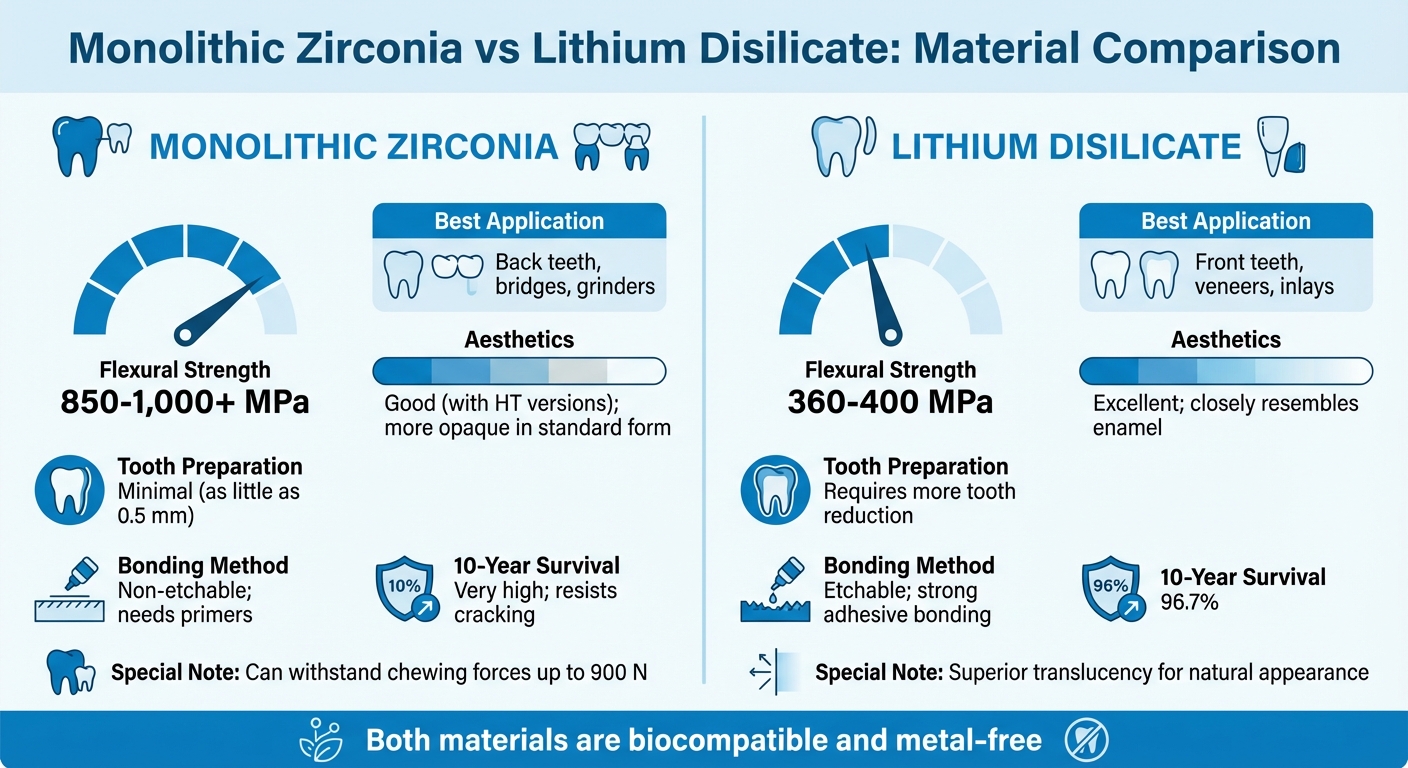
Monolithic Zirconia vs Lithium Disilicate Dental Crowns Comparison
The table below outlines the key differences between advanced crown materials, showcasing how each material performs under different conditions.
Choosing the right crown material depends on where it will be placed and the types of stresses it will endure. Monolithic zirconia stands out for its strength, boasting a biaxial flexural strength of 850 MPa to over 1,000 MPa [21]. This makes it ideal for back teeth (posterior) and for patients who grind their teeth. On the other hand, lithium disilicate shines in terms of aesthetics and translucency, with a flexural strength of 360–400 MPa [21], making it a better fit for front teeth (anterior) where appearance is a priority.
There are compromises, though. Lithium disilicate mimics natural enamel closely but is less durable in high-stress areas, with a 10-year survival rate of 96.7% [21]. On the flip side, zirconia can be reduced to a thickness of just 0.5 mm while still withstanding chewing forces up to 900 N [4]. In contrast, lithium disilicate requires more extensive tooth preparation to maintain its strength. The table below provides a concise comparison of these features:
| Feature | Monolithic Zirconia | Lithium Disilicate |
|---|---|---|
| Flexural Strength | 850–1,000+ MPa [21] | 360–400 MPa [21] |
| Best Application | Back teeth, bridges, grinders [4][21] | Front teeth, veneers, inlays [21] |
| Aesthetics | Good (with HT versions); more opaque in standard form | Excellent; closely resembles enamel [21] |
| Tooth Preparation | Minimal (as little as 0.5 mm) [4] | Requires more tooth reduction [21] |
| Bonding Method | Non-etchable; needs primers [7] | Etchable; strong adhesive bonding [7] |
| 10-Year Survival | Very high; resists cracking [9] | 96.7% [21] |
Both materials are biocompatible and free of metals, making them safe for patients with metal sensitivities [9]. However, zirconia requires careful polishing after adjustments to avoid wearing down opposing teeth [4][9]. These differences highlight how advancements in materials continue to improve dental treatments and patient outcomes.
Conclusion
The move towards digital workflows and cutting-edge materials is transforming the way dental professionals handle crown restorations. Digital crowns are proving to be more precise, with 30% fewer occlusal high points and tighter margins, which significantly lowers the risk of decay [1]. Additionally, advanced materials for chairside restorations provide greater strength and a natural translucency [1][4], ensuring restorations are both long-lasting and visually appealing.
These changes aren’t just about precision – they’re also reshaping the patient experience. Same-day crowns eliminate the need for temporary restorations and reduce the use of anaesthetics, which can help ease patient anxiety [1][3]. The convenience of scanning, designing, and placing a crown in just one visit – usually within 45 to 75 minutes – saves patients time and minimises interruptions to their daily lives [1][5].
For dental professionals, these innovations bring operational benefits too. Digital scanning and CAD/CAM technology not only enhance accuracy but also cut down on material waste. Additive manufacturing, for example, uses about 90% of the starting material, whereas traditional subtractive milling methods waste a significant portion of the ceramic block [15]. This efficiency allows dentists to devote more attention to patient care.
Australian clinics are already leading the charge in embracing these advancements. Practices like Complete Smiles Bella Vista showcase how intra-oral scanning, CAD/CAM systems, and biocompatible materials can provide conservative tooth preparation, better marginal fit, and restorations that closely replicate the natural look and function of teeth [1][4]. These innovations mark a major step forward in improving oral health outcomes and enhancing patient satisfaction.
FAQs
Are 3D-printed dental crowns as durable as traditional crowns?
3D-printed dental crowns, while innovative, still fall short of traditional crowns when it comes to durability – especially in areas like wear resistance and fracture strength. However, newer materials, such as zirconia-reinforced resins, are making strides in closing this gap.
Traditional crowns, typically crafted from porcelain or metal alloys, are well-known for their strength and reliability, backed by years of proven use. On the other hand, 3D-printed crowns bring clear advantages, including quicker production times and highly accurate customisation. As dental technology continues to evolve, these advancements are expected to boost the durability and overall performance of 3D-printed crowns.
What are the advantages of using AI technology in designing dental crowns?
AI technology has transformed the way dental crowns are designed, bringing precision, speed, and personalisation to the process. By enabling the creation of crowns that closely replicate the natural shape, fit, and function of teeth, it significantly reduces problems such as poor fit or the need for adjustments, ultimately leading to better results for patients.
On top of that, AI simplifies and accelerates the design process, cutting down fabrication time while maintaining excellent quality. With advanced algorithms, crowns can be customised to match a patient’s tooth colour and structure with incredible accuracy, boosting patient satisfaction and promoting better long-term oral health.
How does digital scanning enhance the precision of dental crown fittings?
Digital scanning improves the accuracy of dental crown fittings by producing detailed, 3D digital impressions of a patient’s teeth. These scans enable the creation of crowns that fit more precisely, enhancing both comfort and functionality.
Unlike traditional moulds, digital scans significantly reduce the chance of human error. This means fewer adjustments are needed, making the process more efficient and often quicker. The result? Crowns that not only fit better but also look more natural, providing a smoother experience for patients.
Related Blog Posts
- Wear-Resistant Materials in Dental Restorations
- Ceramic Materials in Crowns and Bridges
- CEREC Applications in Dentistry
- Porcelain vs. Ceramic: Strength and Fracture Resistance
Important Notice: Any surgical or invasive procedure carries risks. Before proceeding, you should seek a second opinion from an appropriately qualified health practitioner.
Individual results may vary. The information provided in this article is for educational purposes only and does not constitute medical advice.
Checkout Related Blogs




Get in touch with us
For more information, call us now to start feeling better. Or fill the form below to make appointment
The Latest News from Complete Smiles
How to Clean Clear Plastic Retainers
Checklist for Choosing Wearable Dental Devices
Checklist for Choosing Cloud AI Platforms in Dentistry

Complete Smiles Bella VistaAccepts All Major Health Funds, Including





