





Real-Time AI in Saliva Testing: What to Know

AI saliva testing is changing health diagnostics in Australia by offering faster, pain-free alternatives to blood tests. Using biochemical sensors and machine learning, this technology analyses saliva for health markers, providing results in under five minutes. It’s already being used to detect oral diseases, cancers, and systemic conditions like diabetes and heart disease. Supported by the Australian Dental Association and backed by significant research funding, AI saliva testing is making healthcare more accessible, especially in rural areas.
Key Highlights:
- Non-invasive and quick: Saliva collection is painless and delivers results faster than traditional methods.
- Wide diagnostic scope: Detects over 5,000 biomarkers for oral and systemic diseases.
- AI-powered accuracy: Machine learning ensures precise analysis, even in complex samples.
- Accessible for all: Affordable and portable, ideal for remote communities and at-home testing.
- Regulatory support: Endorsed by professional bodies like the Australian Dental Association.
AI saliva testing is not without challenges, including regulatory approvals and the need for standardised protocols. However, ongoing research is addressing these issues, paving the way for broader adoption in dental practices and beyond.
From Saliva to Science: Biomarkers that Speak Volumes
sbb-itb-2be92ed
How AI Saliva Testing Works
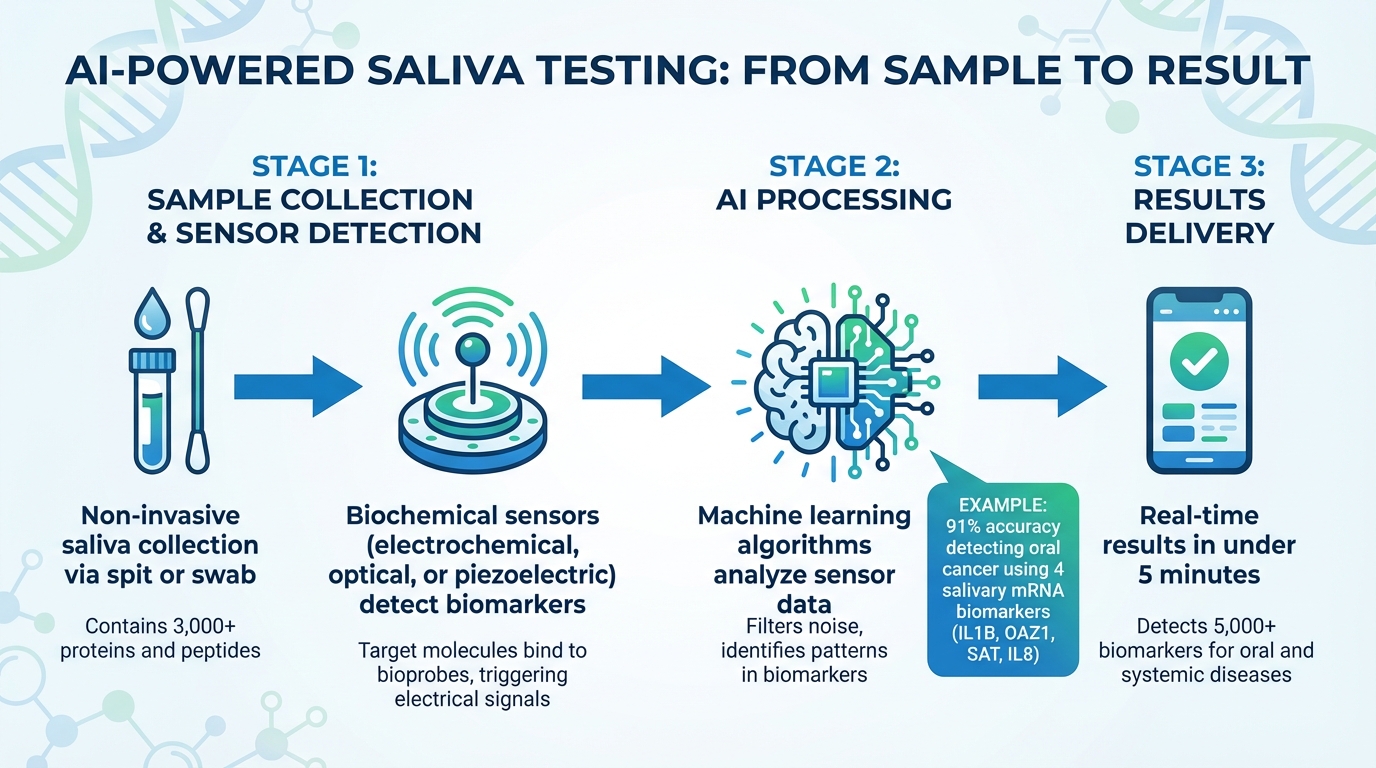
How AI Saliva Testing Works: From Sample Collection to Results
AI saliva testing blends advanced biochemical sensors with machine learning to identify health markers in real-time. At the heart of the system is a transducer – whether optical, electrochemical, or piezoelectric – paired with biological recognition elements like enzymes, antibodies, or nucleic acids. When a target molecule interacts with the sensor, it triggers an electrical signal that can be instantly analysed [6].
Biochemical Sensor Technology
Electrochemical sensors are the go-to choice for analysing saliva in real-time. These sensors detect electrical changes – like current, resistance, or potential – when a target molecule binds to bioprobes on a modified electrode [6][3]. One standout technology, EFIRM, employs a cyclic electric field to rapidly detect DNA or RNA, offering accuracy comparable to tissue biopsies [9].
For a more cost-effective alternative, label-free electrochemical sensors step in. Using nanomaterials such as carbon nanotubes or gold electrodes, these sensors achieve high sensitivity and low detection limits without relying on optical methods [6]. A notable development in 2018 saw the creation of a smartphone-based sensor capable of detecting salivary α-amylase, a key stress biomarker. This device used a sensing chip preloaded with reagents to convert α-amylase into maltose, delivering quantitative stress results in less than five minutes [6].
Once the sensors capture this precise data, machine learning algorithms take over to process it further.
Real-Time Data Processing
AI algorithms enhance the capabilities of these sensors by interpreting the collected data. Machine learning models – often integrated into edge computing devices or smartphones – quickly identify patterns in biomarkers. For instance, a logistic regression model analysing four salivary mRNA biomarkers (IL1B, OAZ1, SAT, and IL8) demonstrated 91% accuracy in detecting oral squamous cell carcinoma [9][5]. These algorithms also excel at filtering out noise in complex saliva samples, distinguishing tumour-related miRNA from those linked to immune responses or local inflammation [9].
Non-Invasive Testing Benefits
Salivary tests via spit or swab are painless and avoid the discomfort of blood tests [3][6]. Saliva contains over 3,000 proteins and peptides, with 20% to 30% of its proteome overlapping with that of plasma, making it a reliable indicator of overall health [5][9]. Humans produce between 1 and 1.5 litres of saliva daily, and salivary cortisol remains stable for up to three months at 5°C and as long as a year at -20°C [6].
Michael Tu from the School of Dentistry at the University of California Los Angeles highlights the potential of saliva in healthcare advancements:
"Saliva is a non-invasive biofluid, which is easy to collect, transport, and store… one of the best candidates for the advancement of point-of-care medicine" [3].
Biomarkers Detected in Saliva
Since the 1980s, our understanding of saliva’s proteome has grown immensely. This once-overlooked biological fluid now offers a wealth of information about both oral and systemic health. With over 3,000 proteins identified in saliva [10], AI-driven tools can now detect a wide range of conditions, from gum disease to cardiovascular issues. These biomarkers provide a pathway to pinpoint not just local oral health problems but also broader health concerns.
Oral Health Biomarkers
One of the key indicators of periodontal tissue destruction is Matrix Metalloproteinase-8 (MMP-8) [5][10]. When paired with inflammatory markers like IL-1β, IL-6, and IL-8, AI systems can assess both the onset and severity of periodontitis [5][10]. For dental caries, the focus shifts to microbial activity, particularly the presence of Streptococcus mutans and Lactobacillus. Elevated levels of S. mutans (>10⁶/mL) and Lactobacillus (>10⁵/mL) are strongly linked to high caries activity [12].
Detecting oral cancer relies on genetic material found in saliva. A specific combination of four salivary mRNAs – IL1B, OAZ1, SAT, and IL8 – has shown 91% sensitivity and specificity for identifying oral squamous cell carcinoma [9]. Additionally, salivary circulating tumour DNA (ctDNA) has demonstrated 100% sensitivity for oral cavity cancers, significantly outperforming plasma-based tests, which achieve only 80% sensitivity [9].
Systemic Health Indicators
Saliva doesn’t just reflect oral health – it also provides a snapshot of the body’s overall condition. Biomarkers from the bloodstream enter saliva through mechanisms like passive diffusion, active transport, or ultrafiltration [8][9]. This makes saliva a powerful tool for detecting systemic conditions.
For example, salivary glucose, α-2-macroglobulin, C-reactive protein (CRP), and cardiac troponin serve as non-invasive alternatives to traditional blood tests for monitoring diabetes and cardiovascular health [8][12]. Notably, salivary CRP levels closely mirror those in plasma, offering a convenient option for heart disease screening [8]. Stress levels can also be effectively monitored through salivary cortisol measurements [11][12].
Salivary exosomes – tiny protective vesicles – preserve genetic material like miRNA, allowing AI to identify cancers located far from the oral cavity. For instance, saliva can reveal markers for lung cancer (EGFR mutations), pancreatic cancer (KRAS), and breast cancer (CA15-3) [9][12]. A practical example of this technology in action is the OraQuick In-Home HIV Test, which the U.S. FDA approved in 2012. This test detects salivary antibodies with 99.98% specificity and 93.0% sensitivity [8].
These systemic biomarkers are paving the way for saliva to become an integral part of clinical diagnostics, offering a non-invasive and accessible alternative for health monitoring.
Clinical Applications in Dental Care
With advancements in real-time AI analysis, saliva testing has become a regular feature in modern dental practices, transforming how diagnoses and treatment plans are developed. By incorporating AI-powered tools, dentists can now detect diseases earlier and tailor treatments more effectively.
Early Disease Detection
Traditional methods like visual and tactile examinations often miss early signs of oral cancer, identifying only 29% of early-stage cases [7]. In contrast, AI-driven metatranscriptomic classifiers, which analyse microbial RNA activity, boast a 92.3% sensitivity for detecting Stage 1 oral cancer. This significant improvement raises 5-year survival rates from 39%–65% for late-stage cases to an impressive 84% when caught early [7].
Point-of-care devices now deliver diagnostic results in under five minutes during routine dental check-ups [7]. For conditions like periodontitis, AI systems monitor Matrix Metalloproteinase-8 (MMP-8) levels to track disease progression and assess treatment effectiveness in real time [5]. This fast-tracked process allows dentists to evaluate immune responses immediately, enabling prompt clinical action without the delays associated with lab testing.
Salivary testing is particularly valuable for high-risk groups, such as tobacco users and people over 50, offering a proactive way to screen for oral premalignant disorders before symptoms appear [7].
Customised Treatment Plans
AI-powered saliva testing supports what experts call "precision dentistry", where treatment strategies are tailored to an individual’s unique genomic and microbial profile [5][1]. Unlike one-off tests, repeated saliva analyses provide insights into trends and disease progression, helping dentists adjust treatment plans based on how a patient responds [5].
"The outcome might help to detect personalised salivary pattern in reaction to different trigger and in future to compute custom-fit therapies for precision dentistry."
– Tim Joda, Clinic of Reconstructive Dentistry, University of Zurich [5]
These advanced AI-integrated biosensing devices can even track drug levels in saliva in real time, ensuring medications stay within the optimal therapeutic range [2][4]. Over time, this longitudinal tracking establishes personalised baselines, making it easier to spot subtle changes that could signal the onset of disease [5].
At-Home Testing Options
For added convenience, at-home saliva tests are now widely available across Australia through major retailers like Coles and Chempro Chemists [13][15]. In fact, the Australian self-testing market is projected to reach $293.4 million by 2024 [13].
One standout is the SaliStick, which earned TGA approval in late 2024 and boasts accuracy rates of 96% to 97% [13][15]. These devices sync with smartphone apps to provide real-time AI-driven interpretations, converting complex biomarker data into easy-to-understand health insights [14]. Another example, the Hormometer™, has shown 94%–97% agreement with gold-standard lab tests [14].
"Australia’s rapid uptake reinforces how ready consumers are for next-generation diagnostics."
– Dr. Guy Krief, Co-Founder and Deputy CEO, Salignostics [13]
At-home testing complements in-clinic assessments and offers a game-changing solution for patients in remote areas. Saliva collection is about 48% cheaper than blood testing, as it eliminates the need for specialised staff and equipment [14]. Research also shows that 68% of women prefer saliva-based methods over traditional options [15], underlining its appeal. For optimal accuracy, patients using at-home kits should wait at least 30 minutes after eating or drinking before collecting a sample [15].
Benefits of AI Saliva Testing
AI saliva testing offers a range of advantages for both patients and dental practices, combining ease, precision, and affordability to improve health outcomes and streamline care.
Patient Comfort
Collecting saliva is quick, pain-free, and straightforward. Unlike blood tests that require needles and trained professionals, saliva samples can be gathered by simply spitting into a tube or using a swab. This non-invasive method is not only more comfortable but also allows for frequent sampling, making it ideal for tracking disease progression or treatment effectiveness. For example, conditions like periodontitis – which impacts 47% of Australian adults – can be monitored more effectively with this approach. The Australian Dental Association supports the use of saliva-based diagnostics for both oral and systemic diseases, further underscoring its value [1].
Improved Accuracy
AI plays a key role in turning saliva samples into highly accurate diagnostics. By applying machine learning to analyse proteomics and transcriptomics data, these tools can detect specific biomarkers with remarkable speed and precision. Portable biosensors can deliver results in as little as 30 seconds to five minutes, depending on the complexity of the biomarker. Techniques like EFIRM (Electric Field-Induced Release and Measurement) push the boundaries even further, identifying biomarkers in under 30 minutes. These advancements are backed by substantial research investments in salivary diagnostics [2][3].
This level of precision not only speeds up the diagnostic process but also makes testing more accessible and cost-effective.
Cost and Access
Saliva testing removes the need for specialised staff, sterile equipment, or expensive third-party lab services. This is especially valuable for dental practices in rural areas of Australia, where access to traditional pathology labs may be limited. By enabling early detection of conditions like oral cancer and periodontitis, saliva testing can help patients avoid costly surgeries or long-term treatments. Additionally, the efficiency of AI-driven testing reduces the need for multiple follow-up visits, streamlining workflows for clinics and improving early diagnosis pathways for patients [2][3].
Current Limitations and Future Development
AI saliva testing holds great promise, but there are still technical and regulatory challenges that need to be addressed before it becomes a standard tool in Australian dental practices. Understanding these obstacles is key to appreciating the path this technology must take to reach its full potential.
Clinical Testing and Regulatory Requirements
One of the main hurdles is that biomarkers are found in much lower concentrations in saliva than in blood, making detection more difficult[4][8]. Saliva’s natural viscosity and high protein levels can also interfere with the extraction of these biomarkers[4]. On top of that, saliva composition varies throughout the day and can be influenced by factors like chewing, smells, and even pain[11].
For AI saliva testing to gain trust in clinical settings, rigorous trials are needed to prove its diagnostic accuracy. Any software designed for therapeutic use must also be registered with the Therapeutic Goods Administration (TGA) as a medical device[16][17]. Another challenge is the lack of standardised protocols for collecting and processing saliva, which makes achieving consistent results in clinical practice tricky[4][8]. These regulatory and technical barriers highlight the complexities of incorporating AI diagnostics into routine dental care.
Adoption in Dental Practices
Even after clinical validation, rolling out this technology in everyday dental practices won’t be straightforward. For starters, insurance companies, dentists, and other healthcare professionals need to see clear evidence of cost-effectiveness before they embrace it[8]. Additionally, dental practices must confirm that any AI diagnostic tools are listed on the Australian Register of Therapeutic Goods (ARTG)[16].
Training dental professionals is another critical step. AI tools are designed to assist, not replace, dentists. Practitioners need to understand how to use AI as a "second opinion" while maintaining ultimate responsibility for patient care. This includes recognising AI errors or "hallucinations" that could lead to incorrect diagnoses[16][18].
"Practitioners must apply human judgement to any output of AI. Regardless of what technology is used to advance healthcare, the practitioner remains responsible for delivering safe and quality care." – Dental Board of Australia [17]
Research Directions
Efforts to overcome these challenges are driving exciting research into more reliable and continuous monitoring solutions. For example, the National Institute of Dental and Craniofacial Research (NIDCR) allocated over $3 million to salivary diagnostics research in fiscal year 2024[2].
Researchers are exploring wearable oral devices and biosensors capable of providing real-time health monitoring[4]. Multi-marker assays, which can detect several biomarkers at once, are also being developed to enhance sensitivity compared to single-marker tests[4]. Technologies like EFIRM (Electric Field-Induced Release and Measurement) are pushing the boundaries by identifying biomarkers in under 30 minutes. In fact, salivary circulating tumour DNA (ctDNA) analysis using EFIRM has shown 100% sensitivity for detecting oral cancer[9].
These advances suggest that, while challenges remain, the future of AI saliva testing is brimming with potential.
Conclusion
Real-time AI saliva testing is reshaping how oral and systemic health is monitored across Australia. By offering a non-invasive and accessible screening method, this technology opens up regular health checks to more people, especially those in rural and remote areas where access to specialised medical equipment can be limited[2]. With results available in as little as five minutes, dentists can now identify conditions like periodontitis and cardiovascular risks during standard check-ups[2]. This advancement allows dental professionals to seamlessly incorporate broader diagnostic capabilities into everyday care.
The Australian Dental Association supports the use of salivary diagnostics for assessing both oral and systemic health[1]. This endorsement highlights the expanding role of dentists in early disease detection and precision care, where treatments are customised based on an individual’s genetic profile and real-time biomarker data[1][5].
"Saliva-based diagnostic tools offer significant advantages over blood, such as being accessible, cost effective, fast, repeatable, and safe." – National Institute of Dental and Craniofacial Research[2]
Although challenges like standardisation, regulatory approval, and clinical validation still need to be addressed, ongoing research is making steady progress in overcoming these hurdles[2]. Future developments even point toward options for continuous, at-home monitoring[2][3].
With these advancements, dental care in Australia is moving toward a more personalised and proactive approach. For both patients and practitioners, staying informed about these innovations ensures readiness for a future where routine dental visits evolve into comprehensive health assessments, enhancing overall wellbeing. As this technology continues to develop, it holds the potential to redefine the role of dentistry in preventive health care.
FAQs
Is AI-powered saliva testing as accurate as traditional blood tests?
Currently, there’s not enough evidence to definitively compare how accurate AI-powered saliva tests are when stacked up against traditional blood tests. Each method brings its own advantages and serves different needs. Saliva testing, for instance, is non-invasive and super convenient, making it a great option for routine monitoring. On the other hand, blood tests are often relied upon for more detailed and thorough diagnostics.
As research into AI-driven saliva testing progresses, its potential to contribute to better oral and overall health care is becoming increasingly apparent.
What challenges are slowing the adoption of AI in saliva testing for healthcare?
Real-time AI saliva testing in Australia faces several hurdles before it can be widely used in healthcare. One major issue is biological variability in saliva. Factors like flow rate, pH levels, and enzyme activity can fluctuate, making it tricky to collect consistent, high-quality samples. On top of that, many biomarkers in saliva are found in extremely low concentrations, which limits the sensitivity of current testing methods. Adding to the complexity, there’s no standardised framework for defining or measuring salivary biomarkers, leading to inconsistent results across laboratories and making it harder to validate AI models.
Another significant challenge is the integration of AI testing into clinical workflows. For these systems to work effectively, devices need to combine precise biosensors with dependable, real-time data transmission. However, technical issues such as sensor drift, high power consumption, and ensuring data security still need to be addressed. Meeting the stringent requirements of the Australian Therapeutic Goods Administration (TGA) is another critical step, and the high costs of these systems can be prohibitive for smaller healthcare practices.
Despite these barriers, if validated, AI saliva testing could become an important tool for dental clinics, particularly those focused on comprehensive care. It has the potential to improve oral health assessments and align practices with evidence-based guidelines.
How can AI-driven saliva testing help with at-home health monitoring?
AI-powered saliva testing turns a simple spit sample into a fast and precise health check, analysed instantly through a smartphone or tablet. By studying proteins, hormones, DNA fragments, and other biomarkers in saliva, AI can uncover stress levels, hormonal shifts, infections, or even early signs of oral and general health concerns.
For Australians, this approach is especially practical. Tests can be done from the comfort of home, with results displayed in familiar metric units like nmol/L, and fees clearly shown in AUD. Wearable devices or handheld tools enable either continuous or on-demand sampling, while cloud-based AI delivers instant feedback, making regular health monitoring straightforward. This technology also equips dental professionals with detailed insights before appointments, allowing them to address potential problems early – often without the need for repeated clinic visits.
When combined with telehealth platforms, AI saliva testing empowers patients to take charge of their oral and overall health. It enables them to track changes over time, spot trends, and reduce the need for in-person consultations.
Related Blog Posts
- AI Research in Oral Disease Detection: Key Findings
- Salivary Tests for Early Detection of Gum Disease
- AI in Dentistry: Benefits of Personalised Oral Health Insights
- AI in Oral Cancer Detection: How It Works
Important Notice: Any surgical or invasive procedure carries risks. Before proceeding, you should seek a second opinion from an appropriately qualified health practitioner.
Individual results may vary. The information provided in this article is for educational purposes only and does not constitute medical advice.
Checkout Related Blogs




Get in touch with us
For more information, call us now to start feeling better. Or fill the form below to make appointment
The Latest News from Complete Smiles
How to Clean Clear Plastic Retainers
Checklist for Choosing Wearable Dental Devices
Checklist for Choosing Cloud AI Platforms in Dentistry

Complete Smiles Bella VistaAccepts All Major Health Funds, Including





