





What Happens at an Orthodontic Consultation

An orthodontic consultation is your first step towards understanding and addressing issues like misaligned teeth, jaw problems, or bite irregularities. Here’s what to expect:
- Preparation: Bring your dental and medical history, a list of medications, and any recent X-rays. Prepare questions about treatment options, costs, and timelines.
- Arrival: Check in, complete any forms, and provide insurance details if applicable.
- Examination: The orthodontist will assess your teeth, jaw, and bite using tools like X-rays, photos, and 3D scans.
- Discussion: You’ll review findings, explore treatment options (braces, clear aligners, etc.), and discuss costs and payment plans.
- Next Steps: Finalise your treatment plan and book follow-up appointments.
This consultation provides clarity on your dental health and sets the stage for a personalised treatment plan.
What Happens at your First Orthodontic Appointment?
sbb-itb-2be92ed
How to Prepare for Your Orthodontic Consultation
A little preparation can make your orthodontic consultation more productive and focused on what you need.
Gathering Your Medical and Dental History
Before recommending treatment, your orthodontist needs a full understanding of your overall health. This includes more than just your teeth – medical conditions, surgeries, and medications can all play a role in shaping your care.
"A complete medical/dental history can reveal conditions or medications that affect treatment decisions [and] identify medications that may interact with anesthetics." – American Dental Association [2]
Prepare a list of all current medications, including supplements, and note any health conditions. Be sure to include contact details for your GP or any specialists you see. If you’ve had dental or orthodontic treatments in the past 12 to 24 months, bring those records along. Prior X-rays can also be helpful, potentially saving you from needing new scans [2].
Questions to Ask Before Your Visit
Having a few questions ready can help you get the most out of your consultation. Think about what’s most important to you. For example:
- How long will treatment take? Most orthodontic treatments last between one and two years, though this can vary depending on the complexity [3].
- What are my options? Ask whether metal braces, clear braces, or Invisalign aligners might work best for your situation. If you’re interested in clear aligners, check if you’re a good candidate [3].
Don’t forget practical questions, too. Ask about dietary restrictions, tips for maintaining oral hygiene during treatment, and what counts as an orthodontic emergency – plus how the practice handles emergencies [3].
What to Bring to Your Appointment
Having the right documents and information on hand can make your appointment run smoothly. Bring your health insurance card (if applicable), photo ID, referral letter, and a list of medications. If you’ve recently had X-rays done at another clinic, request copies ahead of time.
If you don’t have a regular GP, keep in mind that some orthodontists may check your blood pressure, especially if unmanaged health issues are a concern [2].
With everything in place, you’ll be ready to move forward with the diagnostic stage of your consultation.
What Happens During the Consultation
Arriving and Checking In
When you arrive, the front desk team will welcome you and guide you through the check-in process. If you haven’t completed your patient forms online beforehand, you’ll need to fill them out at this stage. These forms gather essential details such as your personal information, medical and dental history, any health concerns, and treatment preferences.
"Upon arrival, you will be greeted by the orthodontic office staff, who will provide you with some paperwork to fill out, if you haven’t already completed this online." – American Association of Orthodontists [1]
The staff will also collect your health fund details to estimate what expenses might be covered. If you’re feeling nervous, let them know – they’re there to help. Once everything is sorted, you’ll move on to the diagnostic stage.
Diagnostic Examinations and Assessments
After being called in, the orthodontist will perform several assessments to thoroughly evaluate your teeth, jaw, and bite. Here’s what you can expect:
| Diagnostic Tool | Purpose |
|---|---|
| Visual Exam | Examines alignment issues and facial structure |
| Bite Analysis | Detects overbites, underbites, crossbites, or open bites |
| X-rays | Checks tooth roots, jawbone health, and any impacted teeth |
| Photographs | Provides a baseline for tracking treatment progress |
| Impressions or 3D Scans | Creates detailed models of your teeth for planning |
Many clinics now use digital intraoral scanners instead of traditional moulds. These scanners are more comfortable and produce highly precise 3D models. The orthodontist might also assess your gum health and jaw joint (TMJ) function, as these factors may influence your treatment options.
If you have habits like teeth grinding or nail-biting, mention them during this stage – they can affect the treatment plan. Once the assessments are complete, the orthodontist will go over the findings with you.
Going Over the Findings with Your Orthodontist
Following the diagnostic exams, the orthodontist will review your X-rays, photos, and scans to explain any issues, such as overcrowding or bite problems, and their impact on your oral health and daily function.
This part of the consultation typically lasts 20–30 minutes [4] and allows for an open conversation. The orthodontist will discuss potential treatment options, whether that’s Invisalign vs traditional braces, or other appliances. Some clinics may even show you sample appliances or physical models to give you a better understanding of how each option works.
"This conversation helps you understand any orthodontic issues the doctor sees and their implications on oral health." – American Association of Orthodontists [1]
Feel free to ask any questions during this discussion. You could inquire about treatment duration, what it feels like to wear the appliance, and the benefits beyond appearance, like improved chewing or speech. This is your chance to clarify everything before moving forward with a plan.
Treatment Planning and Costs
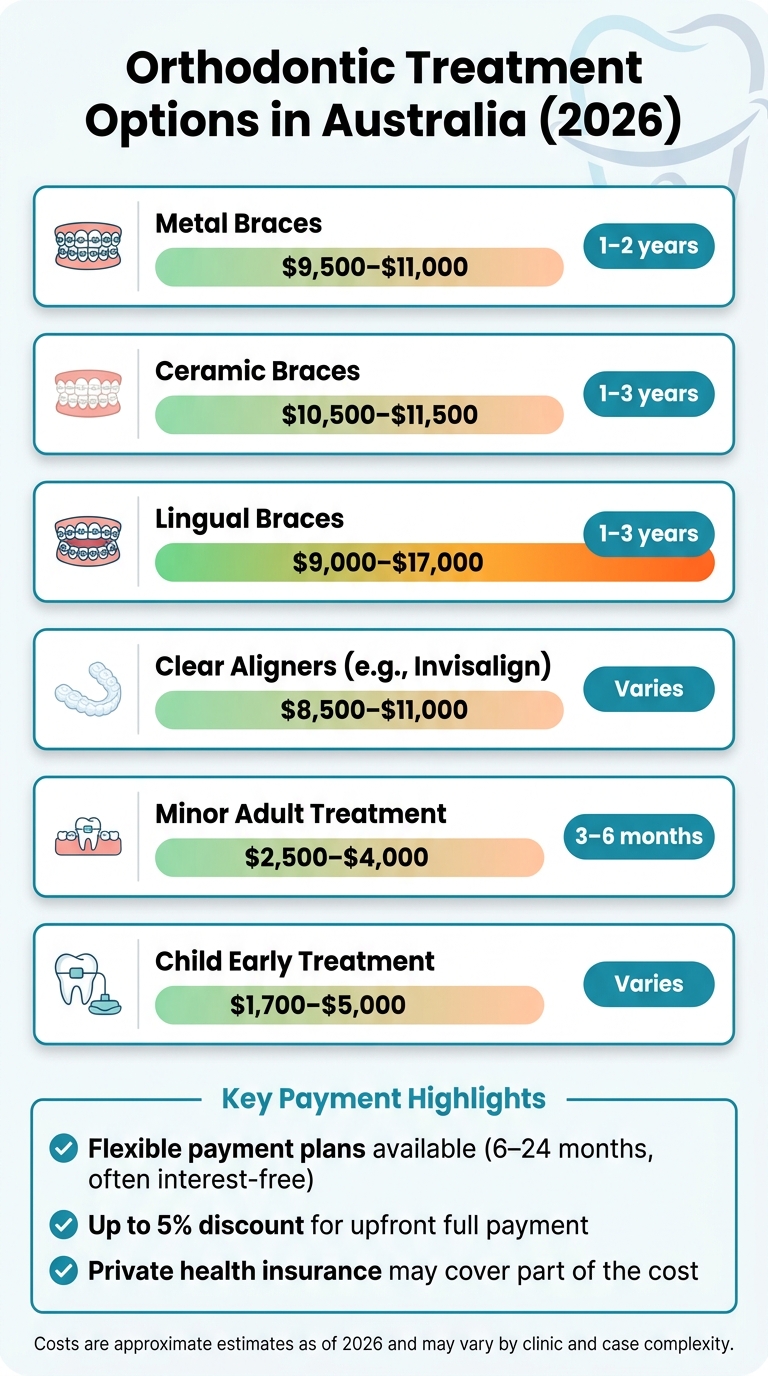
Orthodontic Treatment Options: Cost & Duration Comparison (Australia 2026)
How Your Treatment Plan Is Tailored to You
After your diagnosis, your orthodontist will create a plan specifically designed for your dental needs [1][4]. This plan is shaped by factors like the type of appliance you’ll use, the expected treatment duration, and key milestones along the way. For aligner therapy (when you compare Invisalign providers), custom trays are made using a 3D scan of your teeth. These trays are typically worn for two weeks at a time. If braces are your choice, the process starts with a two-hour fitting session, followed by adjustment visits scheduled every 6 to 10 weeks [4].
Your orthodontist will also explain what happens after treatment, emphasising the importance of retainers to maintain your results.
"The general rule is ‘wear your retainers for as long as you want your teeth to stay straight’." – First Choice Dental [4]
Once your plan is finalised, the next step is understanding the costs involved.
Payment Options and Health Fund Cover
Orthodontic treatment costs in Australia depend on the type of appliance and the complexity of your case. Below is an approximate cost breakdown for various treatments as of 2026 [7]:
| Treatment Type | Estimated Cost | Typical Duration |
|---|---|---|
| Metal Braces | $9,500 – $11,000 | 1 – 2 years |
| Ceramic Braces | $10,500 – $11,500 | 1 – 3 years |
| Lingual Braces | $9,000 – $17,000 | 1 – 3 years |
| Clear Aligners (e.g., Invisalign) | $8,500 – $11,000 | Varies |
| Minor Adult Treatment | $2,500 – $4,000 | 3 – 6 months |
| Child Early Treatment | $1,700 – $5,000 | Varies |
Many orthodontic clinics offer flexible payment plans, often interest-free, ranging from 6 to 24 months. Some even provide up to a 5% discount if you pay the full amount upfront [6][7]. Additionally, private health insurance may cover part of the cost. Be sure to check your policy for orthodontic benefits, waiting periods, and any lifetime limits [5].
Before committing, request a written quote that clearly lists everything included – such as pre-treatment assessments, consultations (including emergency visits), X-rays, appliances, and post-treatment retainers. This ensures you’re not caught off guard by unexpected expenses. Clinics like Complete Smiles Bella Vista also offer flexible payment options to help make treatment more affordable.
Booking Your Follow-Up Appointments
Once you’ve sorted out your treatment plan and costs, the next step is to book your follow-up appointments. At the end of your consultation, schedule your appliance fitting and regular check-ups. For braces, the fitting session generally takes about 2 hours [4]. If you’re using aligners, your appointments may be shorter since the trays are pre-made. Follow-up visits, which usually last 30 to 60 minutes, are scheduled every 4 to 10 weeks, depending on your treatment plan [4][5]. Booking these ahead of time ensures that your treatment stays on track.
Conclusion: Taking the First Step Towards Better Oral Health
An orthodontic consultation is your gateway to understanding your dental needs. From the moment you check in to the diagnostic assessments, every step is designed to inform you about your oral health – not to push you into a decision.
Each phase of the consultation builds on the last, ensuring you walk away with a clear picture of your next steps. You’ll leave with a detailed diagnosis of your orthodontic needs, a personalised treatment plan with clear timelines, and a breakdown of costs along with payment options. As the American Association of Orthodontists aptly states, "The first visit to the orthodontist lays the groundwork for your future smile." [1]
Orthodontic care doesn’t just improve the appearance of your smile. It can also enhance dental function, making tasks like chewing and speaking easier and more effective [1]. It’s an investment that benefits both the aesthetics and functionality of your oral health. This tailored and transparent approach ensures you’re set up for success.
If you’re ready to take the next step, booking a consultation is easy. Many practices, such as Complete Smiles Bella Vista, offer initial consultations to help you explore your options without any obligations. Schedule your consultation today to begin your journey toward a healthier, more confident smile.
FAQs
Do I need a referral for an orthodontic consultation?
No, in Australia, you usually don’t need a referral to see an orthodontist. You can directly schedule an appointment with an orthodontist or a dental clinic that provides orthodontic services.
Will I get braces or aligners on the first visit?
During your first orthodontic consultation, you generally won’t walk away with braces or aligners. Instead, this visit is all about evaluating your teeth, conducting a thorough examination, and developing a treatment plan tailored specifically to you.
How do I know what’s included in the quoted price?
During your orthodontic consultation, the orthodontist will evaluate your dental needs, review your medical and dental records, and may perform X-rays or scans. They’ll walk you through the available treatment options, provide a cost estimate, and outline what’s included in the quoted price. It’s a good idea to ask about any specific services, exams, or appliances that are covered to avoid unexpected expenses. This helps ensure you fully understand your treatment plan and any potential extra costs.
Related Blog Posts
- Pre-Orthodontic Treatment Checklist: What to Know
- 5 Factors Affecting Orthodontic Treatment Feasibility
- Orthodontic Planning: Setting Realistic Goals
- How Orthodontists Monitor Treatment Progress
Important Notice: Any surgical or invasive procedure carries risks. Before proceeding, you should seek a second opinion from an appropriately qualified health practitioner.
Individual results may vary. The information provided in this article is for educational purposes only and does not constitute medical advice.
Checkout Related Blogs




Get in touch with us
For more information, call us now to start feeling better. Or fill the form below to make appointment
The Latest News from Complete Smiles
How to Clean Clear Plastic Retainers
Checklist for Choosing Wearable Dental Devices
Checklist for Choosing Cloud AI Platforms in Dentistry

Complete Smiles Bella VistaAccepts All Major Health Funds, Including





