





How Metal Braces Work: A Simple Guide
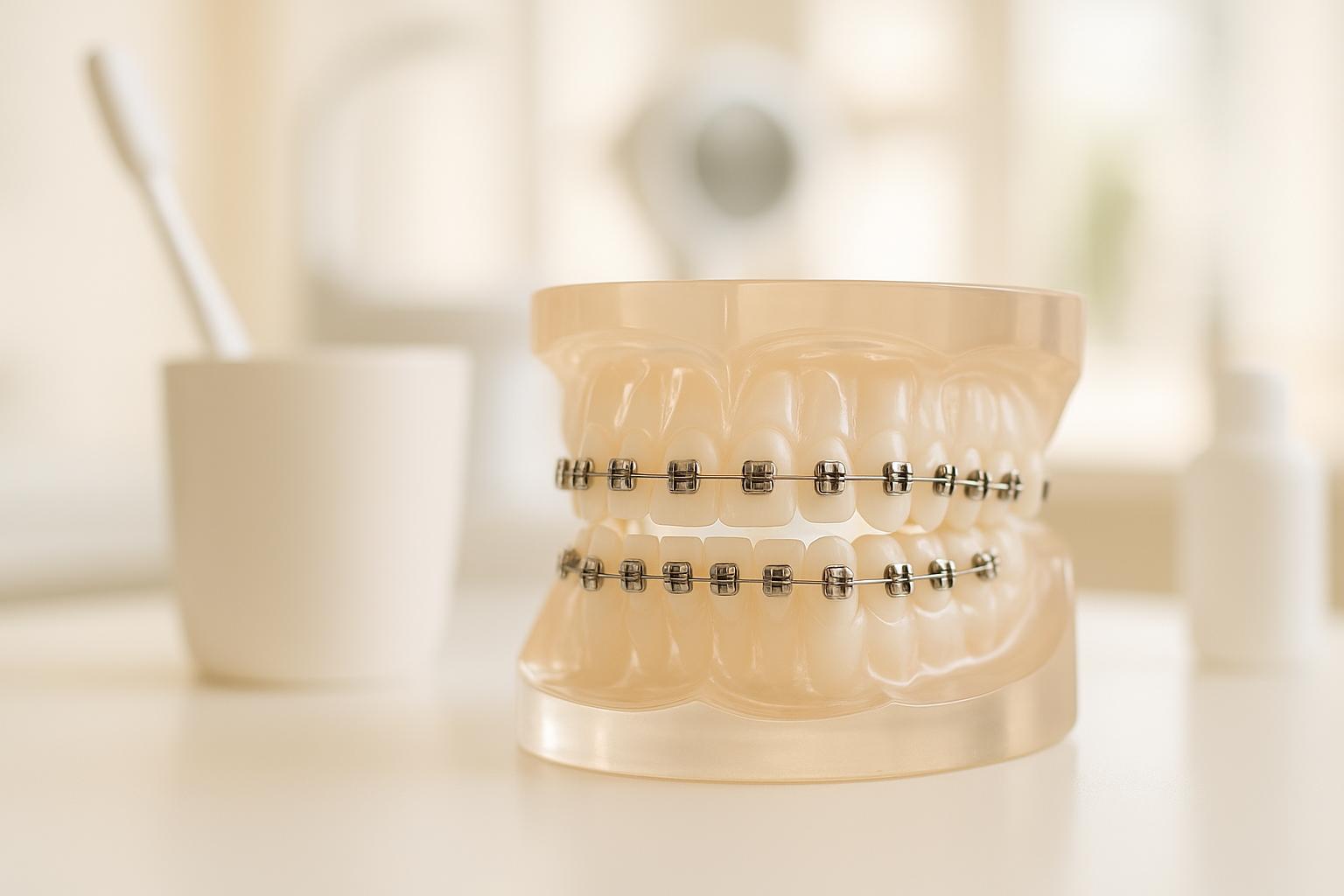
Metal braces are a reliable and cost-effective orthodontic treatment used to straighten teeth and correct bite issues. They consist of stainless steel brackets, an archwire, and elastics, all working together to gradually shift teeth into proper alignment. Here’s what you need to know:
- How They Work: Braces apply consistent, gentle pressure to teeth through the archwire, which is attached to brackets. This pressure triggers a natural process called bone remodelling, allowing teeth to move.
- Treatment Duration: Most people wear braces for 12–36 months, depending on the complexity of their case.
- Cost in Australia: Typically ranges from A$3,000 to A$6,000, making them a budget-friendly option compared to alternatives like ceramic braces or Invisalign.
- Benefits: Durable, effective for complex misalignments, and suitable for all ages.
- Challenges: They are visible, require dietary adjustments, and demand careful oral hygiene to prevent plaque buildup.
Metal braces remain a trusted choice for orthodontic care, offering predictable results when paired with regular adjustments and good maintenance habits.
How braces move teeth (time-lapse) – Braces Explained!
Key Components of Metal Braces
Metal braces are made up of several essential parts that work together to straighten your teeth. Each component plays a specific role in guiding tooth movement, and understanding how they function can give you a better appreciation for the precision behind your orthodontic treatment.
Brackets and Bands
Brackets are tiny stainless steel pieces that serve as the foundation of the braces system. They act as anchor points for the archwires, which are responsible for guiding your teeth into the correct positions [1][3].
For molars and other back teeth, orthodontists often use metal rings called molar bands. These bands wrap around the tooth, providing extra support and stability for the braces system [1]. With brackets and bands securely in place, the archwire takes over to direct the movement of your teeth.
Archwires
The archwire is a thin, flexible wire that connects all the brackets and applies the necessary force to move your teeth [1]. Orthodontists choose archwires carefully, based on the stage of your treatment and your specific needs.
- Nickel-Titanium (NiTi) wires: Ideal for the early stages of treatment, these wires are superelastic and exert gentle, consistent pressure, even on crowded teeth.
- Copper NiTi wires: These respond to temperature changes, making them easier to place on teeth that are tightly packed.
- Beta Titanium wires: These have a balance of flexibility and stiffness, sitting between stainless steel and NiTi wires.
- Stainless steel wires: Stiffer and stronger, these are used in the later stages of treatment when precise adjustments and space closure are needed [5].
The choice of archwire depends on factors like the shape of your dental arch, the treatment phase, and the desired tooth movements. Along with archwires, other elements help fine-tune the forces needed for bite corrections.
Elastics and Ligatures
Ligatures are small elastic bands that hold the archwire securely to each bracket, ensuring the wire can apply the exact forces needed to move your teeth [1][3]. Without them, the system wouldn’t work as effectively.
Larger elastic bands, or elastics, are used to apply additional force for correcting bite issues. These elastics come in different types, each serving a specific purpose:
| Elastic Type | Purpose | Direction |
|---|---|---|
| Class I | Close gaps between teeth | Horizontal (upper molar to upper cuspid hook) [6][7] |
| Class II | Reduce overjet (protruding upper teeth) | Diagonal (retract upper teeth, move lower teeth forward) [6][7] |
| Class III | Correct underbite | Diagonal (retract lower teeth, advance upper teeth) [6][7] |
| Vertical | Fix open bite | Vertical (linking upper and lower teeth) [6][7] |
| Cross | Address crossbite | Diagonal (crossing over front teeth) [6][7] |
Elastics also vary in strength – light, medium, or heavy – and are available in latex or synthetic materials for those with allergies [7]. Your orthodontist carefully calculates the amount of force each component should apply, ensuring that your teeth move at a steady rate of about 1 millimetre per month under consistent pressure [2][4]. This coordinated system of brackets, archwires, and elastics is what makes metal braces so effective.
How Metal Braces Move Teeth
Metal braces work by applying controlled, consistent pressure over time to gradually shift teeth into their correct positions. This process is key to the overall treatment duration and requires patients to closely follow their orthodontist’s guidance.
Application of Pressure
The mechanics behind braces involve steady, gentle pressure. As one expert explains:
"The wire we use initially is called a twist wire, and it’s like a small cable that wants to stay straight. When it’s placed on your teeth, the wire is activated by the heat of your mouth." [9]
The archwire, which is connected to the brackets on your teeth, naturally tries to return to its original straight shape. This creates a continuous force that moves your teeth into alignment. The pressure from the archwire stretches the periodontal ligament on one side and compresses it on the other, allowing the tooth to shift in its socket [9]. During regular orthodontic check-ups, your orthodontist adjusts the archwire to ensure your teeth continue moving as planned [8].
Bone Remodelling Process
Tooth movement relies on a process called bone remodelling. When pressure is applied to a tooth, the body responds by breaking down bone on one side of the root and forming new bone on the other side. This process allows teeth to shift through the jawbone without causing lasting damage [8][9].
On the side where the ligament is compressed, cells called osteoclasts break down bone tissue to make space for the tooth. On the opposite side, where the ligament is stretched, increased blood flow triggers osteoblasts to deposit new bone [10]. Studies show that this process involves the jawbone adapting to mechanical stress, with only minor and reversible effects on the surrounding tissues [11]. The balance between compression and tension creates the conditions needed for gradual tooth movement. Additionally, localised inflammation and changes in blood flow help regulate this remodelling process, ensuring a steady progression [11].
This cellular activity is what allows braces to guide teeth into their proper alignment over time.
Timeline for Tooth Movement
Teeth generally move at a rate of about 1 millimetre per month [12]. For most patients, treatment with metal braces lasts around 24 months, though the timeline can vary from 12 to 36 months depending on the complexity of the case [13][14]. In some instances, particularly challenging cases may take three years or more to complete [8]. Factors such as age – since adults often have denser bone tissue – and the severity of the orthodontic issue can also affect the treatment length [12][13].
Patient cooperation plays a big role in staying on track. Missing appointments, ignoring dietary recommendations, or failing to wear elastics as prescribed can all lead to delays. Keeping up with good oral hygiene is equally important to avoid complications that might slow progress. During each adjustment visit, your orthodontist will monitor your progress, fine-tune the pressure from the archwires, and use tools like springs or rubber bands to guide your teeth into their final positions [9].
The Treatment Process
Getting metal braces is a multi-step journey, with each phase contributing to the goal of properly aligning your teeth and ensuring a smooth treatment experience.
Initial Placement
The first step is the placement of your braces, typically taking one to two hours to complete [15][16]. During this appointment, your orthodontist will clean and prepare your teeth before applying a special dental adhesive to attach brackets to the front of each tooth. A curing light is then used to harden the adhesive, ensuring the brackets stay securely in place [15]. After this, the archwire is threaded through the brackets and secured with elastics or metal ties. Adjustments are made as needed to ensure the braces are set up for proper alignment and bite correction [15][16].
"During your initial appointment, placing braces on your teeth will take about an hour. The orthodontist will determine the best position for effective results and attach your brackets. Though a painless procedure, the team will be around whenever you need them to ensure you are comfortable!"
It’s common to feel some discomfort in the days following this procedure as your mouth gets used to the braces.
Routine Adjustments
Once your braces are in place, routine adjustments keep everything on track. These appointments, which occur every 4–10 weeks and last about 20–30 minutes, are essential for maintaining the gentle pressure needed to move your teeth [17][18]. During these visits, your orthodontist may remove elastic bands and archwires to clean and examine your teeth [18]. Adjustments often involve tightening wires, replacing elastics, or making small modifications to the braces setup [17].
Missing these appointments can slow down your progress, so sticking to the schedule is crucial. The adjustment plan is tailored to your specific needs, factoring in your age, oral health, and the severity of your misalignment. Some mild discomfort after an adjustment is normal and can usually be eased with over-the-counter pain relief, soft foods, or orthodontic wax.
Post-Treatment Retention
After your braces are removed, the retention phase begins. This step is vital for maintaining your newly aligned teeth. Without proper retention, teeth can gradually shift back to their original positions, a process known as relapse [22][23]. Retainers are key to preventing this – they stabilise your bite and allow the surrounding tissues to adapt to the new alignment [19][22].
Typically, you’ll start by wearing your retainer full-time, eventually transitioning to nighttime use. In some cases, long-term or even indefinite retainer wear might be recommended [20][22]. Research shows that skipping retainer use for as little as three months can lead to noticeable shifting of teeth, potentially undoing the results of your treatment [22].
To ensure your retainer remains effective, clean it daily and store it properly when not in use [21][23]. If it stops fitting correctly, contact your orthodontist right away [21]. Neglecting to follow these instructions could result in your teeth moving back, possibly requiring further treatment [19].
sbb-itb-2be92ed
Caring for Metal Braces
Once your braces have been adjusted, taking care of them becomes even more important to ensure your treatment stays on track. Metal braces can create extra spaces where food and bacteria tend to hide, so your daily care routine needs to be a bit more thorough to maintain both your oral health and the effectiveness of your treatment. Here’s what you need to know to keep your braces – and your smile – in great shape.
Oral Hygiene Practices
Brushing and flossing can be trickier with braces, as plaque often gets trapped around the brackets and wires. Plaque is a sticky, invisible layer of bacteria that can lead to cavities and gum irritation if not properly removed [25].
To keep your teeth and braces clean, brushing after every meal or snack is highly recommended. Use a toothbrush angled at 45 degrees to clean along the gumline and beneath the brackets. This technique ensures you reach those hard-to-clean spots. Aim to brush for about five minutes each time [24][25]. If you’re caught without a toothbrush, rinsing your mouth with water can help dislodge food particles [24].
Flossing is equally important but can be challenging with braces. Tools like interdental brushes or water flossers make it easier to clean around the wires and brackets. Try to floss at least once a day. To finish off your routine, use an antimicrobial mouth rinse to kill bacteria and a tongue scraper to keep your breath fresh [24].
Dietary Adjustments
What you eat plays a big role in how well your braces stay intact and how smoothly your treatment progresses [26]. Certain foods can damage brackets and wires, cause discomfort, or even delay your progress. Sticky and sugary foods are especially problematic because they cling to braces and increase the risk of plaque buildup and tooth decay [26].
To protect your braces, steer clear of:
- Chewy treats like lollies and liquorice
- Crunchy snacks such as chips and popcorn
- Sticky foods like caramel and dried fruits
- Hard items, including nuts and pretzels
- Foods that require biting into, like whole apples and raw carrots [26]
Instead, make simple adjustments to your food preparation. For example, cut hard fruits and vegetables into smaller pieces rather than biting into them directly [28]. Cooking vegetables to soften them is another great option [27][28]. Chewing with your back teeth can also help reduce the strain on your brackets [30]. A balanced diet, paired with limited snacking and thorough cleaning after meals, will help keep your teeth and braces in good condition [29].
Regular Dental Visits
Seeing your dentist regularly is just as important as your orthodontic appointments. Professional cleanings can remove plaque and tartar from areas you might miss at home, and your dentist will monitor your overall oral health throughout your treatment [24]. While your orthodontist focuses on aligning your teeth, your dentist ensures that your gums and teeth remain healthy – both are essential for achieving the best results.
Advantages and Considerations of Metal Braces
Metal braces continue to be a trusted choice in orthodontics due to their proven track record and adaptability. However, like any treatment, they come with both benefits and challenges that patients should weigh before deciding.
One of the biggest strengths of metal braces is their ability to tackle complex orthodontic problems. They are effective for patients of all ages, including children, who often benefit from fixed appliances that don’t rely on daily compliance. Plus, they’re built to last – metal braces are sturdy enough to handle everyday wear and tear without chipping or breaking, unlike ceramic alternatives. This durability often translates to fewer emergency visits and a smoother treatment process.
From a cost perspective, metal braces are typically more budget-friendly. In Australia, they generally cost between A$3,000 and A$6,000, whereas ceramic braces can range from A$4,000 to A$8,000, and Invisalign treatments typically cost between A$4,000 and A$7,400 [34]. For families managing orthodontic expenses, this price difference can be a deciding factor.
Another advantage is their fixed nature. Once applied, metal braces stay in place, eliminating the risk of losing or forgetting them. This reliability often leads to more consistent and predictable results.
That said, there are some downsides. The most obvious is their appearance – metal braces are much more noticeable than alternatives like clear aligners or ceramic braces. Interestingly, a 2018 report revealed that 80% of British Orthodontic Society members noticed a rise in adult patients seeking orthodontic treatment [31], showing that many are willing to accept the visibility of metal braces for their effectiveness.
Comfort can also be a challenge. Adjustments often leave the brackets and wires feeling rough against the lips and gums, though orthodontic wax can help ease the irritation [32]. Keeping teeth clean is another hurdle, as braces create hard-to-reach areas where plaque and tartar can build up.
Another key consideration is the risk of relapse. If retainers aren’t used consistently after treatment, teeth can shift back, with relapse occurring in up to 90% of cases [33]. This highlights the importance of long-term commitment to retention.
Comparison Table: Benefits and Challenges
| Advantages | Considerations |
|---|---|
| Effectiveness: Can handle a wide range of orthodontic issues | Visibility: Stand out more than clear aligners or ceramic braces |
| Durability: Designed to resist chipping or breaking | Comfort: May cause irritation, especially after adjustments |
| Affordability: Costs between A$3,000 and A$6,000, generally less expensive than alternatives | Oral hygiene: Requires extra effort to keep teeth clean |
| Consistency: Fixed design eliminates the risk of misplacement | Dietary restrictions: Sticky, hard, or chewy foods may need to be avoided |
| Reliability: Provides predictable results with steady tooth movement | Speech changes: Can temporarily affect how you talk |
| Versatility: Suitable for all age groups, including children | Treatment duration: May take longer than other options |
"The challenges of wearing metal braces are offset by their proven treatment outcomes."
Conclusion
Metal braces are a reliable solution for straightening teeth and correcting bite alignment, suitable for individuals of all ages. By combining brackets, archwires, and ligatures, these braces gently and consistently guide teeth into better positions through the natural process of bone remodelling.
Knowing how metal braces work can help patients make informed choices, especially as younger individuals often see more complete results[35].
Final Thoughts
Choosing metal braces is more than just a step toward straighter teeth – it’s an investment in your long-term oral health, functionality, and self-confidence. While the treatment demands dedication to good oral hygiene, dietary adjustments, and regular orthodontic visits, the rewards can be transformative.
The mechanics behind braces – steady pressure and the body’s natural bone remodelling – highlight their effectiveness. To achieve the best results, working with a specialist who uses advanced diagnostic tools is crucial. After treatment, following retainer guidelines is key to preserving the alignment achieved.
Whether you’re exploring braces for yourself or a loved one, understanding the science and results behind them can provide reassurance in starting orthodontic care. With professional support, you can look forward to improved oral health and a confident smile.
FAQs
How do metal braces compare to other types of braces in terms of cost and effectiveness?
Metal braces are among the most affordable and dependable orthodontic treatments out there. In Australia, their cost typically ranges from $2,500 to $7,000, making them a budget-friendly option compared to alternatives like ceramic braces or Invisalign. For instance, ceramic braces can add an extra $1,500 to $4,000 to your expenses, while Invisalign treatments can go as high as $8,000.
When it comes to performance, metal braces are known for their durability and precision. They often work more quickly to address complex dental issues. While ceramic braces and clear aligners are less noticeable, they might not always deliver the same level of efficiency, especially in challenging cases. For many people, metal braces strike the right balance between cost and results, which is why they remain a top choice for orthodontic care.
What happens during braces adjustments, and how can I ease any discomfort?
During a routine braces adjustment, your orthodontist will usually tighten or replace the wires or make minor tweaks to keep your teeth moving in the right direction. This can lead to a bit of pressure or discomfort for a few days as your teeth settle into their new positions.
To ease any soreness, you can take over-the-counter pain relief like ibuprofen or paracetamol if necessary. Using orthodontic wax on brackets or wires that rub against your cheeks or gums can provide relief as well. Stick to soft foods like yoghurt, mashed potatoes, or soup, and try cold treats like ice cream or chilled drinks to help soothe the area. The discomfort is usually short-lived and should fade within a few days, making it easier to adjust between visits.
How do I keep my teeth clean with metal braces, and what foods should I avoid?
Maintaining proper oral hygiene while wearing metal braces is crucial for keeping your teeth and gums in good shape. Make it a habit to brush thoroughly after every meal, using a soft-bristled or electric toothbrush paired with fluoride toothpaste. Don’t skip flossing – tools like floss threaders or interdental brushes can help you clean those tricky spots around wires and brackets. And, of course, regular dental checkups every six months are a must.
To keep your braces intact, steer clear of foods that are hard, sticky, or crunchy. Things like nuts, popcorn, ice, chewy lollies, and hard biscuits can damage wires or loosen brackets. Instead, opt for softer foods and cut tougher items into smaller, bite-sized pieces for safer and easier eating.
Related Blog Posts
- Invisalign vs Traditional Braces: A Complete Comparison
- Pre-Orthodontic Treatment Checklist: What to Know
- How Wearables Help Prevent Dental Issues
- 5 Differences Between Retainers for Kids and Adults
Important Notice: Any surgical or invasive procedure carries risks. Before proceeding, you should seek a second opinion from an appropriately qualified health practitioner.
Individual results may vary. The information provided in this article is for educational purposes only and does not constitute medical advice.
Checkout Related Blogs




Get in touch with us
For more information, call us now to start feeling better. Or fill the form below to make appointment
The Latest News from Complete Smiles
How to Clean Clear Plastic Retainers
Checklist for Choosing Wearable Dental Devices
Checklist for Choosing Cloud AI Platforms in Dentistry

Complete Smiles Bella VistaAccepts All Major Health Funds, Including





