





Digital Prosthetics: Training for Dental Technicians
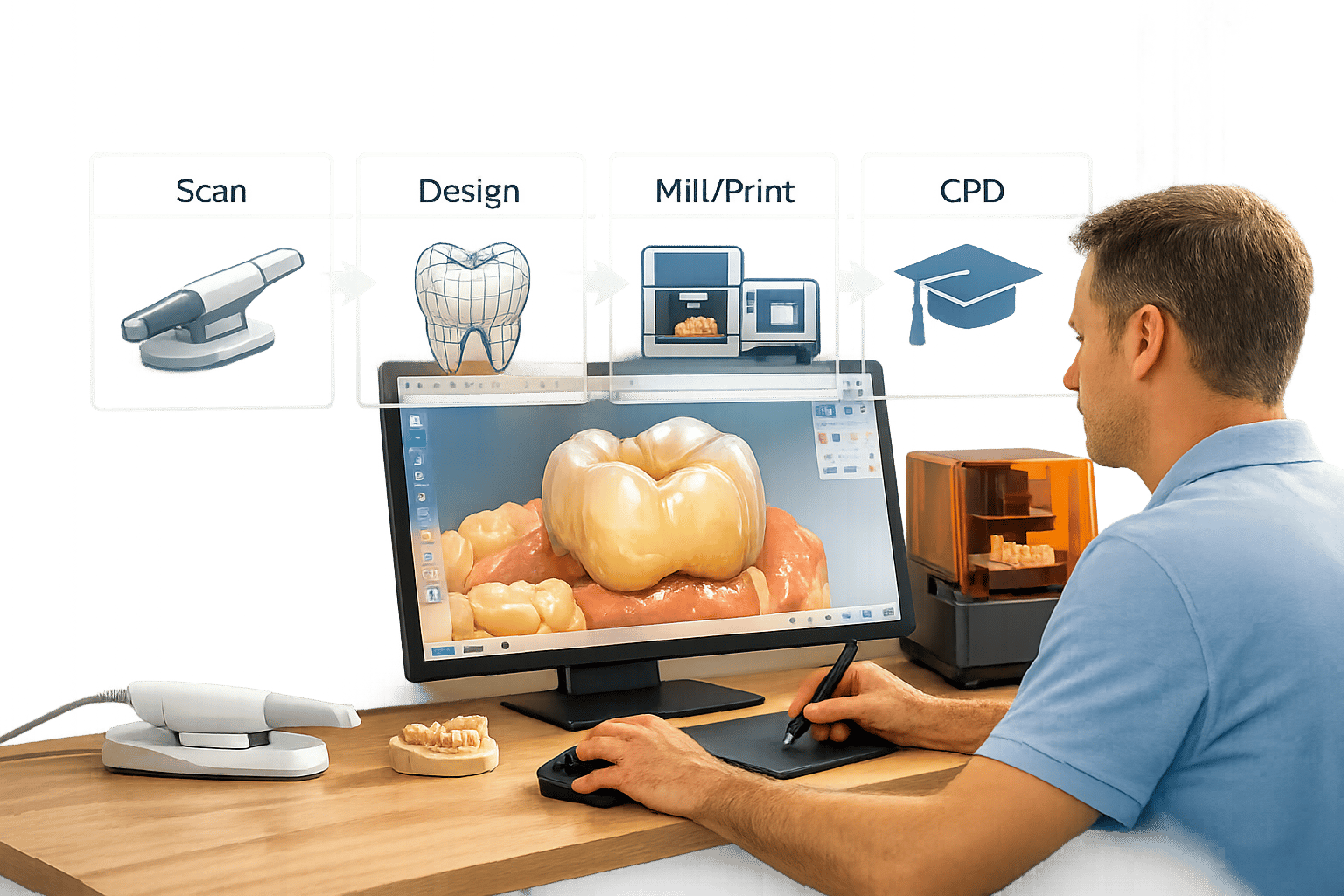
Digital prosthetics is reshaping dentistry, replacing older methods with tools like CAD/CAM, 3D printing, and intraoral scanning. This shift improves precision, speeds up processes, and enhances patient comfort. For dental technicians, it means mastering new software and equipment to meet industry demands. Training programs, like those at RMIT and Griffith University, focus on skills such as comparing digital impressions and traditional methods, denture fabrication, and implant-supported restorations. Shorter courses and conferences also offer targeted learning opportunities. As the field evolves, staying updated with certifications and hands-on practice is key to career success in this tech-driven landscape.
Removable Prosthetics for the Dental Laboratory: Traditional Solutions and Digital Workflow
sbb-itb-2be92ed
Training Programs for Digital Prosthetics
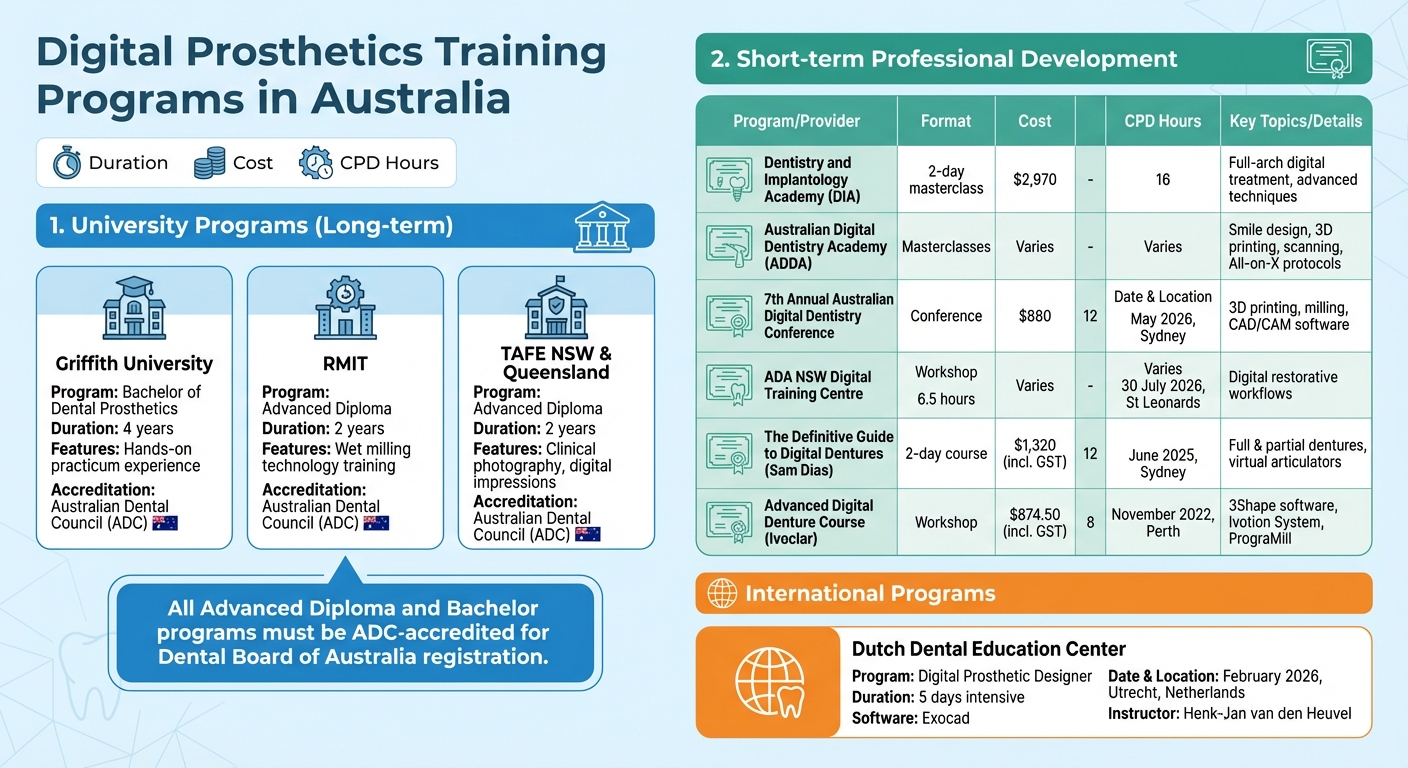
Digital Prosthetics Training Programs in Australia: Duration, Cost & CPD Hours Comparison
Training Providers
If you’re looking to dive into digital prosthetics, there’s a variety of training options to suit different needs. Griffith University, for example, offers a comprehensive four-year Bachelor program that includes hands-on practicum experience [7]. On the other hand, RMIT provides a two-year Advanced Diploma, which features training in wet milling technology [8]. TAFE institutions in New South Wales and Queensland also run Advanced Diploma courses, focusing on areas like clinical photography and digital impressions [5][8].
For those already in the field and looking to sharpen specific skills, shorter, more specialised programs are available. The Dentistry and Implantology Academy (DIA) conducts intensive two-day masterclasses covering advanced techniques such as full-arch digital treatment. These sessions cost $2,970 and come with 16 CPD hours [9]. Similarly, the Australian Digital Dentistry Academy (ADDA) offers masterclasses on topics like smile design, 3D printing, scanning, and All-on-X rehabilitation protocols [6][10][11]. Conferences are another great way to learn. For instance, the 7th Annual Australian Digital Dentistry & Dental Technology Conference, happening in Sydney in May 2026, offers 12 CPD hours with presentations on 3D printing, milling, and CAD/CAM software. The cost? $880 [4].
These varied training options provide the technical foundations and expertise needed to excel in digital prosthetic design.
Core Topics in Digital Prosthetic Courses
Courses in digital prosthetics focus on key areas like intraoral scanning, CAD/CAM design (using tools like 3Shape), and 3D printing [1][12]. Technicians also gain hands-on experience with CAM software such as PrograMill, learning both automated and manual finishing techniques [12].
Advanced modules dive deeper into specialised workflows. Topics include digital denture fabrication, immediate dentures, and systems like the Ivotion Denture System [12]. For example, in November 2022, Ivoclar hosted an Advanced Digital Denture Course in Perth. Led by Mr Peter J. Anastasia (Dip.DT, AdvDip.DP), this course covered 3Shape Digital Denture software, the Ivotion Denture System, and advanced manufacturing processes using PrograMill CAM software and the PrograMill PM7 milling machine. It also provided participants with 8 CPD hours [12]. Other advanced training options include smile design, full-mouth rehabilitation, and All-on-X prosthetic protocols [6][10].
Learning Formats
Training is delivered in various formats, including hands-on workshops, blended learning, and live demonstrations, each tailored to reinforce essential skills. Hands-on workshops are particularly effective for gaining direct experience with the latest tools and technologies. For example, the ADA NSW Digital Training Centre in St Leonards offers a 6.5-hour CPD session on modern digital restorative workflows scheduled for 30 July 2026 [1].
Blended learning combines theory with practical application, ensuring participants understand the "why" behind digital workflows before diving into the "how" [1]. Live demonstrations, on the other hand, are ideal for mastering complex processes like digital denture fabrication. These sessions guide participants step by step, covering everything from initial scanning to final staining and polishing [13]. Intensive two-day programs often provide up to 12 CPD hours and may even offer early registration discounts [13].
When choosing a course, it’s crucial to check that any Advanced Diploma or Bachelor program is accredited by the Australian Dental Council (ADC). This ensures eligibility for registration with the Dental Board of Australia [7][8]. Additionally, multi-stream events like the Sydney 2026 conference not only provide training but also offer networking opportunities with international experts and demonstrations of the latest milling and 3D printing technologies [4].
Skills for Digital Prosthetic Design
To excel in today’s digital dentistry landscape, dental technicians need to move beyond basic training and develop advanced digital design skills.
Digital Workflow Software
Becoming proficient in CAD/CAM platforms like Exocad and 3Shape is essential for dental technicians. These tools allow for precise manipulation of 3D models, defining margins, and making virtual adjustments such as tooth positioning, gingiva shaping, and VDO (Vertical Dimension of Occlusion) calibration. Tasks that once took hours can now be completed in just 10–15 minutes [17].
Technicians must also bridge the gap between design software and manufacturing tools like milling machines and 3D printers. This ensures the digital designs are accurately translated into physical restorations. Familiarity with AI-driven features – such as automated crown proposals and smile design tools – is becoming increasingly important. Reflecting this shift, the National Board for Certification in Dental Laboratory Technology (NBC) introduced a Digital Workflow specialty in January 2024, with the certification exam dedicating a significant portion to "Design Indications" (30–34%) and "Data Acquisition" (21–25%) [16].
Once technicians master design software, the next step is honing skills in digital data acquisition and modelling.
Digital Scanning and 3D Modelling
Accurate data capture is a critical step in the digital design process. Interpreting intraoral scans and creating precise 3D models require a skill set distinct from traditional impression techniques. Digital scanning eliminates the distortion risks associated with physical materials by capturing mucostatic impressions of ridge forms and tissue contours [18][19]. A high-quality scan lays the foundation for effective prosthetic design, and technicians must be adept at identifying and addressing issues in scan quality.
Avant Dental highlights the importance of this step, stating: "The clarity and completeness of the digital impression determines how accurately the denture will adapt to the ridge, how well the borders will seat, and how reliable the virtual try-in becomes." [18]
Despite its potential, only about 3% of dentures produced globally in 2022 used digital scanning technology [14]. However, the benefits are clear: technicians skilled in digital scanning and modelling can streamline workflows, reducing patient visits from five to just two or three [14]. Research also indicates that digitally produced dentures often perform as well as, or better than, traditional ones. For example, some digitally milled prostheses, made from durable materials like PMMA, are up to eight times stronger than their conventional counterparts [17].
Advanced Technology Applications
Modern workflows demand more than just scanning and modelling. They require the integration of multiple datasets to create a comprehensive "digital twin" of the patient. This includes merging intraoral scans, facial data, CBCT imaging and AI-driven analysis, and occlusal analysis. A notable example comes from researchers at the University of Medicine and Pharmacy "Victor Babes" in Timișoara, who, in June 2025, used a fully digital protocol for bilateral maxillary molar rehabilitation. Their workflow combined Medit i700 intraoral scans, MetiSmile facial scans, and Planmeca CBCT data in Exocad software. They even employed the OccluSense digital analyser post-cementation to fine-tune occlusion, enhancing patient comfort [19].
Technicians must also develop expertise in prosthetic-driven implant planning. This includes designing surgical guides and creating complex full-arch restorations, such as All-on-X solutions. High-strength zirconia materials like IPS e.max ZirCAD Prime are now widely used for full-contour restorations, crafted entirely in a virtual environment. Digital workflows have proven to be significantly faster, with implant crown designs taking just 75.3 minutes compared to 156.6 minutes for mixed analogue-digital methods [20]. Mastery of these advanced techniques ensures technicians remain competitive in the rapidly evolving field of digital prosthetic design.
Training in Implant-Prosthetic Rehabilitation and Denture Design
Specialised training builds on core digital design skills, focusing on more complex applications like implant-supported restorations and digital dentures. As dental technicians refine their foundational skills, advanced education becomes essential for tackling these intricate workflows.
Implant-Prosthetic Rehabilitation Methods
Advanced training programs now guide dental technicians through the complete digital workflow for implant cases – starting from initial planning to the final restoration. This training involves integrating various datasets, such as CBCT radiological scans, intraoral scans, photogrammetry, and 3D facial scans, to create a detailed digital patient model [21][23]. Using specialised planning software, technicians virtually position implants, determining the ideal length and diameter while meeting both surgical and prosthetic needs [21][22].
The curriculum also covers designing stackable surgical guides and full-arch All-on-X prosthetics. Trainees learn to create FP1–FP3 restorations using Exocad software [23]. Additionally, immediate loading protocols are a key component, including teeth-in-a-day techniques where pre-designed prostheses are converted into same-day restorations post-guided surgery [23]. This digital approach enhances preoperative planning and fosters better communication between technicians, clinicians, and patients, as highlighted by Sterngold [21].
While implant rehabilitation focuses on integrating patient data, digital denture manufacturing blends traditional denture principles with modern digital techniques.
Digital Denture Manufacturing
Training in digital denture workflows bridges traditional methodologies with advanced technologies. For example, in February 2026, the Dutch Dental Education Center launched the second edition of its Digital Prosthetic Designer program at the Dutch HealthTec Academy in Utrecht. Led by Henk-Jan van den Heuvel, this five-day intensive course transitioned from 3Shape to Exocad software. Participants worked through the entire workflow, including raw data processing, virtual extractions for immediate dentures, and advanced setups like Gysi and Gerber configurations for challenging cases such as crossbites [24].
Australian training programs have also made strides. In June 2025, Sam Dias led a two-day course in Sydney titled "The Definitive Guide to Digital Dentures", offering 12 CPD hours. This program featured a live demonstration of fabricating both full and partial dentures, covering virtual articulators and bonding techniques for carded, milled, and printed teeth. Priced at $1,320.00 (including GST), it detailed workflows for various denture cases and functional setups [13].
Material selection and manufacturing techniques play a crucial role in these courses. Digital dentures are often milled from pre-cured, high-density PMMA pucks, which eliminate issues like porosity and shrinkage seen in traditional acrylics [15]. Training includes evaluating milling, 3D printing, and casting methods, alongside mastering scan data preparation, virtual articulator adjustments, and advanced finishing techniques for lifelike aesthetics [13][24]. Advanced modules explore systems like the Ivotion Denture System and PrograMill CAM software, with courses priced at approximately $874.50 (including GST) for 8 CPD hours [12]. These programs highlight the importance of developing expert-level skills in digital prosthetic design through focused professional education.
Industry Standards and Professional Recognition
Professional qualifications highlight the expertise dental technicians gain through training in digital prosthetics. These credentials build upon foundational education and advancements in digital workflows. In Australia, the Advanced Diploma of Dental Prosthetics (HLT65015) is the nationally recognised qualification required for registration with the Dental Board of Australia and the Australian Health Practitioner Regulation Agency (AHPRA). This certification allows for independent practice and supports career growth[28].
Certifications and Credentials
Training programs are designed to align with National Training Packages, ensuring graduates meet the standards outlined by AHPRA[28]. Modern courses include specialised units, such as CAD/CAM technology and implant-retained overdenture construction. For practitioners trained overseas, the Australian Dental Council (ADC) assesses their competence through a three-stage process. This includes an initial assessment ($647), a written exam ($1,432), and a practical exam ($4,775)[27].
Additionally, Continuing Professional Development (CPD) programs play a key role in verifying and updating skills related to digital workflows vs conventional techniques. These programs establish national benchmarks, enabling comparisons with international standards.
International Competitions and Skill Assessment
Beyond national certifications, global events provide further validation of expertise in digital prosthetics. A significant milestone was achieved in 2026 when "Dental Prosthetics" became an official skill category at WorldSkills Shanghai. This marked the first time digital dental technology was recognised as an independent discipline at WorldSkills competitions[25][26]. The event includes challenges like intraoral 3D scanning, digital prosthetic design, and precision CAD/CAM manufacturing[25].
"The addition of Dental Prosthetics underscores the rapid digital transformation of the global dental industry, marking the first time that digital dental technology has been recognised as an independent skill category in WorldSkills history." – SHINING 3D[26]
These competitions contribute to the global standardisation of digital prosthetic skills, emphasising the importance of formal qualifications. They also align with Industry 5.0 principles by connecting vocational training with modern laboratory needs[25]. Regional events, such as EuroSkills Herning 2025 and WorldSkills ASEAN 2025, offer additional platforms for young professionals to showcase their digital workflow proficiency[26].
Conclusion
Digital workflows have become a cornerstone of modern dentistry, offering precision in diagnosis, streamlined planning, and enhanced prosthesis fabrication[2]. For dental technicians, staying competitive means embracing digital prosthetic training to meet these advancements and deliver better patient outcomes. The adoption of digital CAD/CAM workflows, 3D printing, and intraoral scanning demands not just familiarity with new tools but also a solid foundation in traditional skills.
The value of digital training is backed by research. For instance, 93.75% of dental students expressed positive attitudes towards integrating digital workflows into their learning[29], and 100% of participants showed interest in utilising digital software for future prosthodontic education[3]. These figures highlight the industry’s trajectory. As Jaafar Abduo and Vanya Rasaie observed in the Australian Dental Journal:
Digital workflows now offer significant advantages in diagnosis, treatment planning, communication, and prosthesis design and fabrication[2].
Beyond technical expertise, digital training fosters collaboration between dentists, prosthetists, and technicians. This teamwork results in faster processes, more predictable outcomes, and greater patient satisfaction. Patients particularly benefit from the elimination of traditional impression materials, better-fitting restorations, and fewer chair-side adjustments. With AI, advanced 3D printing, and personalised medicine on the rise, ongoing professional development is no longer optional – it’s essential.
To stay ahead, technicians should focus on hands-on training with advanced tools, enrol in accredited CPD programs, and engage in professional networks to keep up with emerging trends. Developing digital skills not only ensures career longevity but also enhances patient care and clinical efficiency. As the University of Bolton aptly states:
Dental technology is a field that evolves rapidly. Dental technicians stay informed about new techniques, materials, and technology through continuous education and training[30].
FAQs
Which digital tools should a dental technician learn first?
Recent research points out that dental technicians should begin by adopting digital tools that simplify case planning, design, and fabrication processes. Essential tools in this space include CAD software such as Medit CliniCad and exocad, which are ideal for creating digital wax-ups and smile designs. Intraoral scanners play a crucial role in capturing accurate patient records, while 3D printing technology enables the production of models and restorations with precision. Gaining proficiency in these tools is key for seamlessly adapting to today’s digital workflows in prosthetic design.
Do I need an ADC-accredited qualification to work in Australia?
No, having an ADC-accredited qualification isn’t an absolute requirement to work as a dental technician or prosthetist in Australia. However, if you’ve gained your qualifications overseas, you’ll need to go through the assessment and registration processes set by the Australian Dental Council (ADC) and the Dental Board of Australia to practise legally.
How do digital dentures compare with traditional dentures?
Digital dentures bring several benefits compared to traditional ones, particularly in terms of precision and production speed. Using CAD/CAM technologies, such as 3D printing, these dentures ensure a more accurate fit while doing away with the hassle of messy impressions. Unlike traditional dentures, which depend on manual craftsmanship, digital dentures are crafted with greater efficiency and accuracy. However, research is still underway to assess their long-term performance and cost-effectiveness when compared to conventional methods.
Related Blog Posts
- Training Programs for Intraoral Scanners in Australia
- CAD/CAM in Dentistry: Cost vs Value
- Digital Workflow vs Conventional Techniques in Prosthodontics
- Emerging Trends in 3D-Printed Dental Prosthetics
Important Notice: Any surgical or invasive procedure carries risks. Before proceeding, you should seek a second opinion from an appropriately qualified health practitioner.
Individual results may vary. The information provided in this article is for educational purposes only and does not constitute medical advice.
Checkout Related Blogs




Get in touch with us
For more information, call us now to start feeling better. Or fill the form below to make appointment
The Latest News from Complete Smiles
How to Clean Clear Plastic Retainers
Checklist for Choosing Wearable Dental Devices
Checklist for Choosing Cloud AI Platforms in Dentistry

Complete Smiles Bella VistaAccepts All Major Health Funds, Including





