





Bioactive Glass Coatings for Dental Implants: Overview

Bioactive glass coatings are transforming dental implants by addressing two common challenges: poor bone bonding and infection risks. These coatings create a chemical bond with bone tissue, speeding up integration and improving stability. They also release ions that promote bone growth and prevent bacterial growth, a key goal of surface engineering for infection prevention, making them highly effective for patients with weaker bone quality or higher infection risks.
Key points:
- What it is: A coating applied to titanium or zirconia implants to improve bonding with bone.
- How it works: Forms a hydroxyapatite-like layer, mimicking natural bone, and releases ions to stimulate healing and prevent infections.
- Benefits: Faster integration, reduced infection rates, and improved outcomes for patients with low bone density.
- Limitations: Brittle in bulk form, sensitive to moisture, and requires precise manufacturing.
Studies show that bioactive glass-coated implants perform as well as hydroxyapatite-coated ones, with added antibacterial properties. Future advancements include ion-doped variants and zirconia composites for improved strength and healing.
Composition and Properties of Bioactive Glass
Key Components of Bioactive Glass
Bioactive glass is built around a three-dimensional silica (SiO₂) network, which allows it to interact with body fluids and form a durable bond with bone tissue [1].
The classic Bioglass 45S5 formula contains 45% SiO₂, 24.5% Na₂O, 24.5% CaO, and 6% P₂O₅ by weight. Calcium oxide and phosphorus pentoxide mimic the mineral composition of bone, while sodium oxide acts as a network modifier, speeding up the glass’s dissolution process. However, too much sodium can lead to harmful pH increases [1] [3].
Over time, researchers have refined these formulations by adding other ions. For example:
- Strontium stimulates osteoblast activity (bone-building cells) while slowing down osteoclasts (bone-resorbing cells).
- Silver and zinc provide antimicrobial properties and enhance bone bonding.
- Fluoride helps form fluorapatite, a mineral layer resistant to acid [1].
| Bioactive Glass Type | SiO₂ (%) | Na₂O (%) | CaO (%) | P₂O₅ (%) |
|---|---|---|---|---|
| 45S5 (Bioglass) | 45.0 | 24.5 | 24.5 | 6.0 |
| S53P4 | 53.0 | 23.0 | 20.0 | 4.0 |
| 58S | 58.0 | – | 33.0 | 9.0 |
| Biosilicate | 48.5 | 23.75 | 23.75 | 4.0 |
These tailored compositions not only establish strong chemical bonds with bone but also pave the way for the biological processes discussed below.
Biocompatibility and Reactivity
Thanks to its carefully optimised structure, bioactive glass dissolves in a controlled way, triggering bone-regeneration responses. As it dissolves, silicon and calcium ions are released, which activate osteogenic genes like RUNX2 and ALP, both of which are crucial for bone formation [3]. A study published in Biomaterials Research highlights this:
"Bioactive glass is based on silicate and its structure is composed of three-dimensional networks of silica when they are placed in the body they can be able to form strong chemical bonds with tissues, especially with bones." [1]
These ions don’t just passively interact; they actively signal the body to initiate repair processes at the genetic level. This biochemical activity explains the improved osseointegration and antimicrobial properties that make bioactive glass such a valuable material for dental implants. These benefits connect directly to the next sections, where its applications are explored further.
sbb-itb-2be92ed
How Bioactive Glass Improves Dental Implant Performance
Osseointegration and Bone Healing
Bioactive glass plays a critical role in dental implants by promoting osseointegration and aiding bone healing. When it comes into contact with body fluids, it triggers the formation of hydroxyapatite – a compound that closely resembles natural bone mineral. At the same time, it stimulates osteoblasts (bone-forming cells) to multiply and create new bone tissue. This process ensures the implant is securely anchored through a direct chemical bond with the surrounding bone tissue [1].
As highlighted in Biomaterials Research:
"Glass-coated implants were a viable alternative coating material for dental implants, which may allow for wider case selection criteria together with improved integration rates even in the more challenging medically compromised and osteoporotic patients." [1]
Further supporting this, research published in the Journal of Composites and Compounds noted:
"Bioactive glass coatings can decrease the healing time and hence accelerate the formation of the bond between bone and implant." [2]
A clinical trial involving 31 patients and 62 implants confirmed these benefits. The study found that implants with bioactive glass coatings achieved osseointegration rates on par with hydroxyapatite-coated implants – a material often regarded as the benchmark for implant coatings [1]. Beyond promoting faster bone healing, these properties also help reduce the likelihood of infections.
Reducing Implant-Related Infections
In addition to enhancing bone integration, bioactive glass helps lower the risk of implant-related infections. When ions are released from the glass, they raise the local pH, creating an alkaline environment that is unfavourable for bacterial growth. In fluoride-containing variants like BiominF, this process also forms a fluorapatite layer, which is resistant to acid and further strengthens the implant surface [1].
When bioactive glass is doped with elements like silver or zinc, its antimicrobial properties are amplified. For instance, orthodontic bonding agents containing these doped formulations have shown the ability to protect against demineralisation up to 200 to 300 μm away from the bracket site [1].
This dual capability – stimulating bone regeneration while combating bacterial activity – sets bioactive glass coatings apart from traditional implant coatings, which typically address only one of these challenges. When selecting a surface treatment, clinicians can use a checklist for choosing implant coatings to ensure patient suitability and quality standards.
What is bioglass?
Advantages and Disadvantages of Bioactive Glass Coatings
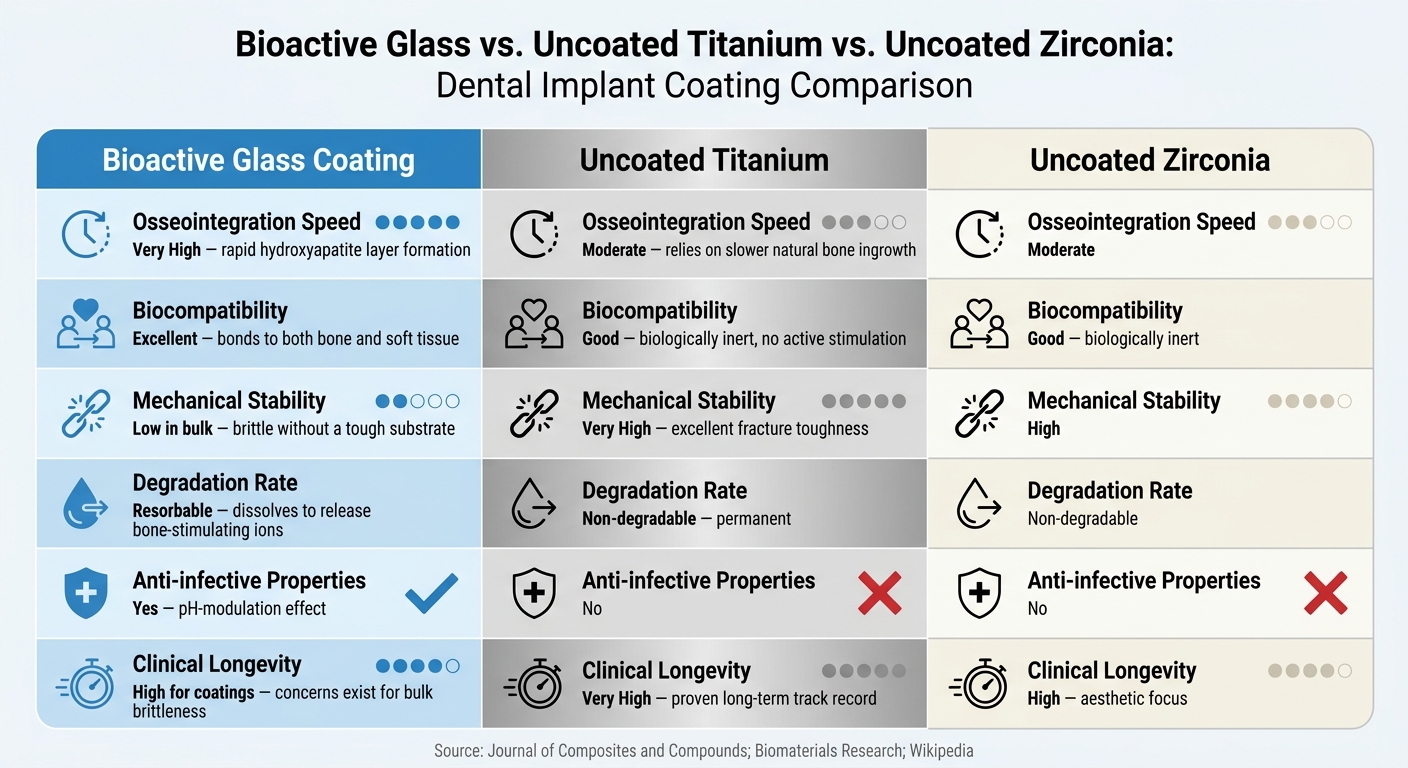
Bioactive Glass vs. Titanium vs. Zirconia Dental Implants: Key Differences
Bioactive glass coatings bring several benefits to dental implants, but they also come with limitations that need to be carefully weighed.
To start with the positives, bioactive glass is non-toxic and chemically similar to natural bone mineral. What sets it apart is its ability to bond with both hard tissues (like bone) and soft tissues (such as gingiva) – a feature that most other coating materials lack [4]. It also has antimicrobial properties, achieved by modulating the local pH, and encourages the activity of bone-forming cells. This aligns with broader developments in antibacterial nanomaterials designed to combat biofilms. This makes it more than just a passive coating; it actively contributes to the implant’s integration and function.
However, bioactive glass has its challenges. It is inherently brittle, with a bending strength ranging between 40–60 MPa, which makes it unsuitable for load-bearing applications in bulk form. As noted on Wikipedia:
"High bioactivity is the main advantage of Bioglass, while its disadvantages includes mechanical weakness, low fracture resistance due to amorphous 2-dimensional glass network." [4]
This brittleness means it is typically used as a thin coating on sturdier materials like titanium or zirconia. Other issues include its sensitivity to moisture and a tendency to crystallise during manufacturing, which can reduce its bioactivity [4][5].
Features, Pros, and Cons Compared
| Characteristic | Bioactive Glass Coating | Uncoated Titanium | Uncoated Zirconia |
|---|---|---|---|
| Osseointegration Speed | Very high; rapid hydroxyapatite layer formation [2][5] | Moderate; relies on slower natural bone ingrowth [5] | Moderate |
| Biocompatibility | Excellent; bonds to both bone and soft tissue [4] | Good; biologically inert with no active stimulation [5] | Good; biologically inert |
| Mechanical Stability | Low in bulk; brittle without a tough substrate [4] | Very high; excellent fracture toughness [2] | High |
| Degradation Rate | Resorbable; dissolves to release bone-stimulating ions [4] | Non-degradable; permanent [5] | Non-degradable |
| Anti-infective Properties | Yes; pH-modulation effect [4] | No | No |
| Clinical Longevity | High for coatings; concerns exist for bulk brittleness [4] | Very high; proven long-term track record [2] | High; aesthetic focus |
This comparison highlights the strengths and limitations of bioactive glass coatings in contrast to uncoated titanium and zirconia, setting the stage for further discussion on their clinical applications and research findings.
Clinical Applications and Research Evidence
Bioactive glass coatings have moved beyond the lab and are now being applied clinically to materials like titanium alloys, zirconia vs. ceramic materials, and fibre-reinforced composite (FRC) implants. These coatings are positioning themselves as strong contenders against the more established hydroxyapatite (HA) coatings.
Case Studies and Research Findings
Clinical trials have highlighted the effectiveness of bioactive glass coatings. A particularly notable study took place at Dr R Ahmed Dental College and Hospital in Kolkata, India, between 2010 and 2011. Researchers S. Mistry, D. Kundu, S. Datta, and D. Basu tested 62 dental implants in 31 patients. Half of the implants were coated with bioactive glass using vitreous enamelling, while the other half used HA applied via microplasma spray. After 12 months of prosthetic loading, both groups showed successful osseointegration, with no implant failures or toxicity. Published in the Australian Dental Journal in 2011, the study concluded:
"The newly developed bioactive glass is a good alternative coating material for dental implants." This research aligns with broader findings on how hybrid coatings improve osseointegration by combining different material properties. – S. Mistry, Department of Periodontics, Dr R Ahmed Dental College and Hospital [6]
On the biomechanical front, a 2014 study led by Ahmed M. Ballo, involving researchers from the University of Turku and the University of British Columbia, examined 36 FRC implants in six pigs over 12 weeks. Threaded FRC implants with bioactive glass coatings achieved a push-out strength of 676 N, compared to 549 N for uncoated implants. Non-threaded BAG-coated implants, however, recorded only 430 N, highlighting the importance of combining the right implant design with the coating for optimal results [7].
Another study conducted at Radboud University Nijmegen Medical Center explored magnetron sputter coatings with varying HA-to-BG ratios on 48 screw-type titanium implants in 16 Beagle dogs. At the 4-week mark, implants with higher concentrations of bioactive glass showed lower bone-to-implant contact compared to those with pure HA or lower BG levels. By 12 weeks, these differences had largely disappeared. Lead researcher John A. Jansen observed:
"The incorporation of BG into HA sputter coatings did not enhance the performance of a dental implant in implantation sites with good bone quality and quantity." [8]
Here’s a summary of the key studies and their findings:
| Study | Subjects | Coating Approach | Key Finding |
|---|---|---|---|
| Mistry et al., 2011 (Australian Dental Journal) | 31 patients, 62 implants | Vitreous enamelling (BG) vs. microplasma spray (HA) | BG matched HA performance over 12 months [6] |
| Ballo et al., 2014 (European Journal of Oral Sciences) | 6 pigs, 36 FRC implants | BAG coating on threaded vs. non-threaded FRC | Threaded BAG implants: 676 N push-out strength at 12 weeks [7] |
| Van Oirschot & Jansen et al., 2014 (Clinical Oral Implants Research) | 16 Beagle dogs, 48 implants | Magnetron sputter HA/BG ratios | High BG levels hindered early healing at 4 weeks [8] |
These studies collectively demonstrate that bioactive glass coatings perform well in many clinical situations, especially when paired with thoughtfully designed implant substrates. However, the concentration of bioactive glass plays a crucial role – higher levels may negatively impact early healing. Future research is focusing on refining coating formulations and enhancing implant designs, with ongoing efforts to develop glass-ceramic and zirconia composites for even better outcomes.
Future Developments in Bioactive Glass Technology
Bioactive glass coatings are advancing quickly, with new ion doping techniques and composite materials promising to improve the performance of dental implants.
Building on successful clinical results, researchers are working on ways to make bioactive glass even more effective. One key area is ion doping, where elements like strontium, copper, cobalt, silver, and zinc are added to the glass. These elements enhance various properties, including bone regeneration, blood vessel formation, antibacterial activity, and the strength of the bond between the implant and bone [1][3].
| Doping Ion | Primary Benefit | Mechanism of Action |
|---|---|---|
| Strontium (Sr) | Bone regeneration | Stimulates osteoblasts and inhibits osteoclasts [3] |
| Copper (Cu) | Angiogenesis | Promotes blood vessel formation [3] |
| Cobalt (Co) | Angiogenesis | Supports vascularisation [3] |
| Silver (Ag) | Antibacterial | Prevents biofilm formation and infections [3] |
| Zinc (Zn) | Bond strength | Improves the chemical bond between glass and bone [1] |
Another exciting development is mesoporous bioactive glasses (MBGs). These materials have a highly porous structure that increases their surface area, allowing for faster and more predictable ion release. This feature speeds up the healing process and makes the material more effective during the early stages of bone integration [3].
On the structural side, zirconia–bioactive glass composites are showing great potential. Recent studies (as of January 2026) have explored using the CaO–MgO–SiO₂ system reinforced with 3Y-TZP (yttria-stabilised zirconia). Composites containing 20 wt.% zirconia have demonstrated a fracture strength of 2.6–3.2 MPa·m⁰·⁵ and an elastic modulus of 94–151 GPa, meeting the mechanical requirements for load-bearing dental implants [9]. This is particularly relevant in Australia, where zirconia implants are popular for their natural appearance and suitability for patients with titanium sensitivities. However, zirconia’s slower bone bonding has been a drawback, which bioactive glass coatings can address effectively [2].
These advancements are especially beneficial for Australia’s ageing population, many of whom face challenges like reduced bone density. For instance, Sr-doped and pro-angiogenic bioactive glasses could significantly improve implant success rates. Additionally, the rise of marine-derived biosilica – made from sea sponges – offers a sustainable material option that aligns with environmental priorities in the Asia-Pacific region [1].
Together, these innovations are transforming dental implant coatings from passive protective layers into active, bio-regenerative solutions designed to address real-world clinical needs.
Conclusion
Bioactive glass coatings offer a promising way to improve implant integration while reducing the risk of infections. This makes them particularly beneficial for patients with lower bone density, as they help speed up osseointegration and improve the long-term stability of implants.
The unique ability of bioactive glass to dissolve and promote apatite bonding, coupled with its stimulation of osteoblast activity, sets it apart from traditional implant surfaces [1].
"Bioactive glass-coated implants were a viable alternative coating material for dental implants, which may allow for wider case selection criteria together with improved integration rates even in the more challenging medically compromised and osteoporotic patients." – Biomaterials Research [1]
Research continues to push boundaries by exploring ion doping and zirconia–bioactive glass composites, paving the way for even more advanced applications. These developments build on the already established advantages of faster integration and lower infection rates.
For those in Australia considering dental implants, consulting with a qualified professional is essential. Clinics like Complete Smiles Bella Vista specialise in implant services and can provide tailored advice to help determine if bioactive glass coatings are the right choice for your needs.
FAQs
Am I a suitable candidate for a bioactive glass–coated implant?
Your eligibility for this type of dental implant depends on several factors, including the condition of your bone and overall oral health. Bioactive glass coatings are designed to improve bone bonding and promote healing, but only a dental professional can evaluate whether this option suits your specific needs. A personalised assessment is essential to ensure the best results for your oral health.
How long do bioactive glass coatings last on an implant?
Bioactive glass coatings on implants are designed to endure for several years. Their durability, however, is influenced by factors such as mechanical stress and the unique conditions of the oral environment. While these coatings are generally long-lasting, precise timelines for their effectiveness are not clearly established in existing research.
Are there any safety risks from the ions released by bioactive glass?
The ions released by bioactive glass can raise some safety concerns, particularly due to its low resistance to fractures and mechanical fragility. That said, when used appropriately, its ability to interact with biological tissues and support healing processes generally makes it safe for medical and dental applications.
Related Blog Posts
- How Hybrid Coatings Improve Osseointegration
- Surface Modifications for Better Osseointegration
- Advances in Biocompatible Implant Coatings
- Bioactive Surface Modifications for Implants
Important Notice: Any surgical or invasive procedure carries risks. Before proceeding, you should seek a second opinion from an appropriately qualified health practitioner.
Individual results may vary. The information provided in this article is for educational purposes only and does not constitute medical advice.
Checkout Related Blogs




Get in touch with us
For more information, call us now to start feeling better. Or fill the form below to make appointment
The Latest News from Complete Smiles
How to Clean Clear Plastic Retainers
Checklist for Choosing Wearable Dental Devices
Checklist for Choosing Cloud AI Platforms in Dentistry

Complete Smiles Bella VistaAccepts All Major Health Funds, Including





