





Advances in Biocompatible Implant Coatings

Advancements in dental implant coatings are transforming how implants interact with the body. Traditional titanium implants rely on mechanical stability, but their bioinert nature limits natural bonding with bone. Biocompatible coatings address this by promoting osseointegration – a direct connection between bone and implant – while also reducing the risk of peri-implantitis and bacterial infections.
Key highlights include:
- Faster Healing: Coatings like zinc-doped surfaces boost bone cell growth by 25% and improve adhesion by 40%.
- Antibacterial Properties: Copper-doped coatings achieve 99.45% effectiveness against Staphylococcus aureus.
- Nanotechnology: Nanotubes and nanoparticle-enhanced surfaces improve cell attachment and prevent infections.
- Bioactive Materials: Hydroxyapatite and bioactive glass mimic natural bone, speeding up integration.
- Alternatives to Titanium: Zirconia implants offer aesthetic benefits and reduced inflammation but require advanced coatings to match titanium’s durability compared to zirconia.
These coatings not only improve implant stability but also fight infections and support long-term success. With emerging technologies like growth factor coatings and hybrid materials, the future of dental implants is focused on better healing and patient outcomes.
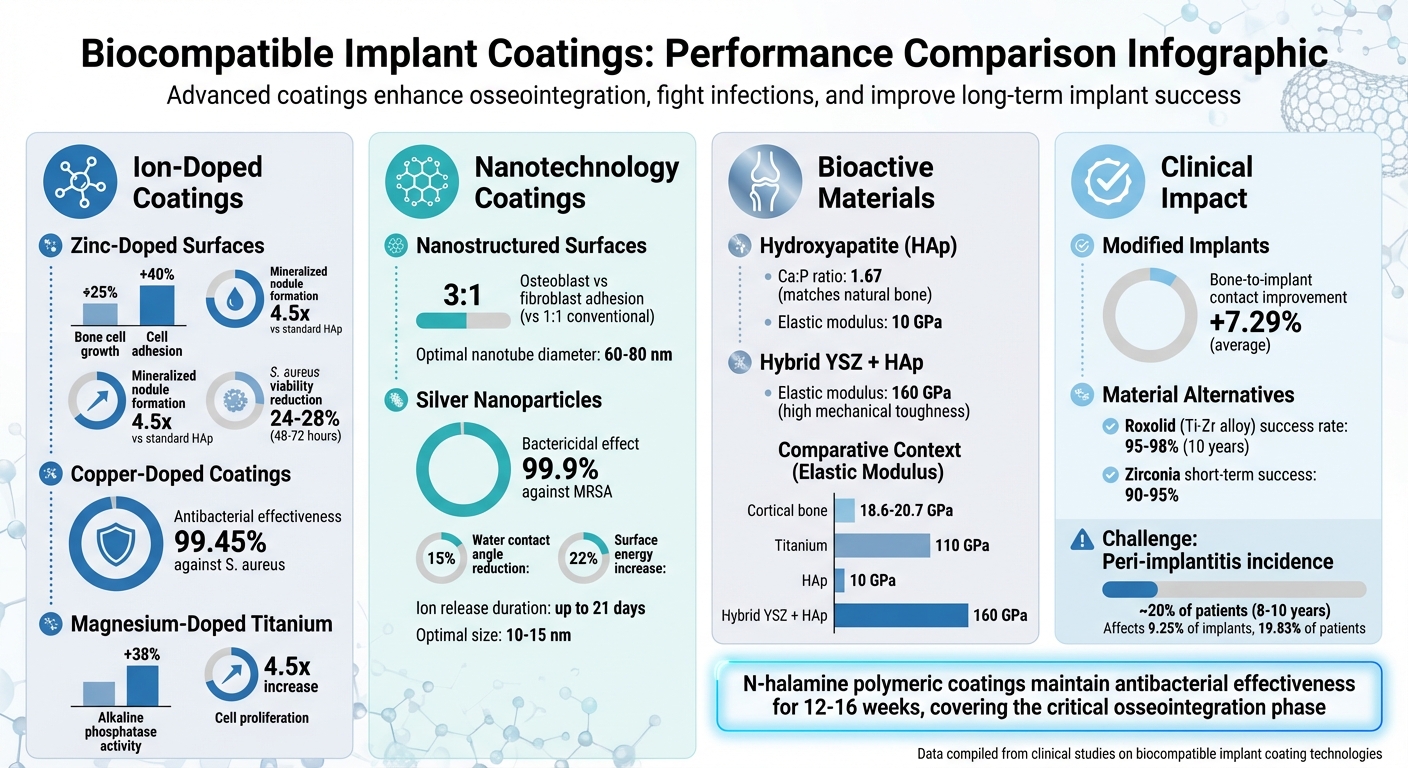
Biocompatible Implant Coating Types: Performance Comparison and Benefits
Advanced implant coatings, a major step forward? – Part 1 w/ Robert Allaker | Focus
sbb-itb-2be92ed
Bioactive Coating Materials
Bioactive coatings play a crucial role in medical implants by forming chemical bonds with bone, which speeds up integration and ensures long-term stability. Below, we delve into the key materials used in these coatings, focusing on hydroxyapatite, bioactive glasses, and hybrid systems.
Hydroxyapatite Coatings
Hydroxyapatite (HAp) is a standout material because it closely resembles natural bone, maintaining the same 1.67 calcium-to-phosphorus ratio that supports bone matrix formation [6]. This similarity enables HAp to act as a scaffold that bone cells can easily recognise and attach to, driving osteoconduction (bone growth on the material’s surface) and osteoinduction (stimulating stem cells to develop into bone-forming cells) [6][7].
"The composition and crystalline structure of HAp allow for numerous ionic substitutions that provide added value, such as antibiotic properties or osteoinduction." – Daniel Arcos and María Vallet-Regí [7]
HAp’s adaptability goes beyond its basic role in bone integration. Its crystalline structure allows for ionic substitutions, which can enhance its properties. For instance, zinc-substituted HAp coatings have shown a remarkable 4.5-fold increase in mineralised nodule formation compared to standard HAp coatings. They also reduce the viability of Staphylococcus aureus by 24% to 28% within 48 to 72 hours [1]. Despite its advantages, HAp has a relatively low elastic modulus of around 10 GPa, which is closer to cortical bone (18.6–20.7 GPa) than titanium (110 GPa). This makes it best suited for thin, non-delaminating applications [6][4].
Bioactive Glass and Hybrid Coatings
Bioactive glass offers another promising approach for enhancing implant integration. When exposed to body fluids, it forms a hydroxyapatite layer, creating a dynamic interface that supports bone healing [4].
"Bioactive glasses (BGs) are a special type of glasses that induce the formation of HA when they get in contact with body fluids." – Francesca Accioni et al. [4]
The real game-changer lies in hybrid coating systems, which combine different materials to address individual shortcomings. For example, combining Yttria-stabilised zirconia (YSZ) with HAp creates a coating that combines YSZ’s high mechanical toughness (160 GPa elastic modulus) with HAp’s bioactive properties [6]. Advances in synthesis methods, such as sol-gel techniques, as well as electrochemical deposition, have made it possible to produce nanocrystalline grain structures, which improve coating purity and consistency. This resolves the mechanical reliability issues that earlier bioactive coatings faced [8]. These hybrid systems are paving the way for multifunctional coatings that integrate osteogenic, antibacterial, and even immunomodulatory features into a single surface [1][2].
Nanotechnology in Implant Coatings
Nanotechnology has taken implant coatings to a new level by refining surface characteristics to actively interact with biological systems. By designing surfaces at the nanoscale – ranging from 1 to 100 nanometres – scientists have created coatings that mimic the natural extracellular matrix found in bone tissue. This approach provides mechanical signals that encourage cells to attach, grow, and transform into bone-forming cells [9].
Interestingly, nanostructured surfaces show a 3:1 preference for osteoblast adhesion compared to fibroblasts, a significant improvement over the 1:1 ratio seen with conventional materials. These surfaces also boost the adsorption of vital proteins like vitronectin and fibronectin, which are critical for early bone integration [5]. By enhancing initial cell attachment and bone integration, nanotechnology builds on previous coating advancements, offering improved osseointegration and infection resistance.
Nanostructured Surfaces
Innovations like titania nanotubes (TNTs) and nanowires have pushed the boundaries of surface engineering. These nanostructures not only add texture but also act as delivery systems for bioactive agents, such as BMP-2, growth factors, or anti-osteoporotic drugs like alendronate [5]. Nanotubes with diameters between 60 nm and 80 nm strike an ideal balance between killing bacteria and supporting cell growth [5].
Electrochemical anodisation has become a go-to manufacturing technique, surpassing traditional plasma spraying. This method produces highly ordered nanotubes with better mechanical stability and a lower risk of delamination [5]. Among various designs, nanopores – essentially fused nanotubes – offer superior mechanical strength compared to individual nanotubes [11].
Surface chemistry also evolves with these structural changes. For instance, a 530 nm thick silver "nano coat" can reduce the water contact angle of titanium by 15% and increase surface energy by 22%. This creates a more hydrophilic surface, which helps retain blood clots and develop a cellular basement layer [10]. Enhanced wettability is crucial for the adsorption of blood proteins, setting the stage for effective cell attachment.
Nanoparticle-Enhanced Coatings
Nanoparticles bring antimicrobial properties to implant coatings while maintaining biocompatibility. Silver nanoparticles, especially those under 50 nm (with 10–15 nm being particularly effective), are widely recognised for their antibacterial capabilities [12]. Research shows that silver-coated titanium surfaces can achieve a 99.9% bactericidal effect against methicillin-resistant Staphylococcus aureus (MRSA) [11].
"The ‘nano coat’ of Ag on Ti is indeed a prophylactic against peri-implantitis, ensuring increased implant success."
– Vaibhav Madiwal, Agharkar Research Institute [10]
Silver ions released from these coatings disrupt bacterial membranes, block DNA replication, and create reactive oxygen species (ROS) to prevent biofilm formation. Impressively, these surfaces maintain a steady release of ions for up to 21 days [9] [10]. Other nanoparticles, like zinc oxide (ZnO) and copper (Cu), also provide antimicrobial benefits while encouraging osteoblast growth [9].
To regulate release rates and reduce potential toxicity, nanoparticles are often encapsulated in biopolymers such as chitosan or silk fibroin [11]. This dual-function coating not only fights infections but also supports bone healing. This is particularly important given that more than 20% of patients experience peri-implantitis within 5–10 years of implantation [5] [11]. These advanced coatings mark a step forward, combining infection prevention with faster and stronger bone integration.
Antimicrobial and Regenerative Coating Systems
Recent developments in nanotechnology and bioactive materials have paved the way for implant coatings that not only fight infections but also promote tissue repair. This dual-purpose approach is critical for tackling peri-implantitis, a condition that affects approximately 9.25% of implants and 19.83% of patients [13]. The challenge lies in striking the right balance between antimicrobial effectiveness and supporting bone cell activity.
Antimicrobial Coatings
Using combined metal-ion strategies has proven to be an effective method for infection control. For example, pairing zinc and silver forms micro-galvanic couples, delivering both long-range and short-range antibacterial effects [3][1]. Similarly, magnesium-doped titanium has shown to enhance alkaline phosphatase activity by 38% and increase cell proliferation by 4.5 times [1].
Antimicrobial peptides, such as GL13K, offer a promising alternative to traditional antibiotics. They effectively inhibit P. gingivalis biofilms while presenting a lower risk of resistance [13]. Additionally, biosurfactants like rhamnolipids have demonstrated the ability to inhibit over 90% of S. aureus within just 24 hours, thanks to their amphiphilic structure [13].
However, achieving the right balance is critical. As Andreia S. Azevedo from the University of Porto explains:
"The balance will always be key to determining the potential of a coating" [13]
Excessive concentrations of silver or certain polymeric coatings can hinder bone cell activity, while insufficient antimicrobial action leaves implants vulnerable, particularly during the crucial first four weeks after placement [14]. To complement these antimicrobial strategies, hybrid implant coatings and regenerative systems play a vital role in enhancing tissue healing and integration.
Growth Factor Coatings
Regenerative coatings are designed to promote tissue healing by incorporating growth factors like Bone Morphogenetic Proteins (BMPs), Platelet-Derived Growth Factor (PDGF), and Fibroblast Growth Factor (FGF). These factors stimulate cellular growth and bone formation, creating an environment that supports cell attachment and osseointegration. By mimicking the extracellular matrix with components such as collagen, fibronectin, and hyaluronan, these coatings encourage seamless integration between the implant and surrounding tissue.
The addition of RGD peptides (arginine-glycine-aspartate) offers a solution to the challenge posed by some antimicrobial coatings, such as PEG, which repel bacteria but may interfere with osseointegration [13]. Furthermore, hydroxyapatite and calcium phosphate coatings act as osteoconductive scaffolds, promoting bone growth. When combined with the enhanced surface energy provided by modern nano coatings – showing up to a 22% increase [10] – these systems create an ideal environment for both infection prevention and bone healing during the osseointegration process [14].
Alternatives to Titanium Implants
Titanium has been the top choice for dental implants for over five decades. However, newer materials like zirconia and titanium–zirconium alloys are stepping into the spotlight, offering distinct benefits tailored to specific patient needs. These alternatives, often paired with advanced biocompatible coatings, are driving growth in the dental implant market, which has been expanding at a rate of over 12% annually [17]. Let’s dive into the aesthetic benefits and coating systems that make these materials stand out.
Aesthetic and Biocompatibility Benefits
Zirconia implants have emerged as a solution to two key issues titanium can’t fully address: aesthetics and metal sensitivity. With its natural ivory-white colour, zirconia blends seamlessly with the surrounding teeth and gums, avoiding the greyish tint titanium can create under thin gum tissue [16][17]. This makes zirconia particularly appealing for implants in the front of the mouth, where appearance is crucial.
For patients concerned about metal sensitivity or those seeking a metal-free option, zirconia vs. ceramic options offer a compelling alternative. While true titanium allergies are rare, affecting less than 0.6% of the population [16], the growing interest in holistic and non-metal treatments has pushed zirconia into the spotlight [15][16]. Beyond its aesthetic appeal, zirconia has a lower tendency to attract bacterial plaque and reduces inflammatory responses in soft tissues compared to titanium [15][17]. Short-term studies show zirconia implants achieve clinical success rates of 90% to 95%, though titanium’s decades-long track record still holds a stronger position [16].
"Zirconia remains a viable alternative to Ti implants. While not as mechanically robust, zirconia implants satisfy a need in the consumer market for aesthetic and non-metal alternatives."
- BIO Integration [15]
Hybrid Coating Systems for New Materials
To rival titanium’s durability and performance, zirconia and titanium–zirconium alloys rely on advanced coating technologies. A notable example is Roxolid, a titanium–zirconium alloy (15% zirconia, 85% titanium) developed by Institut Straumann AG in Basel, Switzerland [15]. This alloy combines enhanced mechanical strength with the elimination of toxic elements found in Ti6Al4V [15][16]. Roxolid implants have achieved success rates between 95% and 98% over a 10-year period, comparable to titanium implants [16].
Hybrid coatings are also pushing the boundaries of what these materials can achieve. For instance, combining yttria-stabilised zirconia with silver-doped hydroxyapatite improves osseointegration and adds antimicrobial protection to zirconia implants, which are naturally more bio-inert than titanium [15][6]. Research by Sollazzo and colleagues has further shown that zirconia oxide coatings enhance osseointegration in living tissue [19]. Techniques like Atomic Layer Deposition allow for ultra-thin coatings of zinc oxide or titanium dioxide, creating antimicrobial barriers without compromising the implant’s structural integrity [18].
However, challenges remain. Zirconia is prone to low-temperature degradation in humid environments, like the mouth, where moisture can cause phase transformations and microcracks [15]. On the other hand, failed titanium implants have been linked to significantly higher concentrations of titanium ions in lymph nodes, highlighting the need for corrosion-resistant alternatives [15]. Both zirconia and titanium–zirconium alloys have shown excellent corrosion resistance, making them well-suited for the chemically active oral environment [15][16]. These advancements in coatings ensure not only structural durability but also improved biological compatibility, addressing many of the issues seen with traditional materials.
Clinical Integration and Future Directions
Regulatory and Clinical Considerations
Bringing advanced biocompatible coatings into clinical use requires thorough validation. In Australia, implant technologies must adhere to stringent Therapeutic Goods Administration (TGA) standards and comply with ISO 10993 protocols, which include tests for cytotoxicity, sensitisation, and systemic toxicity to ensure safety for patients [21][23].
One example is Adelaide-based TekCyte Limited, which employs its Nanovita™ technology – a passive, drug-free coating designed for dental implants and trauma screws. This innovation is backed by detailed technical documentation for TGA and FDA approvals [21]. Similarly, CSIRO‘s patented surface modification technology enhances polymer coating structures to reduce foreign body reactions and infections, as demonstrated through its SIEF projects [20].
While laboratory results are promising, navigating regulatory approvals and achieving commercialisation remain significant hurdles [26]. Long-term clinical data is particularly crucial, as bioimplants are expected to last 15–20 years in older patients and over 20 years in younger patients [22]. Meta-analyses reveal that modified implants improve bone-to-implant contact by an average of 7.29% [25]. However, challenges persist, with peri-implantitis affecting approximately 20% of patients within 8–10 years of implantation [24][26]. These regulatory benchmarks are vital for paving the way toward personalised implant solutions that cater to unique anatomical and biological requirements.
Personalised Dental Care Applications
With regulatory strides being made, personalised dental care is evolving in parallel with these innovations. Technologies like computer-aided design (CAD), 3D printing, and multifunctional coatings now allow for implants tailored to a patient’s specific anatomical structure [24]. Australian institutions, including the University of Sydney and the University of Queensland, are leading efforts to develop scalable plasma-enabled fabrication techniques and biomolecule-functionalised surfaces [27][20].
Dental practices now have access to implants with passive or biomimetic coatings designed to reduce the risk of peri-implantitis without relying on systemic antibiotics [21]. In addition to these custom implant designs, advanced coatings like N-halamine polymers provide sustainable antibacterial protection. These coatings can be reactivated through simple peri-implant irrigation, offering renewable antibacterial efficacy for 12–16 weeks – covering the crucial osseointegration period [14].
"Surface biofunctionalisation of dental implants has emerged as a distinct and promising strategy with the potential to transform peri-implant soft tissue integration."
- Ghazal Shineh [27].
Conclusion: The Impact of Biocompatible Coatings on Dental Implants
Biocompatible coatings have revolutionised dental implants by enabling chemical osseous bonding, moving beyond titanium’s traditional mechanical interlock. This advancement enhances implant stability and reduces the risk of peri-implantitis [1][2].
The data speaks volumes: ion-doped coatings significantly improve cellular responses and antibacterial properties. For instance, zinc-doped coatings increase osteoblast proliferation by 25% and cell adhesion by 40%. Magnesium-doped surfaces elevate alkaline phosphatase activity by 38%, while copper-doped coatings deliver an impressive 99.45% antibacterial efficacy against S. aureus [1][4].
These coatings are more than just surface enhancements – they serve multiple purposes. They encourage bone growth, fight infections, and modulate immune responses. As Handong Zhang from the Shandong Key Laboratory of Rheumatic Disease and Translational Medicine explains:
"Future research should focus on multi-functional coatings that integrate osteogenic, antibacterial, and immunomodulatory properties to enhance clinical performance and patient outcomes" [1].
This multi-functional approach not only ensures better initial osseointegration but also lays the groundwork for more reliable, long-term results. For example, N-halamine polymeric coatings maintain antibacterial effectiveness for 12–16 weeks – covering the critical osseointegration phase – and can be regenerated through simple peri-implant irrigation [14]. This offers clinicians a non-invasive way to manage potential late-stage complications.
FAQs
How do biocompatible coatings enhance the integration of dental implants with bone?
Biocompatible coatings play a crucial role in enhancing the integration of dental implants with the surrounding bone tissue. These coatings create a surface that encourages osteoblasts – bone-forming cells – to attach, grow, and thrive. Many of these coatings use bioactive materials like hydroxyapatite or nanocomposites infused with growth factors, closely mimicking the properties of natural bone.
By increasing the surface’s roughness and energy, these coatings enable a stronger and quicker bond between the implant and the bone. This results in greater stability and a higher likelihood of long-term success for the implant. For patients seeking dependable and lasting tooth replacement options, these advancements represent a significant step forward in modern dental care.
What are the antibacterial benefits of copper-infused coatings on dental implants?
Copper-infused coatings work by releasing copper ions (Cu²⁺), which actively combat the growth of harmful oral bacteria and hinder biofilm formation. This process plays a crucial role in lowering the risk of post-operative infections like peri-implantitis and aids in the seamless integration of implants with the surrounding bone.
By curbing bacterial activity, these coatings contribute to the long-term stability and overall health of dental implants. This represents a meaningful step forward in improving implant technology.
Why is zirconia becoming a popular choice for dental implants over titanium?
Zirconia has become a popular choice for dental implants, largely because of its tooth-like colour, offering a metal-free, aesthetically pleasing alternative to titanium. Its low tendency to attract plaque supports better oral hygiene, while its strong biocompatibility, robust mechanical strength, and chemical stability ensure it remains a durable and dependable option.
For those looking for a contemporary and subtle solution, zirconia combines cutting-edge technology with a natural look and reliable performance.
Related Blog Posts
- How Hybrid Coatings Improve Osseointegration
- Surface Modifications for Better Osseointegration
- Wear-Resistant Coatings for Dental Implants: Overview
- How Nanostructured Coatings Improve Osseointegration
Important Notice: Any surgical or invasive procedure carries risks. Before proceeding, you should seek a second opinion from an appropriately qualified health practitioner.
Individual results may vary. The information provided in this article is for educational purposes only and does not constitute medical advice.
Checkout Related Blogs




Get in touch with us
For more information, call us now to start feeling better. Or fill the form below to make appointment
The Latest News from Complete Smiles
How to Clean Clear Plastic Retainers
Checklist for Choosing Wearable Dental Devices
Checklist for Choosing Cloud AI Platforms in Dentistry

Complete Smiles Bella VistaAccepts All Major Health Funds, Including





