





AI Tools for Dental Practice Management

AI is transforming dental practices in Australia by automating tasks like scheduling, billing, and patient communication. With the dental industry valued at AU$13 billion annually and the digital health market worth AU$2.6 billion, these tools are helping clinics save time, reduce errors, and improve patient experiences. For example, AI-powered systems can reduce no-shows by 40%, automate insurance verification with a 94% success rate, and even analyse X-rays with millimetre precision. While initial costs range from AU$5,000 to AU$25,000, many practices report significant returns on investment through increased efficiency and revenue.
Key Takeaways:
- Scheduling: AI systems predict cancellations and fill slots quickly, cutting unfilled appointments by 20%.
- Billing: Automates claims, reduces coding errors, and improves collections with up to an 89% success rate.
- Patient Communication: Chatbots handle after-hours queries, appointment confirmations, and multilingual support.
- Diagnostics: AI analyses X-rays and predicts treatment outcomes, boosting patient understanding and case acceptance by 30%.
AI adoption in Australian dental practices is growing, driven by clear operational benefits and compliance with local regulations like the Privacy Act 1988. While only 12% of clinics currently use AI, the potential for growth is immense, with tools already delivering measurable improvements in efficiency and patient care.
AI Tools for Scheduling and Patient Communication
Automated Scheduling Systems
Modern scheduling tools are transforming how practices manage appointments. By using predictive algorithms, these platforms can analyse patient history to identify potential cancellation risks[6]. When a cancellation seems likely, the system promptly notifies waitlisted patients who match criteria such as availability, insurance coverage, and treatment type. This approach achieves an impressive 99.2% accuracy in avoiding booking errors and reduces unfilled appointment slots by 20%[6][8].
These systems also offer 24/7 self-service booking through web portals and voice assistants. Patients can schedule, reschedule, or cancel appointments at their convenience, even outside regular office hours[3]. Practices using AI receptionists have reported capturing an additional 21 appointments per month – appointments that might have been missed otherwise. Integration with popular patient management software like Dentrix, Eaglesoft, and Open Dental ensures real-time calendar updates.
For example, Jaza provides plans starting at AU$50 per month and runs outbound reactivation campaigns to contact patients with overdue treatments or those who haven’t visited in over a year[7]. Similarly, Dentina.Ai, launched by Dr Peter Gabbay in response to a 40% missed call rate during the post-COVID period, offers 24/7 call handling from AU$319 per month. Automated SMS and email reminders from these systems have been shown to cut no-shows by up to 40%, saving administrative teams more than 15 hours weekly[6]. Beyond scheduling, AI is making strides in patient communication with the help of interactive chatbots. It is also transforming dental radiology by enhancing diagnostic accuracy.
AI Chatbots for Patient Engagement
AI chatbots are becoming essential for after-hours patient communication. Using natural language processing, these chatbots can manage inquiries, confirm appointments, and even provide emergency triage guidance when staff are unavailable[1]. For instance, Dentalflo AI supports over 20 languages with automatic detection and translation, enabling practices to connect with diverse patient groups. Dentalflo offers scalable options based on practice needs: Web Flo (AU$299/month), Voice Flo (AU$499/month), and Engage Flo (AU$899/month)[3].
"Our AI Jane books new consultations 24/7 directly into our Core Practice Calendar. We have been using her now for 18 months, she takes so much pressure off our front desk team and fills our calendars on autopilot."
– AJ Semaan, Director, The Smile Outlet[3]
Voice-based reminders are another standout feature, driving four times higher engagement compared to standard SMS or email notifications. Some practices report patient satisfaction scores as high as 92%[9][11]. With about 85% of appointments now handled through self-service channels, staff can shift their focus to in-person interactions instead of spending time on phone-based scheduling[9]. Services like DentalReception AI, which offers voice recall reminders starting at AU$169 per month, cater to patients who prefer phone calls over texts[10][11]. These tools not only lighten the administrative load but also improve patient experience through reliable and accessible communication options.
sbb-itb-2be92ed
AI for Billing and Financial Management
Automated AU$ Billing Processes
AI-powered billing systems are transforming how practices manage their finances by cutting down manual tasks. These systems can automatically identify patients with unpaid balances and send reminders via voice calls or SMS, eliminating the need for staff to chase payments manually [12][14]. Practices using AI for collections have seen an 89% collection rate – 12% higher than manual methods – with one platform recovering AU$32,800 in outstanding payments [12].
When integrated with accounting software like Xero, these systems ensure that payments recorded in practice management software are seamlessly transferred to financial accounts. This eliminates duplicate data entry and keeps financial reports accurate [15]. Tools like CareStack include features for credit card processing and recurring payment plans directly within the practice management system. Meanwhile, platforms such as Core Practice and Zentist use historical data to identify billing gaps, forecast monthly income, and highlight which treatments are the most profitable [2][13].
"Surgical Partners… integrate with Dentally to split the Doctor’s billings into practice and doctor share, in real time." – Surgical Partners [15]
Real-time integrations with health funds, such as those offered by Tyro Health, allow practices to process claims instantly via EFTPOS terminals. These systems calculate the remaining balance after the health fund contribution, providing patients with clear out-of-pocket cost information. Beyond billing, AI also simplifies insurance verification, further reducing administrative tasks.
Automated Insurance Verification
AI-driven insurance verification complements automated billing, making financial processes even more efficient by confirming benefits upfront. These tools verify insurance eligibility during the initial phone call, achieving a 94% success rate before appointments [12]. By collecting member IDs and insurance details, they can instantly check coverage percentages, deductibles, and waiting periods through clearinghouse integrations. This eliminates the need for staff to spend hours on hold with insurance carriers [17].
AI significantly reduces administrative workloads, cutting repetitive front-desk tasks by up to 90%. Practices have reported a 99% reduction in time spent logging into payer portals [16]. With 85% of the 15% average claim denial rate being preventable, AI systems help flag errors – like missing X-rays or incorrect codes – before claims are submitted [18][19]. Australian practices using these tools have seen an average return on investment of 9x, along with revenue increases of up to 4.7% [16].
For cost comparison, Patientdesk.ai offers plans starting at approximately AU$150 per month for lighter packages and around AU$1,000 per month for 1,500 minutes of AI handling. This pricing is competitive when compared to traditional manual verification services, which typically range from AU$200 to AU$400 monthly [12][16][18].
5 Simple Ways to Use AI in Your Dental Office (No Extra Software Needed)
AI in Imaging and Diagnostics
AI isn’t just about streamlining administrative tasks – it’s also transforming clinical diagnostics by combining real-time imaging analysis with predictive tools for treatment planning.
AI-Powered Imaging Tools
AI imaging platforms are reshaping how radiographs are analysed, offering a level of precision that manual reviews might miss. For example, Pearl‘s Second Opinion® acts as a kind of digital assistant, scanning X-rays and using colour-coded highlights to flag potential issues: blue for periapical radiolucencies (early-stage infections), green for calculus buildup, and purple for problematic margins in crowns or fillings[21].
These tools turn subjective assessments into clear, measurable data. Bone levels, for instance, can now be measured with millimetre precision: white for healthy levels (0–2.5 mm), yellow for early bone loss (2.5–4 mm), and amber for severe loss (over 4 mm)[21]. In fact, deep learning algorithms have outperformed 14 out of 24 oral and maxillofacial surgeons in diagnosing periapical radiolucencies on panoramic radiographs[22].
The practical impact of these tools is already being felt. In February 2025, Apple Tree Dental in Minnesota introduced Overjet AI software across nine of its centres. A survey of 25 patients revealed that 92% intended to follow the recommended treatment after viewing AI-enhanced visuals, with 80% saying the colour-coded highlights helped them better understand their oral health[22]. Similarly, practices using Pearl AI have reported a 24% increase in case acceptance rates[21].
By providing objective imaging insights, these systems also enhance predictive models, paving the way for more tailored treatment plans.
Predictive Analytics for Treatment Planning
AI doesn’t stop at imaging – it also analyses patient data, including medical history and lifestyle habits, to predict risks like decay or gum disease[25][26]. These predictive models allow practitioners to simulate potential outcomes before starting treatment. For example, in orthodontics, AI has achieved 85% accuracy in forecasting mandibular development in paediatric patients. This capability helps create personalised clear aligner plans, often resulting in shorter treatment times[23][26].
AI also supports decisions around material selection and implant placement. Neural networks can predict how materials like porcelain or titanium will perform based on a patient’s jaw structure and habits[25]. During implant surgeries, AI provides real-time feedback from CBCT scans, guiding placement with impressive precision, reducing coronal deviation to just 0.7 ± 0.3 mm[23].
In Australia, any AI software used for therapeutic purposes must be registered with the Therapeutic Goods Administration (TGA) as a medical device[27]. The Dental Board of Australia underscores the importance of human oversight, stating:
"Practitioners must apply human judgement to any output of AI"[24].
From diagnostics to predictive planning, AI’s capabilities are reshaping dental care, complementing automation in other areas like scheduling and billing to create a more integrated approach to practice management.
Comparison of AI Tools
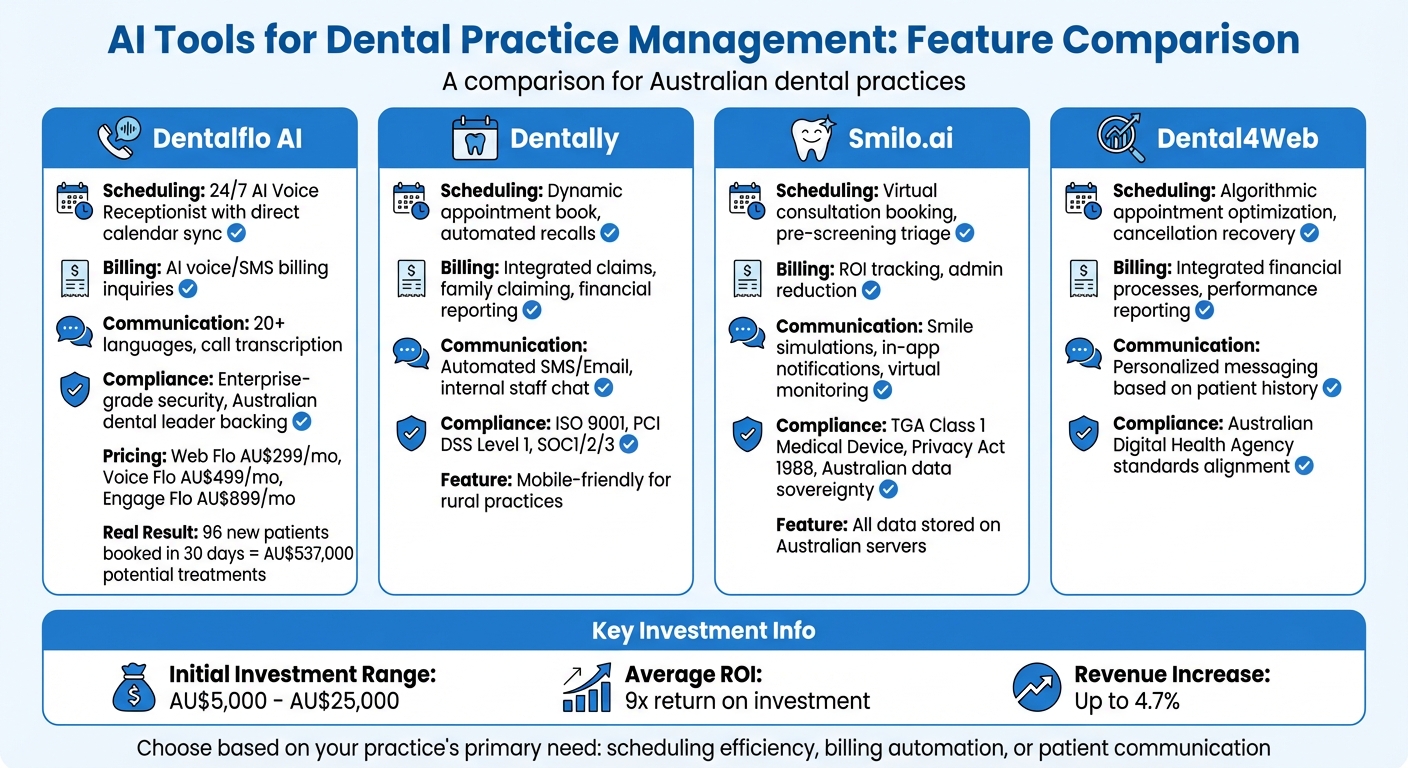
AI Tools Comparison for Australian Dental Practices: Features, Pricing and Compliance
Comparison Table
Selecting the right AI tool for your dental practice depends on your specific priorities – whether it’s streamlining scheduling, automating billing, or improving communication. Each platform excels in different areas. The table below outlines a comparison of four leading tools, focusing on core functions and compliance standards relevant to Australian dental practices.
| Tool | Scheduling AI | Billing AI | Communication AI | Compliance |
|---|---|---|---|---|
| Dentalflo AI | 24/7 AI Voice Receptionist; direct calendar sync (Core Practice, Dentally) | Handles billing inquiries via AI voice/SMS | Multilingual (20+ languages); call transcription & summaries | Enterprise-grade security; Australian dental leader backing |
| Dentally | Dynamic appointment book; automated recalls | Integrated claims submission; family claiming; financial reporting | Automated SMS/Email; internal "Dentally Chat" for staff | ISO 9001, PCI DSS Level 1, SOC1/2/3 |
| Smilo.ai | Virtual consultation booking; pre-screening triage | ROI tracking and admin reduction | Smile simulations; in-app notifications; virtual monitoring | TGA Class 1 Medical Device; Privacy Act 1988 (Cth); Australian data sovereignty |
| Dental4Web | Algorithmic appointment optimisation; cancellation recovery | Integrated financial processes and performance reporting | Personalised messaging based on patient history | Australian Digital Health Agency standards alignment |
The table gives a snapshot of each platform’s capabilities, but let’s dive deeper into key features and compliance considerations.
Dentalflo AI, for example, offers tiered pricing plans to suit different practice needs: Web Flo at AU$299/month, Voice Flo at AU$499/month, and Engage Flo at AU$899/month. A real-world example comes from The Smile Outlet on the Gold Coast, which used Dentalflo AI’s "Jane" assistant to schedule consultations 24/7. Over an 18-month period ending in 2024/2025, the AI booked 96 new patients in just one 30-day window, representing AU$537,000 in potential treatments[3].
Smilo.ai ensures all patient data is stored securely on Australian servers, meeting the requirements of the Privacy Act 1988 (Cth)[28]. Meanwhile, Dentally stands out for its global certifications and mobile-friendly features, which make it a reliable option even for practices in rural areas[20].
It’s worth noting that comprehensive systems often require an upfront investment ranging between AU$5,000 and AU$25,000[1]. To make the best choice, focus on addressing your practice’s most pressing challenges first – whether that’s reducing cancellations or minimising claim denials – before committing to a full-scale deployment[1]. These comparisons highlight how each platform is designed to meet specific operational needs while adhering to Australian regulatory standards.
Benefits and Future Trends of AI in Dentistry
Improved Efficiency and Patient Care
AI technology is transforming how dental practices operate, streamlining processes like scheduling, documentation, and financial management. By automating these tasks, staff can dedicate more time to patient care instead of getting bogged down in paperwork[1]. For Australian dental clinics, AI systems are already proving their worth by reducing unfilled chair time through efficient handling of cancellations and no-shows[1].
Patient communication is another area where AI shines. Tools like AI-powered triage systems provide round-the-clock emergency guidance for issues such as fractured teeth[1]. Additionally, advanced visualisation tools are helping patients better understand their dental conditions and potential treatments. This increased clarity often leads to higher treatment acceptance rates. As Dr. Cindy Roark, Chief Dental Officer at Sage Dental, puts it:
"patients often decline recommended treatment not from lack of trust but because they just don’t see or understand the urgency"[1]
Research backs this up, with 64% of patients struggling to interpret traditional greyscale radiographs[30]. By addressing these challenges, AI not only enhances operational efficiency but also creates a more patient-focused, digitised practice environment. These improvements pave the way for even more transformative developments as AI continues to advance.
Future Trends in AI for Australian Dental Practices
Looking ahead, AI innovations are set to deliver even greater benefits in diagnostics and patient care. The Australian digital health market, currently valued at AU$2.6 billion, is evolving rapidly[1]. While only about 12% of Australian dental practices currently use AI tools, there’s a strong appetite for adoption: 70% of dentists are keen to implement AI for patient education, and nearly two-thirds are interested in using it for diagnostics and practice management[31]. This gap highlights significant growth opportunities.
AI is moving beyond administrative tasks into cutting-edge applications. Technologies like voice-activated clinical documentation, wearable oral health monitors, and advanced analytics tools are shifting from experimental to practical use. These innovations build on existing AI capabilities in scheduling, billing, and diagnostics[1]. AI-powered teledentistry platforms are also poised to improve access to care for patients in rural and remote areas, addressing long-standing service gaps in Australia[29]. Makenzie Harris, Director at Gamma Tech, notes:
"It’s hard to imagine that in five to 10 years from now you’ll walk into a practice that doesn’t utilise AI. AI integration in dental workflows will soon be standard"[30]
Predictive models are another promising development, enabling dentists to foresee disease progression and offer less invasive treatments. Diagnostic tools powered by AI have been shown to boost accuracy by up to 37%. Platforms like Pearl’s Second Opinion have also demonstrated their impact, increasing patient case acceptance by roughly 30% within just 90 days[30]. In August 2025, researchers at the University of Queensland conducted a national review titled "Artificial intelligence in Australian dental and general healthcare", which explored how AI is reshaping clinical decision-making and education across the country[29]. As Sheela Roth, Director of Clinical Operations at Pearl, explains:
"Early detection allows dentists to offer less invasive treatments and prevent more serious issues later"[30]
Conclusion
AI tools have become a key part of the infrastructure for Australian dental practices. With the digital health market valued at AU$2.6 billion and the dental industry generating AU$13 billion annually, adopting AI-driven solutions gives practices a noticeable edge over competitors[1]. This technology directly tackles operational challenges, such as reducing no-show rates by 40% with smart reminder systems and lowering supply costs by 18% through automated inventory tracking[4].
The financial advantages are equally compelling. While there’s an initial investment, these systems often pay for themselves quickly through operational savings, with some practices reporting efficiencies worth up to AU$12,000 per month[4][13]. By shifting from passive data storage to active workflow optimisation, AI enhances both clinical outcomes and business performance.
However, successful implementation requires compliance with strict regulatory standards. The Australian Dental Association (ADA) underscores the importance of maintaining patient safety, protecting data privacy, and ensuring that clinical decisions remain firmly under the control of practitioners[5]. As the ADA Federal Council advises:
"A decision to action an AI system’s result should only be made by a Dental Practitioner taking into account a patient’s clinical presentation, including history, examination and relevant tests"[5].
This regulatory framework ensures that the benefits of AI are delivered responsibly and ethically. Moving forward, practices can focus on high-impact applications such as AI scheduling vs manual systems or insurance verification, ensuring staff are properly trained and selecting systems that seamlessly integrate with existing workflows. As seen with innovations in scheduling and billing, AI’s practical applications touch every aspect of dental practice management. The most forward-thinking practices will use AI to handle routine tasks, freeing up human expertise to strengthen patient relationships and improve both operational efficiency and patient care[1].
FAQs
How do I choose the right AI tool for my practice’s biggest bottleneck?
Start by pinpointing the biggest challenge your practice faces – whether it’s scheduling, patient communication, or administrative tasks. Once you’ve identified the issue, search for AI tools that not only address this specific problem but also integrate seamlessly with your existing systems. Make sure the tool complies with Australian regulations to avoid any legal complications.
For instance, AI scheduling tools can streamline bookings and help minimise disruptions, keeping your daily operations running smoothly. When evaluating options, consider the tool’s features, reliability, and the level of support offered. The right choice will fit into your workflow naturally and help boost overall efficiency.
What Privacy Act 1988 and TGA requirements apply to dental AI in Australia?
In Australia, dental AI tools are required to align with the Privacy Act 1988, which mandates the secure management of sensitive health information. Dental practices must prioritise patient confidentiality by implementing strong security protocols and clear privacy policies.
The Therapeutic Goods Administration (TGA) oversees AI systems that fall under the category of medical devices. These systems must meet strict standards for safety, effectiveness, and quality. Following these regulations is crucial to ensure both ethical practices and legal compliance when using AI in dental care.
How can AI be introduced safely without replacing staff judgement?
AI can be integrated into dental practice management in a way that maintains safety and professionalism by establishing clear boundaries. It’s crucial that AI does not make independent clinical decisions or determine pricing estimates. Instead, it should be implemented with audit trails to allow for thorough human review.
By taking over tasks such as appointment scheduling and patient communication, AI can significantly cut down on administrative burdens. This frees up staff to concentrate on patient care while ensuring that professional judgement and clinical decision-making remain firmly in human hands.
Related Blog Posts
- Real-Time AI in Dental Imaging: What to Know
- How AI Improves Diagnostic Consistency in Dentistry
- AI-Powered Radiology: What Dentists Need to Know
- Ultimate Guide to AI in Dental Implant Radiology
Important Notice: Any surgical or invasive procedure carries risks. Before proceeding, you should seek a second opinion from an appropriately qualified health practitioner.
Individual results may vary. The information provided in this article is for educational purposes only and does not constitute medical advice.
Checkout Related Blogs




Get in touch with us
For more information, call us now to start feeling better. Or fill the form below to make appointment
The Latest News from Complete Smiles
How to Clean Clear Plastic Retainers
Checklist for Choosing Wearable Dental Devices
Checklist for Choosing Cloud AI Platforms in Dentistry

Complete Smiles Bella VistaAccepts All Major Health Funds, Including





