





Real-Time AI in Dental Imaging: What to Know
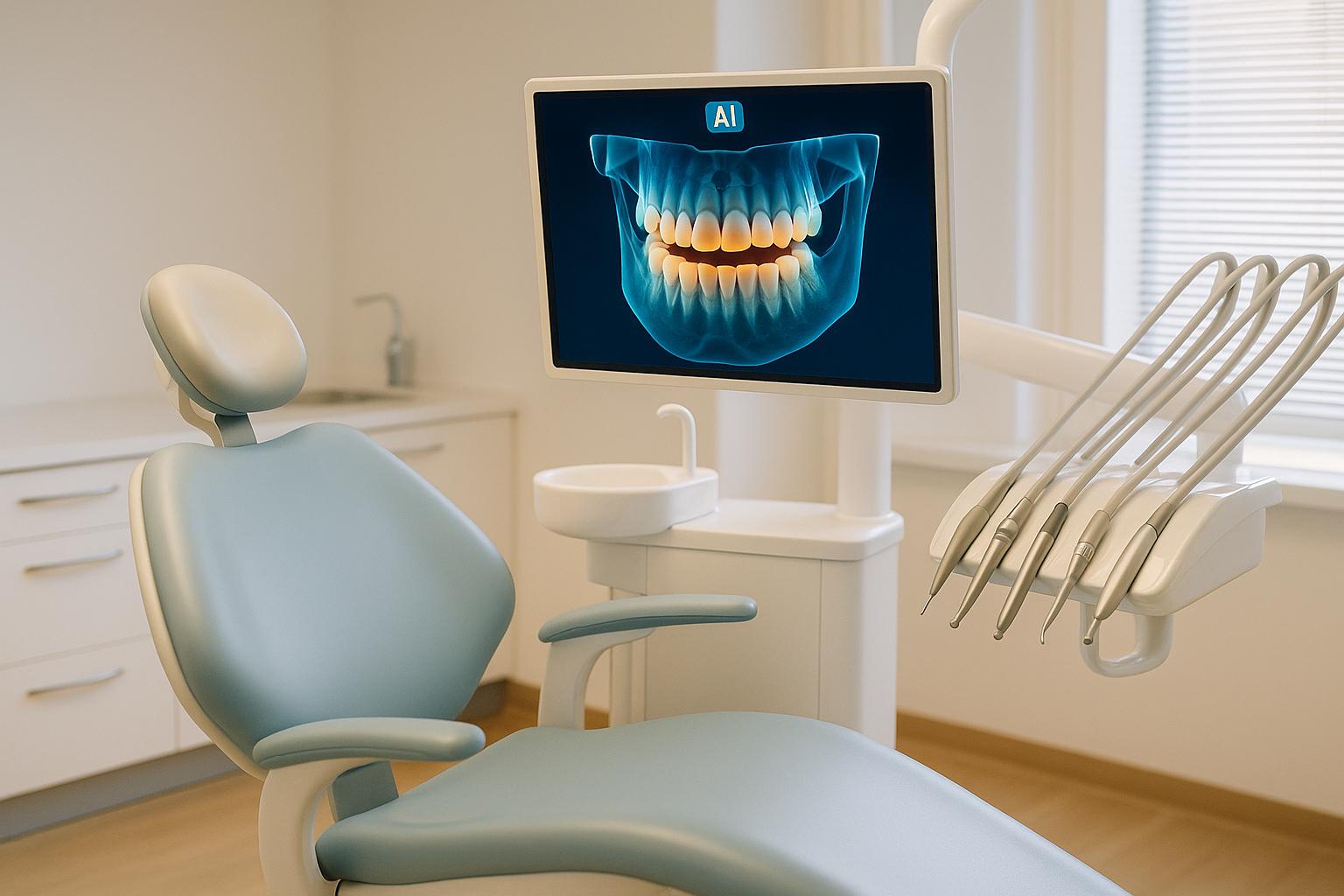
Real-time AI in dental imaging is transforming how dentists diagnose and plan treatments. By instantly analysing X-rays with up to 98% accuracy, AI tools provide detailed, tooth-by-tooth insights in just minutes. This technology is already improving diagnostic precision, reducing delays, and helping dentists identify conditions often missed in traditional assessments.
Key points:
- Instant Analysis: AI evaluates X-rays in minutes, highlighting issues like caries, fillings, and implants with colour-coded annotations.
- Improved Patient Experience: Faster results mean less waiting and clearer communication through visual aids.
- Integration: Tools like Pearl’s Second Opinion® easily fit into existing dental software, making adoption straightforward.
- Challenges: High costs, training demands, and data privacy concerns require careful planning and oversight.
AI is not a replacement for dentists but a tool to support better care. While challenges like accuracy limits and privacy laws remain, advancements in 3D imaging and predictive analytics signal a promising future for Australian dental practices.
How Real-Time AI Works in Dental Radiology
Spotting Dental Issues Instantly
Real-time AI takes radiograph analysis to the next level by quickly identifying potential dental problems. It highlights anomalies using colour-coded annotations, making it easier for dental professionals to spot areas that need attention right away.
This technology doesn’t just work in isolation – it fits right into existing imaging systems without disrupting workflows.
Analysing Images and Fitting Into Workflows
Once installed, tools like Pearl’s Second Opinion® work quietly in the background of current imaging software. When a radiograph is captured, practitioners can access an AI-enhanced view with just a click. Makenzie Harris, Director at Gamma Tech, explains how simple the setup is:
"We remotely install a backend plugin in about 15 minutes. Practitioners can then click into Second Opinion® as images appear, complete with colour-coded annotations." [1]
This seamless integration not only aids in detection but also lays the groundwork for more effective treatment planning.
Enhancing Treatment Decisions
By combining quick detection and smooth integration, real-time AI helps dental professionals make faster, more informed treatment choices. The annotated radiographs allow for efficient reviews, enabling tailored treatment plans to be developed without delay.
Pearl’s AI technology helps a dentist spot caries (cavity) that dentists sometimes miss in x-rays
Benefits of Real-Time AI for Dental Practices and Patients
Real-time AI is transforming the dental field, offering practical advantages for both practitioners and their patients. By building on advanced detection and treatment planning, it brings efficiency, accuracy, and better communication to the forefront of dental care.
Improved Diagnostic Accuracy and Consistency
One of the standout benefits of real-time AI is its ability to minimise variability in diagnoses. Factors like a clinician’s experience, fatigue, or time constraints can lead to inconsistencies, but AI acts as a reliable support system. It can detect early-stage caries, minor periodontal changes, and other subtle issues that might be missed. On top of that, AI promotes uniformity in reporting by using standardised terminology and classification systems. This not only enhances communication between colleagues but also ensures patient records are clear and precise.
Enhanced Patient Communication and Understanding
AI-generated visuals, like colour-coded annotations and highlighted problem areas, can make consultations far more effective. These tools allow dentists to clearly show patients where potential issues lie, making oral health concerns easier to understand. By simplifying complex information, patients are more likely to grasp the reasons behind treatment recommendations. This transparency builds trust and helps patients feel more confident about their care, complementing the diagnostic consistency AI provides.
Faster and More Efficient Practice Operations
With real-time AI, interpreting radiographs becomes quicker and more streamlined. Instead of waiting for manual reviews, dentists can get instant analysis, allowing treatment discussions to happen during the same appointment. This can lead to better scheduling and fewer follow-up visits focused solely on planning. Additionally, AI can prioritise urgent cases and organise findings systematically, reducing administrative workloads. While these efficiencies are a game-changer for busy practices, it’s important to remain aware of the technology’s current limitations.
sbb-itb-2be92ed
Limitations and Challenges of Real-Time AI in Dentistry
Real-time AI has brought exciting possibilities to dentistry, but it’s not without its hurdles. Dental practices need to weigh these challenges carefully to set realistic expectations and ensure smooth integration.
Accuracy Limits and Professional Oversight
AI systems, while powerful, are not perfect. They can stumble when faced with unusual or complex cases that don’t align with their training data. For instance, low-quality images or atypical cases might lead to missed or incorrect diagnoses.
It’s essential to remember that AI is a tool, not a replacement for human expertise. Dentists must always cross-check AI findings to ensure patient care isn’t compromised. Blindly trusting AI recommendations without clinical verification could lead to errors.
Another concern is bias in AI systems, which stems from the data used during training. If the AI has been trained on specific demographics or particular imaging equipment, its performance might falter when dealing with different patient groups or unfamiliar tools. This makes human oversight crucial in every diagnostic decision.
Costs and Training Demands
Setting up real-time AI systems can be a significant financial commitment for Australian dental practices. Advanced imaging tools and AI software often come with price tags ranging from a few thousand to tens of thousands of dollars.
"Implementing AI in your dental practice requires significant upfront capital." – Teero [2]
Beyond the initial investment, practices must account for ongoing costs like software licences, hardware updates, and integration with existing systems. For example, studies estimate the cost of using AI to analyse a pair of bitewings at €8.00 per analysis, with sensitivity analyses considering €4.00 and €12.00 as possible ranges [3]. These recurring expenses can add up quickly.
Training is another critical factor. AI systems often require dental teams to learn entirely new workflows and methods for interpreting data. This transition can be challenging, especially if the AI-generated insights differ from traditional diagnostic approaches.
"Successfully implementing AI requires comprehensive training for your entire team." – Teero [2]
To ease this shift, practices should establish structured training programs, including initial onboarding and continuous education. Detailed documentation and vendor-provided training support can make the process smoother. Assigning tech-savvy team members as internal champions can also help facilitate adoption across the practice.
Patient Privacy and Data Security
AI integration comes with strict privacy requirements under Australian law. Health records are classified as sensitive information under the Commonwealth Privacy Act 1988 and state-specific laws like the Health Records Act 2001 (NSW) [4]. These laws apply to both the data entered into AI systems and the information they generate [5].
Dental practices must ensure that sensitive health data isn’t inadvertently shared with publicly available AI tools. Any breach of this information could result in a notifiable data breach under the Privacy Act [4].
Under Australian Privacy Principle (APP) 11, practices are obligated to take reasonable steps to protect patient information from misuse, loss, or unauthorised access [5]. This means carefully evaluating the security features of AI products and their operating environments.
Data sharing and third-party access also raise concerns. Practices need to scrutinise AI product terms to understand whether developers or other parties might access patient data. Whenever possible, opting for local or on-premises AI solutions can minimise these risks by keeping the data in-house [5].
To stay compliant, practices should update their privacy policies and establish clear internal procedures for AI use. Staff must be trained on the dos and don’ts of AI systems, particularly regarding the handling of personal information. Conducting Privacy Impact Assessments (PIAs) before adopting AI tools can help identify and manage potential privacy risks early on [5].
Additionally, under APP 10, practices must ensure that AI-generated information is accurate. Since AI systems can make mistakes, professional oversight remains essential to verify outputs and maintain accuracy [5]. This further underscores the importance of a balanced approach where technology supports, but doesn’t replace, human judgement.
The Future of AI in Dental Imaging in Australia
Artificial intelligence is expected to play a growing role in dental imaging across Australia. While there are challenges to overcome, advancements in research and technology are bringing exciting possibilities for improved diagnostics and treatment planning. These developments hint at significant progress on the horizon.
Emerging Technologies in Dental AI
New developments in dental imaging are pushing boundaries with technologies like 3D imaging and volumetric analysis, which offer far more detailed insights compared to traditional 2D radiographs. Researchers are also exploring how predictive analytics, using historical data, might help flag potential dental issues earlier.
Another promising area is the integration of machine learning with tools like intraoral scanners. This could eventually enable real-time treatment planning, such as identifying restorative design options or detecting issues during the scanning process. Additionally, efforts are underway to develop automated treatment sequencing, which could optimise the order of procedures by factoring in healing times and patient comfort. These innovations are expected to encourage wider adoption in clinical settings.
Adoption by Australian Dental Practices
Australian dental practices are increasingly looking into AI-driven imaging as a complement to traditional diagnostic methods. Many are exploring advanced tools that can enhance the accuracy and efficiency of their current practices. Local software developers are also creating solutions tailored to meet national privacy regulations and seamlessly integrate with existing practice management systems.
Education is keeping pace with these technological shifts. Australian dental schools and continuing professional development providers are now incorporating AI-related topics into their courses. This ensures that both new graduates and practising dentists are equipped to understand the capabilities and limitations of these emerging technologies.
Long-Term Effects on Patient Care
The integration of AI into dental imaging is set to elevate patient care significantly. Over time, it promises to improve diagnostic accuracy and enable more tailored treatment plans. AI-assisted visualisations and data-driven approaches may lead to earlier interventions and more personalised treatments, which could also help patients better understand their care options.
Streamlined diagnostic and planning processes could reduce treatment times and enhance practice efficiency. As these technologies continue to evolve, the goal is to strike a balance between AI capabilities and clinical expertise, fostering more informed and collaborative decision-making in dental care across Australia.
Conclusion
The use of real-time AI in dental imaging is reshaping the landscape of Australian dental care. By identifying early signs of decay that might otherwise go unnoticed and providing consistent diagnostic insights, tools like Pearl’s Second Opinion® are enabling earlier interventions and enhancing patient understanding with clear, colour-coded visuals [1].
That said, AI serves as a supportive tool rather than a substitute for clinical expertise. It requires ongoing professional oversight, adherence to strict data privacy measures, and the implementation of strong ethical standards [1][6][8][9][10].
Looking ahead, advancements in areas like 3D imaging, predictive diagnostics, and AI-assisted robotics may pave the way for more tailored treatment plans. Features such as ‘virtual patients’ could further enhance treatment planning and precision [7][9][10]. For dental practices in Australia, adopting these technologies will involve balancing their possibilities with a clear awareness of their boundaries. By doing so, practitioners can deliver more accurate diagnoses and better oral health outcomes while maintaining the indispensable value of human expertise.
FAQs
How does real-time AI enhance the speed and accuracy of dental diagnoses compared to traditional methods?
Real-time AI is reshaping dental imaging by boosting both diagnostic precision and speed. These advanced systems can analyse dental images with impressive accuracy, minimising inconsistencies among clinicians. In fact, they boast success rates of up to 87%, compared to 82% with older methods. Plus, they cut diagnostic times by about 35%, enabling quicker evaluations.
AI shines when it comes to detecting issues like alveolar bone loss, achieving accuracy rates between 73.4% and 99%. By simplifying the diagnostic process, AI not only speeds up treatment planning but also contributes to improved patient care.
What challenges do dental practices face when adopting real-time AI technology, and how can they address them?
Integrating real-time AI into dental practices isn’t without its hurdles. One major concern is data privacy and security, as these systems manage sensitive patient information. Practices must adhere to strict privacy laws to ensure this data is well-protected. Another challenge lies in the lack of infrastructure or systems that don’t seamlessly integrate with existing workflows, potentially disrupting daily operations. On top of that, staff may need additional training to use and understand AI effectively.
To tackle these issues, dental practices can prioritise investing in reliable infrastructure that aligns with privacy regulations. Offering AI-focused training for staff can also ease the transition, making it smoother and more efficient. By addressing these challenges head-on, practices can leverage AI to enhance patient care while keeping data secure and operations running smoothly.
How is patient privacy and data security managed when using real-time AI in dental imaging in Australia?
Real-time AI in dental imaging plays a key role in safeguarding patient privacy and data security, aligning with the Privacy Act 1988. Under this legislation, health records are classified as sensitive information, demanding rigorous protective measures. Australian dental practices are required to adopt strategies such as encryption, data anonymisation, and secure storage to ensure patient data is well-protected.
These AI systems are built to uphold the confidentiality, integrity, and security of patient information while adhering to Australia’s legal and ethical standards. By implementing strong data protection protocols, dental clinics can confidently use AI technology without compromising the privacy of their patients.
Related Blog Posts
- AI Research in Oral Disease Detection: Key Findings
- AI vs. Traditional Methods in Pediatric Dental X-Rays
- AI vs. Traditional Methods: Impacted Teeth Detection
- AI-Powered Dental Imaging: Future Trends
Important Notice: Any surgical or invasive procedure carries risks. Before proceeding, you should seek a second opinion from an appropriately qualified health practitioner.
Individual results may vary. The information provided in this article is for educational purposes only and does not constitute medical advice.
Checkout Related Blogs




Get in touch with us
For more information, call us now to start feeling better. Or fill the form below to make appointment
The Latest News from Complete Smiles
How to Clean Clear Plastic Retainers
Checklist for Choosing Wearable Dental Devices
Checklist for Choosing Cloud AI Platforms in Dentistry

Complete Smiles Bella VistaAccepts All Major Health Funds, Including





