




3D Printing Innovations in Orthodontics: Clear Aligners

3D printing has transformed orthodontics, especially in producing clear aligners. By moving from thermoforming methods to direct 3D printing, the process is now faster, more precise, and cost-effective. Patients benefit from better-fitting aligners, improved comfort, and quicker turnaround times. For orthodontists, the technology reduces labour, waste, and costs while enabling in-office production. Materials like shape-memory polymers also improve durability and force retention, with eco-friendly practices reducing material waste. AI integration in orthodontics further enhances treatment accuracy and efficiency, allowing for tailored, high-quality orthodontic care.
Key takeaways:
- Speed: Chairside aligner production in 2–3 hours vs. weeks with thermoforming.
- Precision: 96.25% accuracy within ±0.1 mm for 3D-printed aligners.
- Cost: Production costs drop by nearly 47% compared to thermoforming.
- Materials: Advanced resins offer better fit, force retention, and durability.
- Sustainability: 80–90% less material waste through direct 3D printing.
- AI Role: Improved treatment planning, quality control, and patient monitoring.
3D printing is reshaping orthodontics, delivering faster, more efficient, and patient-friendly solutions.
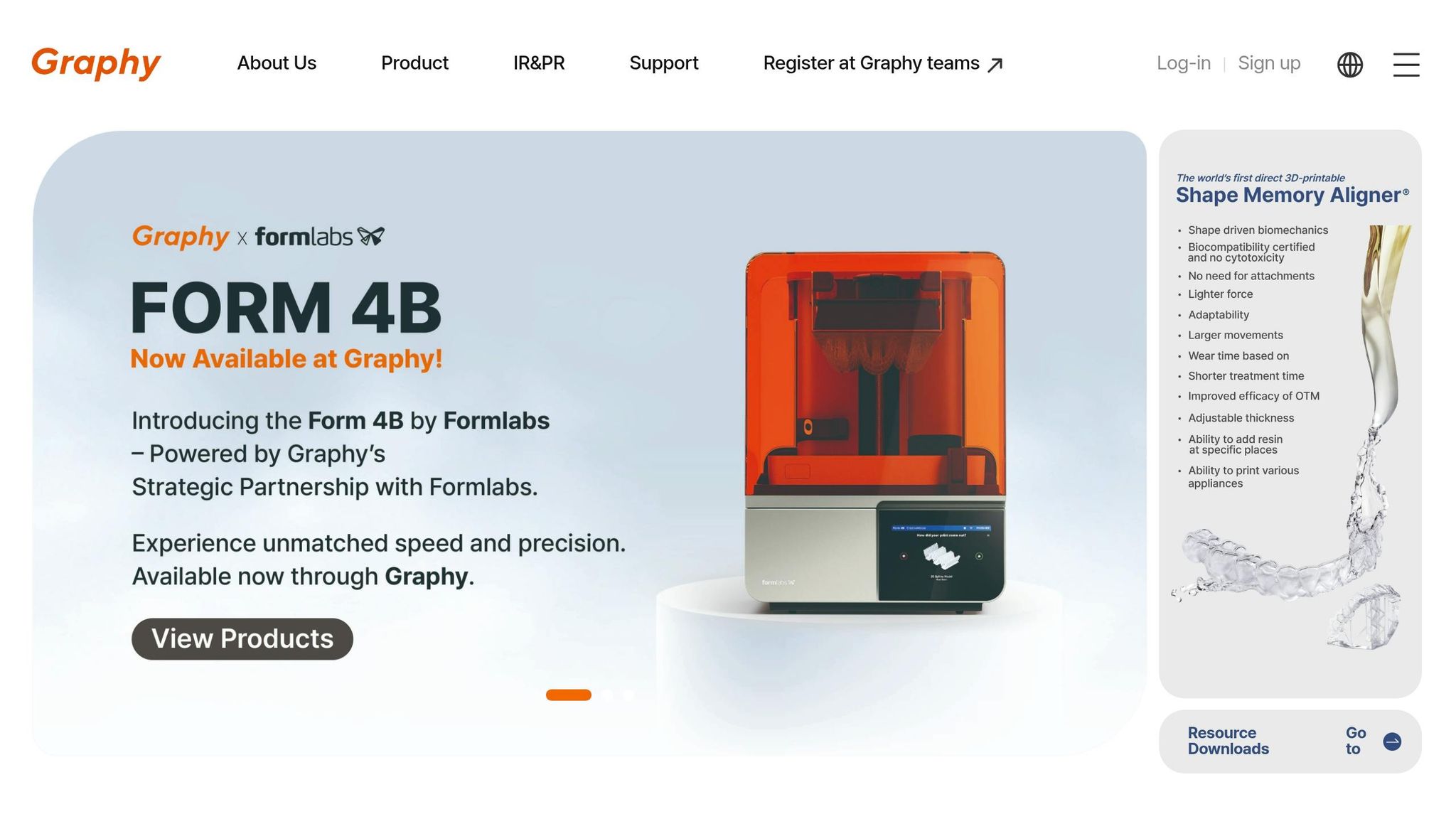
Graphy Revolutionizes Orthodontics with 3D-Printed Aligner Resin and Smart Curing Tech
sbb-itb-2be92ed
The Evolution of Clear Aligner Manufacturing
Since the late 1990s, clear aligner production has made significant strides, transitioning from thermoforming methods to direct 3D printing. This shift has brought faster production times and improved treatment precision.
Thermoforming: The Early Standard
Thermoforming became the go-to method after gaining FDA clearance in 1998. It replaced earlier, labor-intensive techniques where technicians manually adjusted malocclusion models using wax [6]. This process introduced the concept of sequential plastic trays, each designed to gradually shift teeth into alignment [6].
The method involved heating plastic sheets – commonly made from materials like PETG (polyethylene terephthalate glycol), TPU (thermoplastic polyurethane), or polycarbonate – and vacuum-forming them over 3D-printed dental models. Each stage of tooth movement required its own model, meaning a case with 30 aligners needed 30 separate models [7][6].
But thermoforming had its drawbacks. The heating process often caused uneven stretching of the plastic sheets. A sheet starting at 0.75mm thickness could end up anywhere between 0.38mm and 0.69mm after forming [6][7]. This variation wasn’t just cosmetic – thinner materials could reduce orthodontic force by as much as 30% [6].
"Thermoforming is an important way to alter material properties like transparency, surface hardness, water solubility, water absorption ability, flexural modulus, and elastic modulus." – Arabirami Rajasekaran [6]
Thermoforming also required around 5.5 minutes of manual labour per aligner [7]. Outsourcing this process to labs often extended turnaround times to 2–4 weeks [7]. Additionally, the process generated a lot of waste, from discarded resin models to trimmed plastic offcuts [6][7].
These limitations created the need for a more efficient and precise manufacturing technique, paving the way for direct 3D printing.
Direct 3D Printing: The Modern Solution
Direct 3D printing emerged as a solution to thermoforming’s inefficiencies. This method skips the need for intermediary models, instead building the final aligner layer-by-layer using biocompatible photopolymer resins [7][6]. The first direct-printed aligner received FDA clearance in 2022 [7].
This approach offers a significant boost in precision. Direct 3D-printed aligners achieve about 96.25% accuracy within ±0.1mm tolerances, compared to 75.07% accuracy within ±0.2mm tolerances for thermoformed aligners [7]. By eliminating the variability caused by plastic stretching, 3D printing ensures a more reliable fit.
"This workflow enables the development of an in-house aligner system with complete control over desired aligner thickness, extent, and attachments; it is also technically resource-efficient with greater accuracy by excluding all the intermediate steps involved in the thermoforming method." – Prabhat Kumar Chaudhari, Division of Orthodontics, AIIMS [6]
Direct 3D printing is also much faster. Production times drop from weeks to just 2–3 hours for chairside manufacturing [7]. Labour requirements shrink from 5.5 minutes to just 1.5 minutes per aligner, and production costs fall by about 47% [7]. A single 3D-printed aligner costs roughly $6 to produce, compared to $10–$12 for thermoforming. For a full case of 30 aligner pairs, the cost is approximately $410 (including software fees) versus $770 for thermoforming [7].
The materials used in 3D printing also bring new advantages. Modern options like Tera Harz TC-85 and ActiveMemory™ polymers offer shape-memory properties. These materials maintain consistent thickness and can "snap back" to their original shape when exposed to hot water above 60°C, allowing patients to reset deformed aligners [7]. At body temperature (37°C), TC-85 resin demonstrates better viscous behaviour than PETG, with a loss tangent of 0.16 compared to 0.004 [3].
On top of these benefits, direct 3D printing is more eco-friendly. It uses only the resin needed for the aligner itself, cutting down on waste from discarded models and plastic offcuts [6][7].
Benefits of 3D Printed Clear Aligners
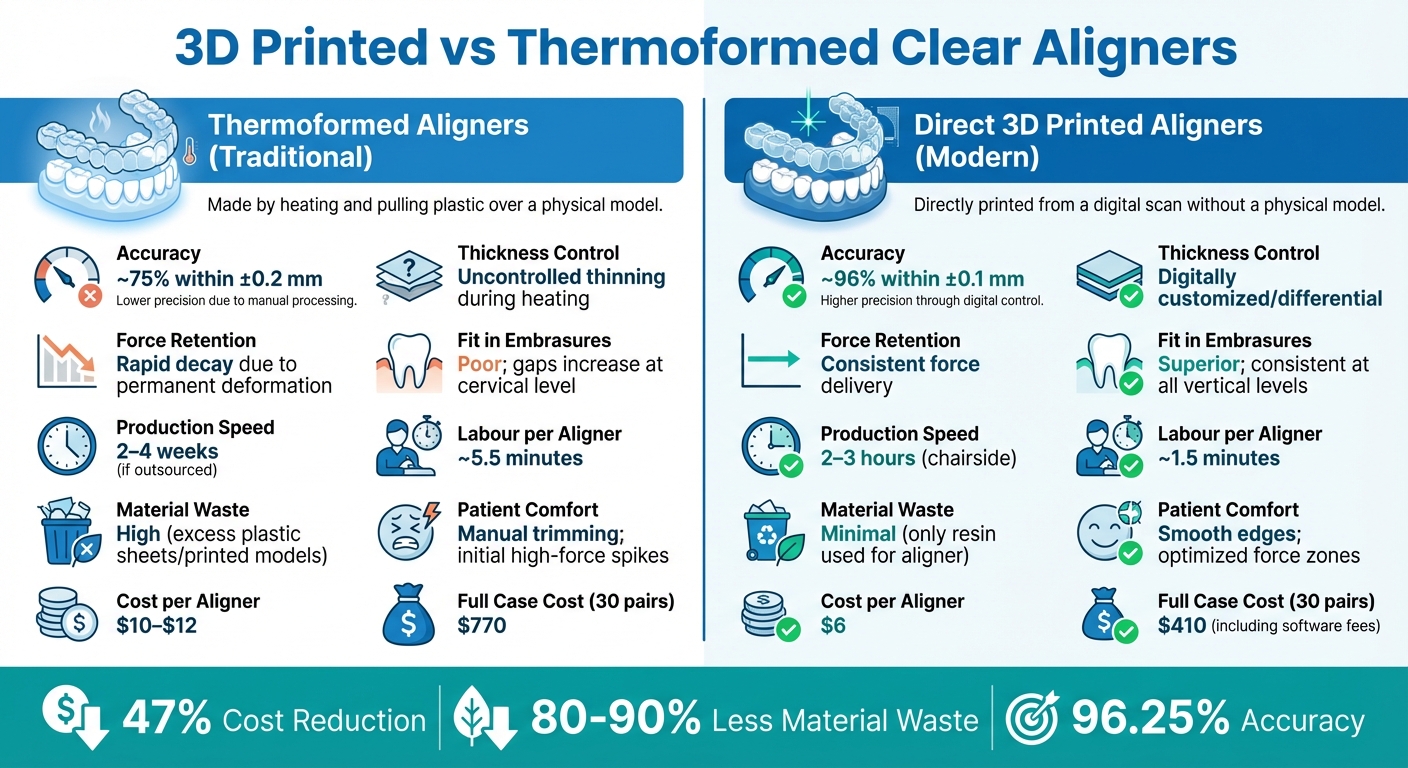
3D Printed vs Thermoformed Clear Aligners Comparison
Key Benefits for Patients and Practitioners
The advancements in clear aligner production through 3D printing have brought notable improvements for both patients and dental professionals. By moving beyond the constraints of thermoforming, direct 3D printing enhances fit, force application, and personalisation.
Direct 3D printing achieves a far superior fit, with an impressive 96.25% accuracy (±0.1 mm) compared to the 75.07% (±0.2 mm) seen in thermoformed aligners [7]. This precision is especially crucial in the embrasures – the spaces between teeth – where 3D-printed aligners excel in maintaining consistent thickness, ensuring a snug fit at all vertical levels [8].
Force delivery is another area where 3D-printed aligners shine. While thermoformed plastic sheets tend to deform in the mouth, leading to rapid force decay, advanced 3D-printed resins like ActiveMemory™ retain their elastic properties throughout the wear cycle [7]. Some materials even incorporate shape-memory capabilities, allowing minor deformations to be corrected with a quick soak in warm water [7][4].
3D printing also allows for targeted thickness adjustments, enabling specific force zones to be programmed [7][4]. This level of customisation isn’t possible with the uniform plastic sheets used in thermoforming. As a result, treatments are not only more effective but also more comfortable, with digitally controlled edges that eliminate the need for manual trimming, reducing the risk of gum irritation [7][4].
"Direct printed aligners enable same-day treatment initiation, reduce refinement needs, improve patient comfort, lower costs by 47%, and minimize environmental impact." – LuxCreo [7]
On the operational side, the technology streamlines workflows significantly. The labour required per aligner drops from 5.5 minutes to just 1.5 minutes, and production costs are reduced by nearly 47% when compared to traditional thermoforming methods [7].
3D Printed vs Thermoformed Aligners: A Comparison
| Feature | Thermoformed Aligners | Direct 3D Printed Aligners |
|---|---|---|
| Accuracy | ~75% within ±0.2 mm [7] | ~96% within ±0.1 mm [7] |
| Thickness Control | Uncontrolled thinning during heating [7][8] | Digitally customised/differential [7][4] |
| Force Retention | Rapid decay due to permanent deformation [7] | Consistent force delivery [7] |
| Fit in Embrasures | Poor; gaps increase at cervical level [8] | Superior; consistent at all vertical levels [8] |
| Speed | 2–4 weeks (if outsourced) [7] | 2–3 hours (chairside) [7] |
| Labour | ~5.5 minutes [7] | ~1.5 minutes [7] |
| Material Waste | High (excess plastic sheets/printed models) [7] | Minimal (only resin used for aligner) [7] |
| Patient Comfort | Manual trimming; initial high-force spikes [7] | Smooth edges; optimised force zones [7][4] |
Materials Used in 3D Printed Clear Aligners
Biocompatible Materials
3D-printed clear aligners rely on advanced materials that go beyond traditional plastics. Many of these aligners are made from aliphatic urethane acrylates, which create cross-linked networks that offer both durability and the ability to retain their shape.
One standout material is Tera Harz TC-85 from Graphy. This aliphatic vinyl ester-urethane polymer has been shown to achieve 96% shape recovery after just 60 minutes at 37°C. Its cross-linked structure helps prevent permanent deformation, making it a reliable choice for orthodontic applications[10].
Another advanced option is LuxCreo’s ActiveMemory™ polymer. This material uses a dual-mechanism design that combines hard segments for stiffness with soft segments for flexibility. The result is a balance between effective force delivery and patient comfort. Impressively, it retains 95% of its initial force after seven days of wear, compared to the 60–70% retention seen in traditional thermoformed plastics. In 2022, the ActiveMemory™ polymer received FDA Class II 510(k) clearance, meeting rigorous ISO 10993 standards for safety, including cytotoxicity and skin sensitisation testing[11].
Shape memory polymers (SMPs) represent another leap forward. These materials can return to their original shape when exposed to heat, whether from body temperature or warm water. This feature allows patients to "reset" their aligners’ shape and force by simply soaking them in warm water[10][11]. Additionally, Formlabs‘ Dental LT Clear, a methacrylate-based resin approved for long-term biocompatibility, is widely used in other dental devices.
To ensure these materials meet safety standards, post-curing in nitrogen-rich environments is employed. This process eliminates uncured monomers and ensures complete polymerisation, avoiding the oxygen-inhibition layer that can occur with standard curing methods[9][13].
While biocompatibility remains a top priority, there’s also a growing emphasis on reducing the environmental impact of aligner materials.
Eco-Friendly Material Design
Direct 3D printing has introduced a more sustainable approach by eliminating the need for physical dental models and vacuum-forming sheets. This method uses resin only where needed, cutting material waste by 80–90% compared to traditional thermoforming techniques[11].
A particularly exciting development is 4D printing technology, which incorporates smart shape-memory polymers. These materials can be reshaped for later treatment stages, reducing waste significantly. For example, research on ClearX aligners from Graphy in 2024 demonstrated that patients could reuse the same aligner by reshaping it in boiling water (100°C) for 10–30 minutes. This process activates the aligner’s shape-memory properties, potentially halving the number of aligners required. In practical terms, this could reduce the carbon footprint of treatment from 4 kg to 1.8 kg of CO₂ per patient[14].
"Smart memory polymers could transform clear aligner fabrication by enabling devices that support two treatment phases, potentially halving plastic usage while retaining clinical effectiveness." – MDPI[14]
These advancements not only enhance the performance of clear aligners but also support a shift towards more sustainable orthodontic practices. However, challenges remain in creating fully biodegradable or recyclable medical-grade resins. Most current materials are still petroleum-based, and while direct printing reduces waste, further research is needed to develop truly sustainable options that meet the stringent biocompatibility requirements for long-term use in the mouth[13].
AI Integration with 3D Printing
AI is taking 3D printing in orthodontics to a whole new level, refining both precision and efficiency in treatments. Instead of relying on manual measurements, AI taps into extensive databases of past cases to predict how individual teeth will respond to specific forces. This approach ensures treatment plans are informed by thousands of real-world outcomes rather than just theoretical models.
AI in Treatment Planning
AI simplifies and accelerates diagnostic tasks that once took considerable time. Take cephalometric analysis – the process of tracing anatomical points on X-rays – as an example. What used to take orthodontists 10 to 20 minutes per patient is now completed by AI in seconds, ensuring standardised results and eliminating the risk of human error[16]. Similarly, tooth segmentation, where individual teeth are identified and separated from 3D scans, is achieved with a 98% accuracy rate thanks to AI algorithms[15].
One of AI’s standout roles is in staging, which involves mapping out how teeth move from their current position to the desired alignment. By simulating millions of potential movement sequences, AI identifies the most biomechanically efficient path. This reduces the number of aligners required and minimises treatment delays caused by teeth blocking each other’s movement[16]. AI also optimises the size, shape, and placement of attachments – those small composite bumps on teeth – to maximise the force delivered by each aligner.
A 2025 study involving 55 patients highlighted the impact of AI-driven decision tree algorithms on treatment outcomes. Using the StrojCHECK® system, aligner tracking adherence improved from 85% to 92%, and patient engagement scores jumped from 4.2 to 7.3[18]. Female participants, in particular, showed significant improvements, with non-compliance rates dropping from 10% to 5%.
But AI’s influence doesn’t stop at treatment planning – it also improves the manufacturing process.
AI-Powered Quality Control
AI plays a crucial role in ensuring quality during production. Tools like LuxLink provide real-time assessments during the 3D printing process, catching deviations before they can affect entire batches[20]. This level of oversight ensures that printed aligners maintain 99% dimensional accuracy when compared to their digital designs[20].
In 2025, Dr Jeremy Manuele of Hamilton & Manuele Orthodontics in Las Vegas adopted the LuxCreo iLux Pro Dental system. By integrating AI-driven software with a closed-loop digital workflow, his practice reduced the number of attachments needed to just two to eight per case – far fewer than the dozen or more typically required with traditional thermoformed aligners[21]. This system also enabled same-day or next-day delivery of perfectly fitted trays.
Dr Bill Layman of Straighten Up Orthodontics in Clearwater, Florida, shared similar successes. With AI-controlled direct printing, his practice cut hands-on lab time by roughly 40%. They could produce up to two dozen trays per batch, with only six minutes of hands-on time per tray[21]. Additionally, AI-powered remote monitoring allowed patients to upload progress photos from home. The software would detect any fit issues in real time, comparing remote and in-office monitoring to notify clinicians only when intervention was necessary[17][19].
"AI in orthodontics is not science fiction it is the modern reality. It’s a tool that helps your doctor diagnose faster, predict results more accurately, and reduce the chance of errors." – Dentovex Orthodontics[16]
Future Developments in 3D Printing for Orthodontics
Orthodontics is evolving at a rapid pace. In 2023, orthodontics contributed to 39% of revenue in the dental 3D printing market, with the additive manufacturing sector growing by 11.1% that same year. This pushed the market value past AU$20 billion[22]. These numbers highlight the growing potential for innovation, as 3D printing expands beyond clear aligners to a wider range of orthodontic applications. Building on the success of aligners, these advancements are redefining how orthodontic devices are created and customised.
Applications Beyond Aligners
3D printing is now being used to produce a variety of orthodontic devices beyond aligners. Customised distalizers, power arms, space maintainers, and bone-anchored maxillary protraction (BAMP) plates are being fabricated using techniques like selective laser sintering (SLS)[22]. These devices benefit from the same precision and tailored fit that have made 3D-printed aligners so effective.
One exciting advancement is the ability to print elastic chains with pre-set, precise forces, allowing clinicians to apply highly specific biomechanical forces during treatment[22]. This moves orthodontics away from the generic approach of traditional elastics. Another game-changing development is 4D printing, which uses shape-memory materials that can adapt over time. Marcel Paľovčík and his team at Comenius University describe this as a step toward "smart orthodontics", where devices can dynamically adjust to changes in tooth positioning[22].
"The rise of 4D memory shape materials signals a potential breakthrough in ‘smart orthodontics’, where directly printed devices can adapt over time." – Marcel Paľovčík et al., Department of Orthodontics, Comenius University[22]
Mass Customisation of Orthodontic Treatments
The move towards in-office manufacturing is making personalised orthodontic care more accessible and efficient. By leveraging the same principles of precision and individualisation seen in aligner production, Australian practices can now produce customised appliances on-site. Faster printers and lower material costs are reducing the need for outsourcing, cutting delays and expenses[1][2]. This shift is enabling clinics to enhance their digital workflows – such as incorporating intraoral scanners and 3D printers – without needing extra lab space[1].
Direct printing also allows for variable thickness designs, tailoring force application to specific areas. For example, 3D-printed aligners can achieve thickness increases of 197% to 470% in critical regions like cervical embrasures, while thermoformed versions often thin out to just 36.5% of the original material thickness[8]. This level of precision can improve complex tooth movements and potentially reduce the total number of aligners needed for treatment.
Looking ahead, the global clear aligner market is expected to grow from AU$4.66 billion in 2024 to AU$28.15 billion by 2032, with a compound annual growth rate of 25.2%[12]. As materials science advances – particularly with the introduction of new biocompatible resins and shape-memory polymers – the ability to customise treatments will only expand. These developments promise to make tailored orthodontic care more efficient and accessible across Australia.
Conclusion
3D printing has reshaped how clear aligners are made. By moving away from traditional thermoforming methods to direct 3D printing, manufacturers have cut down on production steps, reduced material waste, and gained the ability to produce aligners with precise, digitally controlled thicknesses [2][4]. This precision allows orthodontists to apply targeted forces to individual teeth with greater accuracy.
These advancements bring clear benefits for both patients and practitioners. Direct 3D printing maintains the polymer’s original integrity, which is often compromised during thermoforming [5]. Clinical studies show that most 3D-printed aligners achieve an impressive accuracy within 0.25 mm [3]. Additionally, advanced materials like TC-85 resins offer enhanced dimensional stability, ensuring a better fit [3].
Looking forward, new developments in materials science – such as shape-memory polymers and 4D printing – are set to push the boundaries of customisation and efficiency. The introduction of eco-friendly resins and the reduction of plastic waste through additive manufacturing also address growing concerns about sustainability in dental care [5].
The evidence is clear: 3D printing has brought a major leap forward in orthodontics. With faster production times, safer materials, and reduced costs, this technology is making personalised orthodontic treatments more accessible across Australia. Continued research into materials and techniques will only enhance these benefits, ensuring better outcomes for patients and practitioners alike.
FAQs
Are 3D-printed clear aligners safe for long-term wear?
Research shows that 3D-printed clear aligners are safe for long-term use, provided they are crafted using suitable resins. These aligners are considered biocompatible, meaning they work well with the body without causing harm. Ongoing studies are focused on evaluating their mechanical strength and any potential risks to cells, helping to improve both their safety and durability over time.
Do 3D-printed aligners move teeth faster or better than thermoformed ones?
3D-printed aligners are gaining attention for potentially outperforming thermoformed ones in certain areas. Studies indicate they may deliver improved accuracy and a better fit, which can optimise tooth movement. Specific advantages include a more precise embrasure fit and consistent material thickness, both of which contribute to more reliable results. While research on treatment speed is still developing, the precision of 3D printing technology holds promise for achieving more efficient and accurate orthodontic outcomes.
What does in-chair aligner printing change for my appointments and costs in Australia?
In-chair aligner printing is changing the game for orthodontic treatments in Australia. Clinics can now create aligners on-site in roughly three hours, a huge improvement over the traditional 6–8 week timeline. This shift doesn’t just save time – it also slashes costs by up to 75%. Instead of spending AUD 1,500–2,000 per case, clinics can now produce aligners for around AUD 300–400.
Patients reap the rewards, too. They can start their treatment sooner, pay less, and enjoy the added accuracy provided by digital tools like 3D printing and intraoral scanning.
Related Blog Posts
- Digital Orthodontics: CAD/CAM Workflow Explained
- Benefits of 3D-Printed Clear Aligners
- Emerging Trends in 3D-Printed Dental Prosthetics
- AI in Clear Aligners: Research Highlights
Important Notice: Any surgical or invasive procedure carries risks. Before proceeding, you should seek a second opinion from an appropriately qualified health practitioner.
Individual results may vary. The information provided in this article is for educational purposes only and does not constitute medical advice.
Checkout Related Blogs



Get in touch with us
For more information, call us now to start feeling better. Or fill the form below to make appointment
The Latest News from Complete Smiles
How to Clean Clear Plastic Retainers
Checklist for Choosing Wearable Dental Devices
Checklist for Choosing Cloud AI Platforms in Dentistry
Complete Smiles Bella VistaAccepts All Major Health Funds, Including