





Benefits of 3D-Printed Clear Aligners
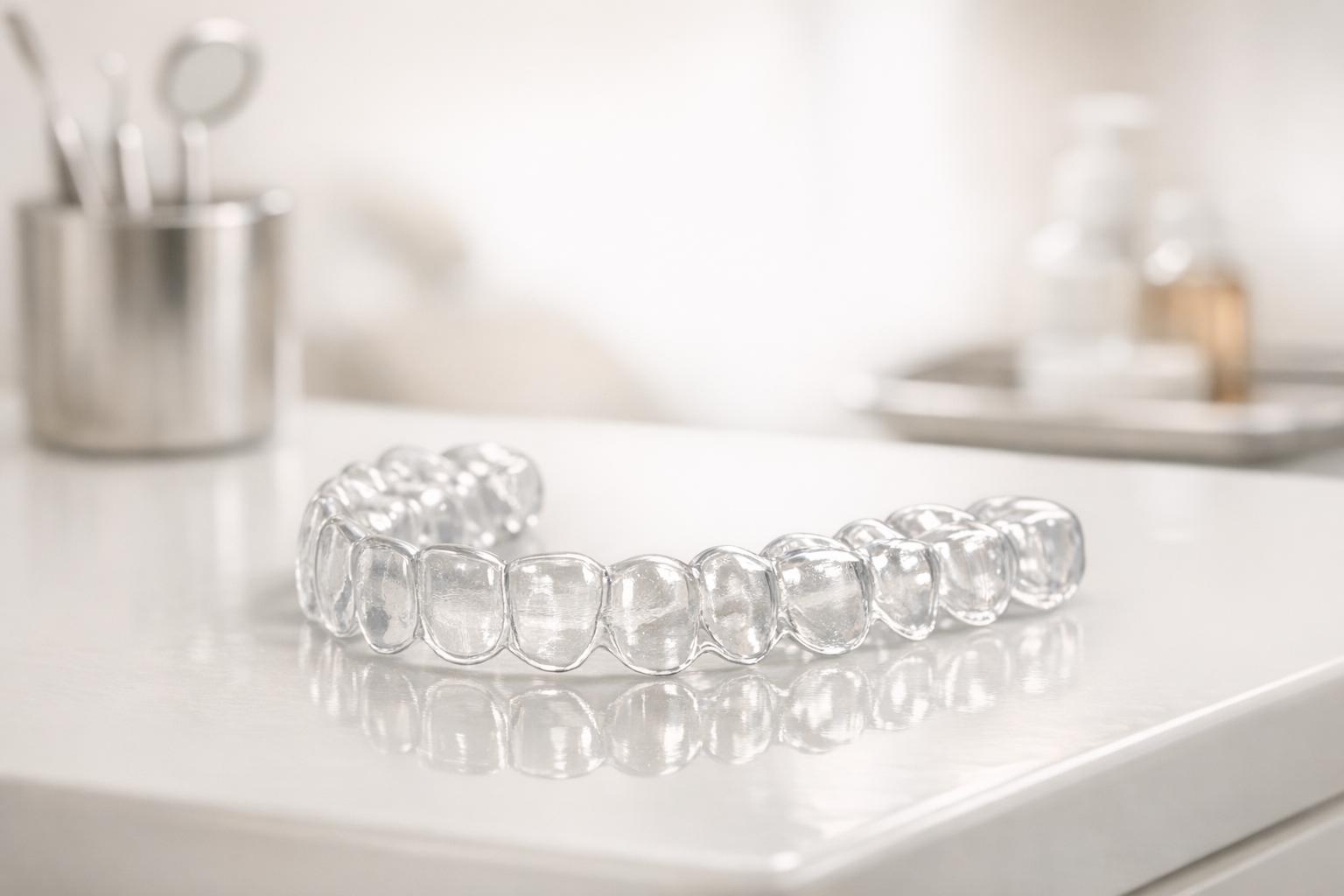
3D-printed clear aligners are changing orthodontics by offering faster production, precise fit, and improved comfort. Unlike older methods, these aligners are made layer-by-layer using advanced materials, ensuring more accurate tooth movement and shorter wait times. They also reduce waste and allow for in-office production, cutting costs significantly. Here’s a quick look at why they’re a game-changer:
- Precision: Aligners are tailored to exact tooth movements with minimal deviation (as little as 0.50 mm).
- Speed: Digital workflows enable same-day or next-day aligner production.
- Customisation: Thickness can be adjusted for optimal force delivery.
- Comfort: Smooth, accurate fits reduce gum irritation and improve wearability.
- Durability: Advanced resins resist deformation and maintain consistent force.
- Cost Savings: Clinics can produce aligners in-house for as low as A$15–A$25 per stage.
- Sustainability: Direct printing reduces plastic waste by eliminating unnecessary materials.
These aligners also open doors to advanced applications, like integrating attachments or using bioactive materials to support oral health. With these advancements, they’re reshaping orthodontic care to be faster, more precise, and eco-conscious.
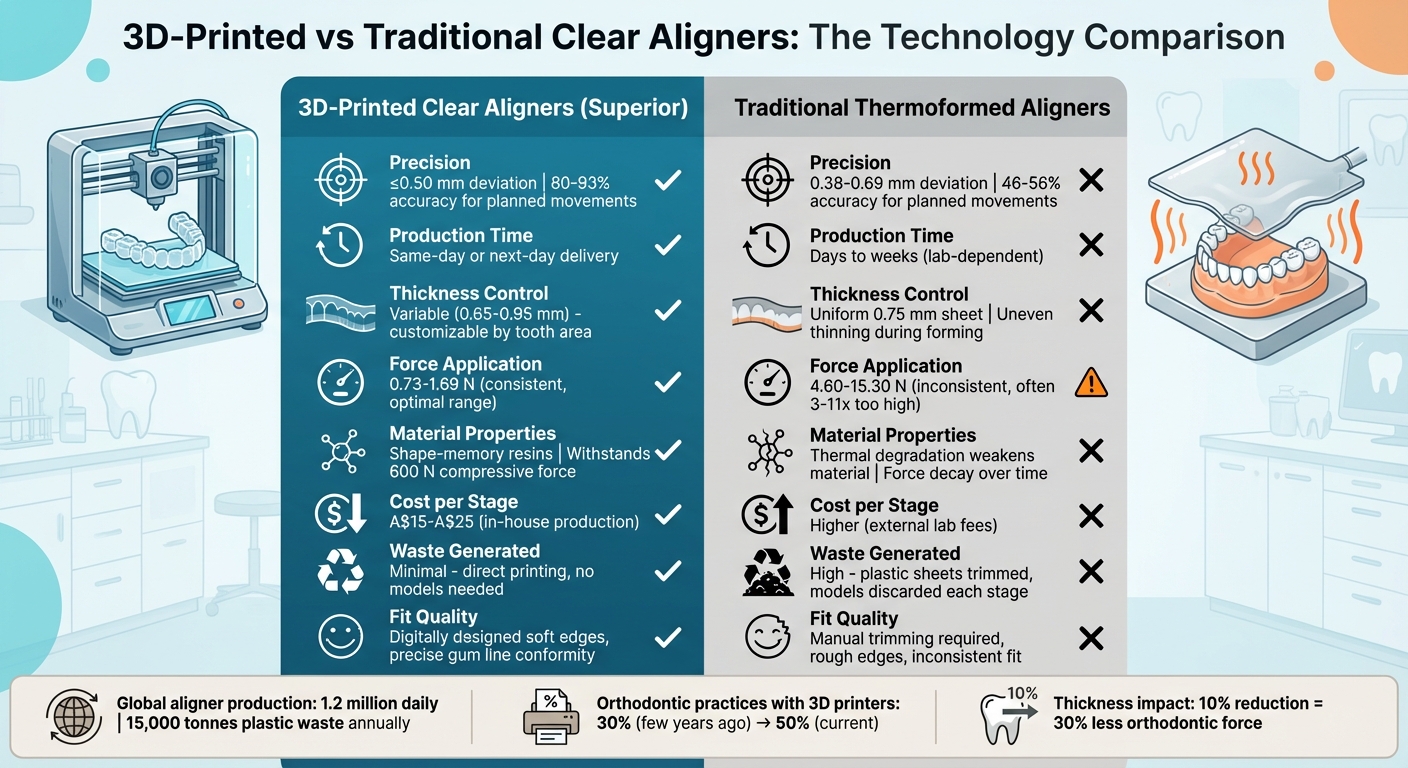
3D-Printed vs Traditional Clear Aligners Comparison
The Direct Print 3D Aligner Advantage in Orthodontics w/ Mike Gordon
1. Precision and Accuracy in Tooth Movement
When your orthodontist creates a digital treatment plan, 3D printing ensures the aligner mirrors the plan with incredible precision. Unlike traditional methods, where thermoforming stretches heated plastic over a mould – leading to uneven thinning and distortion – direct 3D printing constructs aligners layer by layer from biocompatible resin, eliminating inconsistencies [2][6].
The difference in accuracy is striking. Studies reveal that 3D-printed retainers deviate by no more than 0.50 mm, meeting stringent clinical precision standards [2]. On the other hand, thermoformed aligners, made from 0.75 mm plastic sheets, often show variability ranging from 0.38 mm to 0.69 mm in different areas after processing [3]. Such inconsistencies can directly impact how forces are applied to your teeth, which is why 3D printing plays a key role in enabling more tailored treatment options.
"Highly precise clear aligners with soft edges, digitally designed and identically reproduced for an entire set of treatment aligners; offering a better fit, higher efficacy, and reproducibility." – Materials Journal [6]
3D printing also allows orthodontists to control the thickness of aligners in specific areas, fine-tuning the force vectors needed for complex tooth movements. This level of precision is unattainable with traditional methods, where aligners are made from a single sheet of uniform material [2][5]. By managing these force vectors, orthodontists can achieve more predictable outcomes, particularly for tricky movements like rotating small lateral incisors or round premolars [7][8].
In a 2019 study led by researcher P. Jindal, clear aligners 0.75 mm thick were produced using Dental LT resin on a Formlabs 3D printer. When compared to traditional aligners made from Duran foils, the 3D-printed versions showed superior geometric accuracy and were able to withstand higher loads with less displacement [2][6].
2. Faster Production and Shorter Wait Times
Traditional thermoforming methods require a separate physical model for every aligner in a treatment series [4]. This process is both labour-intensive and time-consuming, involving multiple manual steps to create and form each model. Add in the time it takes to ship impressions to external labs, and the timeline for aligner production can stretch from several days to weeks [5]. This conventional method stands in stark contrast to the efficiency of 3D printing.
With 3D printing, these delays are virtually eliminated. The digital workflow – starting with digital scanning, followed by CAD design, direct printing, and post-processing – streamlines the entire process. Orthodontists can move seamlessly from digital treatment planning to producing aligners [2]. Intraoral scanners quickly capture a complete 3D image of the patient’s teeth, often within minutes, paving the way for on-site aligner production [9]. Thanks to the decreasing cost of 3D printers, many orthodontic clinics now have the capability to print aligners in-house [2].
"As 3D-printing of clear aligners is a direct production method, there is no need for printed models and vacuum prototypes, which saves time and money." – Chenyang Niu et al., Frontiers in Materials [2]
This speed is especially helpful when an aligner is lost or damaged. Since treatment data is stored digitally, a replacement can be printed immediately – no need for new impressions or physical moulds [2]. Some clinics even offer chairside production, allowing them to provide aligners during the same visit or shortly after scanning [10].
The efficiency of 3D printing has not gone unnoticed by experts. Jack Slaymaker and his team highlighted in the British Dental Journal that "3D printing is a highly evolving area of dentistry… New advances now allow the in-house delivery of printed aligners" [5]. Moreover, Align Technology, the company behind Invisalign, has been instrumental in advancing the global use of 3D printing for aligner production [9]. This cutting-edge manufacturing method is transforming modern orthodontic care, making treatments faster and more accessible.
3. Customisable Thickness for Optimised Force Delivery
One standout feature of 3D-printed aligners is their ability to vary in thickness, which helps fine-tune the force applied to teeth. Unlike traditional thermoforming, which often leads to uneven thickness, 3D printing builds aligners layer by layer based on a digital treatment plan. This approach allows orthodontists to map out specific thicknesses for different areas of the aligner, tailoring it to the needs of each tooth [12].
With the help of CAD software like Deltaface or LuxDesign, clinicians can precisely adjust material thickness to target specific pressure points [2][7]. For instance, they might add extra thickness to the palatal side of an incisor to encourage labial movement, or to certain areas like the distal-lingual and mesial-labial surfaces to assist with tooth rotation [7]. This level of precision not only makes prescribed movements more predictable but also helps reduce the risk of unwanted tooth shifts.
"Direct printing gave me a way to design every part of the tray to match the tooth… What you design into the movement, you actually get." – Bill Layman, DMD, MBA, Straighten Up Orthodontics [12]
The thickness of the aligner has a major impact on how much force it delivers. Research has shown that reducing the aligner’s material thickness by just 10% can decrease the applied force by up to 30% [3]. Some 3D-printed aligners use thickness gradients – ranging from 0.65 mm to 0.95 mm – that result in more consistent forces, measured between 0.73 N and 1.69 N. This is a significant improvement over thermoformed aligners, which can generate forces varying widely from 4.60 N to 15.30 N [7][11].
Further evidence comes from a study conducted in November 2025 by researchers at the Mohammed Bin Rashid University of Medicine and Health Sciences. They tested three specific thicknesses – 0.50 mm, 0.75 mm, and 1.00 mm – using Tera Harz TC-85 resin to correct rotations of the maxillary right central incisor. The results showed that a thickness of 0.75 mm achieved 80–93% of the planned correction by the fourth stage, delivering a smoother and more consistent derotation process [14]. This ability to customise thickness gives orthodontists greater control over force delivery, anchorage, and the staging of complex movements, leading to more predictable and efficient treatment outcomes [5].
4. Enhanced Comfort and Better Fit
One of the standout benefits of 3D-printed aligners is how precisely they conform to your teeth. Traditional methods, like thermoforming, stretch plastic sheets unevenly over a mould, often leading to inaccurate fits and rough edges that need manual trimming. With 3D printing, aligners are built layer by layer directly from your digital scan, ensuring every tooth surface is captured with precision [2].
The edges of these aligners are digitally designed, resulting in "softer edges" that naturally follow the gum line – no extra smoothing required. Researchers at the University of Milan highlighted this, stating, "Direct 3D printing offers the creation of highly precise clear aligners with soft edges… offering a better fit, higher efficacy, and reproducibility" [6]. This level of precision in design lays the groundwork for improved comfort through advanced materials.
Speaking of materials, 3D-printed aligners take comfort a step further. Resins like Tera Harz TC-85 bring viscoelasticity and shape-memory properties, ensuring the aligners maintain a snug fit while applying consistent and gentle pressure [2]. Studies show that these aligners outperform traditional thermoplastic foils in fitting accuracy [2]. Interestingly, the additive manufacturing process makes these aligners about 12% thicker than their original design specifications, enhancing their structural strength [2].
"3D-printed clear aligners are made from a smooth, flexible material which minimises gum irritation. Designed to be thin and light, they eliminate the bulky feeling of traditional braces." – Simply Teeth [1]
This combination of precise design and advanced materials ensures a more comfortable treatment experience, with consistent and gentle force application throughout [15].
5. Uniform Force Application Across Teeth
Thanks to the precision of 3D printing, aligners now offer a more uniform thickness, which significantly improves treatment accuracy. Unlike traditional thermoforming, which stretches plastic unevenly over a mould and leads to thinning in areas like the anterior and buccal regions, 3D printing creates aligners layer by layer according to exact digital designs. This process eliminates the inconsistencies commonly seen with thermoformed aligners, ensuring a consistent thickness throughout [2] [4].
Why does this matter? Because the thickness of an aligner directly impacts the force it applies to teeth. Even a 10% reduction in thickness can reduce orthodontic force by as much as 30% [3]. Thermoformed aligners, with their variable thickness, often deliver inconsistent forces, which affects treatment outcomes. Studies show that thermoformed aligners achieve only 46–56% accuracy for pre-programmed tooth movements. In comparison, 3D-printed aligners have demonstrated an impressive 80.0–93.1% accuracy in planned rotational corrections [14] [16].
"The ability to print aligners with uniform thickness, which has the advantage of applying uniform forces to all teeth, is a significant benefit of printed aligners." – Frontiers in Materials [2]
On top of ensuring uniform thickness, 3D printing also sidesteps the issue of thermal degradation that can weaken thermoformed materials. Heat exposure during thermoforming alters the molecular structure of plastics, reducing their strength and flexibility [2] [4]. In contrast, 3D printing uses controlled polymerisation, preserving the resin’s mechanical properties. Advanced materials like Tera Harz TC-85 even feature shape-memory properties, allowing aligners to return to their programmed shape at mouth temperature [2] [16]. This reliability in material performance leads to more predictable clinical results.
Additionally, thermoformed aligners often exert forces three to eleven times higher than the optimal range of 70–120 grams, which can hinder smooth tooth movement. 3D-printed aligners, however, deliver forces much closer to this ideal range, enabling more controlled and effective tooth adjustments [16].
sbb-itb-2be92ed
6. Improved Material Properties and Durability
The materials used in 3D-printed aligners bring notable benefits compared to traditional thermoformed plastics. Advanced resins like Dental LT are designed to handle higher loads and resist deformation, making them more durable throughout the treatment process [6]. These resins can endure compressive forces of up to 600 N – similar to normal human biting forces [18] – which reduces the likelihood of cracking, warping, or losing shape during daily wear.
In addition to faster production and precise design, these enhanced material properties contribute to longer-lasting treatment results. Modern 3D printing resins, such as Tera Harz TC-85, have shape-memory capabilities that help maintain consistent force and resist deformation over time. This is a key advantage over thermoformed plastics, which often experience force decay as the material weakens. A study by Chenyang Niu et al. from the Stomatology College of Jiamusi University highlights this advantage:
"The creep behavior of TC-85 provides a progressive increase in static force under cyclic loading, which may improve clinical performance by reducing force decay and preserving the aligner’s orthodontic force." [2]
Unlike thermoforming, the controlled polymerisation process in 3D printing ensures the resin retains its strength, clarity, and durability. Post-curing in a nitrogen atmosphere further enhances polymer cross-linking [9, 11], while centrifugation cleaning helps maintain the aligners’ translucency and aesthetic appeal throughout treatment [13].
These advancements in material properties not only improve the durability of 3D-printed aligners but also contribute to more predictable and consistent orthodontic results.
7. Cost-Effectiveness and In-Office Efficiency
Using in-office 3D printing for clear aligner production can significantly cut treatment costs. Practices can create aligners for as little as A$15 to A$25 per stage, sidestepping the hefty fees charged by major manufacturers and third-party labs [19]. These savings not only reduce expenses but also boost overall practice efficiency.
Dr Jep Paschal of Paschal Orthodontics highlights the practical benefits of in-office production, where patients are scanned and retainers or aligners are printed on the spot. As he puts it:
"It saves chair time, it saves money for the practice, and it enables immediate production of aligners for patient convenience" [19].
The adoption of 3D printing in orthodontics is on the rise. A few years ago, only 30% of orthodontic offices had 3D printers; now, that number has jumped to about 50% [19]. Dr Christian Groth points out the financial advantage:
"Just switching your retainers over to be made by 3D printing is going to pay for the printer in a relatively short period of time" [19].
Professional-grade 3D printers range in cost from A$4,000 to A$50,000, but the investment quickly pays off by eliminating recurring outsourcing fees [19].
Apart from cost savings, 3D printing offers precision, efficiency, and convenience. Dr Edward Y Lin from Orthodontics Specialists of Green Bay adopted a fully in-office model using uLab software. This approach eliminates the need for physical models, reducing material waste and storage issues, while allowing same-day or next-day delivery of aligners [19].
To ease into the transition, orthodontic practices can begin with a single printer dedicated to retainer production, streamlining workflows before expanding to full aligner production. For mid-to-large practices, investing in multiple printers ensures continuity in case of maintenance issues. Assigning a skilled staff member to oversee printer operations allows orthodontists to focus on patient care [19].
8. Reduced Waste Through Efficient Manufacturing
The traditional method of producing aligners creates a surprising amount of waste due to its subtractive manufacturing approach. Typically, aligners are vacuum-formed over 3D-printed dental models using large plastic sheets. Once formed, these sheets are trimmed, and the excess plastic is discarded. Adding to the waste, each stage of treatment requires a new 3D-printed model, which is thrown away after use. This process relies heavily on non-biodegradable, petroleum-based polymers, contributing significantly to plastic waste [3].
On the other hand, direct 3D printing takes a much cleaner approach. Instead of cutting and discarding large sheets of material, this method builds aligners layer by layer, using resin only where it’s needed. By eliminating the need for intermediate models and excess material, the process ensures a more resource-efficient production method [2].
This shift in manufacturing has a meaningful impact. Globally, the production of aligners generates around 15,000 tonnes of plastic waste each year, with approximately 1.2 million aligners made daily [20]. By adopting direct 3D printing, the industry can significantly cut down on this enormous waste. Researchers Abirami Rajasekaran and Prabhat Kumar Chaudhari highlight this benefit:
"Since the thermoforming workflow generates a significant amount of non‐biodegradable waste such as petroleum‐based polymers used in model fabrication, the direct 3D‐printing technique bestows a more environmentally friendly choice" [3].
Additionally, producing aligners in-office reduces waste even further by cutting down on supply chain steps and the packaging they require. This approach aligns with the principles of "Green Dentistry", offering a more sustainable way to deliver orthodontic care by using materials efficiently and responsibly [2]. The reduction in waste showcases how 3D printing not only improves clinical workflows but also supports environmental consciousness.
9. Potential for Advanced Clinical Applications
The advancements in 3D printing are taking orthodontic treatment to a whole new level. While earlier benefits focused on improving accuracy and efficiency, the latest developments are opening doors to entirely new treatment possibilities.
For instance, 3D printing now allows attachments to be directly integrated into aligners. This eliminates the need for time-consuming bonding procedures and reduces the chance of errors. A study published in Scientific Reports revealed that 3D-printed attachments exhibit 3.7 times lower displacement values (0.088 mm compared to 0.326 mm), ensuring more stable and predictable tooth movements [21].
Another exciting development is the creation of hybrid appliances. These devices combine orthodontic treatment with solutions for conditions like temporomandibular joint disorders (TMD) or obstructive sleep apnoea. By integrating multiple functionalities into a single appliance, patients with overlapping conditions can benefit from more streamlined and efficient care [2].
Emerging material technologies are also pushing the boundaries of what aligners can do. Shape memory polymers (SMPs), such as Tera Harz TC-85, bring 4D printing into the mix. These materials maintain consistent force levels and allow for larger tooth movements. In a 2025 preclinical study, 3D-printed aligners achieved between 80.0% and 93.1% of planned rotational corrections for maxillary incisors without the need for auxiliary attachments. Residual rotations were reduced to just 4°–5°, demonstrating their effectiveness [2][3][14].
Additionally, bioactive materials are being incorporated into aligners. For example, resins infused with bioactive glass can release ions that help remineralise teeth and prevent white spot lesions during treatment [2][17].
These innovations go beyond just improving clinical outcomes – they represent a shift toward more holistic dental care. By transforming aligners into tools that actively support oral health throughout treatment, 3D printing is reshaping the future of orthodontics.
Conclusion
The emergence of 3D-printed clear aligners has reshaped orthodontic care, addressing many of the challenges posed by traditional thermoformed appliances. This technology offers improved precision, allowing aligners to fit more accurately and guide teeth with better predictability. Plus, production times are drastically reduced – often completed within the same day or the next – eliminating the need for patients to endure lengthy waits [22][23].
These aligners are custom-made to minimise gum irritation and deliver consistent force, ensuring steady and effective tooth movement [24][25]. From a sustainability perspective, direct 3D printing significantly cuts down on material waste by removing the need for physical dental models at every stage of treatment, making dental practices more eco-friendly [2].
Industry experts are also recognising the impact of this technology:
"3D printing is the only technology that enables dental professionals to customise clear aligners cost-effectively." – AMFG [23]
Additionally, in-house production helps make orthodontic care more affordable, reducing costs compared to traditional methods [23]. With the development of advanced materials like shape memory polymers and bioactive resins, the potential applications for 3D-printed aligners are set to grow even further.
As 3D printing continues to revolutionise orthodontics, these advancements are creating more accessible and patient-focused care. If you’re in the Bella Vista area and looking for modern orthodontic solutions, Complete Smiles Bella Vista offers a range of services, including Invisalign treatment. With cutting-edge digital workflows and personalised care, they aim to improve both oral health and aesthetics. Visit completesmilesbv.com.au to explore their treatment options.
FAQs
How do 3D-printed clear aligners ensure precise tooth movement?
3D-printed clear aligners are crafted using detailed digital scans of your teeth, capturing an exact replica of your dental structure. This high level of precision ensures the aligners fit perfectly and apply the right amount of pressure to gently guide your teeth into their desired positions.
Thanks to this technology, the aligners deliver precise and controlled tooth movement, leading to a smoother and more comfortable treatment process. With fewer adjustments needed along the way, the entire orthodontic journey becomes more efficient and customised to suit your individual needs.
Why are 3D-printed clear aligners more comfortable to wear?
3D-printed clear aligners are crafted using cutting-edge digital tools to match the unique contours of your teeth with incredible accuracy. Made from smooth, lightweight plastic, they’re designed to avoid sharp edges and unnecessary bulk, giving you a snug fit that’s gentle on your gums, cheeks, and tongue.
This personalised approach doesn’t just improve comfort – it also helps reduce irritation when compared to traditional aligners. It’s no wonder they’ve become a go-to option for those looking for a more comfortable and hassle-free orthodontic solution.
How does 3D printing make clear aligner production more environmentally friendly?
3D printing has transformed aligner production by drastically cutting down on waste. Unlike traditional thermoforming methods, which often result in surplus plastic waste, 3D printing uses materials efficiently, applying them only where they’re needed. On top of that, the resin used in the process is frequently recyclable, helping to reduce the overall carbon footprint.
By reducing waste and promoting sustainable practices, 3D-printed aligners stand out as a more environmentally friendly choice for orthodontic care.
Related Blog Posts
- How Material Composition Affects Clear Aligner Performance
- How 3D Imaging Improves Orthodontic Treatment Outcomes
- Digital Orthodontics: CAD/CAM Workflow Explained
- Durability of 3D Printed Dentures vs Traditional Materials
Important Notice: Any surgical or invasive procedure carries risks. Before proceeding, you should seek a second opinion from an appropriately qualified health practitioner.
Individual results may vary. The information provided in this article is for educational purposes only and does not constitute medical advice.
Checkout Related Blogs




Get in touch with us
For more information, call us now to start feeling better. Or fill the form below to make appointment
The Latest News from Complete Smiles
How to Clean Clear Plastic Retainers
Checklist for Choosing Wearable Dental Devices
Checklist for Choosing Cloud AI Platforms in Dentistry

Complete Smiles Bella VistaAccepts All Major Health Funds, Including





