





3D Printing in Clear Aligner Production

3D printing is reshaping how clear aligners are made, offering faster production, improved precision, and reduced waste compared to older methods. Instead of relying on moulds and thermoforming, direct 3D printing creates aligners straight from digital designs, cutting production time from weeks to just hours. This process uses advanced biocompatible resins that maintain consistent orthodontic force and allow for precise thickness control, improving treatment outcomes.
Key highlights:
- Speed: In-office production enables same-day aligners.
- Cost: Direct printing reduces costs by about 47% per treatment.
- Accuracy: 96.25% precision within ±0.1 mm compared to 75.07% for thermoformed aligners.
- Waste Reduction: Less reliance on disposable plastic models.
While challenges like resin variety and regulatory approvals remain, 3D printing is making aligner production faster, more precise, and less wasteful for Australian dental practices.
LuxCreo – Direct Printing Clear Aligners – Review
sbb-itb-2be92ed
Traditional Thermoforming Workflow with 3D-Printed Models
The traditional method for producing clear aligners relies on a combination of digital scanning, 3D printing, and thermoforming. This approach has been a dependable standard, offering a straightforward route from patient evaluation to finished aligners. While direct printing technologies are on the rise, thermoforming continues to be widely used due to its reliability and well-established processes.
From Intraoral Scans to 3D-Printed Models
The workflow begins with capturing the patient’s dental structure using an intraoral scanner rather than traditional impressions, such as iTero, Trios, or Medit. This creates a digital impression (STL file) in just a few minutes. Orthodontic CAD software is then used to segment the teeth and map out sequential treatment stages. Each stage is saved as a separate STL file, which is then prepped for 3D printing. To ensure stability during printing and thermoforming, a 3 mm solid base is added below the gingival margin.
The models are sliced into thin horizontal layers, balancing speed with precision. Most practices use vat polymerisation technologies like SLA, DLP, or LCD for printing, employing specialised dental ortho resins that can handle temperatures up to 190°C [6]. Following printing, the models are cleaned, dried, and UV-cured to achieve their final mechanical properties. Once completed, these precise 3D models are ready for the thermoforming stage.
Thermoforming and Post-Processing
With the 3D-printed models prepared, a thermoplastic sheet – typically 0.75 mm to 1 mm thick – is heated and formed over each model using either a pressure or vacuum-forming machine. Pressure formers, which use compressed air at around 35–40 PSI (2.5–3 Bar), generally produce a better fit than vacuum formers. Before forming, a releasing agent like silicone spray or vegetable oil is applied to make it easier to separate the plastic sheet from the model.
However, thermoforming can introduce inconsistencies. For example, a 0.75 mm thermoplastic sheet may thin out unevenly, with thicknesses ranging from 0.38 mm to 0.69 mm depending on the area. After forming, the aligner is carefully trimmed from the model using crown scissors or carbide burs. The edges are then polished with fine sandpaper or polishing wheels to minimise the risk of gingival irritation. Finally, the aligners are cleaned with water and liquid soap, then packaged in labelled zip-lock bags that detail the patient’s name and treatment stage. On average, traditional thermoforming requires about 5.5 minutes of labour per aligner, making it more time-consuming than newer direct printing methods [8].
Direct 3D Printing of Clear Aligners
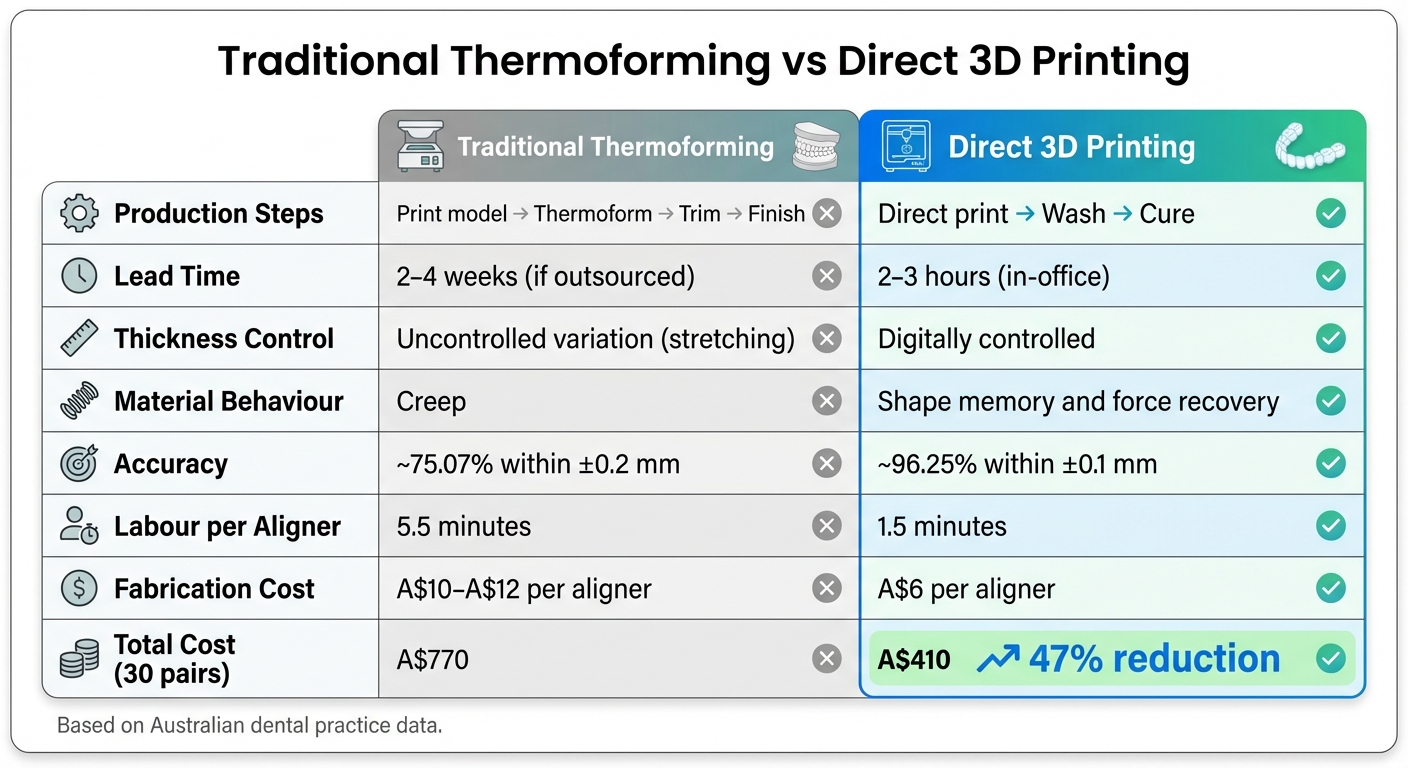
Traditional Thermoforming vs Direct 3D Printing for Clear Aligners Comparison
Direct 3D printing takes the established thermoforming workflow to the next level by cutting out the need for intermediary physical models. While this article focuses on aligners, 3D bioprinting in dental implants is also transforming restorative procedures. Instead, aligners are produced directly from biocompatible resins. This approach is quickly gaining popularity in Australian dental practices aiming to simplify their processes and speed up treatment times.
How Direct 3D Printing Works
The process begins with the aligner design being sent straight to a 3D printer. These printers rely on vat polymerisation technologies such as Digital Light Processing (DLP), Stereolithography (SLA), or Liquid Crystal Display (LCD/mSLA). Among these, DLP uses a projector to cure an entire layer of resin at once, which makes it faster. SLA, on the other hand, uses a UV laser to cure resin point by point, delivering high precision but at a slower pace [1][3].
The key to this method is the use of specialised biocompatible resins. Examples include Tera Harz TC-85 from Graphy and Dental LT Clear Resin from Formlabs. Tera Harz TC-85, an aliphatic vinyl ester-urethane polymer, stands out for its shape-memory properties, which ensure consistent orthodontic force [1][2]. After printing, any leftover resin is removed using centrifugation or ultrasonic cleaning with isopropyl alcohol. This is followed by UV curing in a nitrogen-rich environment to prevent issues like the oxygen inhibition layer [1][7]. The entire process – from scanning to a finished aligner – takes just 2 to 3 hours, making same-day treatment a possibility [8].
"This workflow enables the development of an in-house aligner system with complete control over desired aligner thickness, extent, and attachments; it is also technically resource-efficient with greater accuracy by excluding all the intermediate steps involved in the thermoforming method." – Prabhat Kumar Chaudhari, Division of Orthodontics, AIIMS [1]
This efficient process is a stark contrast to the traditional thermoforming method, which involves more steps and materials.
Thermoforming vs Direct 3D Printing
The differences between these two methods go beyond just workflow. Direct 3D printing offers around 96.25% accuracy within ±0.1 mm tolerances, compared to the 75.07% accuracy within ±0.2 mm achieved by thermoformed aligners [8]. One standout feature of direct printing is its ability to digitally control the thickness of the aligner. This means the software can adjust thicknesses within a single aligner to optimise force on specific teeth [1][8]. Thermoforming, by comparison, lacks this precision, with processed plastic sheets showing uneven thickness ranging from 0.38 mm to 0.69 mm [1].
Here’s a breakdown of how the two methods compare:
| Feature | Traditional Thermoforming | Direct 3D Printing |
|---|---|---|
| Production Steps | Print model → Thermoform → Trim → Finish | Direct print → Wash → Cure |
| Lead Time | 2–4 weeks (if outsourced) | 2–3 hours (in-office) [8] |
| Thickness Control | Uncontrolled variation (stretching) [1] | Digitally controlled [1] |
| Material Behaviour | Creep [8] | Shape memory and force recovery [8] |
| Accuracy | ~75.07% within ±0.2 mm [8] | ~96.25% within ±0.1 mm [8] |
| Labour per Aligner | 5.5 minutes [8] | 1.5 minutes [8] |
| Fabrication Cost | A$10–A$12 per aligner [8] | A$6 per aligner [8] |
The table highlights the efficiency and savings that direct printing offers, although it’s worth noting the limited range of biocompatible resins currently available for this newer technology [2][8].
For a typical treatment involving 30 pairs of aligners, direct printing costs about A$410 (including software fees), compared to A$770 for thermoforming – a 47% cost reduction [8]. Additionally, direct printing generates less waste by removing the need for physical models at every stage, making it a more environmentally friendly choice [1][8]. However, as a newer technique, it still has some limitations, particularly in the variety of resins available compared to the broader selection of thermoplastic sheets used in traditional methods [2][8].
Key Technologies and Materials for Clear Aligner Production
The production of 3D-printed clear aligners hinges on two essential factors: the technology used for printing and the materials involved. Both must achieve microscopic precision while ensuring safety for long-term use inside the mouth.
3D Printers and Software
Clear aligner manufacturing is dominated by vat polymerisation technologies, primarily Stereolithography (SLA), Digital Light Processing (DLP), and Liquid Crystal Display (LCD/mSLA). Each method offers distinct advantages in terms of speed, accuracy, and surface quality.
- SLA printers rely on a UV laser to cure resin point by point. This approach delivers incredibly smooth surfaces with minimal layer lines, though it tends to be slower [10].
- DLP systems use a digital micromirror device to cure entire layers at once. They balance high accuracy with faster production speeds, though minor pixel or layer lines may appear [10].
- LCD printers cure layers using LCD panels to mask the light. These are more affordable but often provide lower resolution compared to high-end DLP systems [10].
Alongside the hardware, advanced software plays a key role in optimising production. AI-powered design tools like LuxDesign automate tasks such as aligner thickness customisation and attachment placement. Slicing software like LuxFlow and PreForm maximises efficiency by enabling multiple cases to be printed simultaneously. Meanwhile, cloud-based systems help manage printer fleets, ensuring consistent quality and uninterrupted production.
A standout example comes from Modern Clear, a German aligner manufacturer. In November 2022, the company scaled to over 3 million aligners annually by utilising 40 Formlabs Form 3 SLA printers. With a 24/7 production cycle and Formlabs’ Dashboard software, a team of just five people maintained a 96% print success rate across 10,000 jobs. CEO Gleb Grützner attributed their aligners’ high transparency to the exceptional quality of their printed models: "The reason why our aligners are so transparent is that the printed model, before we thermoform, is printed really, really in high quality." [13]
| Technology | Light Source | Speed | Surface Finish |
|---|---|---|---|
| SLA | UV laser | Slower (point-by-point curing) | Extremely smooth; minimal layer lines [10] |
| DLP | UV projector with micromirrors | Faster (layer-by-layer curing) | High detail; minor pixel/layer lines [10] |
| LCD (mSLA) | LCD panels | Faster | Affordable; lower resolution [10] |
Materials for 3D Printing Aligners
The materials used in clear aligner production must meet stringent biocompatibility standards while maintaining durability throughout treatment. Leading options include Tera Harz TC-85 from Graphy, Dental LT Clear from Formlabs, and ActiveMemory™ Polymer from LuxCreo. These materials comply with ISO 10993 standards, addressing concerns like cytotoxicity, irritation, and sensitisation.
What sets these resins apart is their shape-memory capability. Unlike traditional thermoformed plastics like PETG or TPU, which lose 30–40% of their force within a week, materials like ActiveMemory™ retain up to 95% of their initial force after seven days [11]. This ensures consistent tooth movement. Additionally, these aligners can regain their original shape when soaked in hot water (above 60°C), refreshing their force profile [11].
In 2022, LuxCreo’s DCA resin became the first FDA-cleared material (Class II 510(k)) specifically designed for direct-print clear aligners. The validation process included the entire "4D Aligner" system, comprising LuxDesign software, the iLux Pro Dental Printer, and iLuxCure Pro post-processing units [11].
The chemical makeup of these resins varies. For instance, TC-85 is an aliphatic vinyl ester-polyurethane polymer, while Dental LT Clear is based on methacrylate chemistry [2, 14]. Studies show TC-85 achieves a 96% shape recovery ratio after 60 minutes at 37°C [9]. Proper post-processing is crucial; aligners must undergo ultrasonic cleaning in isopropyl alcohol and curing in a nitrogen-enriched UV chamber. This prevents an oxygen inhibition layer and ensures biocompatibility [1].
"The 3D printed resin-cured clear dental aligners are more suitable because they have better geometric accuracy and mechanical resistance." – Jindal et al. [12]
Benefits and Challenges of 3D Printing in Clear Aligner Production
Advantages of 3D Printing
3D printing is transforming clear aligner production by improving precision, reducing time, and lowering waste. Unlike traditional orthodontics and Invisalign thermoforming, direct 3D printing eliminates multiple steps – such as moulding and manual trimming – leading to fewer errors and better geometric accuracy [1]. It also allows for digitally controlled thickness, ensuring consistent force application. This is important because even a 10% reduction in aligner thickness can decrease orthodontic forces by as much as 30% [1].
One standout advantage is the ability to produce aligners in-office. Patients can be scanned in the morning and receive their aligners by the afternoon, a stark contrast to outsourced methods that can take weeks [5]. Additionally, 3D printing cuts down on waste by removing the need for petroleum-based physical models, which are non-biodegradable [1]. Studies also suggest that aligners printed with TC-85 resin hold up better under mechanical stress compared to thermoformed options [4].
| Feature | Traditional Thermoforming | Direct 3D Printing |
|---|---|---|
| Workflow | Indirect (requires physical models) | Direct (no model required) |
| Thickness Control | Variable (0.38–0.69 mm from 0.75 mm sheet) [1] | Digitally controlled and customisable |
| Lead Time | Days to weeks (often outsourced) | Hours (can be done chairside) [5] |
| Material Waste | High (non-biodegradable models) | Low (additive process) [1] |
| Edge Quality | Requires manual trimming/polishing | Smooth, digitally defined edges [12] |
While the benefits are clear, there are still significant hurdles to overcome.
Challenges to Overcome
Regulatory requirements are a major obstacle. Although materials like Tera Harz TC-85 have received approvals from organisations such as the FDA and EC, full commercial approval for direct aligner use is still pending in many cases [2]. Another concern is the biocompatibility of current 3D-printing resins, as some exhibit varying levels of cytotoxicity over time [2].
Post-processing also presents challenges. Printed aligners must go through careful cleaning processes, such as centrifugation or the use of soft scrapers, to remove uncured resin. Failing to do so can lead to poor surface quality and weaker mechanical properties [2]. For example, the compression modulus ratio between cured and uncured aligners can range from 4.46 to 5.90, highlighting the need for proper curing [2]. Other technical issues include shrinkage, warping during cooling, and visible interlayer lines, particularly with Digital Light Processing (DLP) technology [3].
Finally, practitioners must follow strict curing protocols – such as maintaining a temperature of 80°C for 15–20 minutes – to ensure the material reaches its optimal strength and biocompatibility [2]. These challenges underline the need for precision and adherence to established procedures to fully unlock the potential of 3D printing in aligner production.
The Future of 3D Printing in Clear Aligner Technology
Integrated Digital Workflows
The orthodontic field is rapidly shifting towards fully digital systems that combine intraoral scanning workflows, AI-powered treatment planning, and high-speed 3D printing into one seamless process. This modern approach eliminates the delays and inefficiencies of older methods, where physical impressions had to be shipped to labs and plaster models stored for future use [5].
AI technology is now a key part of treatment planning software, enabling automatic tooth movement simulations and the creation of print-ready files for chairside 3D printers. A standout development is the adoption of LCD printing technology, which delivers high-resolution results at a lower cost compared to older SLA and DLP systems [14]. Clinics have found that printing aligners at a 0° build angle (parallel to the build plate) ensures the best dimensional accuracy while also speeding up production [14]. These advancements are making digital workflows more efficient and practical in clinical settings.
New materials like Tera Harz TC-85 resin are also changing the game. These shape-memory resins allow aligners to be refreshed with warm water, improving their fit and force control [15]. Danielle Long from Fine Orthodontist Sydney highlights the benefits:
"Direct-printed aligners give us more control than traditional ones… we can also vary the thickness of different parts of your aligner, something that thermoforming can’t do" [15].
This streamlined workflow not only speeds up aligner production but also opens doors to broader clinical applications.
Potential Impact on Australian Dentistry
For Australian dental practices, these advancements offer a chance to improve both accessibility and affordability in orthodontic care. By adopting in-office digital workflows, clinics can eliminate the reliance on large-scale centralised manufacturing and international shipping, which often add weeks to treatment timelines and increase costs [5]. Forward-thinking practices are already embracing same-day "scan-to-aligner" production. For example, in March 2025, Fine Orthodontist Sydney, led by Specialist Orthodontist Dr. Martin Fine, became one of the first Australian clinics to implement direct-printed aligner technology through the FineLine® system. By using advanced light-sensitive resins and in-house production, the clinic skipped traditional thermoforming steps and achieved more precise control over aligner forces [15].
This technology also brings environmental benefits. Direct printing eliminates the need for thousands of disposable plastic models, significantly reducing waste that would otherwise end up in landfill [15]. For regional and remote areas in Australia, in-office production could make orthodontic treatment more accessible by removing the logistical hurdles of working with distant labs. The Australian Society of Orthodontists underscores this point:
"the skill and knowledge of your orthodontist are far more important than the type name of your aligners" [15].
This highlights that the true value lies in how these advancements are applied in practice, not in the specific brand of aligners being used.
Conclusion
3D printing has transformed the way clear aligners are produced, replacing the traditional multi-step thermoforming process with efficient digital workflows. This evolution – from indirect printing, which involves creating moulds, to direct printing of aligners – removes unnecessary steps and cuts down on material waste. In Australia, dental practices are now capable of delivering custom aligners on the same day.
What’s more, direct printing enhances clinical accuracy. By allowing variable thickness and integrating shape-memory resins like TC-85, these aligners optimise tooth movement and offer better control compared to uniform thermoformed sheets [1][17]. Resins such as TC-85 ensure an ideal fit even under high activation, leading to predictable and consistent results [4]. This precision directly improves treatment outcomes.
Digital workflows also simplify everyday challenges. For instance, if a patient misplaces their aligner, a replacement can be printed from the saved digital design within hours, avoiding the lengthy wait for lab production [5]. Additionally, direct printing has a lower environmental footprint, as it eliminates the need for thousands of petroleum-based plastic moulds [1][16]. As Srini Kaza of Align Technology explains:
Direct 3D printing enables Align to create solutions without the added first step of creating a mould, making 3D printing more ecologically sustainable than current processes and more efficient [16].
These advancements point to a future where digital workflows become even more integral to orthodontics. The dental 3D printing market is growing rapidly, with leading manufacturers now producing over 1 million custom aligner components daily [16]. For Australian dentists, this means offering faster, more precise, and more environmentally conscious care.
Looking ahead, tools like AI-driven treatment planning and cutting-edge biocompatible resins are poised to elevate clear aligner therapy even further. However, no matter how advanced the technology becomes, the skill and expertise of the clinician will always remain central to successful treatment [15].
FAQs
Are 3D-printed aligners safe to wear?
Yes, 3D-printed aligners are considered safe for use. That said, they may exhibit minor cytotoxicity and contain slightly higher residual monomer levels. To minimise any risks, it’s important to strictly adhere to the manufacturer’s post-curing instructions during their production process.
How long does in-office 3D printing take for a new or replacement aligner?
In-office 3D printing of a new or replacement aligner usually takes around 3 hours. This efficient process speeds up production significantly compared to older techniques, offering patients a quicker and more convenient solution when adjustments or replacements are needed.
Will direct 3D printing change how my aligners feel or move my teeth?
Direct 3D printing is changing how aligners are made by offering precise control over their thickness, fit, and design. This precision enables the creation of aligners that are more tailored to individual needs, potentially making them more comfortable to wear. Studies indicate that 3D-printed aligners could enhance the predictability of tooth movement and overall comfort, thanks to the materials used and the accuracy of the manufacturing process. Efforts are continually being made to ensure these aligners meet clinical standards in terms of both comfort and effectiveness.
Related Blog Posts
- Digital Orthodontics: CAD/CAM Workflow Explained
- Benefits of 3D-Printed Clear Aligners
- Emerging Trends in 3D-Printed Dental Prosthetics
- 3D Printing Innovations in Orthodontics: Clear Aligners
Important Notice: Any surgical or invasive procedure carries risks. Before proceeding, you should seek a second opinion from an appropriately qualified health practitioner.
Individual results may vary. The information provided in this article is for educational purposes only and does not constitute medical advice.
Checkout Related Blogs




Get in touch with us
For more information, call us now to start feeling better. Or fill the form below to make appointment
The Latest News from Complete Smiles
How to Clean Clear Plastic Retainers
Checklist for Choosing Wearable Dental Devices
Checklist for Choosing Cloud AI Platforms in Dentistry

Complete Smiles Bella VistaAccepts All Major Health Funds, Including





