





Wear Resistance of CAD/CAM Restorative Materials

CAD/CAM restorative materials, like zirconia, lithium disilicate, and resin-based composites, are integral to modern dentistry. Their durability, particularly wear resistance, ensures restorations maintain function and protect natural teeth over time. Here’s what you need to know:
- Why it matters: Wear resistance affects longevity, bite function, and the safety of opposing teeth.
- Key materials:
- Zirconia: Strong (800–1,200 MPa), but can wear opposing teeth if not polished.
- Lithium disilicate: Aesthetic and durable, but causes more antagonist wear.
- Resin composites: Gentle on opposing teeth but less durable.
- PEEK: Absorbs stress well, reducing fractures but wears faster.
- Testing methods: Simulated chewing cycles and real-life studies assess wear, surface roughness, and material loss.
- Clinical insights: Zirconia is ideal for high-stress areas; resin-based materials balance wear on opposing teeth.
Selecting the right material depends on the restoration’s location, patient needs, and desired balance between durability and tooth preservation.
Common Materials and Their Wear Properties
Zirconia and Lithium Disilicate
Monolithic zirconia is known for its exceptional strength and hardness, with a flexural strength ranging from 800–1,200 MPa and hardness levels around 9.6 GPa [1][9]. The surface finish plays a critical role here: polished zirconia is gentle on opposing teeth, but rough surfaces can increase wear on natural teeth significantly [3][8].
Lithium disilicate, on the other hand, offers a lower hardness (approximately 4.2 GPa) compared to zirconia while excelling in aesthetics and lithium disilicate flexural strength [3][9]. In simulated three-body wear tests – which mimic wear involving food particles – lithium disilicate showed strong resistance, with an average wear depth of just 2.85 µm [3]. Clinical studies highlight its impact on opposing teeth: over a 24-month period, lithium disilicate layered restorations caused considerably more antagonist wear (0.3 ± 0.1 mm) compared to translucent monolithic zirconia (0.1 ± 0.07 mm) [8][7].
Next, composites and nano-hybrid materials introduce a contrasting wear profile.
Composite Resins and Nano-Hybrid Materials
Resin-based composites and nano-hybrid materials, such as Lava Ultimate, offer advantages for opposing teeth due to their lower hardness [5]. However, these materials tend to wear down more rapidly than ceramics. In two-body wear tests, resin-based composites exhibited mean volume losses between 2.72–2.85 mm³, while lithium disilicate showed a smaller volume loss of 1.41 mm³ [3].
"Lava Ultimate crowns are the most natural antagonist-friendly; these were the most susceptible to vertical and volume loss." – Ella A. Naumova, Department of Biological and Material Sciences in Dentistry, Witten/Herdecke University [5]
Interestingly, surface hardness alone doesn’t determine wear resistance. Factors like filler configuration and micromorphology play a bigger role. Clinical studies monitoring 3M Filtek Supreme XTE and Lava Ultimate restorations reported acceptable mid-term survival rates of up to 5.5 years, even in patients with severe tooth wear [3].
Beyond zirconia and ceramic materials or composites, advanced materials such as PEEK and cobalt-chrome offer distinct wear characteristics.
Advanced Materials: PEEK and Cobalt-Chrome
Polyetheretherketone (PEEK) is a newer restorative material with unique properties. Its low elastic modulus allows it to absorb stress through plastic deformation, which reduces the risk of fractures [10]. In simulated chewing studies involving 120,000 cycles, PEEK crowns exhibited twice the material wear of zirconia crowns but were three times less abrasive to opposing teeth [10].
"PEEK also has a low modulus of elasticity compared to the bone, which allows for a better absorption of functional stress by deformation. This acts as a great advantage over the ceramic materials used." – Abhay, S.S. et al. [10]
Ceramic-reinforced PEEK variants, such as BioHPP, strike an improved balance between elasticity and rigidity, making them suitable for single crowns and short-span bridges [10]. Meanwhile, cobalt-chrome’s wear patterns against enamel make it a reliable choice for more complex restorations [8][1]. These differences in material properties highlight the importance of choosing the right CAD/CAM restorative material for long-term success.
sbb-itb-2be92ed
Testing Methods for Wear Resistance
Laboratory Testing and Abrasion Studies
Dual-axis chewing simulators, like the CS-4.8 masticator from Willytec, are designed to mimic human chewing by applying a vertical load of 50 N combined with a 0.7 mm horizontal slide [6][11][5]. These tests often involve thermocycling (cycling between 5°C and 55°C) and the use of artificial saliva at pH 7.0 to replicate oral conditions [11][5].
When studying wear resistance, researchers differentiate between two-body wear – which measures direct contact between a restoration and an antagonist (e.g., a ceramic crown against a resin block) – and three-body wear, where an abrasive medium like a millet seed suspension is added to simulate food particles during chewing [11][3]. For instance, a June 2019 study at Pusan National University tested 12 CAD/CAM materials over 100,000 cycles with thermocycling. The results showed that monolithic zirconia (Zirkonzahn Prettau) experienced significantly less volumetric loss (0.037 ± 0.838 mm³ × 10⁻³) compared to lithium disilicate (116.7 ± 214.7 mm³ × 10⁻³) [11][4].
To measure wear, researchers rely on 3D profilometry and gravimetric analysis to calculate volumetric loss and assess surface roughness (Ra). Surface roughness is a critical factor because increased roughness encourages plaque accumulation and can compromise aesthetics [6][11][5]. For example, after simulated wear, CAD-CAM ceramics showed an increase in surface roughness from 0.21 µm to 0.28 µm, while 3D-printed resins saw a more dramatic rise from 0.35 µm to 0.62 µm [6].
These controlled laboratory tests provide a foundation for understanding material performance before moving to clinical evaluations.
Clinical Studies on Long-Term Wear
Clinical studies build on laboratory findings by assessing wear resistance in real-life conditions. While lab tests provide controlled data, clinical research evaluates factors like survival rates, marginal adaptation, and the effect on opposing teeth – variables that simulators can’t fully replicate [2][11]. For example, zirconia fixed dental prostheses have demonstrated survival rates of up to 100% after five years, while aluminium oxide crowns achieved 100% survival over seven years [2].
The relationship between lab cycles and clinical time varies. Some studies equate 100,000 chewing cycles to about one year of masticatory forces, while others suggest 240,000–250,000 cycles are needed to simulate a year [6][11][5]. In February 2017, researchers at Witten/Herdecke University simulated five years of wear (1,200,000 cycles) using a Willytec chewing simulator with artificial saliva and a 5 kg weight. Their findings showed that Lava Ultimate crowns were the most "antagonist-friendly" but also prone to vertical and volumetric loss [5].
Clinical studies also highlight the benefits of precise marginal adaptation in CAD/CAM restorations. Better adaptation reduces plaque accumulation, minimises periodontal inflammation, and lowers the risk of secondary caries [2]. These insights underscore the importance of combining lab and clinical data to fully evaluate dental materials.
What Makes CAD/CAM Dental Restorations Stronger And More Durable? – The Pro Dentist
Comparing Material Performance
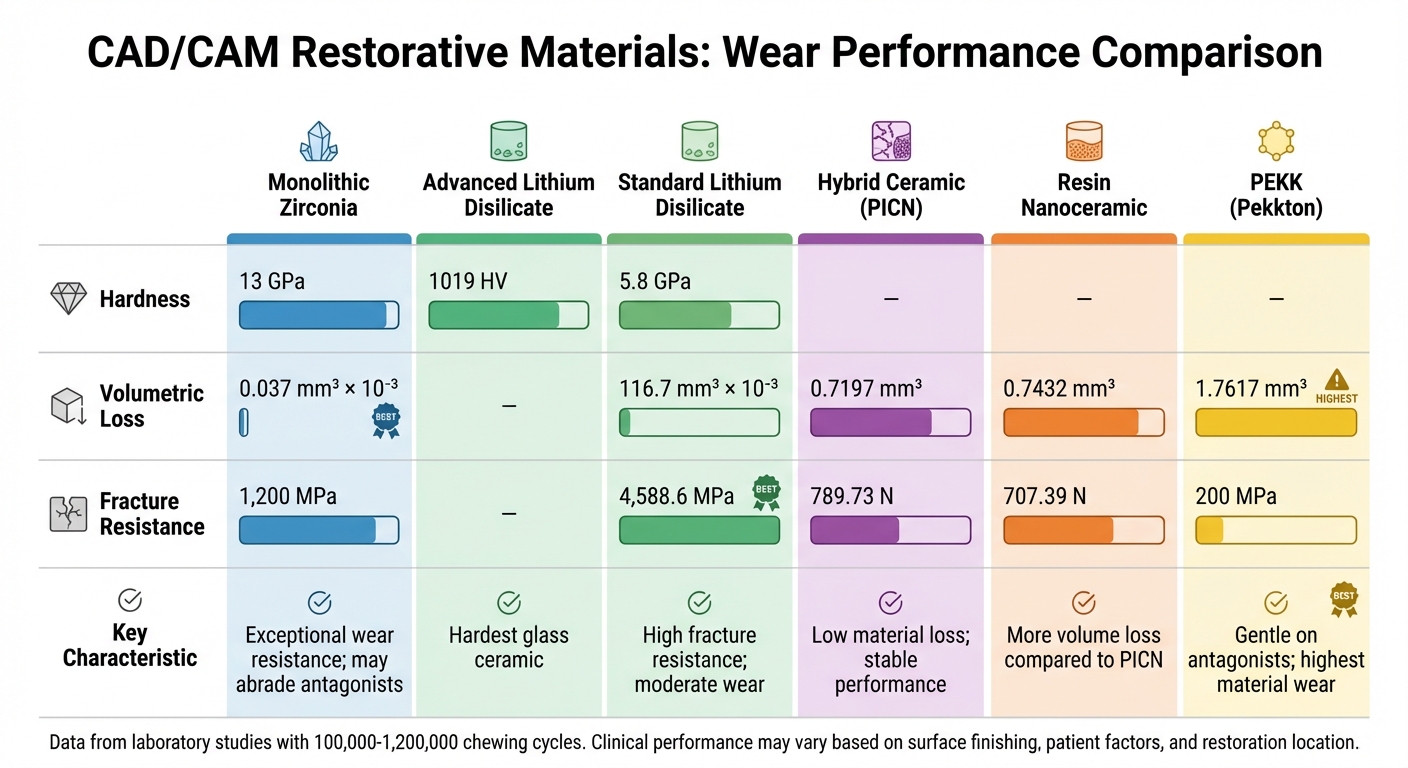
CAD/CAM Dental Materials Wear Resistance Comparison Chart
Wear Resistance Comparison Table
When it comes to CAD/CAM restorative materials, understanding their wear performance is critical. Laboratory and clinical studies provide valuable insights, particularly into the durability and wear resistance of different CAD/CAM restorative materials. Monolithic zirconia stands out as a top performer, boasting exceptional hardness – around 13 GPa compared to the 5.8 GPa of lithium disilicate [4].
For glass ceramics, advanced lithium disilicate (e.g., CEREC Tessera) leads the pack with a Vickers hardness of approximately 1019 HV, making it the hardest option in its category [14]. On the other hand, PEKK (Pekkton) is noted for its ability to minimise wear on opposing teeth, even though it experiences the highest material volume loss at 1.7617 mm³ [13].
| Material Type | Hardness | Volumetric Loss | Fracture Resistance | Key Characteristic |
|---|---|---|---|---|
| Monolithic Zirconia | 13 GPa [4] | 0.037 mm³ × 10⁻³ [4] | 1,200 MPa [4] | Exceptional wear resistance; may abrade antagonists |
| Advanced Lithium Disilicate | 1019 HV [14] | – | – | Hardest glass ceramic |
| Standard Lithium Disilicate | 5.8 GPa [4] | 116.7 mm³ × 10⁻³ [4] | 4,588.6 MPa [12] | High fracture resistance; moderate wear |
| Hybrid Ceramic (PICN) | – | 0.7197 mm³ [13] | 789.73 N [15] | Low material loss; stable performance |
| Resin Nanoceramic | – | 0.7432 mm³ [13] | 707.39 N [15] | More volume loss compared to PICN |
| PEKK (Pekkton) | – | 1.7617 mm³ [13] | 200 MPa [13] | Gentle on antagonists; highest material wear |
Material hardness also plays a crucial role in vertical wear. For instance, zirconia-reinforced lithium silicate (ZLS) materials like VITA SUPRINITY experience a vertical loss of 14.1 µm after 1,200,000 chewing cycles, compared to 9.3 µm for polymer-infiltrated ceramic networks (PICN) like VITA ENAMIC [5]. In high-stress areas, such as posterior restorations, lithium disilicate and ZLS materials provide fracture resistance values ranging from 976 to 1,137 N – significantly higher than the 707 to 789 N seen in hybrid materials [15].
Although PEKK demonstrates the highest material loss, its ability to reduce wear on opposing teeth makes it a compelling choice in specific cases. These performance metrics are invaluable for clinicians when selecting materials that align with the restoration’s location and the patient’s occlusion needs.
Clinical Applications and Material Selection
Choosing Materials for Posterior Restorations
Posterior teeth handle immense chewing forces, so choosing materials with excellent wear resistance is crucial [6][17]. Monolithic zirconia stands out for its strength (900–1,400 MPa flexural strength) and impressive five-year survival rates of 100%. It’s a go-to option for multi-unit bridges, full-arch rehabilitations, and cases involving bruxism. These complex cases often require specialist dental care to ensure long-term success. Similarly, zirconia-reinforced lithium silicate offers comparable fracture toughness, making it another reliable choice [2][17][5].
When protecting the opposing teeth is a priority, resin nanoceramics like Lava Ultimate excel. They cause minimal wear to opposing teeth (0.39 µm³) while experiencing slightly higher volume loss themselves (4.2 µm³) [5]. These materials strike a balance, preserving both the restoration and the natural teeth.
Polymer-infiltrated ceramic networks (PICN), such as Vita Enamic, offer another excellent option. With an elastic modulus close to natural dentine (15–30 GPa), these materials absorb chewing forces effectively. In simulations, they demonstrated the lowest crown volume loss (1.01 µm³), making them ideal for general dental treatments like posterior single crowns where maintaining vertical dimension is key [2][5]. For single-tooth restorations, like implant-supported crowns, nanoceramics provide the biomechanical compatibility needed to distribute stress evenly [2].
These choices highlight how material selection influences restoration durability and performance, setting the stage for understanding the role of surface treatments and environmental factors.
Factors Affecting Long-Term Performance
The way a material’s surface is treated plays a big role in how it wears over time. Polished zirconia, for instance, is less abrasive than glazed zirconia when in contact with opposing enamel [4].
"Zirconia with glazing is more abrasive than polished zirconia" – Bora Gwon et al. [4]
This makes high-quality polishing a better choice than glazing, as it reduces wear on opposing teeth.
Environmental factors in the mouth also affect material longevity. For example, polymeric CAD/CAM materials absorb water, and monomers like TEGDMA can increase flexibility but reduce wear resistance [16]. Toothbrushing simulations (100,000 cycles) show that materials with smaller, evenly distributed filler particles resist wear better than those with larger, harder particles [16]. Additionally, factors like saliva pH changes, temperature fluctuations, and abrasive foods accelerate the degradation of resin-based materials more than ceramics [6][5]. Increased surface roughness from chewing can also lead to more plaque build-up, staining, and faster wear on opposing teeth [5].
Together, these factors shape the long-term durability and clinical success of CAD/CAM restorations, making material choice and surface treatment essential considerations.
Conclusion
The ability of CAD/CAM materials to resist wear is a cornerstone of durable dental restorations. Research shows that material composition and microstructure play a more decisive role in wear resistance than hardness alone.
"Vickers hardness testing alone cannot hold for a correlation with wear behaviour of materials" [3]
This highlights the importance of clinicians evaluating more than just surface hardness when choosing materials for specific clinical needs.
Evidence suggests that CAD/CAM ceramics, like lithium disilicate and zirconia, outperform resin-based materials in demanding conditions. For instance, after 100,000 chewing cycles, ceramic crowns exhibited a wear depth of just 25 µm (±2 µm), compared to 58 µm (±3 µm) for 3D-printed resin crowns [6]. Such differences directly impact the lifespan of restorations, making ceramics a more reliable choice for high-stress environments.
Material selection also hinges on clinical priorities. Monolithic zirconia offers unmatched strength, making it ideal for posterior bridges. On the other hand, resin nanoceramics, like Lava Ultimate, are gentler on opposing teeth, causing only 0.39 µm³ of wear on natural dentition, despite experiencing a higher material loss themselves (4.2 µm³) [5]. The decision often comes down to whether the focus is on preserving the restoration or protecting the patient’s natural teeth.
Surface finishing is another critical factor. Smooth surfaces not only reduce enamel wear but also limit plaque build-up and bacterial adhesion [4]. Proper finishing techniques, combined with an understanding of how materials handle both direct contact and three-body wear, are essential for achieving long-lasting clinical success.
The rise of CAD/CAM systems underscores their mechanical advantages over traditional lab methods. With advancements like 3D-printed zirconia now reaching flexural strengths of 800–1,200 MPa [1], clinicians have an expanding array of high-performance options. Success in restorative dentistry lies in matching material properties to the unique demands of each case, from chewing forces to antagonist characteristics. These insights not only enhance clinical outcomes but also reflect how CAD/CAM technologies are shaping modern dentistry in Australia.
FAQs
Which CAD/CAM material is best for bruxism?
Polymer-infiltrated network ceramics and zirconia are excellent choices for addressing bruxism, thanks to their impressive wear resistance. Polymer-infiltrated ceramics closely mimic the wear rates of natural enamel, making them a balanced option for restorative work. On the other hand, zirconia stands out for its exceptional durability, particularly in resisting wear from opposing teeth. Both materials provide reliable solutions for managing bruxism in restorative dentistry.
Will zirconia wear down my opposing teeth?
Zirconia is known for causing minimal wear on opposing teeth in most cases. However, when zirconia is polished, it can result in greater wear on the opposing surfaces. This largely depends on factors like the specific material finish and the conditions under which it is studied.
Is polishing better than glazing for reducing wear?
Polishing tends to result in less wear on restorative materials like monolithic zirconia when compared to glazing. However, it can lead to increased wear on the opposing enamel. On the other hand, glazing usually produces a smoother surface, which might be kinder to opposing teeth but is more susceptible to wear over time. The decision between the two methods often hinges on whether the focus is on reducing wear to the restoration or protecting the opposing teeth.
Related Blog Posts
- Wear-Resistant Materials in Dental Restorations
- Fatigue Resistance of CAD/CAM Dental Materials
- Material Options for Chairside CAD/CAM Restorations
- Stress Distribution: Ceramic vs Composite
Important Notice: Any surgical or invasive procedure carries risks. Before proceeding, you should seek a second opinion from an appropriately qualified health practitioner.
Individual results may vary. The information provided in this article is for educational purposes only and does not constitute medical advice.
Checkout Related Blogs




Get in touch with us
For more information, call us now to start feeling better. Or fill the form below to make appointment
The Latest News from Complete Smiles
How to Clean Clear Plastic Retainers
Checklist for Choosing Wearable Dental Devices
Checklist for Choosing Cloud AI Platforms in Dentistry

Complete Smiles Bella VistaAccepts All Major Health Funds, Including





