





How NLP Improves Dentist-Patient Communication
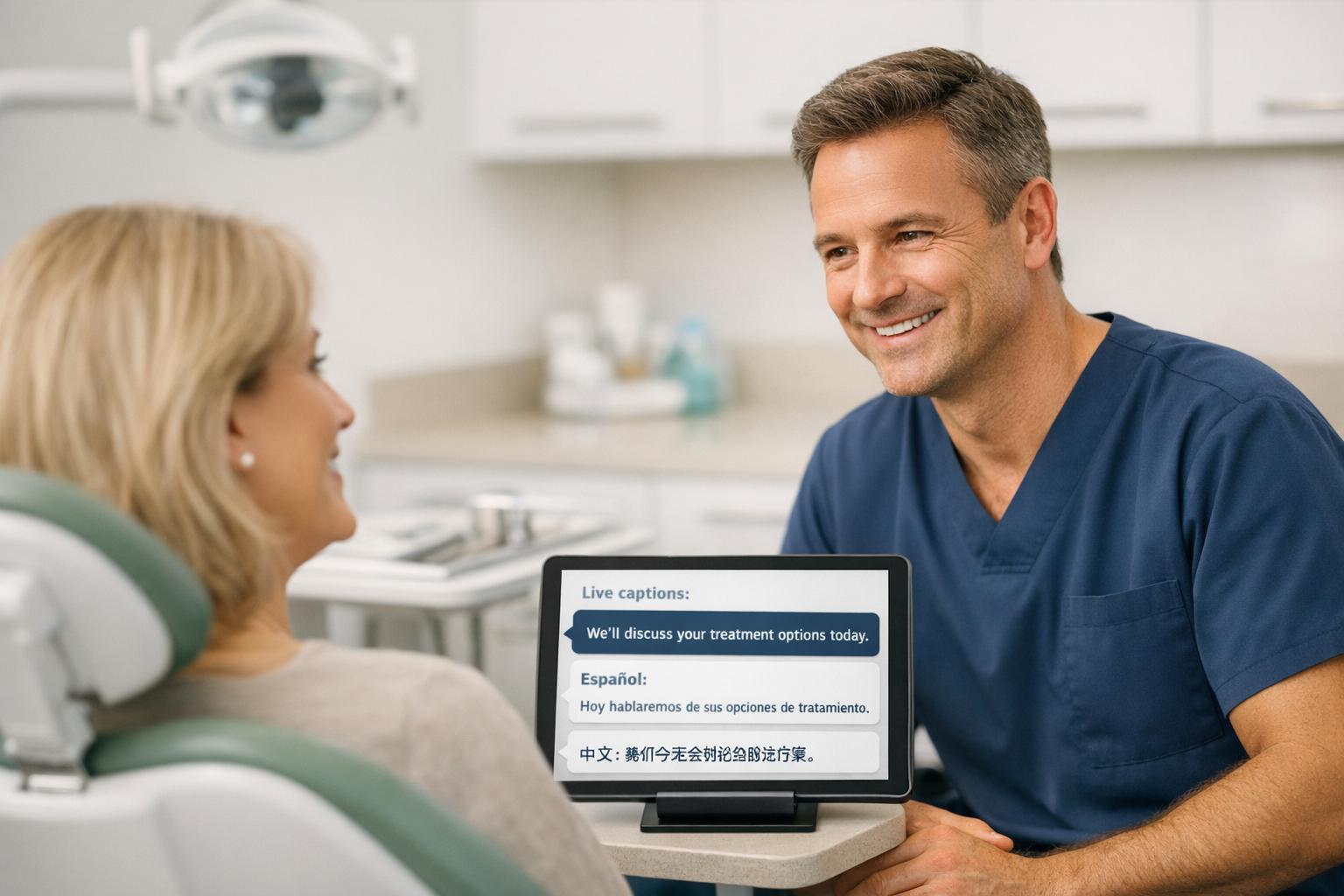
Natural Language Processing (NLP) is transforming dentist-patient interactions in Australia. By leveraging AI tools like chatbots, speech recognition, and sentiment analysis, dental practices are improving communication, reducing administrative burdens, and making care more accessible. Here’s how:
- Chatbots: Answer patient queries, schedule appointments, and provide 24/7 support, reducing staff workload.
- Speech Recognition: Converts spoken notes into text, saving dentists time on documentation.
- Sentiment Analysis: Identifies patient emotions, helping dentists address concerns like anxiety.
- Translation Tools: Break down language barriers, aiding multilingual communities in understanding care plans.
These tools improve patient understanding, satisfaction, and clinic efficiency while requiring dentists to review AI-generated outputs for accuracy. When used responsibly, NLP supports better care delivery and strengthens patient trust.
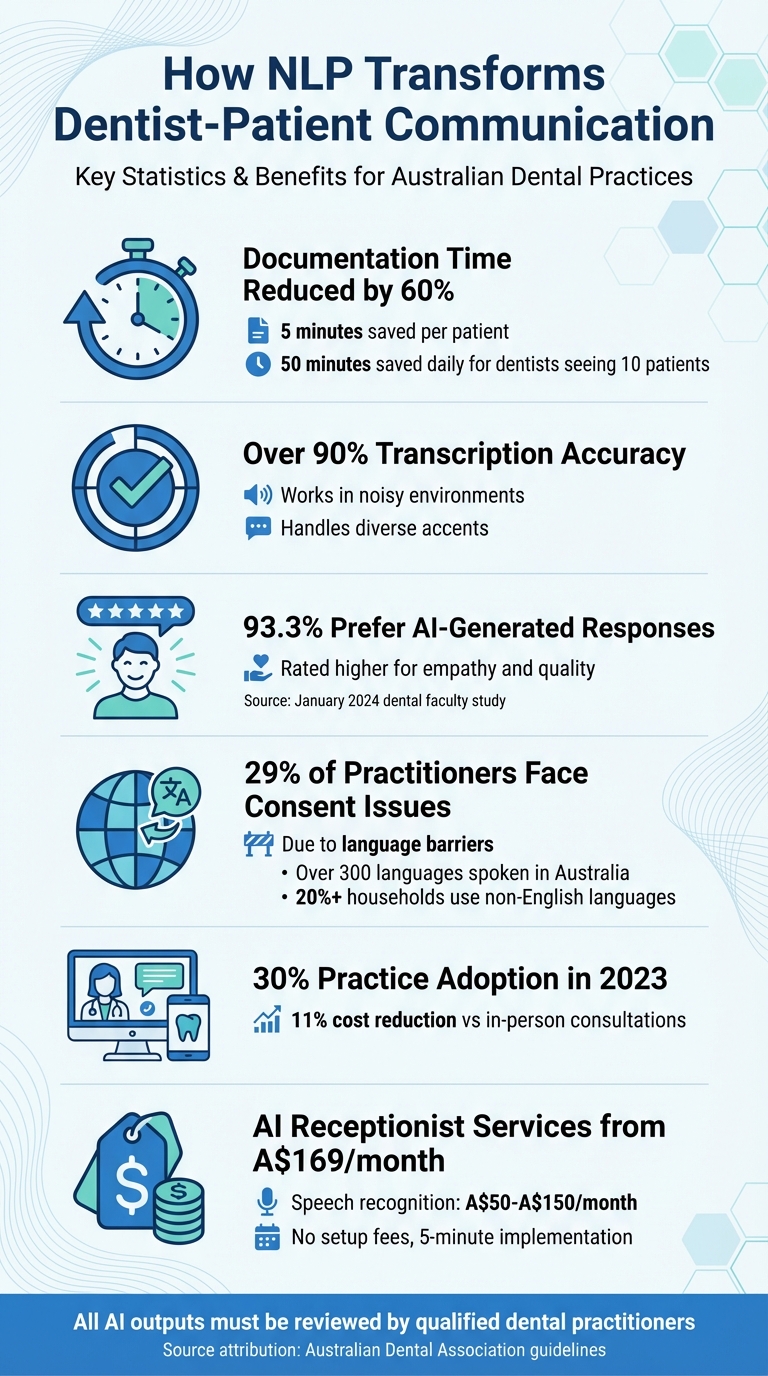
How NLP Improves Dental Practice Efficiency: Key Statistics and Benefits
Using Conversational AI to Manage Patient Interactions
Conversational AI is now transforming routine dental communications across Australia. Acting as a digital assistant available around the clock, these systems manage tasks like scheduling appointments, answering FAQs, and sending reminders – making them particularly useful for teledentistry by supporting patients outside normal clinic hours [4].
Automating Common Patient Questions
AI chatbots are capable of managing multiple patient interactions simultaneously. They address routine concerns such as procedure costs, insurance details, and post-treatment care. For example, a 2022 study by Tzeng et al. demonstrated that using an AI chatbot for dental consultations significantly boosted patient satisfaction. By automating repetitive inquiries, the chatbot also reduced the workload on staff, cutting down the need for manual follow-up calls [1].
These systems go beyond basic Q&A. They can create customised patient documents tailored to individual health needs. A study conducted in November 2024 at Boston University showcased this potential. Researchers had 27 periodontists evaluate AI-generated documents for dental implant surgery. The findings? ChatGPT-generated consent forms for diabetic patients were not only more effective (P < .001) but also provided accurate and detailed information on surgical risks and post-op care [3].
Faye Mear from Corona Marketing Limited highlights the value of such tools:
"AI chatbots can be the ‘always-on front desk,’ adept at handling a wide range of predictable interactions that, reception staff currently spend a significant proportion of their day fielding" – Faye Mear, Corona Marketing Limited [4]
By taking over repetitive tasks, conversational AI allows dental staff to concentrate on more complex care coordination. When integrated with practice systems, these tools streamline communication and enhance efficiency in teledentistry.
Connecting with Practice Management Systems
To maximise their potential, conversational AI systems must sync with existing electronic health records (EHR) and practice management systems (PMS). This integration offers practical benefits, such as real-time calendar updates and seamless compatibility with local platforms like HealthEngine [6]. For Australian dental practices, ensuring these systems can integrate smoothly is essential.
The Australian Dental Association underscores the importance of patient safety in this context:
"The use of Generative AI in dentistry should be limited to low-risk applications, where its output can and will be verified by a Dental Practitioner or auxiliary staff member" – Australian Dental Association [5]
All AI-generated outputs – whether appointment reminders, clinical notes, or educational materials – must be reviewed by a qualified dental practitioner before being implemented [5]. Practices must also comply with the Office of the Australian Information Commissioner (OAIC) guidelines, ensuring patient data is encrypted during transit and securely stored [5][6].
For Australian clinics, AI receptionist services typically start at around A$169 per month with no setup fees. Some providers promise implementation in under five minutes without requiring IT expertise [6][7]. When adopting such systems, it’s crucial to establish smart escalation protocols. This ensures that sensitive or urgent inquiries are routed to human staff instead of being solely managed by AI [7].
sbb-itb-2be92ed
Better Documentation with NLP Speech Recognition
Recent advancements in conversational AI are transforming how dental practices manage documentation, making workflows smoother and more efficient. In Australia, dentists are now using speech recognition technology to dictate clinical notes. Instead of typing during or after consultations, they can simply speak their observations. This approach not only saves time but also allows practitioners to focus more fully on patient care. Interactive dental education with voice AI and automated transcription then convert these dictations into structured clinical notes, significantly reducing administrative tasks.
Faster and More Accurate Documentation
AI-powered speech recognition systems can reduce documentation time by up to 60%, saving approximately 5 minutes per patient. For a dentist seeing 10 patients a day, this translates to 50 minutes saved daily [8][9][12][14]. This extra time can be spent seeing additional patients or focusing on more complex cases.
Modern natural language processing (NLP) systems achieve over 90% accuracy, even in noisy environments or when dealing with diverse accents [1][8][9]. However, as noted by the King’s College London research team:
"The goal is to help clinicians become editors of their notes – not just authors – while maintaining safety and accuracy." – King’s College London Research Team [8]
Dentists must adopt a "human-in-the-loop" approach, reviewing all AI-generated notes for errors. While these systems are highly advanced, they can still occasionally misinterpret details like specific teeth or treatment plans, which could lead to clinically significant errors [8][9]. Ultimately, dentists remain legally responsible for verifying and approving all documentation [10].
Australian practices are now integrating speech recognition tools directly into their existing systems to build on these time-saving benefits.
Implementing Speech Recognition in Australian Dental Practices
With the efficiencies offered by advanced transcription tools, Australian dental practices have several integration options. Some practice management systems, such as Dentally and CareStack, now come with built-in AI note-taking features [12][11]. Alternatively, standalone applications like ToothNotes, hosted in Australia, provide dedicated speech recognition services. Pricing typically ranges from A$50 per month for basic plans to A$150 for standard plans [13].
Before adopting these systems, legal compliance must be ensured. In New South Wales, South Australia, Tasmania, Western Australia, and the ACT, recording consultations without patient consent is illegal [10]. Practices must obtain documented consent and adhere to health record retention guidelines, which require keeping records for at least seven years or until a child reaches 25 years of age [10].
Another key consideration is data sovereignty. The Australian Privacy Principles mandate that health information be stored securely, preferably on Australian servers, to avoid complications with international data laws [13][10]. Practices should confirm where their AI provider stores data and whether it’s being used for "AI learning" without explicit permission. Although these transcription tools are currently not regulated by the Therapeutic Goods Administration, conducting a trial period can help ensure the software meets clinical needs and maintains accuracy [10].
Tailoring Communication with Sentiment Analysis
Clear communication is essential in dentistry, and sentiment analysis takes it a step further by offering real-time insights to improve patient interactions. Using natural language processing (NLP) tools, dentists can assess patient emotions during conversations. By analysing the emotional tone of texts, emails, and call transcripts, sentiment analysis sheds light on patient concerns and perceptions [1].
Detecting Patient Emotions and Concerns
Sentiment analysis can pinpoint emotions like fear or anxiety in patient communications. Ashish Pandey from Daswani Dental College highlights its value:
"Understanding a patient’s anxiety regarding a particular procedure can prompt the dentist to provide additional reassurance and support." [1]
This is especially useful in teledentistry, where physical cues like body language are absent. Sentiment analysis can flag concerns, enabling dentists to offer reassurance before issues escalate [1] [15]. That said, these tools aren’t without limitations. Research shows that while sentiment analysis can be highly accurate, it sometimes struggles with interpreting complex syntax or subtle emotional nuances [16].
NLP-driven systems take these emotional insights and use them to craft responses tailored to individual patient needs.
Creating Personalised Messages for Patients
Once patient emotions are identified, NLP systems can shape follow-up communications to address their specific concerns. AI-powered chatbots, for instance, can deliver personalised responses that directly tackle patient anxieties [1]. For Australian dental practices, the Australian Dental Association suggests using Generative AI for low-risk tasks – like producing easy-to-understand summaries of clinical notes or treatment letters – with all outputs reviewed by a qualified dental practitioner [5].
Additionally, practices can analyse patient feedback from online reviews and surveys. NLP algorithms can uncover recurring themes and emotional pain points, helping dental teams refine their services and better meet patient expectations [1].
Communicating with Multilingual and Multicultural Patients
With over 300 languages spoken across Australia and more than 20% of households using a language other than English at home, dental practices face unique challenges in delivering clear and effective care. Research shows that around 29% of dental practitioners have encountered issues with informed consent due to language barriers, underscoring the need for reliable translation solutions [18].
Real-Time Language Translation
Natural Language Processing (NLP)-powered translation tools are making it easier for dentists to communicate with patients who speak different languages. These tools process spoken or written language, allowing dentists to explain treatment plans and provide care instructions quickly. Features like back-translation loops add an extra layer of accuracy by translating the output back into the original language to confirm the intended meaning [19].
One example of this in action is the CALD Assist app, created by CSIRO’s Australian eHealth Research Centre and Western Health. The app includes over 200 professionally interpreted phrases in 10 languages, such as Arabic, Cantonese, Mandarin, and Vietnamese. Trials conducted at Melbourne hospitals, including Footscray, Sunshine, and Williamstown, showed shorter assessment times and boosted clinician confidence in patient understanding [17]. However, when using NLP tools, dentists must stick to clear, straightforward language. A 2021 proof of concept by Thoughtworks for automated translation in Australian clinical settings revealed that even simple phrases like "fasting" could be misinterpreted by AI as "going faster". To address this, the system flagged translations with low confidence, allowing medical staff to intervene if necessary [19].
These tools not only improve communication but also help create the foundation for stronger patient trust.
Building Trust with Multilingual Patients
Using NLP tools effectively can help dental practices build trust and improve care in Australia’s diverse communities. As David Colls from Thoughtworks explains:
"Language acts as a gatekeeper to inclusion – without clear and accessible translation, it restricts access to education, health services, and legal protection." [19]
By incorporating professionally validated phrases and multimodal support, dental teams can bridge language gaps. Lyn Bongiovanni, Manager of Language Services at Western Health, highlights the importance of culturally sensitive communication:
"The questions that we ask are culturally appropriate, they cannot be misunderstood, they’re clear, they’re simple. If an answer is longer than yes or no that’s when you need to call an interpreter." [17]
The Dental Board of Australia reminds practitioners that they remain responsible for ensuring patient safety and care quality, no matter what technology is used [2]. While NLP tools are helpful, they should complement – not replace – human judgement and professional interpreters, especially for complex cases. When applied thoughtfully, these tools enable dental practices to serve Australia’s multilingual communities more effectively without compromising clinical accuracy or patient safety.
Future Developments in NLP for Dentistry
The future of dentistry is set to be revolutionised by advancements in Natural Language Processing (NLP), promising to make dentist–patient communication more seamless and personalised. These changes aim to enhance the quality of care and improve patient experiences.
Conversational AI with Emotional Intelligence
Imagine dental AI that doesn’t just understand what you’re saying but can also sense how you’re feeling. Future systems are expected to combine NLP with tools like biosensors and camera analytics to pick up on stress indicators such as an increased heart rate, facial tension, or changes in vocal tone. This could help dentists identify patient discomfort during post-treatment check-ins and respond accordingly [20].
A recent study from January 2024 revealed that 93.3% of blinded dental faculty preferred AI-generated responses for their empathy and quality [21]. This finding has encouraged dental schools to include AI prompt design in their curricula. Ashish Pandey from Daswani Dental College highlights this shift:
"By embracing NLP, the dental community can pave the way for a more patient-centered, efficient, and effective approach to oral healthcare." [1]
Additionally, post-visit portals are likely to evolve to provide home-care tutorials tailored to individual needs. These tutorials could adjust dynamically based on factors like a patient’s anxiety levels, preferred learning styles, or cultural background [20].
While these innovations will enhance real-time communication, the broader potential lies in fully automated systems that streamline patient care.
Fully Automated Communication Systems
Automation is already transforming how dental practices operate, and the future looks even more promising. Today’s automated platforms can handle most of the patient journey, from scheduling appointments to post-treatment follow-ups. This is particularly beneficial for emergencies, offering 24/7 triage services. For instance, in the US, where 2.2 million dental-related emergency room visits occur annually, many of these cases could be managed remotely [24]. In Australia, teledentistry adoption reached 30% of practices in 2023, and these systems are estimated to reduce costs by about 11% compared to in-person consultations [22].
Orthodontics is one area where AI-driven remote monitoring is making waves. These systems can automatically track treatment progress, such as aligner movement or gum health. However, they aren’t a substitute for critical physical examinations, like X-rays or pulp testing, which remain essential for accurate diagnoses [23].
While these technologies offer convenience, they come with responsibilities. Practices must ensure strict adherence to privacy laws and ethical standards and openly communicate how patient data is used [1]. The true measure of success will not only be operational improvements but also reductions in patient anxiety and better continuity of care [20].
Conclusion
Natural Language Processing (NLP) is reshaping how dentists and patients interact in Australia, offering practical benefits that improve both efficiency and the quality of care. From AI-powered chatbots that answer routine patient queries instantly to speech recognition systems with over 90% transcription accuracy in clinical settings, these tools are lightening administrative workloads and boosting patient satisfaction [1].
These technologies tackle several important challenges: real-time translation helps practices connect with multilingual communities more effectively, sentiment analysis allows dentists to identify patient anxiety remotely and respond with empathy, and voice-to-text systems free up dentists to spend more time focusing on their patients.
However, it’s crucial for Australian dentists to oversee all AI-generated outputs carefully and ensure they comply with the Privacy Act and Australian Privacy Principles, as outlined in this article.
NLP isn’t just about streamlining operations – it’s about putting patients first. By leveraging these tools, dental practices can improve oral health outcomes for communities across Australia.
For those looking to adopt NLP, the focus should remain on striking a balance between technological innovation, regulatory adherence, and professional expertise. When applied responsibly, these tools can redefine patient care, simplify workflows, and enhance teledentistry services – all while keeping human judgement and accountability central to quality dental practice.
FAQs
Is it safe for a dental chatbot to manage my personal health information?
Yes, using a chatbot is safe as long as it adheres to Australian privacy laws, such as the Privacy Act 1988 and the Health Records Act 2001. These laws are designed to ensure the secure handling, confidentiality, and correct management of sensitive health information. To safeguard your data, always verify that the chatbot complies with these regulations.
Do I need to give consent if my dentist uses speech-to-text during my appointment?
Yes, your dentist must obtain your consent before using speech-to-text or AI transcription tools during your appointment. This is essential to meet privacy laws and medico-legal requirements. Dentists are obligated to safeguard patient confidentiality and ensure you are fully informed before employing such technologies.
When should a human interpreter be used instead of an AI translation tool?
In situations where precision, subtlety, or sensitivity is paramount – like intricate discussions or deeply personal matters – a human interpreter becomes indispensable. While NLP tools can handle basic exchanges, they often fall short when it comes to grasping idiomatic language, emotional undertones, or nuanced context. For scenarios involving legal matters, ethical considerations, or detailed explanations such as medical diagnoses or treatment plans, human interpreters provide the clarity and trust needed. This is especially vital in Australia’s multicultural environment, where understanding diverse perspectives is key to effective communication.
Related Blog Posts
- How AI Improves Remote Dental Care
- AI in Dentistry: Benefits of Personalised Oral Health Insights
- NLP in Dental Records: Common Applications
- How Multilingual AI Helps Dental Clinics Communicate
Important Notice: Any surgical or invasive procedure carries risks. Before proceeding, you should seek a second opinion from an appropriately qualified health practitioner.
Individual results may vary. The information provided in this article is for educational purposes only and does not constitute medical advice.
Checkout Related Blogs




Get in touch with us
For more information, call us now to start feeling better. Or fill the form below to make appointment
The Latest News from Complete Smiles
How to Clean Clear Plastic Retainers
Checklist for Choosing Wearable Dental Devices
Checklist for Choosing Cloud AI Platforms in Dentistry

Complete Smiles Bella VistaAccepts All Major Health Funds, Including





