





Research on Dental Restoration Longevity

Dental restorations don’t last forever, but their lifespan depends on materials, techniques, and patient care. Here’s what you need to know:
- Restoration Lifespan: Composite fillings often last 10–15 years, while crowns and ceramics can exceed 20 years with proper care.
- Failure Causes: Secondary decay and fractures are the main culprits, often influenced by poor oral hygiene or bruxism.
- Materials Matter: Indirect restorations like lithium disilicate ceramics show higher survival rates (96.8% at ~8 years) compared to direct resin composites.
- Patient Role: Daily brushing, flossing, and regular dental check-ups are critical for maintaining restorations.
- Future Trends: Bioactive materials and digital dentistry (e.g., CAD/CAM cost vs value and 3D printing) are advancing durability and precision.
Taking care of your restorations and choosing the right materials can extend their life significantly. Let’s explore the details.
Factors That Affect How Long Restorations Last
Patient Behaviour and Oral Health
The way patients care for their teeth on a daily basis often plays a bigger role in how long restorations last than the materials used. Lifestyle choices and oral hygiene habits are key factors in determining outcomes [1]. For instance, poor brushing and flossing habits can drastically increase the risk of restoration issues, with studies showing an odds ratio of 8.0 for such deficiencies [6]. This means patients with inadequate oral hygiene are eight times more likely to encounter problems with their dental work.
Parafunctional habits like bruxism (teeth grinding) also pose a major risk. Bruxism increases the likelihood of restoration fractures by nearly double, with an odds ratio of 1.9 [6]. For those who grind their teeth, wearing occlusal stabilisation splints can help protect restorations from excessive pressure [7]. Additionally, regular dental visits – recommended at least once or twice a year – are critical for checking the condition of restorations and catching early signs of failure [1].
While patient habits are vital, the dentist’s skill and technique are equally important in determining the success of restorations.
Clinical Technique and Skill
The expertise and technique of the dentist play a huge role in how long a restoration will last. According to the Dental Materials Journal, even the best materials can fail if not applied correctly, making proper technique essential [1]. When done right, at least 60% of resin composite restorations can last over 10 years [2]. However, poor application, such as inadequate moisture control during bonding or improper light curing, can lead to premature failure.
Experience also matters when it comes to clinical judgement. Deciding whether a restoration needs replacement isn’t always straightforward. For example, distinguishing between minor staining on an older restoration and a genuine failure requires a trained eye and sound judgement [8]. Ultimately, restoration longevity often depends on a mix of clinical skill, material quality, and patient care.
Material Type and Restoration Size
The type of material used and the size of the restoration also play a big role in its durability. Indirect restorations, like ceramic ones, tend to last longer than direct resin composites, especially in areas of the mouth that experience high stress [7][4]. For example, lithium disilicate ceramic restorations boast a survival rate of 96.8% over 7.8 years, compared to 84.9% for indirect resin composites [1].
Restoration size is another key factor. Larger restorations, such as Class IV composite restorations, experience more mechanical stress, which can reduce their lifespan. In a study of 3.5 million restorations, larger restorations had survival rates about 10% lower than smaller ones like Class III and Class V restorations over 15 years [3]. The type of material also affects the mode of failure: composites tend to fail due to secondary caries or bulk fractures, while ceramics are more prone to debonding or even causing fractures in the tooth itself [1][8][4].
sbb-itb-2be92ed
Longevity of Composite Restorations and Preventing Knit Lines
New Materials and Techniques
The latest developments in materials and techniques are reshaping dental restorations, aiming to extend their lifespan while closely imitating natural tooth structure and actively supporting oral health.
Biomimetic Dentistry
Biomimetic dentistry takes a conservative approach to tooth restorations, focusing on preserving as much of the natural tooth as possible. Instead of removing large amounts of healthy tooth material for mechanical retention, this method uses advanced bonding techniques to work with the existing structure [10][11]. The philosophy emphasises an "additive approach", which prioritises maintaining the integrity of the tooth.
A notable biomimetic strategy is the "sandwich technique," where a glass ionomer cement (GIC) base is layered beneath composite resin. This combination improves the marginal seal and reduces the risk of coronal leakage [11]. Recent advancements in material science have introduced low-stress flowable bases that decrease polymerisation stress to just 1.4 MPa, compared to 4 MPa in traditional flowables. This significantly lowers the chances of marginal failure and post-operative sensitivity [11].
The rise of digital dentistry has further enhanced biomimetic approaches. For instance, Polymer-Infiltrated Ceramic Network (PICN) CAD-CAM restorations now enable "no-prep" protocols that preserve tooth structure while achieving outstanding results. A 2020 study in the Journal of Dentistry demonstrated this with 192 "no-prep" Vita Enamic PICN CAD-CAM restorations, which achieved a 100% survival rate and 93.5% success rate over two years using a 24-hour bonding protocol [10]. Additionally, bioactive materials are redefining restorations by supporting natural tooth remineralisation.
Bioactive Materials
Bioactive materials mark a shift from traditional, passive fillings to restorations that actively promote oral health. Unlike standard composites, which act as inert barriers, bioactive materials release essential ions like calcium, phosphate, and fluoride, aiding in the remineralisation of tooth structures [12]. These materials form an apatite layer at the interface between the restoration and the tooth, improving the seal and reducing the likelihood of secondary caries.
Glass ionomer cements are among the most widely used bioactive materials, offering fluoride release and remineralisation properties that are particularly beneficial for patients with a high risk of caries [9]. Newer bioactive composites incorporate calcium and phosphate fillers, while bioactive glass additives provide antimicrobial benefits by targeting cariogenic bacteria [12]. However, challenges remain, particularly with mechanical strength. For example, glass ionomer restorations have an annual failure rate of around 7%, often due to material loss [9][11].
Digital Dentistry and 3D Printing
Digital technology is revolutionising dental restoration by improving precision and fit. Tools like intraoral scanners and CAD/CAM systems have dramatically enhanced the accuracy and reliability of restorations [13]. These innovations eliminate common issues with traditional methods, such as distortion in physical impressions or errors in manual occlusal records. The result? Better-fitting restorations with improved longevity. For example, survival rates for CAD/CAM-produced indirect onlays range from 73.1% to 100% over the medium term [4].
3D printing has taken personalisation to a new level, enabling the creation of custom components using materials like light-cured resins and polylactic acid (PLA) [13]. Digital archiving offers another advantage, allowing for the exact replication of lost or damaged restorations without the need for extensive adjustments. Additionally, virtual articulators and jaw motion tracking simulate mandibular movements, reducing the risk of restoration failure caused by bite misalignment [13]. For patients, these advancements often translate to fewer appointments – digital workflows can condense the traditional five-visit process for complete dentures into just two or three visits [13].
How to Extend the Life of Dental Restorations
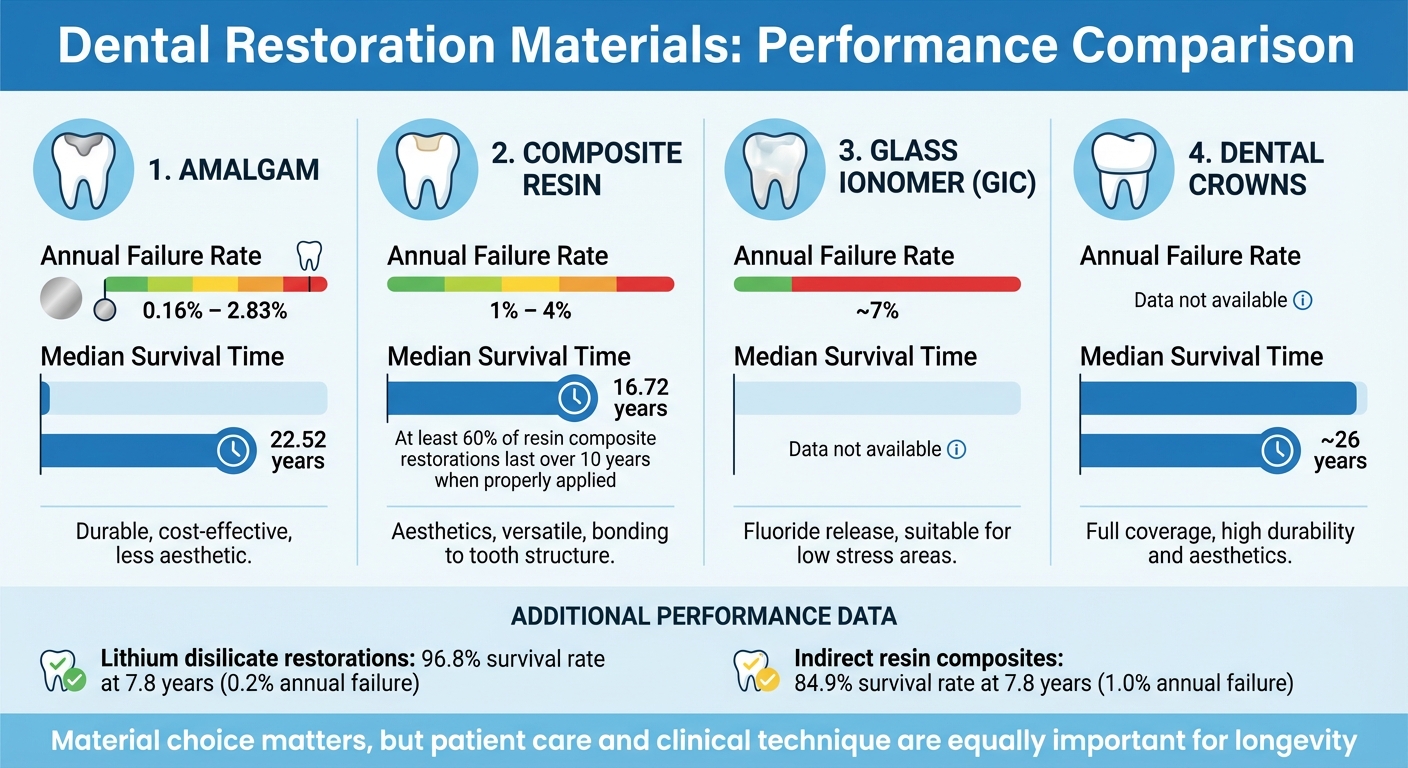
Dental Restoration Materials Comparison: Failure Rates and Longevity
Studies indicate that about 50% of restorations in general dental practice are replacements for those that have failed or become defective [9]. This underscores the importance of proper care to maintain restorations. Even with the best materials, consistent care and professional oversight are essential to maximise their lifespan.
Patient Care at Home
Daily oral hygiene plays a key role in keeping restorations intact. Brushing with fluoride toothpaste and flossing daily help maintain the bond of restorations [9]. Reducing frequent snacking and cutting down on fermentable carbohydrates can lower plaque acidity, protecting both natural teeth and restorations. For individuals with dry mouth (xerostomia), saliva substitutes can aid hydration and support remineralisation. Additionally, quitting smoking is highly recommended, as nicotine can decrease saliva flow and promote the growth of harmful bacteria. If you grind your teeth (bruxism), wearing a mouthguard can offer protection [9]. While home care is essential, it works best when combined with regular professional maintenance.
Professional Maintenance
Professional dental visits every 3 to 6 months are crucial for monitoring restorations. Dentists can check for early signs of wear, cracks, or decay, and annual X-rays can detect hidden issues like bone loss or decay under crown margins [14][16]. This approach is particularly beneficial for dental implants, which can achieve a success rate of 95% to 98% after 10 years when properly maintained. Routine check-ups and cleanings allow potential problems to be addressed early, helping to preserve restorations in the long run.
If you notice gum bleeding, discomfort while chewing, or a loose restoration, reach out to your dentist as soon as possible.
Choosing Materials and Treatments
While the materials used in restorations are important, patient habits and the dentist’s technique are equally significant in determining how long they last. For instance, lithium disilicate restorations have shown a survival rate of 96.8% after 7.8 years, compared to 84.9% for indirect resin composites. The annual failure rates for these materials are approximately 0.2% for lithium disilicate and 1.0% for resin composites [1].
| Restoration Material | Annual Failure Rate | Median Survival Time |
|---|---|---|
| Amalgam | 0.16% – 2.83% [9] | 22.52 years [15] |
| Composite Resin | 1% – 4% [9] | 16.72 years [15] |
| Glass Ionomer (GIC) | ~7% [9] | Not specified |
| Dental Crowns | Not specified | ~26 years [15] |
Opting for materials with lower failure rates can improve restoration longevity. However, it’s not just about the materials. A large study involving 72,196 anterior composite restorations revealed that failure rates varied significantly based on the dentist, ranging from 2% to 11% annually. This highlights the importance of clinical skill in achieving long-lasting results [17]. Additionally, repairing ageing restorations instead of replacing them entirely is a conservative and effective way to extend the life of both the restoration and the tooth [1].
Conclusion: Research Findings and Future Developments
Main Findings
The discussion on factors, materials, and techniques highlights some key takeaways. Restoration longevity isn’t solely about the materials used; it’s also influenced by patient habits, clinical expertise, and individual risk factors.
"Longevity of composite restorations is definitely not only about materials" [1].
Studies reveal that lifestyle choices, the clinician’s skill, and patient-specific risks play a more critical role than the brand of material. The primary reasons for restoration failures are secondary caries and fractures, with over 75% of secondary caries cases emerging after three years of use [5]. However, when applied correctly, resin composite restorations can last over a decade in around 60% of cases, according to earlier research.
Areas for Future Research
There’s still much to explore in improving restoration outcomes. One major gap is the lack of long-term studies exceeding 10 years, as most available data comes from shorter-term research that may overlook late-stage failures [2][18][5].
Sindhu Rajarajan from the Department of Continuing Professional Development, UCL Eastman Dental Institute, emphasised, "Further research, including well-managed randomised controlled trials using standardised protocols and longer follow-up periods, is essential to reconfirm the long-term efficacies of anterior composite restorations" [18].
Emerging technologies like AI-driven diagnostic tools are paving the way for advancements. For instance, in 2024, a study in the Netherlands achieved an F1-score of 0.719 in detecting secondary caries on bitewing radiographs using AI [1]. Additionally, research into genetic factors influencing caries susceptibility, cost-effectiveness of various restorative methods, and the performance of newer materials like monolithic zirconia could offer valuable insights. Enhancing practitioner knowledge about technical aspects, such as maintaining proper light-curing unit irradiance values, also holds the potential to significantly improve restoration outcomes [9].
FAQs
What can I do to make my dental restorations last longer?
To help your dental restorations last as long as possible, there are a few key things to keep in mind. Start with maintaining excellent oral hygiene – this means brushing and flossing daily and keeping up with regular dental check-ups. These habits are essential for preventing problems like secondary decay, which is one of the most common reasons restorations fail over time.
Be mindful of behaviours that could damage your dental work. Teeth grinding, nail-biting, or chewing on hard objects can all put unnecessary stress on restorations. If you grind your teeth while you sleep, a custom-fitted mouthguard can offer protection and reduce the risk of damage. While modern dental materials and techniques have made restorations more durable, their lifespan also depends on the dentist’s skill and how well your treatment plan is tailored to your specific needs.
By combining daily oral care with regular professional check-ups and avoiding habits that strain your teeth, you can help your dental restorations last for years to come.
What are the latest advancements in dental restoration materials and techniques?
Recent progress in dental restoration materials has brought about impressive improvements in both durability and how closely they resemble natural teeth. Take modern dental composites, for instance. These now incorporate advanced resin matrices paired with fillers like silica, glass, or quartz. The result? Stronger materials with better wear resistance that can mimic the look of real teeth more effectively. Plus, they enable minimally invasive procedures, making them a flexible choice for restoring both front and back teeth.
But here’s the thing: the lifespan of dental restorations isn’t just about the materials. Research highlights that factors like the dentist’s skill, the size and location of the restoration, and even patient habits – like grinding or a tendency toward tooth decay – play a crucial role. Thanks to continuous advancements, these materials are becoming tougher, more visually appealing, and even more compatible with the body. This means restorations are not only lasting longer but also performing better as time goes on.
How do daily habits affect the lifespan of dental restorations?
Daily routines have a big impact on how long your dental restorations – like fillings, crowns, or implants – will last. Keeping up with proper oral hygiene, such as brushing twice a day and flossing, helps ward off decay and gum disease, both of which can damage these restorations.
At the same time, certain habits can work against you. Teeth grinding (bruxism), smoking, or eating a diet packed with sugary or acidic foods can weaken restorations over time, making them more likely to fail. Regular dental check-ups and professional cleanings are just as important. They help catch potential problems early, giving your dentist a chance to fix small issues before they become bigger ones.
By sticking to good habits and taking care of your teeth, you can help your dental restorations last longer and keep your smile in top shape.
Related Blog Posts
- Wear Resistance of Polymer-Based Restoratives
- Durability of Metal-Ceramic Restorations
- Studies on Implant Longevity: Key Findings
- Study: Hygiene Habits and Restoration Durability
Important Notice: Any surgical or invasive procedure carries risks. Before proceeding, you should seek a second opinion from an appropriately qualified health practitioner.
Individual results may vary. The information provided in this article is for educational purposes only and does not constitute medical advice.
Checkout Related Blogs




Get in touch with us
For more information, call us now to start feeling better. Or fill the form below to make appointment
The Latest News from Complete Smiles
How to Clean Clear Plastic Retainers
Checklist for Choosing Wearable Dental Devices
Checklist for Choosing Cloud AI Platforms in Dentistry

Complete Smiles Bella VistaAccepts All Major Health Funds, Including





