





Comparing Cleaning Protocols for Adhesive Bonding Success

In adhesive dentistry, the cleaning step is critical for ensuring durable bonds. Residues from root canal sealers can block adhesives from properly penetrating dentin, leading to issues like microleakage and restoration failure. This article evaluates four cleaning methods – xylol, ethanol, immediate acid etching, and delayed acid etching – focusing on their ability to remove residues, improve hybrid layer thickness, and enhance bond strength.
Key Findings:
- Xylol: Best at removing epoxy resin-based sealers like AH Plus. Produces thicker hybrid layers (up to 10.27 µm) and cleaner dentinal tubules.
- Ethanol: Struggles with non-polar sealers, resulting in thinner hybrid layers and lower bond strength.
- Immediate Acid Etching: Effective for cleaning dentin but timing is crucial – can leave residues if done before sealers fully set.
- Delayed Acid Etching: Allows sealers to set but shows no major bond strength improvement compared to immediate etching.
Quick Comparison:
| Cleaning Method | Residue Removal | Hybrid Layer Thickness (µm) | Bond Strength (MPa) |
|---|---|---|---|
| Xylol + Immediate Etching | High | 10.27 | 14.62 |
| Xylol + Delayed Etching | High | 8.94 | 18.10 |
| Ethanol + Immediate Etching | Low | 5.63 | 13.01 |
| Ethanol + Delayed Etching | Low | 5.53 | 17.01 |
Proper cleaning protocols, especially with xylol, are key to achieving strong, durable adhesive bonds. Clinicians should choose methods based on the type of sealer and clinical conditions.
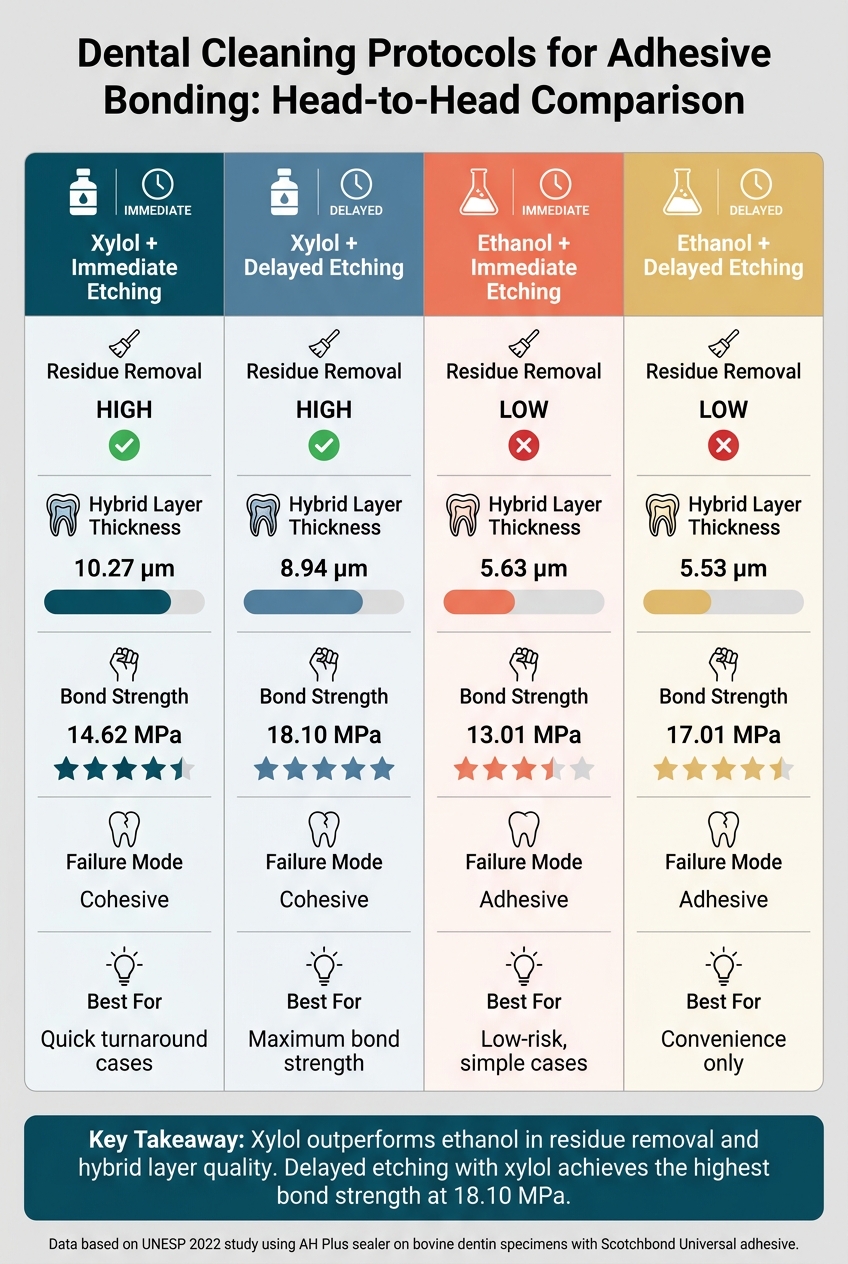
Dental Cleaning Protocols Compared: Residue Removal, Hybrid Layer & Bond Strength
1. Dentin Cleaning With Xylol
Xylol, a non-polar solvent, has proven effective at dissolving epoxy resin-based sealers like AH Plus, which is widely used in Australia. A 2022 study from São Paulo State University (UNESP), led by Tatiane Miranda Manzoli and Milton Carlos Kuga, examined the cleaning efficiency of xylol compared to 95% ethanol. Using 120 bovine dentin specimens contaminated with AH Plus, the study revealed that xylol-treated samples had less residue (median scores: 1–2) than those cleaned with ethanol (median score: 3).
This superior cleaning ability seems to improve the hybrid layer quality. With fewer residues and clearer dentinal tubules, adhesive monomers can penetrate the dentin collagen network more effectively. When xylol cleaning was paired with immediate acid etching, the hybrid layer reached an average thickness of 10.27 µm – nearly double the 5.63 µm thickness achieved with ethanol cleaning.
Here’s a summary of the hybrid layer thickness and residue persistence for xylol-based cleaning under different etching conditions:
| Etching Timing | Hybrid Layer Thickness (µm) | Residue Persistence (Median Score) |
|---|---|---|
| Immediate | 10.27 | 2 |
| 7 Days Delayed | 8.94 | 1 |
Interestingly, while xylol produced a thicker hybrid layer, it did not significantly enhance microshear bond strength compared to ethanol when using the universal adhesive Scotchbond Universal in an etch-and-rinse protocol. However, xylol-treated samples showed mostly cohesive failures, indicating a more integrated bond. The timing of acid etching – whether done immediately or after seven days – did not significantly impact cleaning efficiency or bond strength, offering clinicians greater flexibility in their procedures [1].
Next, let’s explore the effects of ethanol on dentin cleaning and bonding performance.
sbb-itb-2be92ed
2. Dentin Cleaning With Ethanol
Ethanol is a go-to option in many dental clinics thanks to its low toxicity and easy availability. In adhesive bonding, it’s often used as a wet-bonding agent, helping to keep the demineralised collagen matrix expanded. This expansion reduces the hydrophilicity of dentin, theoretically improving the penetration of hydrophobic adhesive monomers. However, when compared to xylol, ethanol has some clear shortcomings [4].
While ethanol is effective at maintaining the collagen matrix’s expansion, its limitations become evident when dealing with sealer residues. Specifically, ethanol struggles with epoxy resin-based sealers like AH Plus. The reason? A mismatch in polarity. Ethanol is polar, while AH Plus is non-polar, making it difficult for ethanol to dissolve these types of sealers [2].
The persistence of these residues creates significant challenges. Sealer remnants block the dentinal tubules, reducing the effectiveness of acid etching and making it harder for adhesive monomers to penetrate the collagen network. As a result, ethanol-treated dentin forms a much thinner hybrid layer compared to xylol-treated samples. Unfortunately, neither immediate nor delayed etching can fully address this residue problem [5][6].
"Dry and ethanol-impregnated cotton pellet methods are ineffective in removing sealers or increasing bond strength." – BMC Oral Health [2]
For clinicians, this highlights an important consideration: ethanol may not be the best choice when dealing with sealer contamination, especially in retreatment cases. Proper surface cleaning is critical for achieving strong adhesive bonds, and selecting the right cleaning protocol can make all the difference.
3. Immediate Acid Etching
Immediate acid etching, carried out right after surface cleaning, removes the smear layer and sealer residues, creating open dentinal tubules that allow adhesives to penetrate effectively [6]. However, timing is everything. If etching is done immediately after root canal filling – before the sealer has fully set – it can actually prevent thorough residue removal. As one study states, "The application of acid etching immediately after root canal filling appears to favour the persistence of sealer residues over the dentin, since they have not yet achieved their final set" [6].
This highlights the importance of the cleaning step before etching. The choice of solvent used prior to etching significantly impacts the results. For instance, using xylol as the solvent results in a hybrid layer with an average thickness of 10.27 µm and a median microshear bond strength of 14.62 MPa. On the other hand, substituting ethanol for xylol reduces the hybrid layer thickness to 5.63 µm and lowers bond strength to 13.01 MPa [6]. This suggests that the solvent has a greater influence on outcomes than the timing of the etching process. Adjusting etching times could also further refine bonding results.
For clinicians managing deep cavities or subgingival margins, a "short etch" approach may be a practical option. Using 37% phosphoric acid for just 3 seconds (instead of the typical 15 seconds) maintains consistent bond strength and marginal adaptation while preserving hydroxyapatite and minimising over-demineralisation [7].
4. Delayed Acid Etching
Delayed acid etching involves waiting 7 days after completing a root canal filling before applying acid. The idea behind this delay is to allow the sealer to fully set, potentially minimising any leftover sealer residue. However, research indicates that when using Scotchbond Universal adhesive in an etch-and-rinse mode, there’s no statistically significant difference in microshear bond strength between immediate and delayed etching protocols [6]. What does change, though, is the failure mode. Delayed etching tends to result in more cohesive failures rather than adhesive ones, hinting at a stronger bond at the interface [6]. This shifts attention from the timing of etching to the type of cleaning solvent used.
When delayed etching is paired with xylol cleaning, the hybrid layer reaches about 8.94 µm, with a median bond strength of 18.10 MPa. On the other hand, combining delayed etching with ethanol produces a thinner hybrid layer – around 5.53 µm – and a slightly lower median bond strength of 17.01 MPa [6]. Xylol, being non-polar, excels at removing epoxy resin-based sealers, performing effectively regardless of when acid etching is applied. This aligns with earlier findings from immediate etching studies, reinforcing the importance of the cleaning solvent over etching timing.
Pros and Cons of Each Protocol
When it comes to cleaning protocols in dentistry, each method brings its own strengths and weaknesses in areas like residue removal, bond strength, hybrid layer quality, and ease of use.
Here’s a detailed comparison of two commonly researched protocols:
| Protocol | Residue Removal | Bond Strength | Hybrid Layer Quality | Ease of Use |
|---|---|---|---|---|
| Ethanol (75%) | Poor – ineffective for non-polar sealers like AH Plus [2] | Lower; bond strength is significantly below that of uncontaminated dentin [2] | Poor – fails to clear dentinal tubules effectively [2] | High – widely available and simple to apply |
| Immediate Acid Etching | Phosphoric acid effectively decontaminates and removes the smear layer [3] | Improves bond strength compared to water rinsing alone [3] | Good – though it may etch deeper than some cements can penetrate [3] | High – a standard clinical step needing no extra tools |
Both protocols focus on residue removal, a step that water spray rinsing alone cannot achieve effectively. Water rinsing leaves behind microscopic residues that block dentinal tubules, which in turn hampers resin monomer flow and weakens bond strength [3].
"A tooth preparation cleansing protocol using particle abrasion with low‐pressure aluminum oxide particles provided a significant improvement in bond strength to contaminated dentin, while rinsing with water spray resulted in the lowest mean bond strength of the self-adhesive resin cement to dentin." – Yada Chaiyabutr, DDS, MSD, DSc [3]
This highlights the critical role of choosing the right cleaning protocol. Immediate acid etching with phosphoric acid stands out for its ability to thoroughly clean and enhance adhesive bonding by decontaminating the dentin surface. On the other hand, while ethanol is convenient and easy to use, its inability to remove non-polar contaminants effectively limits its usefulness in achieving strong bonds. Clinicians need to weigh these factors carefully to ensure optimal results.
Conclusion
Cleaning protocols play a crucial role in influencing adhesive bond strength and the longevity of restorations. Certain agents have proven more effective at removing sealer residues. For instance, phosphoric acid (37.5%) and surfactant-based cleaners like Katana™ Cleaner have shown superior results compared to traditional methods. Phosphoric acid etching not only removes sealer residues but also opens dentinal tubules, while Katana™ Cleaner, with its gentler pH of 4.5, offers strong decontamination through its 10-MDP monomer composition [2].
When addressing contamination from hemostatic agents, low-pressure aluminium oxide particle abrasion (27 μm at approximately 280 kPa) has been identified as the most effective mechanical method for restoring bond strength to near pre-contamination levels [3].
Outdated methods like dry cotton pellets and 75% ethanol are no longer recommended, as they fail to effectively remove modern canal sealers and result in low bond strength [2].
For Australian dental professionals, such as those at Complete Smiles Bella Vista, implementing evidence-based veneer bonding protocols is essential to minimise microleakage and ensure long-lasting results. Standardising the use of phosphoric acid or 10-MDP-based cleaners, with mechanical debridement reserved for severe contamination cases, reflects current best practices. Tailoring cleaning protocols to the type of contaminant is critical for achieving strong adhesive bonds and durable restorations. These insights reinforce the importance of selecting the right approach for optimal outcomes.
FAQs
Is xylol safe to use in the mouth?
Xylol is unsafe for oral use because it is classified as a flammable liquid and can cause skin irritation, among other health risks. These characteristics make it inappropriate and hazardous for any applications inside the mouth.
Does waiting 7 days before etching really help the bond?
Waiting for seven days before etching doesn’t have solid evidence supporting its impact on improving bond strength. Recent studies indicate that etching immediately or within a short time frame can be just as effective, provided the cleaning method is appropriate. The key is to match the etching protocol with the cleaning technique to achieve the best results.
What should I use if the sealer isn’t epoxy-based?
If the sealer you’re using isn’t epoxy-based, you might want to explore other cleaning methods to ensure proper bonding. Some options include:
- Ethanol
- Phosphoric acid mixed with ethanol
- Cleaning paste
- Distilled water
These approaches have been researched for their ability to enhance adhesive bonding results.
Related Blog Posts
- Chemical Adhesion in Dental Bonding: How It Works
- Effect of Application Techniques on Bonding Success
- How to Remove Contaminants for Stronger Dental Bonds
- Factors Affecting Dental Bond Strength
Important Notice: Any surgical or invasive procedure carries risks. Before proceeding, you should seek a second opinion from an appropriately qualified health practitioner.
Individual results may vary. The information provided in this article is for educational purposes only and does not constitute medical advice.
Checkout Related Blogs




Get in touch with us
For more information, call us now to start feeling better. Or fill the form below to make appointment
The Latest News from Complete Smiles
How to Clean Clear Plastic Retainers
Checklist for Choosing Wearable Dental Devices
Checklist for Choosing Cloud AI Platforms in Dentistry

Complete Smiles Bella VistaAccepts All Major Health Funds, Including





