





How to Remove Contaminants for Stronger Dental Bonds

When bonding dental restorations like crowns or veneers, contaminants such as saliva, blood, and debris can weaken the adhesive connection, reducing bond strength and durability. Cleaning the surface thoroughly is essential to ensure reliable adhesion. Here’s what you need to know:
- Common Contaminants: Saliva forms a protein-rich pellicle that reduces surface wettability, while blood introduces proteins that interfere with bonding. Debris from try-ins or preparation can also block adhesion.
- Cleaning Methods:
- Water Rinsing: Removes loose debris but often leaves organic films behind.
- Phosphoric Acid: Effective for glass ceramics or zirconia but unsuitable for the latter due to residue issues.
- Ivoclean Paste: Ideal for zirconia, removing phosphate contaminants and restoring bond strength.
- Air Abrasion: Creates micromechanical retention on zirconia but requires precise pressure to avoid damage.
- Post-Cleaning Treatments: Applying silane coupling agents improves adhesion for silica-based materials, while primers like 10-MDP enhance zirconia bonding.
Step 1: Identifying Common Contaminants
Saliva and Blood
The try-in phase is a major source of contamination during dental bonding procedures. When a restoration is placed in the patient’s mouth to check its fit and appearance, the bonding surface inevitably comes into contact with saliva and blood [2].
Saliva is a complex mixture of water, glycoproteins, mucins, enzymes, bacteria, and electrolytes. Within minutes, these components form a thin, protein-rich pellicle – about 10 to 20 nanometres thick – on the restoration surface [5]. This film reduces the surface’s wettability, making it harder for resin cement to properly infiltrate [5].
"Saliva is a complicated contaminant, as it contains proteins, phospholipids, enzymes, and phosphate groups that can adhere firmly to zirconia surfaces." – MDPI Prosthesis [2]
Blood adds another layer of complexity. It introduces proteins like fibrinogen and platelets, which create a barrier that lowers surface free energy and makes effective adhesion even more difficult without thorough cleaning [2].
Debris from Preparation and Try-Ins
Materials used during the try-in phase – such as silicone-based pastes, dental stone, or isolation media – can leave behind debris that interferes with micromechanical interlocking and primer bonding [2].
In a study involving 80 zirconia specimens, researchers found that water rinsing alone resulted in significantly lower shear bond strength (12.46 MPa) compared to uncontaminated surfaces (24.68 MPa) [4].
Contamination Issues by Material Type
Different dental materials react uniquely to contamination:
- Zirconia: Zirconia is particularly vulnerable because it relies more on chemical bonding than mechanical retention. Unlike porcelain or lithium disilicate, zirconia lacks a glass phase and cannot be etched with hydrofluoric acid, making chemical interactions critical [4]. Saliva, with its phosphate groups, can block bonding sites for functional monomers like 10-MDP [2]. Additionally, air abrasion (sandblasting) increases surface roughness and energy, which can attract organic contaminants [6]. Without proper cleaning, saliva contamination can reduce zirconia’s micro-shear bond strength from 59.5 MPa to 33.5 MPa [2], and in some cases, thermocycling has led to complete bond failure (0 MPa) [3].
- Glass-Ceramics: Porcelain and other glass-ceramics are moderately affected by contamination. Debris can fill the etched microporosities on their surface, but re-etching can often resolve these issues [4].
- Resin Composites: These materials also face challenges. Their high degree of conversion makes bonding difficult when contaminants disrupt the interface [7].
Understanding these common contaminants is crucial for implementing proper cleaning techniques in the following steps.
sbb-itb-2be92ed
Tips and tricks bonding protocols
Step 2: Methods for Removing Contaminants
Different materials need specific cleaning techniques to effectively restore bond strength. Once contaminants are identified, the cleaning method should be chosen based on the type of material and the level of contamination.
Water Rinsing and Air Drying
Water rinsing is a straightforward method, but it has its drawbacks. While it can remove loose debris, it often leaves behind an organic protein pellicle, which acts as a barrier to proper bonding.[4] To avoid leaving mineral deposits, distilled water is recommended. After rinsing, use oil-free compressed air to ensure the surface is completely dry, as even small traces of oil or lubricant can weaken bond strength. Research shows that zirconia specimens cleaned only with water rinsing failed entirely during thermocycling.[4] For materials less affected by phosphate residues, chemical cleaning can offer better results.
Cleaning with Phosphoric Acid
Phosphoric acid is effective for certain materials. For example, dentin or lithium disilicate can be re-etched with 37% phosphoric acid for 10–15 seconds, which can restore bond strength significantly – rising from 20.29 MPa to 24.58 MPa.[1] However, this method is unsuitable for zirconia, as phosphoric acid leaves phosphate residues that block oxide binding sites. Studies on zirconia found that cleaning with phosphoric acid resulted in bond strengths of only 7.93 MPa, compared to 18.18 MPa achieved using specialised cleaning products.[6] For materials where phosphoric acid isn’t appropriate, dedicated cleaning pastes provide a better alternative.
Using Ivoclean Paste
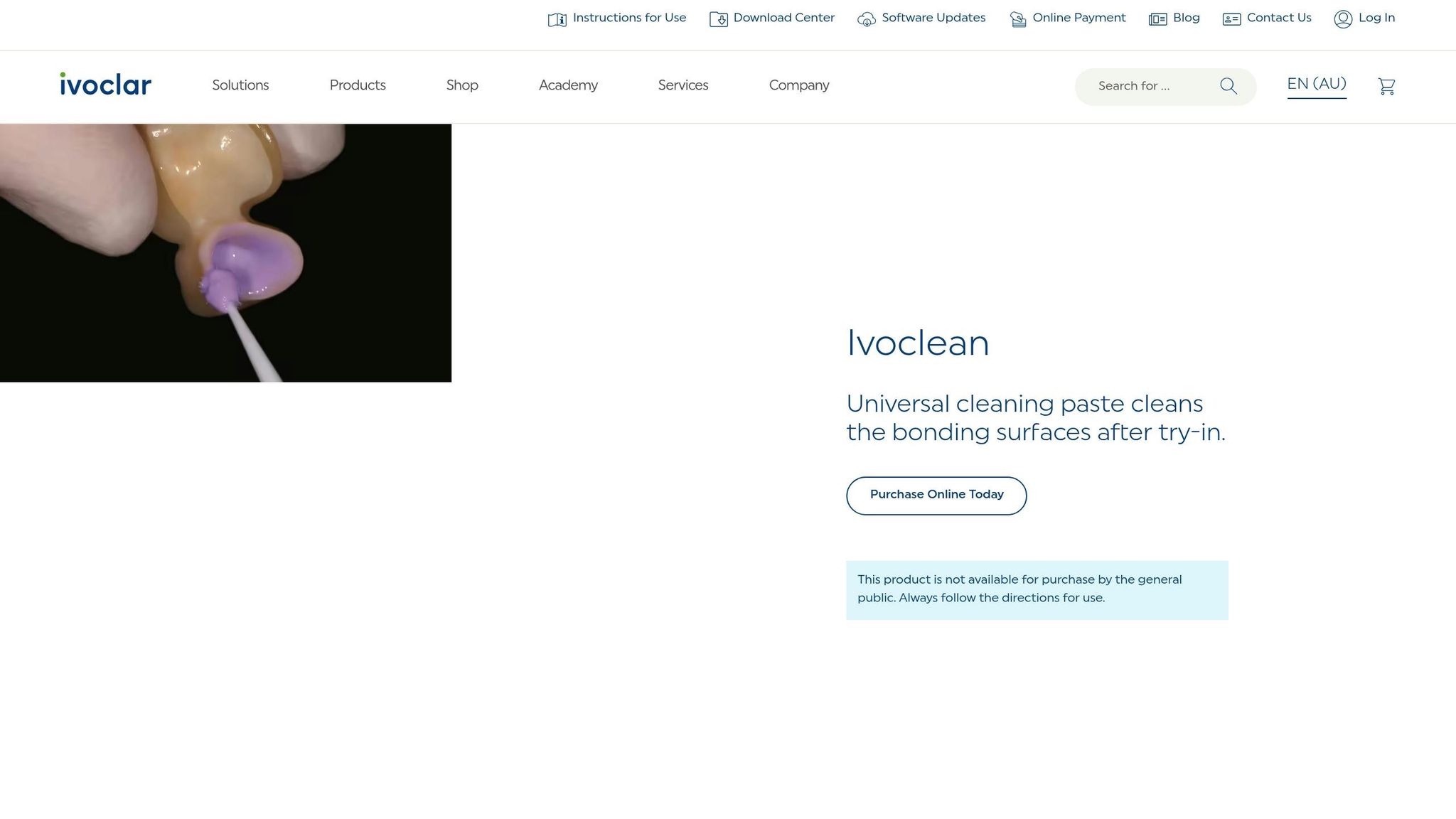
Ivoclean, an alkaline paste with a pH of 13, contains zirconium oxide particles that attract phosphate contaminants. These particles act like scavengers, removing saliva and blood proteins from the restoration surface.[4] To use Ivoclean, apply it with a micro-brush, let it sit for 20 seconds, rinse thoroughly until the purple colour disappears, and dry the surface with oil-free air. This method is especially effective for zirconia, restoring shear bond strength to 21.48 MPa – close to the 24.68 MPa observed in uncontaminated samples.[4] For high-translucency zirconia, Ivoclean has demonstrated micro-shear bond strengths of 56.7 ± 4.8 MPa, compared to just 33.5 ± 6.3 MPa after water rinsing.[2] However, it’s important to note that Ivoclean is designed exclusively for extraoral use on restorations and should not be used intraorally on tooth structures.
Step 3: Improving Bond Strength After Cleaning
Once the surface is clean, additional treatments can help strengthen the chemical and mechanical bonds.
Applying Silane Coupling Agent
Silane coupling agents serve as a connector between ceramic surfaces and resin adhesives. These agents have silanol groups that bond with the inorganic fillers in ceramics, while their organofunctional groups co-polymerise with the methacrylate groups in resin adhesives [11]. This dual action makes silane especially effective for silica-based materials like porcelain. It also increases the surface energy of the restoration, improving "wetting" and allowing the adhesive to flow into micro-retentions more effectively [9][11].
Most commercial silane primers consist of 1–5% silane dissolved in an ethanol-water mix [9]. Before use, check the solution’s clarity – if it looks cloudy or milky, it has polymerised and should be discarded [9]. For zirconia and other non-silica materials, silane alone won’t work unless the surface is first treated with a silica coating using tribochemical methods [9]. Blowing a hot air stream over the silane coating after application can thin the layer and significantly improve micro-tensile bond strength [10].
For zirconia and other non-silica materials, alternative approaches are necessary.
Airborne Particle Abrasion for Zirconia
Airborne particle abrasion is a method used to create micromechanical irregularities on zirconia surfaces, improving retention. This technique involves blasting the surface with aluminium oxide (Al₂O₃) particles. Clinically, 50-μm Al₂O₃ particles are applied at 0.2–0.3 MPa (2–3 bar) for about 20 seconds, with the nozzle positioned 10–15 mm from the surface [2][4]. This process increases both the surface area and energy, enhancing the wetting capability of resin cements and primers [4].
"Micromechanical adhesion was a more effective mechanism than chemical adhesion and airborne particle abrasion significantly increased mean shear bond strengths compared with another surface treatments." – Materials Science and Engineering: C [12]
After abrasion, rinse the restoration in an ultrasonic bath filled with distilled water for 3–5 minutes to remove leftover Al₂O₃ particles [2][4]. Then, use a 10-MDP primer to bond with zirconia’s metal oxides [2][4]. Research shows that this process can restore shear bond strength to 21.92 ± 2.85 MPa, which is close to the 24.68 ± 5.46 MPa seen in uncontaminated samples [4].
Comparing Cleaning Methods
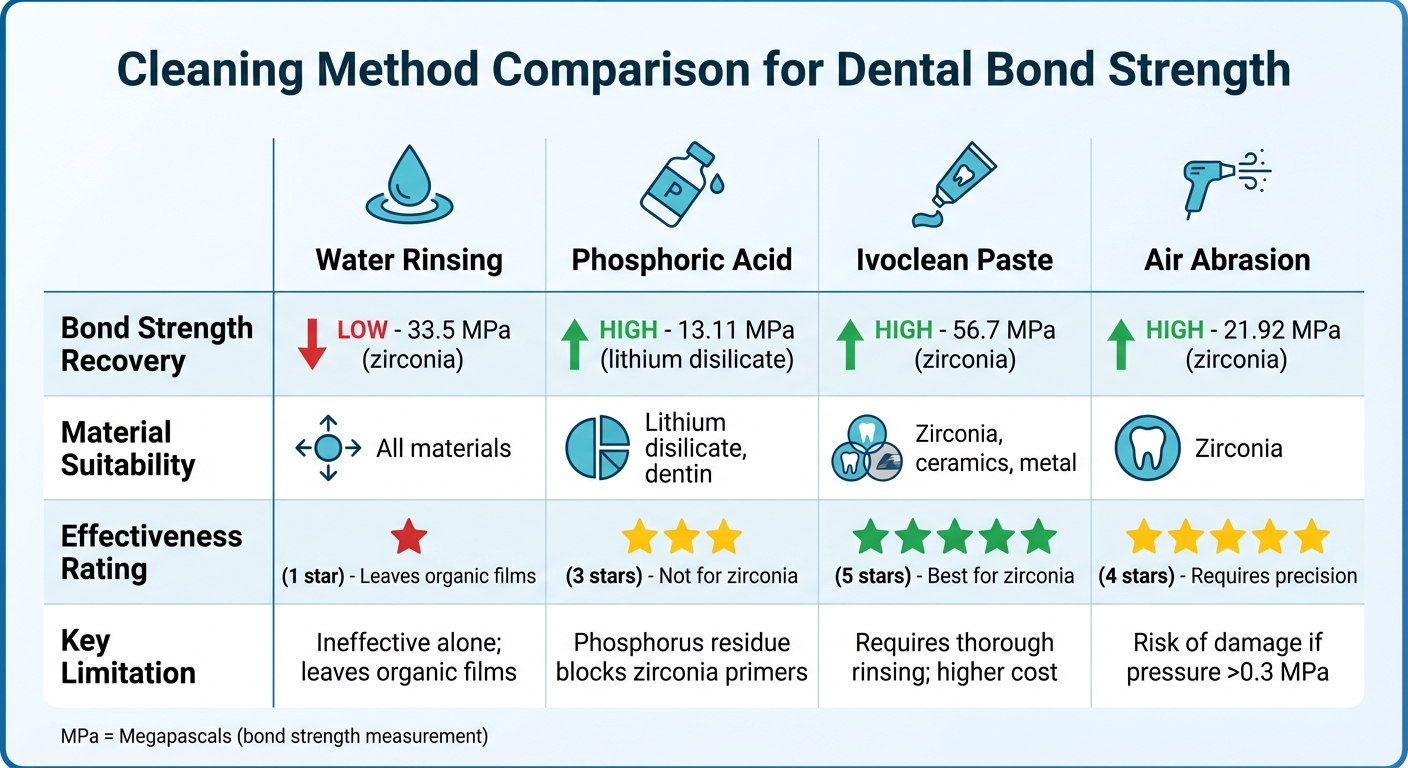
Dental Bond Cleaning Methods Comparison: Effectiveness by Material Type
Following the earlier discussion on identification and removal techniques, this section breaks down how different cleaning methods perform in restoring bond strength, depending on the material in question. The effectiveness of these methods can vary widely across dental materials, making it crucial to choose the right approach.
Water rinsing, while commonly used, is often the least effective. It struggles to remove organic pellicles formed by saliva and blood. For example, one study found that water rinsing restored zirconia bond strength to just 33.5 MPa, compared to 59.5 MPa in an uncontaminated control group [2].
Phosphoric acid works well for cleaning lithium disilicate surfaces, achieving shear bond strengths of 13.11 MPa – comparable to the 12.59 MPa achieved using hydrofluoric acid etching [5]. However, it’s less effective on zirconia due to phosphorus residues that interfere with primer application [2][4].
For zirconia, Ivoclean and air abrasion are more effective options. Ivoclean restores zirconia bond strength to 56.7 MPa, nearly matching uncontaminated controls. Air abrasion, while also effective, improves bond strength to 21.92 MPa and requires precise pressure control to avoid damaging the surface. Pressures above 0.3 MPa (3 bar) can cause surface flaws [2][4].
Cleaning Method Comparison Table
The table below summarises the performance, material compatibility, and safety considerations for each method:
| Method | Bond Strength Recovery | Material Suitability | Safety Notes |
|---|---|---|---|
| Water Rinse | Low (33.5 MPa for zirconia [2]) | All materials | Ineffective alone; leaves organic films behind. |
| Phosphoric Acid | High for glass ceramics (13.11 MPa for LDS [5]) | Lithium disilicate, dentin | Leaves phosphorus residue on zirconia, which blocks primers. |
| Ivoclean | High (56.7 MPa for zirconia [2]) | Zirconia, ceramics, metal | Requires thorough rinsing; may involve higher costs. |
| Air Abrasion | High (21.92 MPa for zirconia [4]) | Zirconia | Risk of surface damage if pressure exceeds 0.3 MPa (3 bar). |
When selecting a cleaning method, it’s essential to align the approach with the type of restoration material. For glass ceramics like lithium disilicate, phosphoric acid is a reliable option. Zirconia, on the other hand, benefits most from specialised cleaning methods such as Ivoclean or carefully controlled air abrasion.
Conclusion: Achieving Stronger Dental Bonds
Summary of Cleaning Techniques
To create durable dental bonds, removing contaminants from surfaces requires precise, material-specific cleaning methods. This guide has highlighted key techniques, showing that Ivoclean and air abrasion consistently outperform basic water rinsing for zirconia. For glass ceramics and dentin, phosphoric acid re-etching proves highly effective. For instance, re-etching contaminated dentin with 37.5% phosphoric acid for 10 seconds can boost micro-shear bond strength to approximately 24.58 MPa, compared to roughly 20.29 MPa achieved with water rinsing alone [1].
When tackling zirconia restorations, Ivoclean restores bond strength to an impressive 56.7 MPa, while water rinsing lags behind at around 33.5 MPa [2]. Similarly, for surfaces with temporary cement residues, professional air polishing with sodium bicarbonate improves bond strength to about 11.53 MPa, nearing the 12.92 MPa observed with fresh dentin [8]. The takeaway? Water rinsing alone often falls short, so selecting the right cleaning method for each material is essential.
The Importance of Professional Dental Care
While effective cleaning methods are vital, professional expertise is just as critical to ensure optimal bonding outcomes. Dental bonding is a highly technique-sensitive process, requiring meticulous surface preparation and a controlled environment. As Vichakorn Vongtavatchai from the Department of Operative Dentistry, Chulalongkorn University, points out: "Pumice polishing alone was insufficient for removing temporary cement, resulting in reduced bond strength of the subsequently applied resin cement" [8]. This highlights the importance of professional oversight, as dentists use specialised tools and products – such as MDP-based cleaners, air-abrasion units with 50-µm alumina particles, and advanced chemical agents – not accessible for home use.
Dentists bring the clinical judgement needed to choose the best decontamination methods for different restoration materials and adhesive systems. Whether determining when to re-etch a surface or applying Ivoclean after try-ins, their expertise ensures strong, lasting bonds. For tailored advice on restorative procedures and maintaining oral health, consider visiting Complete Smiles Bella Vista for expert guidance.
FAQs
How can I tell if a restoration surface is contaminated?
A restoration surface that has been contaminated might display visible residues or changes in its surface chemistry. To determine if cleaning has successfully removed these contaminants, testing the bond strength is essential. This step ensures the surface is adequately prepared for the best possible adhesive bonding.
What’s the safest way to clean zirconia after a try-in?
The best way to clean zirconia after a try-in is by rinsing it with water or using specialised cleaning products like ZirClean™ or Ivoclean. Make sure to rinse and dry the zirconia thoroughly. This process helps remove any contaminants and improves bond strength, all while protecting the zirconia surface.
When should silane or 10‑MDP primer be applied after cleaning?
When working with glass-ceramics, silane is used after the etching process to create a bond with the glass particles. On the other hand, 10-MDP primer is applied following the sandblasting of oxide ceramics like zirconia, enhancing adhesion. The selection of these materials is determined by the specific type of restorative material being handled.
Related Blog Posts
- Chemical Adhesion in Dental Bonding: How It Works
- Bond Strength of CAD/CAM Materials with Adhesives
- Effect of Application Techniques on Bonding Success
- Ceramic vs. Zirconia Crown Bonding Techniques
Important Notice: Any surgical or invasive procedure carries risks. Before proceeding, you should seek a second opinion from an appropriately qualified health practitioner.
Individual results may vary. The information provided in this article is for educational purposes only and does not constitute medical advice.
Checkout Related Blogs




Get in touch with us
For more information, call us now to start feeling better. Or fill the form below to make appointment
The Latest News from Complete Smiles
How to Clean Clear Plastic Retainers
Checklist for Choosing Wearable Dental Devices
Checklist for Choosing Cloud AI Platforms in Dentistry

Complete Smiles Bella VistaAccepts All Major Health Funds, Including





