



Self-Etch vs. Total-Etch Bonding: Durability Compared

When choosing between self-etch and total-etch bonding systems for dental restorations, durability and clinical application are key factors. Both systems have strengths and limitations, making them suitable for different scenarios:
- Self-Etch: Combines etching and priming in one step, simplifying the process. It performs well on dentine, reduces sensitivity, and is less technique-sensitive. However, it provides lower bond strength on enamel, especially intact surfaces, and may degrade faster in acidic conditions.
- Total-Etch: Uses phosphoric acid for separate etching, achieving high bond strength on enamel. It’s ideal for anterior restorations and aesthetics but requires precise moisture control and may increase sensitivity.
Quick Comparison
| Feature | Self-Etch Bonding | Total-Etch Bonding |
|---|---|---|
| Etching Step | Combined in one step | Separate phosphoric acid |
| Best Use | Dentine-heavy restorations | Enamel-heavy restorations |
| Enamel Bond Strength | Moderate to high | Very high |
| Sensitivity | Lower | Higher |
| Durability in Acid | Less resistant | More resistant |
For balanced outcomes, a selective-etch technique (etching enamel with phosphoric acid, self-etch on dentine) offers a practical middle ground. Universal adhesives also allow flexibility, adapting to both approaches while maintaining retention and bond strength over time.
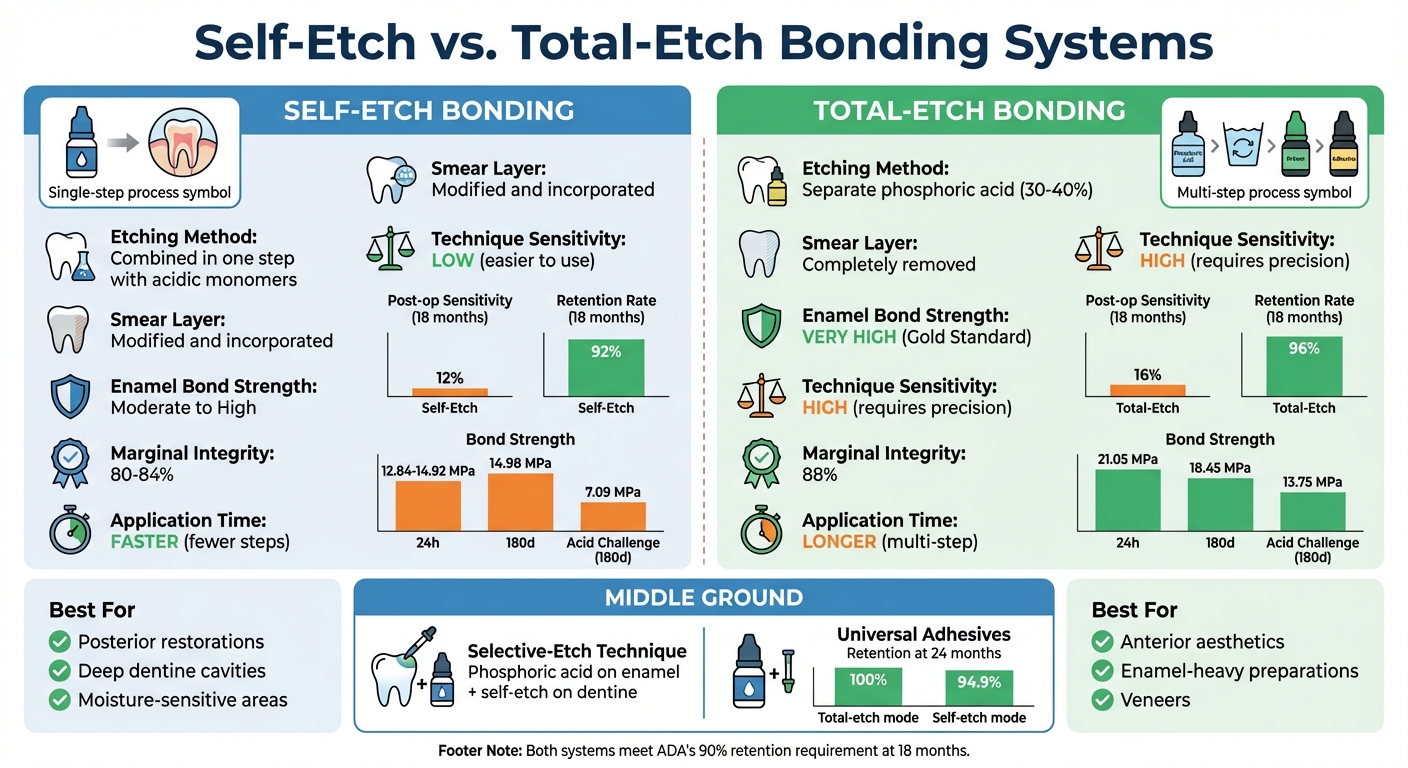
Self-Etch vs Total-Etch Dental Bonding Systems Comparison
Self-Etch Bonding Explained
How Self-Etch Bonding Works
Self-etch bonding combines etching and priming into a single step, making the process more efficient. It uses acidic monomers like 10-MDP, Phenyl-P, or 4-MET to simultaneously demineralise enamel and dentine while infiltrating the tooth structure with resin [1]. As the acid dissolves hydroxyapatite, resin monomers penetrate the demineralised surface, forming a hybrid layer [6]. Unlike traditional methods, the acidic component stays on the tooth, preventing the collapse of exposed collagen caused by over-drying [1]. These systems are categorised by their pH levels: "strong" (pH < 1), "intermediately strong" (pH ≈ 1.5), "mild" (pH ≈ 2), and "ultra-mild" (pH ≥ 2.5) [7]. This process is key to their clinical effectiveness, influencing both their strengths and weaknesses.
Benefits of Self-Etch Bonding
One of the standout benefits of self-etch bonding is its simplicity. By eliminating separate steps, it reduces chairside time and lowers the risk of technique-related errors [1]. There’s no need to worry about over-drying or leaving the tooth too moist, making it less technique-sensitive.
"Self-etch and selective-etch are the most predictable relative to production of postoperative tooth sensitivity." – Gordon J. Christensen, DDS, PhD, MSD [5]
Clinical research supports this, showing that self-etch adhesives lead to less postoperative sensitivity compared to total-etch systems. For example, an 18-month study reported sensitivity rates of 12% for self-etch systems versus 16% for total-etch techniques [2]. These systems are particularly effective for posterior restorations, deep cavities, and situations where controlling moisture is challenging [1]. However, they do come with some trade-offs.
Drawbacks of Self-Etch Bonding
While self-etch systems excel in many areas, they fall short in bonding to enamel. Compared to phosphoric acid etching, they generally achieve lower bond strength, especially on unground or intact enamel surfaces [1]. This is because the acidic monomers in self-etch systems often lack the aggressiveness needed to create a strong, retentive enamel texture.
"The disadvantage is some self-etch adhesives, which perform better for bonding to dentine than total-etch systems, are not acidic enough to create surface texture on enamel." – Nathaniel Lawson, DMD, Ph.D., Assistant Professor and Director of the Division of Biomaterials, UAB School of Dentistry [3]
In an 18-month clinical study of noncarious cervical lesions, total-etch systems maintained a marginal integrity of 88%. In comparison, two-bottle self-etch systems dropped to 80%, and one-bottle systems to 84% [2]. For anterior restorations where aesthetics are crucial, this reduced bond strength can be problematic. Another concern is the hydrophilic nature of one-step self-etch adhesives, which may attract water over time and weaken the bond [2].
sbb-itb-2be92ed
Total-Etch Bonding Explained
How Total-Etch Bonding Works
Total-etch bonding, often called etch-and-rinse, involves a separate step using phosphoric acid to prepare both enamel and dentine before applying adhesive. Here’s how it works: a 30–40% phosphoric acid gel is applied, with enamel etched for 15–25 seconds and dentine for up to 15 seconds. This process removes the smear layer and opens the dentinal tubules. Afterward, the acid is thoroughly rinsed away with water, and the tooth is gently air-dried to achieve a matte finish. It’s crucial to maintain slight moisture to preserve the collagen matrix.
Next, a primer and adhesive – often combined in modern two-bottle systems – are applied. Excess solvent is evaporated, and the adhesive is light-cured. This process creates macro-tags around enamel prisms and micro-tags within them, ensuring a strong mechanical bond. This step-by-step approach is key to achieving the superior bond strength associated with total-etch systems.
Benefits of Total-Etch Bonding
Total-etch bonding is often considered the gold standard for enamel adhesion due to its exceptional bond strength. Studies show that total-etch systems achieve a mean shear bond strength of 27.16 MPa, compared to 19.46 MPa for one-step self-etch systems [8]. This strength comes from the aggressive etching action of phosphoric acid, which has a pH below 1. It effectively etches enamel – composed of approximately 92% hydroxyapatite – creating deep, retentive patterns for bonding.
"Etching enamel when you can creates the best bond." – Jason Goodchild, DMD, Director of Clinical Affairs, Premier Dental Products Company
The method also provides an excellent marginal seal, which is especially important for anterior restorations where both aesthetics and durability matter. Additionally, this technique works well with dual-cure resin systems, making it suitable for a variety of restorations.
Drawbacks of Total-Etch Bonding
While total-etch bonding delivers strong adhesion, it comes with some challenges. Precision is essential – over-drying can collapse collagen fibres, while over-wetting dilutes the primer, both of which hinder resin infiltration.
"Over-etching dentin results in postoperative sensitivity as well as decreases in bond strength due to the demineralization penetrating further into the tubules than the resin tags will go, and formation of a gap." – Dr. Lee Ann Brady, DMD
Another concern is the potential for postoperative sensitivity, as the technique fully opens dentinal tubules. If these aren’t sealed adequately by the bonding agent, sensitivity can occur. Additionally, phosphoric acid may activate matrix metalloproteinases (MMPs), enzymes that can break down the adhesive bond over time. These challenges highlight the importance of controlling moisture and following recommended etching times carefully to optimise results.
Self-Etch vs. Total-Etch: Direct Comparison
Technique Differences
The key distinction between self-etch and total-etch bonding systems lies in how they prepare the tooth surface. Total-etch uses 30–40% phosphoric acid to remove the 10 µm smear layer and expose dentinal tubules. This step requires rinsing and drying the tooth after application [10].
Self-etch systems simplify the process by combining etching and priming into one step. Acidic monomers in the self-etch adhesive simultaneously demineralise and penetrate the tooth structure, eliminating the need for rinsing [1][10]. Instead of removing the smear layer, self-etch systems modify it and incorporate it into the bonding process, reducing the moisture-control challenges often seen with total-etch techniques [2][10].
A selective-etch method bridges the gap between the two systems. In this approach, phosphoric acid is applied only to enamel margins, followed by a self-etch adhesive on dentine. This hybrid method seeks to enhance enamel bond strength while reducing dentine sensitivity [3].
These procedural differences significantly impact clinical performance, as outlined below.
Performance Comparison
The technical differences between these systems influence their clinical outcomes. For example, an 18-month study on noncarious cervical lesions showed that total-etch systems achieved a 96% retention rate, compared to 92% for both one-bottle and two-bottle self-etch systems [2]. Since the American Dental Association requires a minimum 90% retention rate at 18 months, all systems met this standard [2].
Marginal integrity showed some variation. Total-etch systems achieved an 88% rate, while one-bottle and two-bottle self-etch systems reached 84% and 80%, respectively [2]. Additionally, self-etch systems reported lower postoperative sensitivity [2].
"The benefit of self-etch is it takes away some of the technique sensitivity of etching dentin with phosphoric acid." – Nathaniel Lawson, DMD, PhD, Assistant Professor, UAB School of Dentistry [3]
Self-etch systems also save time by condensing the process into fewer steps. While total-etch requires multiple steps – etching, rinsing, drying, priming, and bonding – self-etch systems streamline the process, making them particularly useful in moisture-sensitive areas or for deep posterior restorations [1][10].
These performance differences are crucial for evaluating the long-term durability of each bonding system.
Comparison Table
| Feature | Self-Etch Bonding | Total-Etch Bonding |
|---|---|---|
| Etching Step | Combined in primer/adhesive [1][10] | Separate phosphoric acid etch [1][10] |
| Smear Layer | Modified and incorporated [2][10] | Completely removed [10] |
| Enamel Bond Strength | Moderate to High [1] | Very High (Gold Standard) [1] |
| Technique Sensitivity | Low [1] | High [1] |
| Post-op Sensitivity (18 months) | 12% [2] | 16% [2] |
| Retention Rate (18 months) | 92% [2] | 96% [2] |
| Application Time | Faster, fewer steps [1][10] | Longer, multi-step process [1][10] |
| Best Clinical Use | Posterior restorations, deep dentine [1] | Anterior aesthetics, enamel-heavy preparations [1] |
This table captures the essential differences between self-etch and total-etch systems, helping clinicians choose the most suitable option for specific cases.
Durability: Which System Lasts Longer?
Bond Strength Over Time
When it comes to long-term durability, bond strength plays a critical role in clinical success. Total-etch systems tend to start strong, with higher initial bond strength compared to self-etch systems. For instance, at 24 hours, the two-step total-etch system Adper Single Bond 2 showed a mean bond strength of 21.05 MPa, outperforming the two-step self-etch system Clearfil SE Bond at 14.92 MPa and the one-step self-etch system at 12.84 MPa [4]. However, this initial advantage diminishes over time.
After 180 days of water storage, total-etch systems retained a bond strength of 18.45 MPa, while the two-step self-etch system remained relatively stable at 14.98 MPa [4]. By the 15-month mark, differences in bond strength between adhesive systems became statistically insignificant. As Armstrong and colleagues observed:
"Although differences in bond strength were observed across adhesive systems up to 6 months of storage, no differences were noted at 15 months. This may represent common degradative mechanisms" [9].
Thermal cycling, a common stressor, reduces bond strength by roughly 40% in certain systems [4]. Self-etch adhesives, in particular, are more prone to degradation in acidic environments. For example, after 180 days in a citric acid solution (pH 2.3), the bond strength of two-step self-etch systems dropped to 7.09 MPa, while total-etch systems maintained a higher strength of 13.75 MPa [4]. These findings highlight the resilience of total-etch systems under challenging conditions.
Clinical Study Results
The durability trends observed in the lab are echoed in clinical studies. An 18-month study on noncarious cervical lesions (NCCLs) offers a practical perspective. All adhesive systems tested met the ADA’s requirement of a 90% retention rate over 18 months [2].
While marginal integrity showed some variation, overall clinical performance was comparable across systems [2]. The study concluded:
"The clinical performance of total-etch and self-etch adhesive systems in NCCLs did not differ significantly with regard to the evaluated parameters – retention, marginal integrity, and postoperative sensitivity" [2].
For universal adhesives containing 10-MDP, research consistently shows that a total-etch approach enhances dentine bond strength across all conditions, including short-term testing, thermocycling, and extended immersion [11]. This underscores how the choice of etching strategy can influence long-term results, even with modern adhesive technologies [11].
How to Choose the Right Bonding System
Factors to Consider
When deciding between self-etch and total-etch bonding systems, the choice often comes down to the tooth substrate. For enamel-dominant cases, such as anterior veneers, total-etch systems are the go-to. The use of phosphoric acid in these systems ensures strong etching, which is ideal for achieving excellent marginal integrity. On the other hand, self-etch systems work better for dentine-dominant cases, like deep posterior cavities. They seal dentinal tubules effectively, helping to reduce postoperative sensitivity.
However, total-etch bonding requires careful moisture control. Over-drying can collapse collagen fibres, while over-wetting may dilute the primer. Self-etch systems are more forgiving in situations where isolation is challenging, making them a practical choice for reducing sensitivity in certain cases [3].
For a balanced approach, a selective-etch technique offers the best of both worlds. This involves etching only the enamel margins with phosphoric acid while using a self-etch adhesive on dentine. Dr. Nathaniel Lawson, Director of the Division of Biomaterials at UAB School of Dentistry, advocates for this method:
"The ideal combinations of these two modes is selective-etch. In other words, employ phosphoric acid application on the enamel and self-etch application on the dentin" [3].
"We now understand that etching enamel when you can creates the best bond. And keeping phosphoric acid off of dentin is probably a good idea" [3].
These insights help clinicians weigh the pros and cons of each system and refine their bonding strategies based on the clinical situation.
Universal Adhesives as an Alternative
For those seeking flexibility and efficiency, universal adhesives present a versatile solution. Products like 3M Scotchbond Universal Plus and GC G2-Bond Universal incorporate advanced monomers, including 10-MDP and silane, allowing clinicians to switch between self-etch, total-etch, and selective-etch techniques with a single bottle. This simplifies workflows without compromising effectiveness.
In a 24-month clinical evaluation, universal adhesives demonstrated impressive performance, with a 100% retention rate in total-etch mode and 94.9% in self-etch mode [12].
To maximise results, selective enamel etching is recommended when using universal adhesives, as it enhances bond strength without increasing the risk of dentine sensitivity. Additionally, it’s crucial to ensure the adhesive contains high-purity 10-MDP. Impurities in this monomer can interfere with calcium salt formation, potentially weakening the bond over time.
Universal adhesives provide a streamlined, adaptable option for clinicians aiming to optimise bonding outcomes across a range of cases.
Dentin Bonding Agents (Etch & Rinse / Self Etch / Universal Adhesives) – Which one is the BEST???
Conclusion
Both self-etch and total-etch systems deliver dependable clinical results. For instance, studies on non-carious cervical lesions report retention rates of 96% for total-etch systems and 92% for self-etch systems at 18 months [2]. Both surpass the American Dental Association’s minimum retention benchmark of 90%. Ultimately, the choice between these systems hinges on the tooth substrate and the clinical scenario.
Total-etch systems are particularly effective for enamel-dominant preparations, such as anterior restorations where maintaining marginal integrity is crucial. The use of phosphoric acid in these systems creates deep micropores in the enamel, providing excellent mechanical retention. On the other hand, self-etch systems are better suited for dentine-heavy cases, like deep posterior cavities, as they reduce postoperative sensitivity by sealing dentinal tubules without causing aggressive demineralisation.
Long-term studies reveal key differences in durability. After 180 days of ageing, total-etch systems showed bond strengths of about 18.45 MPa, compared to 14.98 MPa for self-etch systems [4]. When exposed to citric acid challenges, self-etch bonds dropped to 7.10 MPa, whereas total-etch bonds retained a higher strength of 13.75 MPa [4]. This highlights the superior resistance of total-etch systems in acidic environments over time.
In clinical practice, these findings encourage the adoption of combined approaches. Techniques like selective-etching – where phosphoric acid is applied only to enamel margins while self-etch adhesives are used on dentine – offer a balanced solution, optimising enamel bond strength without compromising dentine. Universal adhesives containing 10-MDP simplify workflows, enabling clinicians to tailor their approach to specific cases while ensuring strong retention for both enamel and dentine.
FAQs
Which bonding method is best for my tooth: self-etch, total-etch, or selective-etch?
When it comes to dental bonding, the right method depends on your specific clinical needs.
- Total-etch delivers a strong bond to enamel but requires precise technique, especially when working with dentin, as it’s more sensitive to errors.
- Self-etch streamlines the process, making it less technique-dependent. It’s particularly useful for deep cavities or situations where controlling moisture is challenging.
- Selective-etch strikes a balance by targeting the enamel for etching while reducing the risk of sensitivity in the dentin.
To find the best approach for you, it’s always a good idea to consult your dentist. They can assess your individual case and recommend the most effective bonding method.
Will the bonding choice affect sensitivity after my filling?
When deciding between self-etch and total-etch bonding systems, the key takeaway is that proper technique plays a bigger role than the system itself in reducing sensitivity after a filling. Studies indicate that when applied correctly, there’s no noticeable difference in postoperative sensitivity between the two methods. While self-etch adhesives might have an edge by sealing dentinal tubules right away, both approaches are effective when used as intended. Ultimately, individual patient response and the dentist’s technique matter more than the choice of bonding system.
Do acidic foods and drinks make bonded restorations fail sooner?
Yes, acidic foods and drinks can weaken the bond strength of dental restorations, potentially causing them to fail earlier than expected. Acidic substances, like those found in citrus fruits or low-pH beverages, can reduce the durability of both total-etch and self-etch adhesive systems. Studies indicate that prolonged exposure to acidic environments compromises the bond’s integrity, increasing the likelihood of restoration failure over time, particularly in cases of dental erosion.
Related Blog Posts
- Advances in Dental Adhesives: What to Know
- Ceramic Bracket Bonding: Adhesive Types Compared
- Effect of Application Techniques on Bonding Success
- Factors Affecting Dental Bond Strength
Important Notice: Any surgical or invasive procedure carries risks. Before proceeding, you should seek a second opinion from an appropriately qualified health practitioner.
Individual results may vary. The information provided in this article is for educational purposes only and does not constitute medical advice.
Checkout Related Blogs



Get in touch with us
For more information, call us now to start feeling better. Or fill the form below to make appointment
The Latest News from Complete Smiles
How to Clean Clear Plastic Retainers
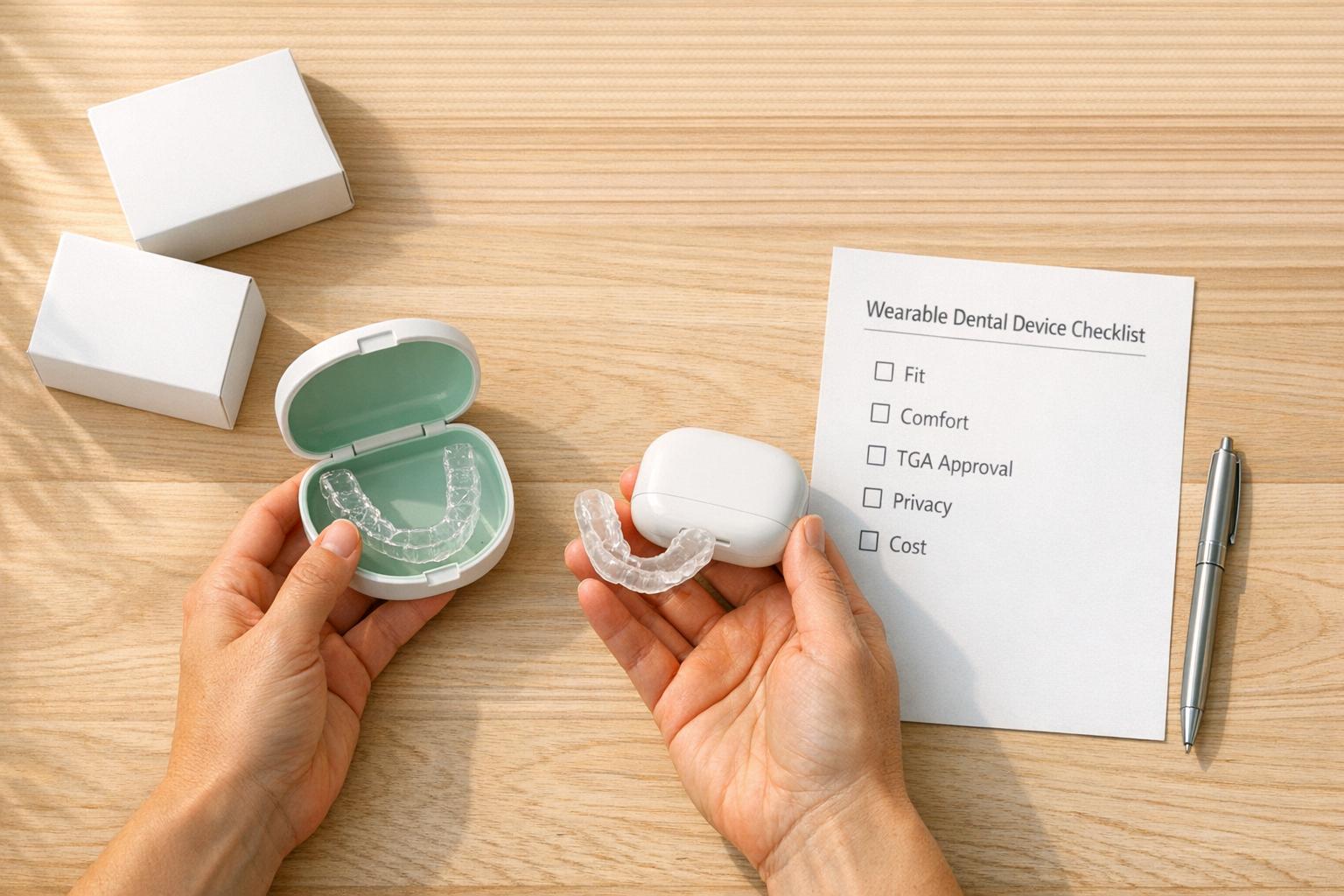
Checklist for Choosing Wearable Dental Devices
Checklist for Choosing Cloud AI Platforms in Dentistry
Complete Smiles Bella VistaAccepts All Major Health Funds, Including