





How Nanotechnology Improves Dental Restoration Durability
Nanotechnology is transforming dental restorations by making them stronger, longer-lasting, and more resistant to wear and decay. By using materials like silica, zirconia, and nano-hydroxyapatite, these advancements address common issues such as cracking, wear, and bacterial growth. For Australians, this means fewer dental visits, reduced costs, and improved oral health outcomes.
Key Takeaways:
- Stronger Materials: Nano-filled composites and ceramics handle chewing forces better, resist wear, and maintain their polish.
- Less Decay: Antimicrobial nanoparticles, such as silver and zinc oxide, prevent bacterial growth and secondary decay.
- Improved Aesthetics: Nano-based materials mimic natural enamel for better-looking restorations.
- Cost Challenges: Nano-restorations can cost AUD 200–500 more per treatment, limiting access for some patients.
While these advancements are promising, cost and regulatory hurdles remain. Research into materials like carbon nanotubes and bioactive coatings continues to push the field forward, with personalised, long-lasting solutions expected in the near future.
The secret to durable adhesion in restorative dentistry
Problems with Conventional Dental Restorations
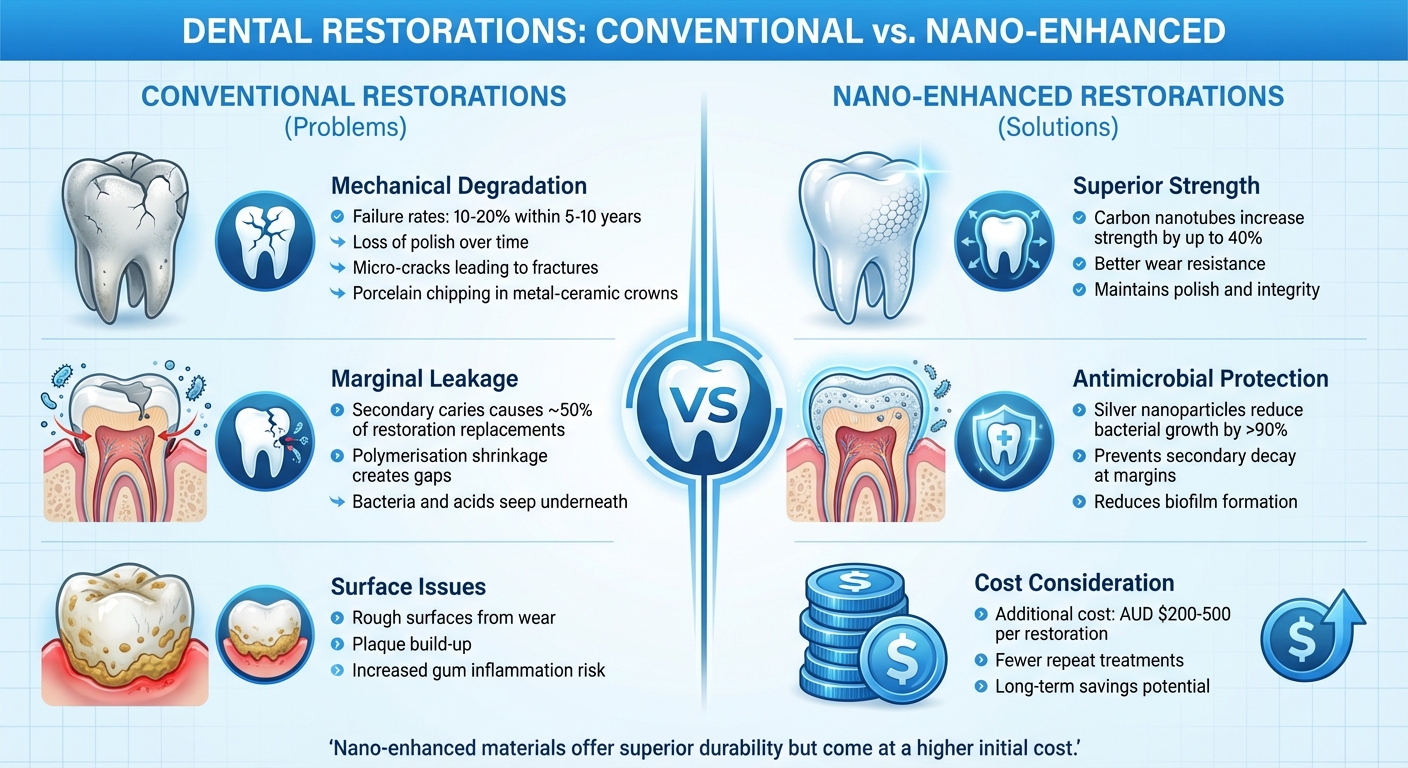
Conventional vs Nano-Enhanced Dental Restorations Comparison
Traditional dental materials like amalgam, older composites, glass ionomers, and metal–ceramic crowns have long been used in restorative dentistry. However, their durability issues often lead Australians back to the dentist for repeat treatments on the same tooth.
One major drawback is mechanical degradation. Conventional composites lacking nano-fillers tend to lose their polish over time. As chewing dislodges larger filler particles from the resin matrix, the surface becomes rough, which can result in micro-cracks. These cracks may eventually lead to full fractures, especially in larger posterior restorations subjected to heavy biting forces [3][5]. Metal–ceramic crowns are also prone to porcelain chipping at their interface, while amalgam fillings may corrode or break down after years of stress from chewing [1]. Clinical studies show that posterior composite restorations often have failure rates of 10–20% within 5–10 years due to wear, fractures, or recurrent decay at the margins [6]. This highlights the challenges of maintaining long-term durability with these materials.
Another significant issue is polymerisation shrinkage and marginal leakage. When composites cure, they shrink slightly, creating gaps at the margins. These gaps allow saliva, bacteria, and acids to seep underneath the restoration, resulting in microleakage – a leading cause of secondary caries [3][5][6]. Secondary caries is responsible for nearly half of all resin composite restoration replacements, according to many clinical studies [6]. Older amalgam fillings and crowns with cement washout face similar problems, as they expose dentine and create plaque-retentive areas where decay can progress unnoticed [1][3]. This inability to maintain a sealed margin remains a critical challenge for conventional materials.
Rough surfaces from worn restorations further compound these issues. They provide an ideal environment for plaque build-up, which increases the risk of gum inflammation and additional decay [3][5]. Patients with heavy biting forces, such as those who grind or clench their teeth, or those with large, multi-surface restorations, are especially susceptible to these problems [3]. Over time, repeated restorations can weaken the tooth structure, often leading to more invasive treatments like crowns, root canals, or even extractions [1][6]. For Australians, whether paying out-of-pocket or through health insurance, this cycle can mean significant financial and emotional stress over a lifetime [3].
Given these challenges, there is growing interest in advanced restorative materials, particularly those incorporating nanotechnology, to improve the longevity of dental work. Practices such as Complete Smiles Bella Vista are increasingly adopting these cutting-edge techniques to help patients avoid repeated procedures and preserve as much natural tooth structure as possible.
How Nanotechnology Improves Dental Restorations
Nanotechnology is reshaping the way dental restorations are created, offering improvements in both durability and aesthetics. By incorporating nanoscale materials into resins and ceramics, these advanced formulations are better equipped to withstand everyday wear and tear while minimising factors that lead to degradation. The result? Restorations that not only last longer but also maintain their appearance over time.
In Australia, where dental practitioners often face challenges with high-load areas like posterior teeth, nano-enhanced materials are becoming a game-changer. These formulations are being widely adopted in clinics to support minimally invasive treatments while ensuring long-term success. This shift is particularly important in addressing the unique demands of Australian patients, who benefit from restorations designed to handle significant functional stress.
Dentists are increasingly drawn to the promise of nano-based solutions, which deliver stronger, more visually appealing, and patient-friendly results. These advancements are opening up exciting conversations about the role of nanoparticles in enhancing strength, antimicrobial properties, and biocompatibility in dental restorations. Up next, we’ll delve deeper into how specific nano-components contribute to these benefits.
sbb-itb-2be92ed
Patient Benefits of Nano-Enhanced Restorations
Nano-enhanced restorations aren’t just about durability; they also bring a range of benefits tailored to patient needs.
Extended Restoration Lifespan
One of the standout advantages of nano-enhanced restorations is their ability to significantly reduce the need for frequent repairs. Thanks to their superior wear resistance and strong marginal integrity, materials like nano-enhanced composites and ceramics are better equipped to handle daily chewing forces compared to traditional options. This means fillings, crowns, and implants last longer, potentially lowering lifetime dental costs in AUD by cutting down on re-treatments over the years[3][4][5].
Beyond cost savings, these long-lasting restorations help preserve more of the natural tooth structure and minimise post-operative sensitivity. Clinics such as Complete Smiles Bella Vista incorporate these advanced materials into tailored treatment plans, ensuring they address individual oral health needs and budgets effectively.
Better Aesthetic Results
Nano-filled composites are designed to closely mimic the natural translucency and light reflection of enamel, making them ideal for seamless restorations[1][5]. For front-tooth fillings, dentists can layer different shades and translucencies to replicate the complex structure of natural teeth, ensuring the restoration blends perfectly.
Additionally, the fine particle size of these materials ensures a lasting polish, gloss, and colour stability, which are essential for maintaining a natural look, especially in cosmetic procedures[1][3].
Reduced Risk of Infection and Decay
Many nano-enhanced materials are formulated with antimicrobial nanoparticles, such as silver, zinc oxide, or titanium dioxide, which actively inhibit bacterial adhesion and biofilm formation on the restoration’s surface[1][3]. This antimicrobial feature is particularly valuable at the margins – the critical junction between the tooth and the restoration – where secondary decay often begins. For instance, silver nanoparticles have been shown to reduce Streptococcus mutans, while titanium dioxide helps lower overall bacterial loads[7].
When it comes to dental implants, nano-engineered surfaces provide a dual benefit: they improve bone cell attachment for stronger osseointegration and reduce bacterial colonisation, helping to prevent peri-implantitis[1][2]. This combination lowers the risk of implant failure and reduces the need for complex corrective procedures. Moreover, some bioactive nanomaterials actively promote remineralisation at the tooth-restoration interface, offering additional protection against recurrent decay at vulnerable margins[3][4].
Challenges and Future Developments in Nano‐Based Dental Restorations
While nano‐enhanced dental materials offer promising benefits, they still face several practical challenges that limit their widespread adoption. Many of these technologies remain in the experimental stage, with hurdles like cost and regulatory processes adding to the complexity of their implementation[1].
Cost and Accessibility Factors
Creating nano‐enhanced dental materials isn’t cheap. The production process often involves sophisticated methods like nanoparticle synthesis, anodisation, or plasma treatment. These techniques can drive up material costs by 20–50%, adding an estimated AUD 200–500 per restoration[1][4]. For many Australians, especially those relying on public dental schemes like the Medicare Chronic Dental Scheme, these additional costs can make such treatments inaccessible[1][4].
Budget constraints in Australian dental practices – whether under Medicare or private health insurance – mean that these advanced materials are often limited to specialist clinics or high-end practices such as Complete Smiles Bella Vista, which focus on cutting-edge techniques. Adding to the challenge, regulatory approval from the Therapeutic Goods Administration (TGA) requires manufacturers to provide extensive safety data. This process can take anywhere from 12 to 24 months and cost between AUD 50,000 and 200,000 per application[1].
Safety concerns also play a role. For instance, nanoparticles like silver may carry risks of toxicity or even cause discolouration in some cases[1]. Additionally, there’s growing concern about the environmental impact of nanoscale particles entering wastewater. Research from the University of Sydney underscores the need for long-term clinical trials to fully evaluate these risks[1][4]. Overcoming these cost and safety barriers is essential to unlocking the full potential of nanotechnology in dental restorations.
Research on New Nanomaterials
Despite these challenges, ongoing research is paving the way for breakthroughs in dental restoration technology. Scientists are focusing on materials that could significantly improve the strength, antimicrobial properties, and overall performance of dental restorations.
For example, carbon nanotubes (CNTs) have shown the ability to enhance the tensile strength and dimensional stability of polymers and nanocomposites by up to 40%[1]. Research from the University of Melbourne also suggests that CNT-based coatings not only promote osseointegration – similar to nano-hydroxyapatite – but also reduce microbial adhesion, making them highly promising for dental applications[1][4]. Other innovations, like silver-loaded polydopamine nanocoatings, have demonstrated over 90% reductions in bacterial growth during experimental trials[1].
Electrospun silk fibroin membranes are being studied for their potential in periodontal regeneration, while nanoparticles like zirconium dioxide and titanium dioxide are showing promise in improving the antifungal resistance of denture bases, particularly for older patients[1][4].
Looking to the future, experts anticipate a shift toward personalised, bioactive restorations by 2030. These could include 3D-printed nanocomposites and targeted drug delivery systems, potentially reducing the need for replacement procedures by up to 50%. Additionally, TGA approvals for antimicrobial nanocoatings are expected within the same timeframe, further advancing the field of dental restorations[1][2][4].
Conclusion
Nanotechnology is transforming the field of dental restorations by improving mechanical strength, wear resistance, and marginal integrity[1][4]. These advancements are not just technical; they bring practical benefits that patients can feel and see.
Materials enhanced with nanotechnology now closely resemble natural enamel, both in appearance and function. They also help combat bacterial growth, lowering the risk of infections. What’s even more exciting is the development of bioactive and therapeutic restorations that do more than just fix teeth – they actively support long-term oral health. Research shows promise for creating restorations that last longer and contribute to better overall oral health outcomes. While cost remains a hurdle, these innovations signal a shift toward stronger, more bioactive solutions.
Looking ahead, ongoing research into carbon nanotubes, advanced antimicrobial coatings, and 3D-printed nanocomposites could make these cutting-edge treatments more accessible. In Australia, leading clinics are already adopting these nano-enhanced materials for treatments like dental implants and porcelain veneers, offering personalised care that aligns with the latest advancements in dental technology. It’s clear that nanotechnology is poised to redefine the future of dental care, setting new benchmarks for durability and patient outcomes[1][2].
FAQs
How does nanotechnology make dental restorations more durable?
Nanotechnology is transforming dental restorations by adding nanoscale particles to restorative materials. These microscopic additions significantly boost the strength of the materials, making them better equipped to resist wear, fractures, and deterioration over time.
Another advantage of this technology is its ability to create smoother and more precise finishes. This not only enhances the appearance of dental work but also minimises plaque build-up, contributing to better oral health. By tackling common challenges like wear and tear, nanotechnology is paving the way for more durable and dependable dental solutions that cater to individual requirements.
Are nano-enhanced dental treatments more expensive in Australia?
Nano-enhanced dental treatments in Australia often come with a higher price tag. This is largely due to the inclusion of advanced materials and state-of-the-art technology in these procedures. The overall cost can vary significantly depending on factors like the type of treatment, the materials involved, and the clinic you choose.
To get an accurate idea of what you might pay, it’s a good idea to speak directly with your dentist. They can assess your individual needs and provide a tailored estimate based on your treatment plan.
Are nanoparticles in dental materials safe to use?
Nanoparticles have gained attention in dental materials for their potential to improve both durability and performance. However, questions around their safety remain, especially concerning possible toxicity or unforeseen effects on biological systems. To address these concerns, strict regulatory guidelines are enforced to ensure all materials meet high safety standards.
Researchers are actively studying the long-term effects of nanoparticles to build a more comprehensive understanding before they are widely adopted in clinical settings. For now, patients can take comfort in knowing that the dental materials currently in use undergo thorough safety testing and adhere to stringent protocols.
Related Blog Posts
- Nanomaterials in Dentistry: Wear Resistance Explained
- Antimicrobial Nanocomposites for Tooth Regeneration
- Nanocomposites for Dental Stem Cells: Key Insights
- Nanotechnology vs Traditional Dental Materials
Important Notice: Any surgical or invasive procedure carries risks. Before proceeding, you should seek a second opinion from an appropriately qualified health practitioner.
Individual results may vary. The information provided in this article is for educational purposes only and does not constitute medical advice.
Checkout Related Blogs




Get in touch with us
For more information, call us now to start feeling better. Or fill the form below to make appointment
The Latest News from Complete Smiles
How to Clean Clear Plastic Retainers
Checklist for Choosing Wearable Dental Devices
Checklist for Choosing Cloud AI Platforms in Dentistry

Complete Smiles Bella VistaAccepts All Major Health Funds, Including





