





How AI Sensors Detect Oral Health Issues
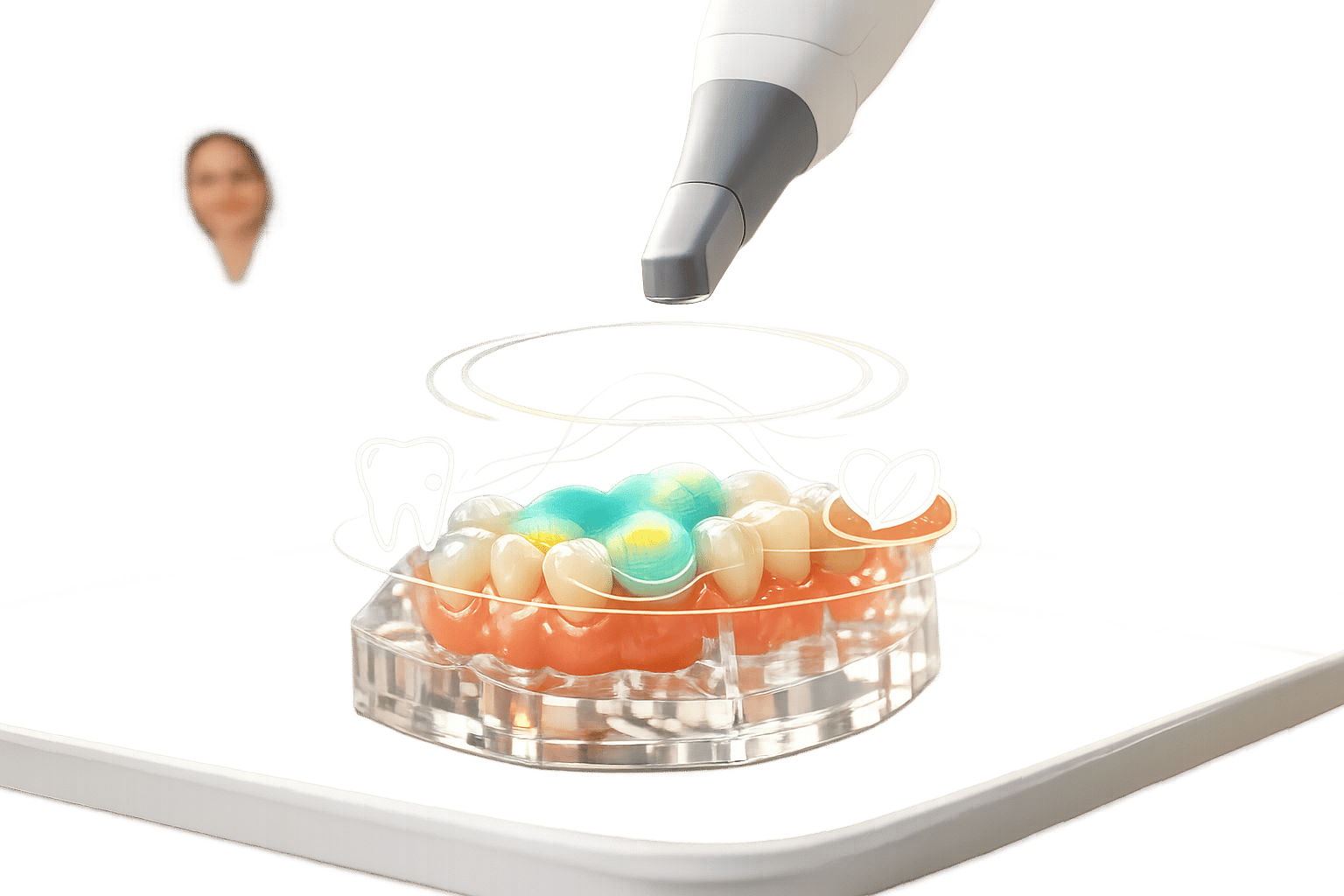
AI is transforming dental care by helping detect tooth decay, gum disease, and other oral health problems with precision that rivals – or even surpasses – traditional methods. Here’s what you need to know:
- Accuracy: AI systems achieve up to 95% diagnostic accuracy for dental conditions, outperforming human dentists in some cases.
- Early Detection: AI identifies issues like cavities and gum disease in their earliest stages, often missed during visual exams.
- Technology: Tools like intraoral scanners compared to traditional impressions and deep learning models analyse 3D images, X-rays, and photographs to locate decay, bone loss, and more.
- Real-Time Monitoring: Smart sensors track pH, temperature, and brushing habits, providing continuous insights into oral health.
- Access to Care: AI supports tele-dentistry, bringing high-quality diagnostics to rural and underserved areas.
These advancements help dentists provide earlier, less invasive treatments, saving time and costs for patients. However, human oversight remains essential to ensure ethical and accurate care.
Dental AI: The Artificial Intelligence Revolution in Dentistry
sbb-itb-2be92ed
How AI Detects Cavities and Tooth Decay
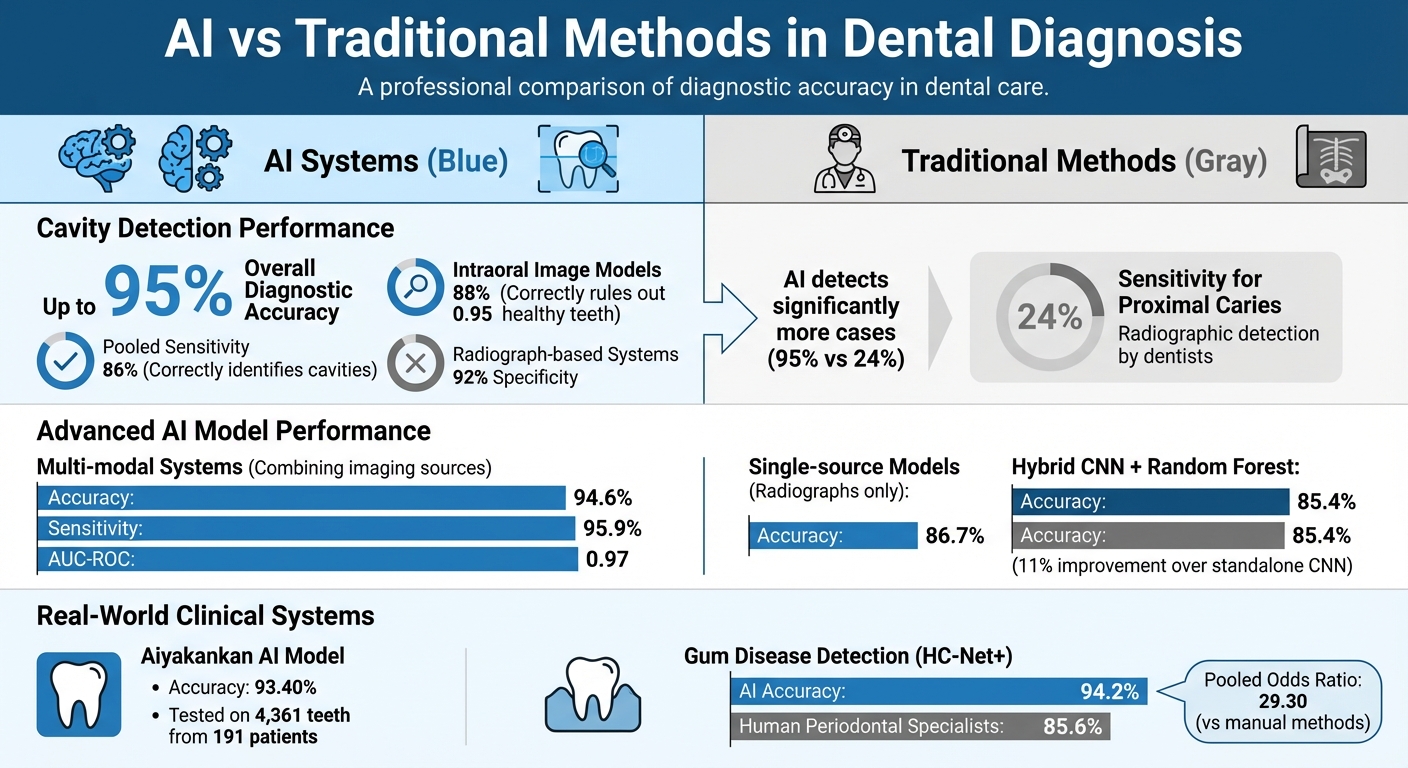
AI vs Traditional Methods: Dental Diagnosis Accuracy Comparison
AI systems pinpoint cavities by analysing dental images using deep learning (DL) and convolutional neural networks (CNNs). These technologies process a variety of imaging types – bitewing radiographs, periapical X-rays, panoramic scans, and intraoral photographs – to identify decay at all stages, from early mineral loss to fully developed cavities [6]. By performing feature extraction and semantic segmentation, AI can analyse images at the pixel level to locate decay with precision [8].
Some advanced systems combine multiple imaging sources for even better results. For example, multi-modal systems integrate ResNet-50 encoders and EfficientNet-B4, merging data from radiographs and intraoral photographs using attention mechanisms [5]. This method achieved an impressive 94.6% accuracy in recent studies, with sensitivity reaching 95.9% and an AUC-ROC of 0.97 [5]. In contrast, models relying on a single imaging source, such as radiographs alone, reached around 86.7% accuracy [5]. These advancements highlight the power of combining imaging types to improve diagnostic accuracy.
An example of this innovation is the Videa Dental Assist system, which received FDA approval in May 2022. It analyses bitewing, periapical, and panoramic radiographs for patients as young as three years old [6]. Another system, the Aiyakankan AI model (developed by Aicreate), was tested between April and June 2023 at Zhujiang Hospital, Southern Medical University. Using MobileNet-v3 and U-net architecture, it analysed 4,361 teeth from 191 patients in real-time clinical settings, achieving 93.40% accuracy [9].
Accuracy Rates for AI Caries Detection
AI systems have demonstrated consistently high performance in detecting cavities. Meta-analyses reveal a pooled sensitivity of 86%, meaning AI correctly identifies 86% of actual cavities, and a specificity of 91%, indicating it accurately rules out 91% of healthy teeth [4]. Models using intraoral images perform slightly better, achieving sensitivity of 88% and an AUC of 0.95 [4]. Radiograph-based systems, on the other hand, excel in specificity, reaching 92%, which helps reduce false positives [4].
In comparison, traditional radiographic detection of proximal caries by dentists has a pooled sensitivity of just 24%, far below what AI systems achieve [6]. Hybrid models that pair CNN feature extraction with Random Forest classifiers have reached 85.4% accuracy, an 11% improvement over standalone CNN models [8]. This level of precision opens up opportunities for earlier and more effective interventions.
Benefits of Early Detection
AI-powered early detection has the potential to transform dental care by enabling non-invasive treatments. Spotting decay in its earliest stages allows dentists to recommend preventive or minimally invasive measures, reducing the need for fillings or more complex restorative procedures. AI is particularly adept at identifying incipient caries – subtle structural changes in teeth that often go unnoticed during routine visual exams [7]. This is especially useful for detecting occlusal and dentin lesions, where traditional methods often underestimate the depth of decay [7].
The economic impact is also noteworthy. Dental caries treatment costs approximately US$357 billion annually, accounting for nearly 4.9% of global healthcare spending [6]. By enabling earlier, less invasive interventions, AI can help cut these costs significantly, preventing decay from advancing to stages that require costly treatments.
AI in Diagnosing Gum Disease
AI is reshaping how dentists diagnose and manage gum disease, offering precision that surpasses traditional methods. By analysing radiographs, these tools use convolutional neural networks (CNNs) to pinpoint critical anatomical landmarks like the cemento-enamel junction (CEJ) and alveolar bone crest. These landmarks are key indicators of periodontal disease. What sets AI apart is its ability to automate measurements that were once subjective, providing consistent and objective data to guide treatment decisions.
A 2025 meta-analysis revealed that AI algorithms had a pooled odds ratio of 29.30, making them far more effective at identifying periodontitis compared to manual methods [13]. One standout model, HC-Net+, achieved an impressive diagnostic accuracy of 94.2%, outperforming periodontal specialists who averaged 85.6% [2]. Developed between 2022 and 2024, HC-Net+ was tested on 10,881 panoramic radiographs from centres in Hong Kong, Shanghai, and Rome. It maintained an accuracy rate above 92.4% across all locations [2].
"HC-Net+’s ability to surpass specialist accuracy while making diagnostic expertise more accessible positions it as a transformative tool for precision dentistry." – Nature [2]
AI Analysis of Radiographs for Gum Health
AI systems analyse various types of radiographs – panoramic, periapical, and bitewing – to detect early signs of bone loss and periodontal issues. These tools calculate radiographic bone loss (RBL) by measuring two distances: from the CEJ to the alveolar bone crest (Distance 1) and from the CEJ to the root apex (Distance 2). The RBL percentage is then determined using the formula: (Distance 1 / Distance 2) × 100% [12]. This automated process eliminates the inconsistencies of manual measurements, where inter-examiner reliability often falls between kappa values of 0.45 and 0.48 [2].
Sophisticated frameworks break down tasks into modules handled by specific AI models. For instance, YOLOv8 identifies tooth positions, Mask R-CNN outlines tooth boundaries, and TransUNet evaluates the degree of bone loss [11]. The deviation between AI-generated measurements and the ground truth established by periodontists has been noted as low as 5.28% [11]. When analysing periapical radiographs, AI achieved a pooled sensitivity of 87.2% and specificity of 81.5% for detecting disease [13]. Panoramic radiographs demonstrated a diagnostic accuracy of 89.45% for comprehensive periodontitis staging [11].
Automated Grading of Periodontal Disease
Building on these precise measurements, AI takes diagnosis a step further by automating the staging and grading of periodontal disease. These systems align calculated bone loss with clinical frameworks, such as the AAP 2017 guidelines, to determine disease severity. In October 2025, researchers at the University of Medicine and Pharmacy at Ho Chi Minh City developed a YOLOv8-based system using 500 panoramic radiographs. This framework automated periodontitis staging (Stages I–IV) and grading (Grades A–C), integrating RBL data with patient factors like age and smoking history. The system achieved precision rates between 0.95 and 0.97 [12].
Similarly, Fang Hospital in Thailand developed a YOLOv8 model in January 2025 to predict tooth prognosis. Using 2,000 panoramic radiographs, the model categorised prognosis into five levels: Good, Fair, Poor, Questionable, and Hopeless. It relied on bone support percentages set by the Thai Association of Periodontology, achieving an F1 score of 0.90 [14]. These AI tools not only reduce diagnostic errors caused by fatigue or inexperience but also assist in treatment planning, helping dentists decide whether to retain or extract teeth [10][14].
Real-Time Monitoring and Predictive Applications
AI has taken a leap forward in oral health by enabling continuous monitoring and early risk detection. These advancements allow for timely interventions, blending behavioural insights with clinical data to create a more comprehensive approach to dental care.
Integration with Behavioural Data
AI’s ability to analyse behavioural data alongside clinical findings has elevated its role in risk assessment. For instance, smart toothbrushes equipped with 3D motion tracking can track brushing habits – like duration, frequency, and missed areas. Combine this with physiological markers such as pH levels, bacterial activity, and signs of inflammation, and you get a well-rounded picture of oral health [16].
A practical example of this integration comes from Clyde Munro Dentistry in Perth, Scotland. In 2024, Dr Amanda Bassey-Duke implemented an AI system across six surgeries. The results were striking: the practice saw a 30% boost in treatment acceptance rates and improved diagnostic accuracy. The system identified 37% more cases of disease and enabled the delivery of 24% more care [15]. By presenting patients with clear, AI-generated radiologic findings, the clinic not only improved outcomes but also enhanced patient trust in diagnosis.
Improving Preventive Care
AI is reshaping preventive dentistry by offering personalised alerts and recommendations tailored to individual risk profiles. Tools like wearable monitors and apps such as TestMyTeeth [3] let users perform at-home plaque screenings. Meanwhile, AI chatbots provide customised educational content and reminders, helping patients stick to their oral hygiene routines.
"Real-time monitoring using AI improves patient adherence to preventive regimens and thereby decreases periodontal disease incidence." – Open Dentistry Journal [16]
Augmented reality is another exciting development, allowing patients to visualise plaque build-up in real time. This feature, particularly useful for younger patients, encourages better brushing habits by making the process interactive and engaging. By moving away from one-size-fits-all advice and focusing on data-driven, individualised care, AI is helping tackle potential oral health issues before they become major problems.
AI-Assisted Multi-Condition Diagnosis
Modern AI platforms have moved beyond detecting single oral health conditions to diagnosing multiple issues in a single scan. By leveraging deep learning models like Convolutional Neural Networks (CNNs), these systems can identify cavities, restorations, gum disease, and anatomical anomalies all at once. They don’t just focus on individual teeth but also provide a comprehensive diagnosis for the patient as a whole [2][17][18]. This approach has significantly improved diagnostic efficiency, as shown in several recent studies.
One standout example comes from a multinational study published in February 2025. Researchers tested an AI system on 6,669 dental panoramic radiographs sourced from the Netherlands, Brazil, and Taiwan. The results were impressive: the system achieved a macro-averaged AUC-ROC of 96.2% across eight dental conditions. Even more striking, it processed images 79 times faster than human experts. It also demonstrated a 67.9% higher sensitivity in detecting periapical radiolucencies and a 4.7% improvement in identifying missing teeth compared to human professionals [17].
Other evaluations back up these findings, showing consistently high accuracy across various conditions. For instance, when diagnosing dental caries using intraoral images, AI models achieved a pooled sensitivity of 0.88 and an AUC of 0.95 [4]. These results underscore the growing reliability and speed of AI in handling complex dental diagnoses.
Clinical Integration of AI in Dentistry
AI dental sensors are no longer confined to research labs – they’re becoming part of everyday dental practice across Australia. These tools act as valuable complements to dentists, offering objective, second-opinion assessments that assist in clinical decision-making. One area where this technology shines is in tele-dentistry, helping to bridge the gap in care for patients in rural and regional areas where access to specialists is often limited.
AI as a Diagnostic Aid
AI serves as a "second opinion", helping dentists confirm their findings and spot conditions they might miss. Studies show that AI-backed digital scans can match traditional visual examinations in detecting dental decay, with some achieving diagnostic agreement rates as high as 100% [1]. By applying consistent diagnostic criteria, AI reduces variability between practitioners. However, it’s important to note that human oversight remains crucial. In Australia, the Dental Board of Australia and the Therapeutic Goods Administration (TGA) ensure that dentists retain the final say in diagnoses. AI is there to assist – not replace – human judgment [21]. This reliable diagnostic support is also a cornerstone for expanding tele-dentistry services across the country.
Supporting Tele-Dentistry in Australia
AI’s role extends beyond diagnostics; it’s also transforming access to dental care through tele-dentistry. AI-powered tools are making it easier to bring specialist care to remote and underserved areas. Portable intraoral scanners allow non-dental staff to capture images, which AI software analyses for potential risks. This ensures that specialists only need to travel for cases requiring their expertise [22]. Additionally, digital 3D models can be shared with specialists for review, eliminating the need for patients to travel to major cities.
An example of AI’s potential in tele-dentistry is "Mouth Map", an oral cancer screening tool developed by Dr. Tami Yap from the University of Melbourne. As of late 2025, this custom-built software was being trialled in Germany to fine-tune its accuracy, with plans for an Australian rollout to support remote screenings [22]. Hybrid care models, which combine virtual AI screenings with in-person treatments, have already shown promise. For instance, Virtual Dental Home (VDH) models have reduced emergency dental visits by 25% [20].
"AI isn’t 100 per cent accurate now, so you risk recommending inappropriate treatments. I think we need to be mindful that AI is an assistant and not a replacement." – Dr. Arosha Weerakoon, Senior Lecturer, University of Queensland School of Dentistry [22]
AI is also playing a role in dental education. It allows students to train within their rural communities using AI-assisted feedback and virtual learning environments. This approach could help address workforce shortages in regional areas [21][22].
Conclusion
AI sensors are reshaping how oral health issues are detected and managed in Australia. These advanced tools can pinpoint early-stage cavities that might go unnoticed during traditional examinations and measure periodontal bone loss with remarkable precision. By offering consistent, data-backed insights, they support more effective, evidence-based treatments. Research even shows that AI-assisted diagnostics help clinicians detect 37% more dental issues and provide 24% more care to patients who need it most [15].
But the benefits don’t stop at the dental chair. AI-powered tools are also empowering patients by offering real-time feedback on brushing habits and plaque levels. This immediate insight helps patients better understand their oral health, which has been shown to increase treatment acceptance by 10% to 20% [19]. For Australians living in rural and regional areas, AI is bridging the gap to specialist care through tele-dentistry, making advanced dental support more accessible than ever.
However, the rollout of AI in dentistry must be approached with care. To avoid diagnostic bias, AI models need to be trained on diverse datasets, and clinicians should always oversee AI-generated findings. As Associate Professor Mihiri Silva from the Murdoch Children’s Research Institute wisely points out:
"Visual examinations are the gold standard in dental care but we need to find new ways to better detect tooth decay as soon as early signs of decay occur" [1].
AI has the potential to meet this need, but its true value comes when paired with the experience and judgement of dental professionals. This combination of technology and expertise is setting the stage for the future of integrated dental care in Australia.
Looking ahead, the focus will likely shift toward hybrid models that merge AI’s precision with the empathy and skill of human clinicians. As Australia continues to embrace remote care solutions, ethical and transparent use of AI sensors could help dental practices save over 20 hours per week [15], boost diagnostic accuracy, and improve public oral health through early detection and preventive strategies.
FAQs
Is AI dental detection safe and reliable?
AI-powered dental detection is regarded as both safe and reliable. Research shows that it achieves accuracy levels comparable to traditional visual examinations when diagnosing conditions like early childhood tooth decay and gum disease. Clinical studies also emphasise its strong diagnostic consistency, making it a trustworthy option for identifying oral health concerns promptly.
What can AI sensors track between dental visits?
AI-powered sensors are transforming how we monitor oral health by spotting issues like cavities, gum disease, plaque buildup, calculus, and enamel defects between dental check-ups. These sensors rely on advanced tools such as intraoral imaging, salivary biosensors, and digital scans to detect problems in real time. By identifying potential concerns early, they allow for timely intervention, helping to prevent more serious dental issues and promoting healthier teeth and gums over the long term.
Will AI tools change my treatment plan or costs?
AI tools are changing how treatment planning and costs are approached by identifying oral health problems like cavities and gum disease with impressive accuracy. This precision means issues can be caught earlier, allowing for timely interventions that might avoid the need for more complex and expensive procedures down the line. On top of that, AI speeds up the diagnostic process, delivering faster and more accurate evaluations. These improvements pave the way for more focused, preventative care, influencing both the choices made in treatment and the associated costs.
Related Blog Posts
- How AI Wearables Detect Early Gum Disease
- AI in Dentistry: Benefits of Personalised Oral Health Insights
- AI in Oral Cancer Detection: How It Works
- How AI Detects Periodontal Disease Early
Important Notice: Any surgical or invasive procedure carries risks. Before proceeding, you should seek a second opinion from an appropriately qualified health practitioner.
Individual results may vary. The information provided in this article is for educational purposes only and does not constitute medical advice.
Checkout Related Blogs




Get in touch with us
For more information, call us now to start feeling better. Or fill the form below to make appointment
The Latest News from Complete Smiles
How to Clean Clear Plastic Retainers
Checklist for Choosing Wearable Dental Devices
Checklist for Choosing Cloud AI Platforms in Dentistry

Complete Smiles Bella VistaAccepts All Major Health Funds, Including





