



How to Use Interpreters in Dental Practice

When patients struggle with English, communication gaps can lead to serious risks, including misunderstandings, improper consent, and overlooked treatment instructions. In Australia, where linguistic diversity is common, professional interpreters help bridge these gaps and improve patient safety.
Here’s what you need to know:
- Use interpreters for patients with limited English proficiency, especially for general dental treatments, legal discussions (like consent), or complex procedures.
- Avoid relying on family members or children as interpreters due to risks of inaccuracy and confidentiality concerns.
- Prepare by identifying language needs early, booking professional interpreters (e.g., TIS National or NABS for Auslan), and briefing them before appointments.
- During consultations, speak directly to the patient, avoid jargon, and use short, clear sentences with pauses for interpretation.
- Confirm understanding using the teach-back method and document interpreter use in clinical notes.
Proper use of interpreters ensures patients fully understand their care, reducing risks and improving outcomes.
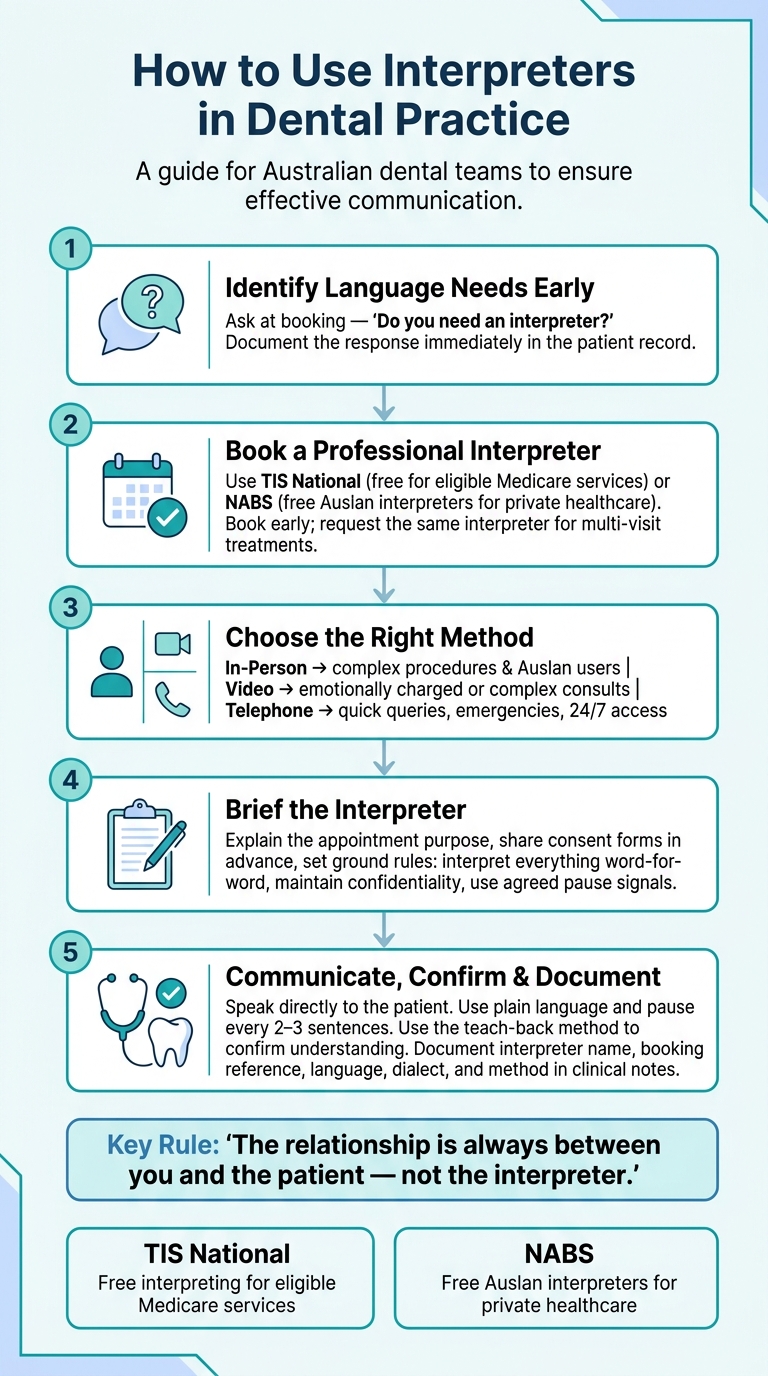
How to Use Interpreters in Dental Practice: Step-by-Step Guide
Best Practices: Interpreter Use in the Clinical Setting
sbb-itb-2be92ed
When to Use an Interpreter
Effective communication is essential in healthcare, and knowing when to involve an interpreter can make a big difference in patient safety. The key indicator for engaging an interpreter is limited English proficiency (LEP). If a patient struggles to understand basic instructions or describe their symptoms in English, it’s crucial to arrange for an interpreter before the appointment, not as an afterthought.
Some clinical situations demand professional interpretation. Take informed consent, for instance. When discussing the risks, benefits, and alternatives of treatments like dental implants, oral surgery, or root canal therapy on multi-rooted teeth, every detail matters – both legally and clinically. As one guideline highlights:
"The consent form signed by a non‑English speaking patient must contain a statement signed by the Interpreter that he/she has interpreted the content of the form." [7]
Similarly, post-operative instructions are critical. Misunderstanding aftercare advice can lead to complications that could have been avoided.
Here’s a quick reference table for situations where professional interpretation is most crucial:
| Situation | Examples |
|---|---|
| Major treatments | Dental implants, orthodontics, minor oral surgery, multiple crowns or bridgework |
| Complex clinical cases | Multi-rooted root canal therapy, full-mouth rebuilds, high-risk extractions |
| Communication barriers | Difficulty understanding terms like "gums", "molars", or "cheeks" |
| Legal and administrative | Informed consent, explaining risks, post-operative instructions |
Professional interpretation is also vital for patients with non-verbal communication needs. For example, around 50% of Aboriginal and Torres Strait Islander people may experience hearing-related communication issues, compared to roughly 10% of the wider Australian population [3]. For Deaf or hard-of-hearing patients, a qualified Auslan interpreter can be booked for private healthcare appointments at no cost through the National Auslan Interpreter Booking Service (NABS).
While it might seem convenient to ask a family member or friend to interpret, this approach comes with risks. Relatives often lack the specialised knowledge of dental terminology and may unintentionally leave out or misrepresent critical information. Using children as interpreters is especially problematic, both for accuracy and due to confidentiality concerns. Patients may hesitate to share sensitive health details when a family member is present.
Preparing for the Appointment
When you’ve decided to use an interpreter, taking the time to prepare properly can make all the difference in ensuring the appointment runs smoothly and effectively.
Getting Started: Identifying Language Needs
The first step is to identify the patient’s preferred language well in advance – ideally during the scheduling process, not on the day of the appointment. A simple and direct approach works best. For example, when booking the appointment, ask: "Do you need an interpreter for your appointment?" Document the patient’s response immediately in their record to avoid any confusion later.
Once you’ve confirmed the need for an interpreter, book one as early as possible. In Australia, services like TIS National offer free interpreting for eligible Medicare-rebatable services [6], while the National Auslan Interpreter Booking Service (NABS) provides free Auslan interpreters for private healthcare appointments [3]. If the treatment involves multiple stages, like a root canal followed by a crown, try to ensure the same interpreter is available for each visit. This consistency helps build trust and ensures clear communication throughout the treatment plan and costs [1].
Choosing the Right Interpretation Method
The best interpretation method depends on factors like the complexity of the appointment, the patient’s emotional state, and whether visual aids or documents will be used [5]. Here’s a quick breakdown:
| Method | Best Suited For | Advantages | Limitations |
|---|---|---|---|
| In-Person | Complex procedures, surgeries, or sensitive discussions; Auslan users | Allows for non-verbal cues, physical documents, and stronger rapport [5][6] | Requires advance booking; may be harder to arrange in rural areas [1] |
| Video | Complex consultations when in-person isn’t feasible; emotionally charged situations | Offers visual connection and is better than phone for gauging reactions [5][6] | Needs reliable internet and compatible hardware like a tablet or monitor [5] |
| Telephone | Quick consultations, emergencies, or appointment confirmations; high-anonymity scenarios | Provides immediate access, 24/7 availability, and supports many languages [5][6] | Lacks visual cues; not suitable for Auslan or highly stressed patients [5] |
For in-person Auslan interpretation, consider seating arrangements carefully. Position the interpreter beside the dentist and opposite the patient to ensure clear sightlines [4][3].
Once you’ve picked the most suitable method, take a moment to brief the interpreter to set everyone up for success.
Briefing the Interpreter
A well-prepared interpreter can make communication during the appointment far more effective.
Before the appointment begins, provide the interpreter with a clear understanding of what to expect. As the Sydney Local Health District recommends:
"The interpreter will be in a better position to accurately interpret if they have a clear understanding of the purpose of the appointment and the role of all parties involved." [5]
Explain the purpose of the visit, any dental terms they might encounter, and whether they’ll need to perform sight translation (e.g., reading forms aloud in the patient’s language). If you’ll be using consent forms or providing post-treatment instructions, share these documents with the interpreter ahead of time so they can prepare [5].
Set clear ground rules, such as:
- Using a hand gesture or other non-verbal signal when the dentist needs to pause.
- Interpreting everything said in the room without omission or summarisation.
- Maintaining strict confidentiality.
Finally, schedule a small buffer before the appointment starts to allow time for this briefing without feeling rushed. This extra preparation ensures the session runs as smoothly as possible.
Communicating Effectively During the Appointment
Clear communication during an appointment is crucial for creating a positive patient experience. By combining thorough preparation with effective in-person strategies, you can ensure your messages are understood and your patient feels heard.
Best Practices for Clear Communication
When speaking to a patient through an interpreter, always address the patient directly and maintain eye contact with them. This keeps the patient at the centre of the conversation and helps you observe non-verbal cues, such as a furrowed brow or hesitant nod, which might indicate confusion or concern.
Use straightforward language. For example, ask, "Where is your pain?" instead of saying, "Ask him where his pain is." Keep your sentences short and pause every two to three sentences to give the interpreter time to accurately translate. Dr Santarossa highlights the importance of allowing extra time during consultations:
"If you don’t allocate an extra 10 or 15 minutes, you’ll spend double that trying to calm a distressed patient later. The investment in time always pays off." [3]
Avoid using dental jargon, acronyms, or idiomatic expressions. Technical terms like "occlusal surface" or "periapical pathology" might not translate clearly. Instead, use plain language – for example, "the biting surface of the tooth" or "an infection at the tip of the root" – to minimise confusion and ensure accurate interpretation.
The Role of the Interpreter
It’s essential to understand the interpreter’s role and communicate this clearly to all parties. According to the Victorian Government Guidelines:
"The interpreter’s role is not to add to the communication, but only to interpret what is being said." [4]
Interpreters serve three key functions: they act as conduits, clarifiers, and cultural bridges to help overcome communication barriers. As conduits, they relay every word spoken without adding, omitting, or altering the message. As clarifiers, they may pause to seek clarification on ambiguous terms but should explain this to the patient beforehand. As cultural bridges, they help you understand expressions of pain or hesitation that may be influenced by cultural norms rather than clinical factors [4].
However, the ultimate responsibility for the consultation lies with the healthcare provider. The Sydney Local Health District emphasises this:
"The health care provider alone holds clinical responsibility for the appointment and is responsible for outlining what will happen." [5]
While interpreters are there to support communication, managing the consultation remains the practitioner’s responsibility.
Ensuring Understanding and Following Up
Confirming Patient Understanding
Asking a patient, "Do you understand?" often leads to a simple nod or "yes", which might not reflect their actual comprehension. Instead, use the teach-back method. Through the interpreter, ask the patient to explain in their own words how they will handle their care. For instance: "Just to ensure I’ve explained this properly, could you describe how you’ll care for your stitches tonight?" This approach highlights any misunderstandings and provides an opportunity to clarify.
It’s also helpful to check for understanding at various points during the appointment rather than waiting until the end. Pay attention to non-verbal cues like a furrowed brow, hesitation, or blank expressions, which may indicate confusion. If you spot these signs, pause to clarify. Once you’re confident the patient understands, document the session thoroughly.
Documenting Interpreter Use
Every interpreted consultation should be clearly recorded in the clinical notes. Include details such as the interpreter’s full name, booking reference number, the language and dialect used, and the method of interpretation (onsite, telephone, or video). The Sydney Local Health District advises:
"As the treating health professional, you also have a right to an interpreter and a duty of care to ensure that all information given and gathered is accurate." [5]
For example, your note might read: "Interpreter [Name] (Booking Ref: XXXXX) provided Vietnamese interpretation via telephone."
If a patient declines the use of a professional interpreter, make sure to document that the service was offered and refused. This protects both the patient and the healthcare provider, ensuring that there is a clear record in case of any concerns about communication accuracy during the appointment.
Practical Guidelines for Dental Teams
Key Do’s and Don’ts
After preparing thoroughly for appointments and ensuring clear communication during sessions, following these practical tips will help dental teams work effectively with interpreters. These steps align with the preparation and communication strategies outlined earlier.
The golden rule for working with an interpreter is simple: the relationship is always between you and the patient – not the interpreter.
"Interpreters are a bridge, but you have to remember the relationship is between you and the patient." – Dr. Santarossa, Dentist [3]
This means addressing the patient directly in the first person. For example, say, "How are you feeling today?" instead of, "Ask him how he feels." Position the interpreter slightly to the side or behind the patient to keep the focus on the patient and ensure they remain central to the conversation. Maintaining eye contact with the patient reinforces this connection throughout the consultation.
Ethically, interpreters are required to relay everything said in the room word-for-word. It’s important to avoid discussing non-clinical matters as this could lead to confusion. Remember that the dentist is fully responsible for all clinical decisions – the interpreter’s role is strictly to facilitate communication, not to provide advice or opinions on treatment.
Here’s a quick-reference table of essential practices:
| Practice | Do | Don’t |
|---|---|---|
| Eye contact | Maintain eye contact with the patient | Look at the interpreter while speaking |
| Language | Use plain, short phrases | Use dental jargon, slang, or metaphors |
| Interpreter choice | Use NAATI‑credentialed professional interpreters | Rely on family members or children |
| Pacing | Pause every two to three sentences | Speak for long stretches without pausing |
| Side conversations | Step outside the room for unrelated discussions | Chat with staff in front of the patient |
| Clinical authority | Dentist retains full clinical responsibility | Ask the interpreter for their opinion on the patient |
In addition to verbal communication, non-verbal cues play a key role in patient-centred care. Before starting any procedure, establish simple hand signals with the patient. For example, a raised hand could mean "stop" or "I need a break." These signals become crucial when verbal communication is limited – such as when the chair is reclined, or instruments are in use. Taking the time to agree on these cues ensures the patient feels supported and in control during their treatment.
Conclusion
Making effective use of interpreters in dental care hinges on preparation, clear communication, confirming patient understanding, and thorough documentation. Skipping any of these steps can lead to serious risks for both the patient and the practice.
The benefits are well-documented. As Edgardo Garcia, Translation Services Director at Children’s Medical Center Dallas, explains: "Using trained interpreters results in more accurate diagnoses and better patient compliance." [2] These practices are not just helpful – they are essential for achieving the best possible outcomes.
For dental teams in Australia, professional interpretation services are often more accessible than they might think. Organisations like TIS National and the National Auslan Interpreter Booking Service (NABS) offer free interpreting for eligible private healthcare appointments, breaking down a major barrier to effective communication [3][6].
Interpreters are key to delivering safe, patient-focused dental care. Every patient has the right to fully understand their diagnosis, treatment options, and post-care instructions. By following the outlined guidelines and using trained interpreters, dental teams can ensure that patients leave the chair with clarity and confidence about their care.
"If we ignore communication, then we create anxiety. Too often that leads to sedation or GA as the default, when it can often be as simple as asking: what would make you feel more comfortable?" – Dr. David Fu, Special Needs Dentist [3]
FAQs
How do I tell if a patient needs an interpreter?
Patients who may need an interpreter can often be identified by observing their comfort and confidence in communicating in English. If they struggle to understand or express themselves – especially in high-pressure scenarios like dental visits – it could indicate the need for additional language support. This is particularly important for individuals from non-English speaking backgrounds or when discussing complex treatments that require informed consent. In such cases, a professional interpreter can help ensure both clear communication and mutual understanding.
What should I do if a patient refuses a professional interpreter?
If a patient chooses not to use a professional interpreter, it’s important to carefully evaluate their communication needs and clearly record their decision. While respecting their choice, ensure they are aware of the potential difficulties this might create in understanding medical information. To bridge any gaps, consider using alternatives like simplified language, visual aids, or other tools to help convey key information. Always make sure to document both the refusal and the measures you took to maintain effective communication.
Which is better for dental visits: phone, video or in-person interpreting?
In-person interpreting is often the go-to choice for dental visits because it enables direct interaction, allows interpreters to observe body language, and supports clearer communication. These factors are crucial for accurate diagnoses and ensuring patients feel at ease. When onsite interpreters aren’t available, phone and video interpreting step in as practical alternatives. Video interpreting, in particular, provides the added benefit of visual cues. Still, for sensitive or complex conversations, in-person interpreting stands out as the most effective way to build trust and ensure clear understanding.
Related Blog Posts
- Cultural Sensitivity in Dentistry: Key Challenges and Solutions
- How Multilingual AI Helps Dental Clinics Communicate
- Solving Communication Barriers in Multicultural Dental Practices
- How NLP Improves Dentist-Patient Communication
Important Notice: Any surgical or invasive procedure carries risks. Before proceeding, you should seek a second opinion from an appropriately qualified health practitioner.
Individual results may vary. The information provided in this article is for educational purposes only and does not constitute medical advice.
Checkout Related Blogs



Get in touch with us
For more information, call us now to start feeling better. Or fill the form below to make appointment
The Latest News from Complete Smiles
How to Clean Clear Plastic Retainers
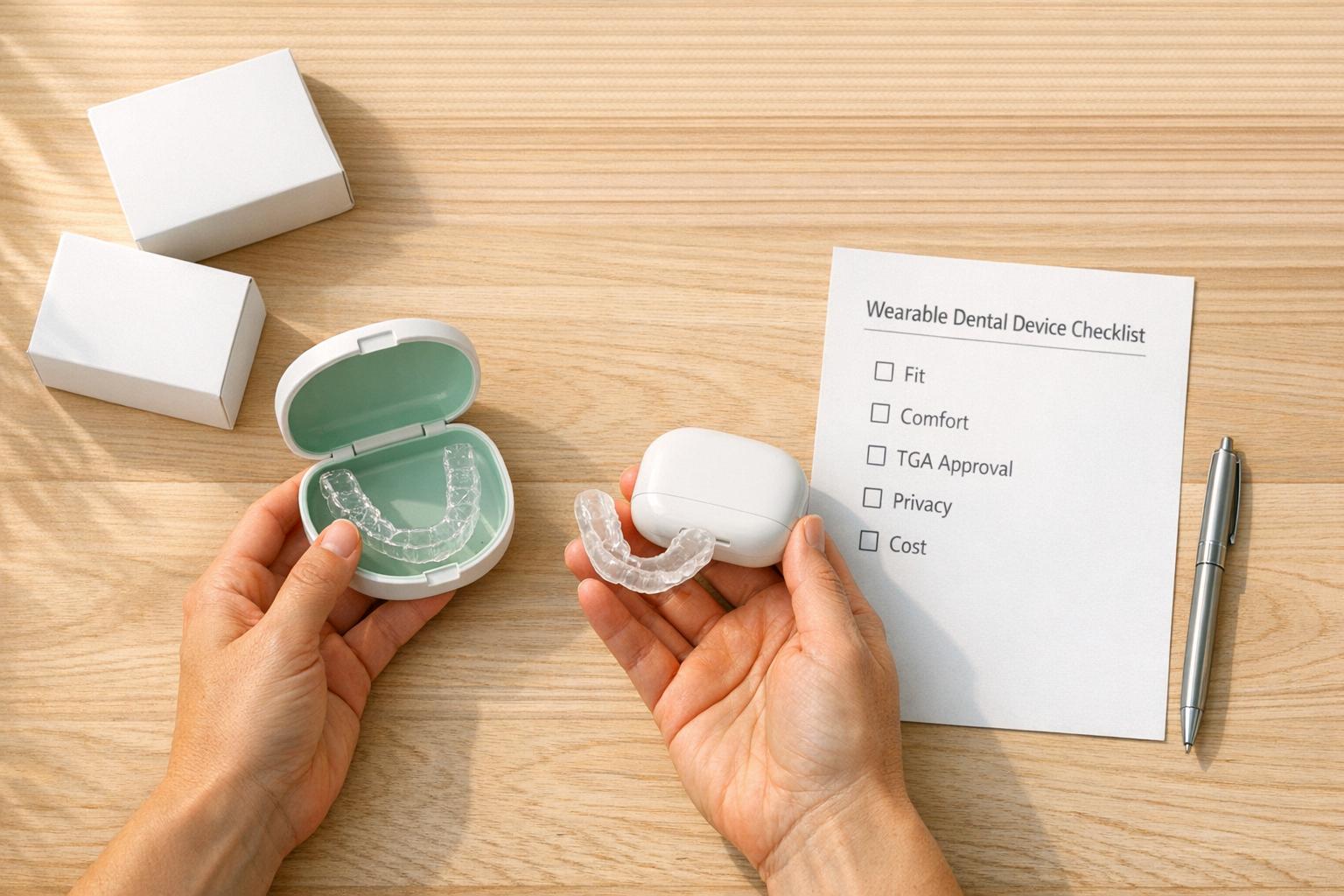
Checklist for Choosing Wearable Dental Devices
Checklist for Choosing Cloud AI Platforms in Dentistry

Complete Smiles Bella VistaAccepts All Major Health Funds, Including