





Static vs Dynamic Navigation in Surgery

When it comes to dental surgery, precision matters. Static and dynamic navigation systems are two advanced tools designed to improve implant placement accuracy. Both rely on CBCT scans and planning software to map out the ideal implant position before surgery. However, they differ in how guidance is applied during the procedure:
- Static Navigation: Uses a pre-fabricated physical guide to direct the drill along a fixed path. This method is accurate but lacks flexibility if changes are needed mid-surgery.
- Dynamic Navigation: Utilises real-time optical tracking and displays the drill’s position on a monitor, allowing on-the-spot adjustments during surgery.
Both systems significantly outperform freehand techniques in accuracy, with static guides achieving a mean angular error of 2.52° and dynamic systems 3.66°. Choosing the right system depends on the complexity of the procedure, patient anatomy, and the need for intraoperative flexibility.
Quick Comparison:
| Feature | Static Navigation (sCAIS) | Dynamic Navigation (dCAIS) |
|---|---|---|
| Flexibility | None | High |
| Accuracy | 2.52° angular error | 3.66° angular error |
| Setup Time | Requires pre-fabrication | Same-day possible |
| Cost | Lower upfront cost | Higher upfront investment |
| Best For | Simple, fixed plans | Complex or changing scenarios |
Both systems aim to improve patient outcomes by enhancing precision and reducing complications. Your choice should align with the specific needs of the surgery and available resources.
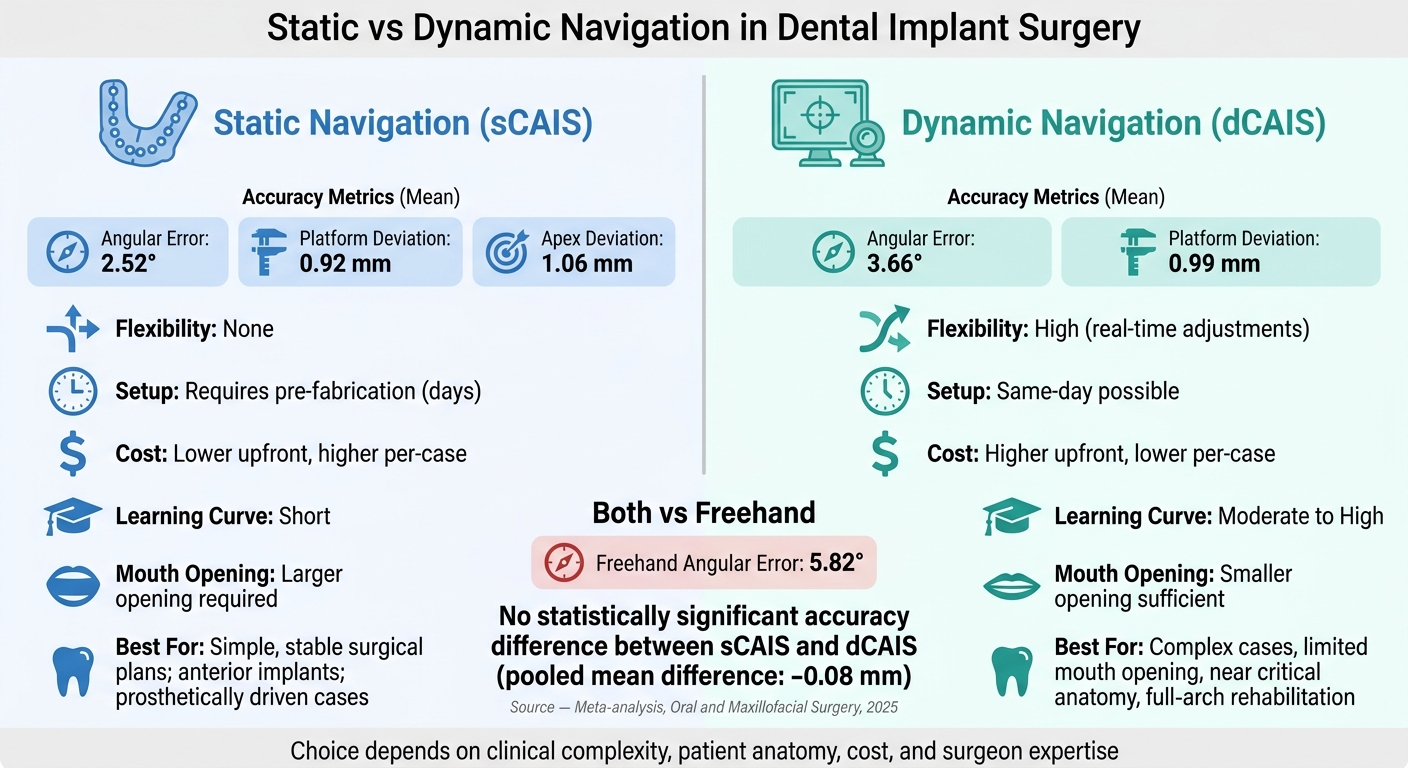
Static vs Dynamic Dental Navigation: Side-by-Side Comparison
Clinical case: Static guided implant surgery or a dynamic navigation system?
sbb-itb-2be92ed
What Are Static Navigation Systems?
Static computer-assisted implant surgery (sCAIS) relies on a custom-made physical guide to direct the surgical drill to a pre-planned position and angle. These guides are designed with metal sleeves and are created before the procedure begins, locking in the surgical plan ahead of time [3].
How Static Navigation Works
The process kicks off with a CBCT scan, which provides a 3D image of the patient’s bone structure. Using specialised planning software, the clinician determines the ideal implant position, depth, and angle based on this scan data [3][4].
Once the plan is finalised, the guide is fabricated using CAD/CAM technology or 3D printing. This step happens in a lab, meaning same-day "scan-to-surgery" workflows aren’t an option with static systems [4]. During the procedure, the guide is placed in the patient’s mouth, supported by teeth, soft tissue, or bone, and the drilling follows the pre-determined path with precision [3].
This structured workflow highlights both the strengths and drawbacks of static navigation.
Pros and Cons of Static Navigation
Static navigation offers a high level of accuracy compared to freehand techniques. Studies show that static guides achieve a mean angular deviation of just 2.52°, while freehand placements average 5.82° [3]. Deviations at the platform and apex are also smaller, measuring 0.92 mm and 1.06 mm, respectively [3]. This precision is especially useful in prosthetically driven planning, where implant angulation plays a key role in the success of the final restoration.
However, static systems come with some notable limitations. The biggest drawback is the lack of intraoperative flexibility. If unexpected changes arise during surgery, the guide cannot be adjusted, and creating a new one would require starting the process over [3][4]. The guide itself can also obstruct the surgeon’s view and restrict irrigation at the drill site, requiring manual cooling [3]. Additionally, patients with limited mouth opening may not be suitable candidates due to the combined thickness of the guide and drill length, particularly in posterior regions [3][4]. Proper seating of the guide is critical to avoid deviations [3][4].
These factors influence when and where static navigation is most effective.
Clinical Uses of Static Navigation
Static guides are ideal for cases with a straightforward and stable surgical plan. They perform particularly well in single implant placements and anterior tooth replacements, where maintaining precise angulation is crucial. The surrounding teeth in these areas provide strong support for the guide, further enhancing accuracy [1][3]. Research also suggests that static systems may achieve slightly better apical accuracy in anterior regions compared to dynamic navigation [4].
On the other hand, situations requiring flexibility – such as molar placements, patients with restricted mouth opening, or cases where the plan might change mid-surgery – are generally better suited for dynamic navigation systems.
What Are Dynamic Navigation Systems?
Dynamic computer-assisted implant surgery (dCAIS) provides surgeons with continuous control during procedures. Instead of using patient-specific implant surgical guides, these systems rely on real-time optical tracking to monitor the drill’s position. This information is displayed live on a screen, offering ongoing feedback throughout the surgery.
How Dynamic Navigation Works
The process starts with a CBCT scan and digital treatment planning. Unlike static guides that need to be fabricated in a lab, dynamic navigation systems use tracking markers attached to the patient’s jaw and the surgical handpiece. An infrared or binocular camera reads these markers in real time, sending positional data to the navigation software.
During the procedure, the drill’s live position, depth, and angulation are superimposed on the patient’s 3D CBCT scan. This is often visualised as a crosshair or "bull’s-eye" on the screen, enabling the surgeon to make adjustments as needed. Because there’s no guide fabrication involved, the entire workflow – from scanning to surgery – can be completed in a single day [4]. This real-time tracking introduces immediate benefits, though it also comes with certain limitations.
Pros and Cons of Dynamic Navigation
Dynamic navigation offers flexibility during surgery. If the clinical situation differs from the initial plan, adjustments can be made on the spot. This includes changes to the implant’s location, size, length, width, or shape – something static guides cannot accommodate. Modern planning also incorporates AI to predict osseointegration success based on these parameters. A study in the International Journal of Implant Dentistry highlights this advantage:
"The designed implant location and the size, length, width, and shape of the implant can be changed during the operation when it is needed to be changed according to the actual intraoral condition of the patients." [4]
Another benefit is the unobstructed surgical field. Without a physical guide covering the site, the clinician has a clear view and can irrigate the osteotomy directly. This reduces the risk of heat-induced bone damage [3]. Studies have shown that dynamic systems achieve mean platform deviations of around 0.99 mm and angular deviations of approximately 3.66°, which are significantly more accurate than freehand techniques [3].
However, these systems aren’t without drawbacks. They require a considerable initial investment and additional tracking equipment in the operatory. Moreover, dynamic navigation is operator-dependent, meaning surgeons need specific training to master the coordination required for screen-guided drilling [4]. Accuracy can also decrease when the implant site is far from the tracking marker, particularly in distal molar areas [2]. These factors influence when dynamic navigation is the best choice, as explored in its clinical applications.
Clinical Uses of Dynamic Navigation
Dynamic navigation shines in cases where static guides fall short. For instance, in patients with limited mouth opening, dynamic systems make it easier to access posterior regions without the bulk of a guide. This flexibility also benefits full-arch rehabilitations and narrow spaces where static systems may not be suitable [3].
Additionally, dCAIS is highly effective near critical anatomical structures like the inferior alveolar nerve or maxillary sinus. It is also invaluable in cases with atrophic bone, where precision is critical [2]. Unlike static guides, which often require brand-specific surgical kits, dynamic systems are compatible with any implant system [3].
Static vs Dynamic Navigation: A Direct Comparison
Comparing static and dynamic navigation systems side by side highlights their impact on clinical decision-making and practice workflows.
Workflow and Flexibility Differences
Static navigation involves multiple pre-surgical steps, including CBCT scanning, digital planning, guide fabrication, and 3D printing – all of which must be completed before the patient arrives. On the other hand, dynamic navigation streamlines the process, enabling same-day scanning, planning, and surgery without needing a physical guide [3].
However, static systems lack flexibility during surgery. If unexpected challenges, like variations in bone quality, arise, a new guide must be created – adding time and cost [3]. Dynamic navigation, by contrast, allows surgeons to adjust implant position, depth, or angulation during the procedure [1][2]. While static systems have a shorter learning curve, as the guide physically directs the drill path, dynamic systems demand more coordination between hand movements and screen visuals [1]. These differences also influence the accuracy and safety of each system.
Accuracy, Safety, and Clinical Outcomes
Both static and dynamic systems significantly improve accuracy compared to freehand techniques. A meta-analysis from 2025 found no significant difference between the two approaches, reporting mean angular deviations of 2.52° for static and 3.66° for dynamic systems, compared to 5.82° for freehand methods. The mean positional difference between static and dynamic navigation was just −0.08 mm [1][3].
"Using CAIS (dCAIS or sCAIS) substantially improved accuracy compared to the FH approach, with no statistically significant difference between dCAIS and sCAIS." – Oral and Maxillofacial Surgery [1]
Dynamic systems offer a notable safety advantage: better irrigation. Without a physical guide blocking the surgical site, cooling fluids can reach the osteotomy more effectively, reducing the risk of heat-induced bone damage [3][4].
Cost and Practical Considerations for Australian Practices
Beyond clinical performance, cost plays a key role in choosing between these systems, especially for Australian practices. Static navigation has a lower initial cost but higher per-case expenses, as each guide requires biocompatible resins, metal sleeves, and either in-house 3D printing or external lab fabrication [4][2]. Dynamic navigation, while requiring a larger upfront investment for optical tracking hardware and software, has lower per-case costs due to reusable components [4].
| Feature | Static Navigation (sCAIS) | Dynamic Navigation (dCAIS) |
|---|---|---|
| Initial Investment | Low to moderate | High [4] |
| Per-Case Cost | Higher (guide fabrication) | Lower (reusable components) |
| Planning Lead Time | Days (lab/printing) | Same day [4] |
| Intraoperative Flexibility | None | High [1][2] |
| Mouth Opening Requirement | Larger mouth opening needed | Smaller mouth opening sufficient [3] |
| Learning Curve | Shorter | Moderate to high [4] |
For Australian clinicians, Ivoclar Australia notes that dynamic navigation may reduce the need for costly bone augmentation in borderline cases, potentially offsetting some of the higher equipment costs [5]. However, the International Journal of Implant Dentistry cautions that "the current dynamic navigation equipment is expensive, and its accuracy still needs to be verified by more clinical studies. In addition, the surgical guide can achieve satisfactory results with a lower price for both doctors and patients." [4]
Choosing between these systems depends on the clinical situation, available resources, and the surgeon’s expertise – topics that will be explored further in the following sections.
Using Navigation Technologies in Modern Dental Care
Navigation Systems Within the Digital Dentistry Toolkit
Modern dental care is increasingly adopting digital tools to improve precision and efficiency during treatment. Both static and dynamic navigation systems play a key role in this evolution, integrating CBCT and intraoral scans vs impressions for detailed digital planning. Static systems use this data to create a physical surgical guide via CAD/CAM software and 3D printing. In contrast, dynamic systems utilise the same information for real-time optical tracking during procedures [2][3].
These systems enable prosthetically driven planning, often referred to as "backwards planning." This approach begins with the final restoration and works in reverse to position the implant in a way that maintains healthy bone and soft tissue while ensuring better long-term implant stability [4]. Additionally, computer-assisted navigation allows clinicians to operate with a reduced safety margin of 1–2 mm near critical structures like nerves and the maxillary sinus. This is a significant improvement over the larger buffers required in freehand surgeries [2]. These advancements not only improve surgical accuracy but also elevate the standards of care.
Advanced Dental Care at Complete Smiles Bella Vista

In Sydney’s Hills District, Complete Smiles Bella Vista offers a range of advanced dental treatments using cutting-edge digital technologies. Under the leadership of Dr. James Hanna, the practice specialises in procedures like dental implants and root canal therapy, delivering personalised care that bridges general and specialist dentistry.
With these advanced tools, selecting the right navigation system depends heavily on the specific needs of the patient and the complexity of the procedure.
Choosing Technology Based on Clinical and Patient Needs
The decision between static and dynamic navigation systems hinges on factors like patient anatomy and surgical complexity. For patients with limited mouth opening, dynamic navigation is often the better choice, as static guides can be too bulky to access posterior regions comfortably [3][4]. Similarly, for complex cases where unexpected challenges may arise during surgery, the flexibility of dynamic systems offers a distinct advantage.
"Correct implant positioning has obvious advantages, such as good esthetics results, long-term health of soft and hard tissue, and it can ensure optimal occlusion and implant loading." – Affiliated Stomatological Hospital of Fujian Medical University [4]
Training is another critical consideration. Research suggests that once a clinician becomes proficient in dynamic navigation, their years of surgical experience have little impact on placement accuracy [4]. This underscores the importance of structured training programs to ensure clinicians can use the software effectively. For Australian practices, the decision to adopt either system should also account for the initial investment in equipment and the time required to build expertise.
Ultimately, the choice of navigation technology should be guided by the clinical scenario, the resources available, and the surgeon’s skillset, ensuring the best possible outcomes for each patient.
Conclusion
Static and dynamic navigation systems both offer valuable support for freehand implant placement. According to a meta-analysis, there is no statistically significant difference in overall accuracy between the two, with a pooled mean difference of just −0.08 mm [1]. This similarity in precision highlights that the real strength of each system lies in how well it fits specific clinical needs.
Static navigation is ideal for straightforward cases where the surgical plan is established ahead of time and keeping costs manageable is a priority. On the other hand, dynamic navigation shines in more intricate scenarios, such as same-day procedures or when anatomical challenges – like a limited mouth opening – make a physical guide less practical [3][4].
"The choice between dynamic and static CAIS may depend on other factors (cost, workflow, surgeon preference), as accuracy differences are minimal." – Oral and Maxillofacial Surgery [1]
For Australian dental practices, balancing factors like upfront investment, per-case costs, and the complexity of procedures is crucial. The best choice ultimately depends on the specific needs of the patient and the expertise of the clinician.
Both systems share the common goal of achieving accurate implant placement, contributing to better oral health and functional outcomes.
FAQs
Which option suits my implant case best?
The decision between static and dynamic navigation hinges on the complexity of your case and the level of precision required. Dynamic navigation shines in more intricate cases or situations where real-time adjustments are necessary, offering a higher degree of accuracy. On the other hand, static guides are dependable but less flexible, making them ideal for simpler cases with predictable anatomy. It’s best to consult your dental specialist to determine which approach aligns with your specific needs.
Does navigation reduce risks near nerves and sinuses?
Navigation systems, whether static or dynamic, play an important role in improving the precision of dental implant placement. This precision is crucial for reducing risks associated with critical structures like nerves and sinuses. Studies indicate that dynamic navigation systems provide a higher level of accuracy compared to static guides or freehand methods. This added precision helps minimise the risk of damaging sensitive neurovascular structures. By enhancing placement accuracy, these systems significantly lower the chances of complications, offering better protection for nerves and sinuses during dental implant procedures.
Will dynamic navigation make treatment faster or cheaper?
Dynamic navigation systems are known to boost precision in dental implant procedures, offering greater accuracy than static guides or freehand techniques. However, these advancements don’t necessarily lead to faster or more affordable treatments. The process often demands additional time for setup and calibration, and the need for specialised equipment and training can drive up costs. While the accuracy is a clear advantage, it doesn’t typically result in shorter treatment durations or reduced expenses.
Related Blog Posts
- Flapless vs. Flapped Implant Surgery: Comparison
- What Is Digital Guided Implant Surgery?
- What Are Patient-Specific Implant Surgical Guides?
- Advances in Guided Endodontic Microsurgery
Important Notice: Any surgical or invasive procedure carries risks. Before proceeding, you should seek a second opinion from an appropriately qualified health practitioner.
Individual results may vary. The information provided in this article is for educational purposes only and does not constitute medical advice.
Checkout Related Blogs




Get in touch with us
For more information, call us now to start feeling better. Or fill the form below to make appointment
The Latest News from Complete Smiles
How to Clean Clear Plastic Retainers
Checklist for Choosing Wearable Dental Devices
Checklist for Choosing Cloud AI Platforms in Dentistry

Complete Smiles Bella VistaAccepts All Major Health Funds, Including





