





AI in Dental Implants: Predicting Osseointegration Success
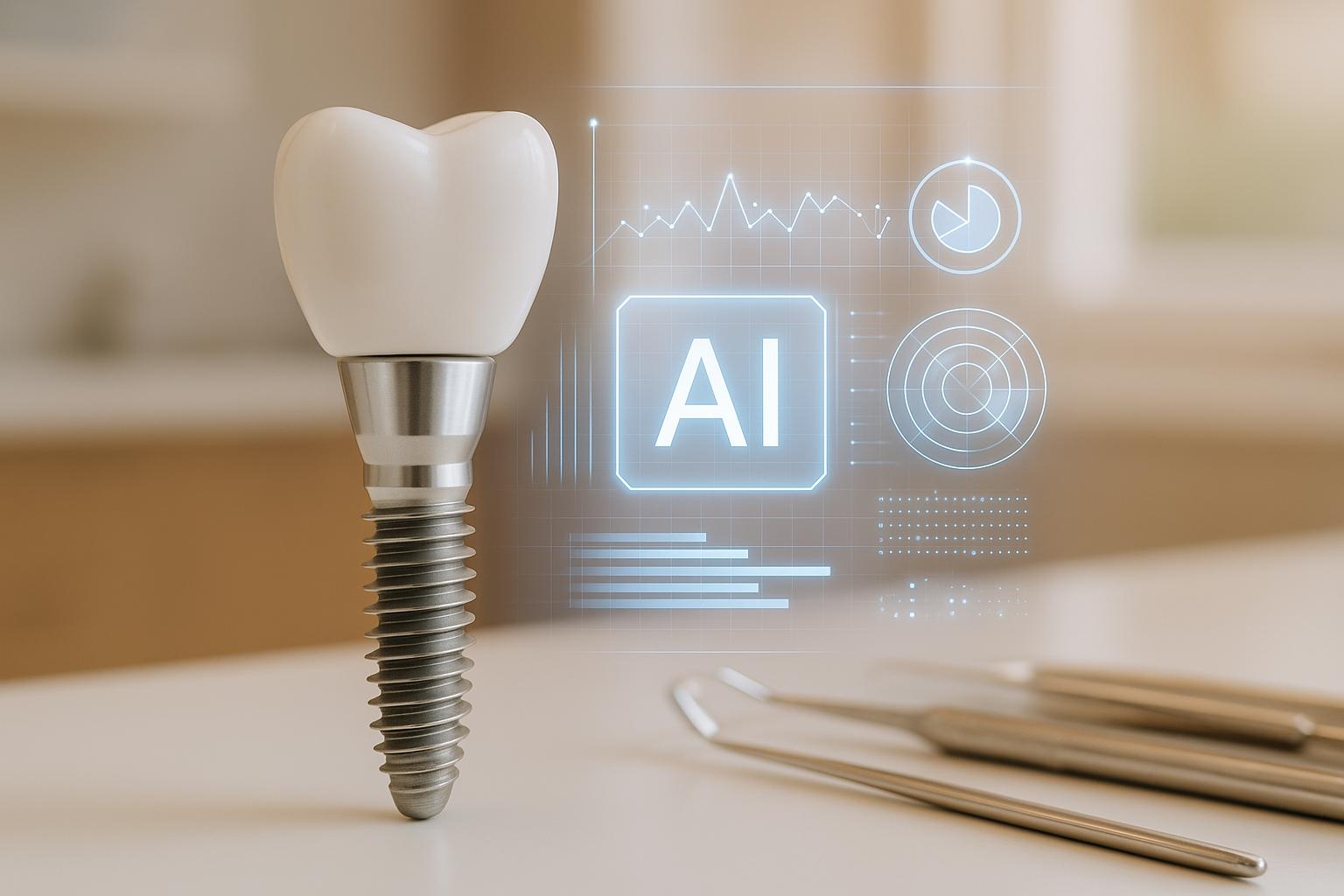
AI is transforming dental implants, making procedures more precise and outcomes more reliable. Here’s how it’s improving osseointegration (the bond between bone and implant):
- Predictive Power: AI analyses X-rays and patient data to predict implant success rates with up to 99.8% accuracy.
- Pre-Surgery Planning: Faster, data-driven treatment plans ensure implants fit perfectly and avoid critical areas like nerves.
- Surgical Guidance: AI-powered tools and robotic systems reduce errors during surgery, improving implant placement precision.
- Post-Surgery Monitoring: AI tracks healing and detects complications early, like infections or bone loss, for better long-term results.
In Australian practices, AI is already helping dentists personalise treatments, improve success rates, and enhance patient care. With ongoing research, it’s set to reshape implant dentistry even further.
Want to know more about how AI is changing every step of the dental implant process? Let’s dive in.
Big data and artificial intelligence: The future in implant dentistry?
AI Models for Predicting Implant Success
AI has become a powerful tool in predicting the success of dental implants by analysing a wide range of patient data. These models are shaping the future of clinical practices, as we’ll explore in later sections.
Common AI Models Used in Implant Dentistry
When it comes to predicting outcomes in dental implant procedures, several AI models stand out for their ability to refine and improve accuracy. Among the most commonly used are regression models, decision trees, and neural networks.
- Regression models: Linear regression helps identify relationships between factors like patient age, bone density, and medical history to predict implant survival time. Logistic regression, on the other hand, estimates the likelihood of binary outcomes – such as the success or failure of an implant. More advanced techniques, such as Cox Proportional Hazards and multivariate regression, evaluate multiple variables simultaneously to provide a more thorough assessment of implant outcomes [4].
- Decision tree models: These models use a hierarchical structure to map out the decision-making process. This approach makes it easier for clinicians to interpret links between patient characteristics and predicted outcomes [4].
- Neural networks: Known for their ability to process large datasets, neural networks can uncover complex, non-linear patterns in data. This makes them particularly effective at identifying intricate relationships that might go unnoticed with traditional methods [4].
Data Used for AI Predictions
The success of AI predictions relies heavily on the quality and diversity of the input data, which directly impacts the accuracy of these models. Clinical data is meticulously digitised and processed to ensure relevant features are captured. Radiographic images – including those from CBCT scans, panoramic, and periapical radiographs – are especially crucial. These images often undergo segmentation, alignment, and noise reduction to extract the most meaningful information.
For example, a study by Oh et al. [6] examined panoramic and periapical radiographs from 580 patients, covering 1,206 dental implants. The analysis involved seven deep learning models, incorporating technical refinements like Otsu’s method for segmentation, followed by manual corrections and alignment.
In addition to radiographic data, demographic and lifestyle information – gathered through patient records and questionnaires – is categorised and normalised. This data provides valuable context about individual factors that could influence implant outcomes.
Benefits Over Standard Methods
AI models offer clear advantages over traditional assessment techniques. Conventional methods often fall short in capturing the multifactorial nature of implant success, leading to limited predictive accuracy [4]. In contrast, AI excels at managing complex, non-linear relationships. Neural networks, in particular, can detect subtle patterns that standard methods might miss [4].
AI algorithms also deliver impressive accuracy rates, ranging from 70% to as high as 99.8% [2]. For instance, one neural network model achieved a 94.48% accuracy rate in predicting the survival of single dental implants [1].
Beyond accuracy, AI provides faster analysis and can integrate diverse data types – such as demographic, clinical, radiographic, and genetic information. This comprehensive approach offers a more complete understanding of the factors that influence implant success, paving the way for smoother and more efficient clinical workflows [4].
Clinical Use and Workflow Integration
AI is reshaping the dental implant process, transforming how clinicians manage everything from planning to post-operative care. By integrating AI into each stage of the workflow, dental professionals can achieve greater precision and improve patient outcomes throughout the implant journey. Let’s dive into how AI is making a tangible difference in clinical practice.
Pre-Surgery Planning
AI’s predictive abilities are revolutionising pre-operative planning by processing patient data to assist clinicians in making more informed decisions. By analysing radiographic images, 3D scans, and clinical records, AI helps identify the best treatment strategies for implant placement based on evidence [7]. For example, AI-powered segmentation of anatomical structures – such as bones, nerves, teeth, and sinuses – can be up to 116 times faster than manual methods [7]. These systems assess factors like bone quality and dimensions, ensuring implant placement avoids critical anatomical features. Additionally, predictive modelling allows clinicians to visualise potential outcomes for different treatment plans, further refining the planning process.
During Surgery Guidance
AI takes centre stage during surgery by offering real-time assistance that enhances precision. Robotic systems powered by AI provide dynamic guidance, helping clinicians navigate surgical sites with greater accuracy [5]. Research shows that robotic assistance significantly reduces placement deviations, with angular deviation dropping from 8.23° ± 7.14° to 3.46° ± 3.11° [8]. A notable milestone was reached in 2017 when the FDA approved the first robotic surgical assistant for dental implant procedures. That same year, a robot in China successfully placed two implants without direct intervention from a dentist [1]. These AI systems continuously analyse real-time data – such as bone density and proximity to critical structures – allowing for dynamic adjustments during the procedure, reducing errors and improving outcomes [5][8].
After Surgery Monitoring
AI doesn’t stop at surgery – it plays a critical role in post-operative care by monitoring healing and long-term implant success. By analysing time-series imaging and clinical data, AI can detect early signs of complications like inflammation, bone loss, or implant instability [10]. Predictive analytics have proven highly accurate (87% to 94.48%) in modelling osseointegration outcomes, helping clinicians anticipate potential challenges [1]. Beyond healing, AI systems analyse biomechanical factors like occlusal forces, prosthetic wear, and patient habits to prevent implant overload or mechanical failure [10]. Remote monitoring platforms powered by AI also streamline patient follow-up, sending automated reminders for check-ups and medication schedules. Telemedicine tools further enhance post-surgical care by enabling seamless communication between patients and dental professionals during recovery [5][9].
Accuracy and Reliability of AI Predictions
The effectiveness of AI in predicting osseointegration largely relies on its ability to deliver consistent and precise results that clinicians can rely on. Recent studies have shown that AI often performs better than traditional methods in this domain.
Results from Recent Studies
A systematic review revealed that AI algorithms achieve accuracy levels between 70% and 99.8% when predicting dental implant outcomes [2]. Sensitivity rates ranged from 67% to 95%, while specificity varied from 78% to 100% [2].
"AI algorithms have demonstrated promising accuracy levels in dental implant prognosis prediction, with reported accuracy ranging from 70% to 99.8%. Additionally, these algorithms have the potential to significantly reduce the duration of analysis when compared with manual methods." – A.Y. Alqutaibi et al. [2]
Specific studies back this up: Zhang et al. reported an 87% accuracy rate for predicting implant loss using a deep learning model, while another neural network achieved 94.48% accuracy in predicting single implant survival [1]. A 2023 review of 17 studies reported accuracy rates of 62% to 80% for predicting successful osseointegration [11].
Deep learning models, in particular, have shown consistent performance across various metrics. One study found sensitivity, specificity, and accuracy values ranging from 0.811 to 0.833, 0.780 to 0.857, and 0.799 to 0.836, respectively [13]. The mean AUROC (Area Under the Receiver Operating Characteristic curve) values ranged from 0.890 to 0.922, highlighting their strong predictive capabilities [13].
When compared directly to traditional methods, AI often comes out ahead. For example, a randomised controlled trial found that an AI-assisted group achieved a 92% implant success rate, compared to 78% in the traditional assessment group. Additionally, the AI model showed 87% accuracy in predicting implant success, outperforming the 71% accuracy of traditional methods [12].
Testing and Model Improvement
Developing reliable AI models requires rigorous testing and constant refinement. Metrics such as sensitivity, specificity, accuracy, and AUROC values are used to evaluate performance [13], ensuring models perform well across diverse patient groups and clinical conditions.
Data quality is a major factor in improving AI accuracy. High-quality training datasets with diverse patient demographics allow models to generalise better to real-world scenarios. Standardising data collection and processing protocols also ensures consistency across different clinical settings [6].
Clinical trials play a key role in validating AI systems. Testing these systems in real-world environments helps identify limitations and areas for improvement, which is especially relevant for Australian dental practices that serve multicultural communities [6].
Preprocessing techniques are also critical. The way AI systems process radiographic images and clinical data can significantly affect accuracy [13]. Researchers are continually refining these techniques to extract the most relevant information, ensuring that AI predictions remain reliable and useful for clinicians.
These ongoing advancements in testing and refinement explain the performance variations among different AI models, as outlined below.
AI Model Comparison
| AI Model Type | Predictive Accuracy | User Interpretability | Clinical Integration |
|---|---|---|---|
| Neural Networks | 87–94.48% accuracy | Low – complex decision paths | Moderate – requires training |
| Deep Learning Models | 79.9–83.6% mean accuracy | Very Low – "black box" approach | High – automated image analysis |
Deep learning models, such as convolutional neural networks (CNNs), are particularly effective for image analysis. In a comparison of seven deep learning models, ResNet-50 achieved the highest accuracy at 89.6%, while ResNet-18 had the lowest at 70.2% [13]. These models integrate well with existing imaging systems but do require significant computational power.
Choosing the right AI model depends on clinical needs, available resources, and the importance of interpretability in decision-making. Many practices are now adopting hybrid approaches, combining multiple AI techniques to boost both accuracy and practical utility.
sbb-itb-2be92ed
Challenges and Future Directions
Integrating AI technologies into Australian dental practices comes with its fair share of hurdles. Understanding these challenges is essential for clinicians thinking about adopting AI and for researchers aiming to push the field forward.
Current Challenges
Data privacy and regulatory hurdles are significant roadblocks. AI systems depend heavily on patient data, raising concerns about how this data is stored, used, and shared [3]. On top of that, the lack of clear AI guidelines creates uncertainty around safety and effectiveness [3]. Another issue is clinician training. Many dentists may not have the technical expertise needed to interpret AI-generated insights, making practical training a necessity for successful integration [3].
Clinical validation is also a sticking point. Many AI models haven’t been rigorously tested in real-world settings. Factors like patient characteristics, bone quality, implant type, and surgical plans often aren’t fully accounted for [1]. While some systems perform well in controlled studies, their accuracy can drop significantly in actual practice.
These problems highlight the pressing need for better data and more transparent AI models.
Data Quality and Model Clarity
The reliability of AI systems often hinges on the quality and diversity of the data they are trained on. Unfortunately, many current datasets fall short. They don’t always reflect the multicultural and diverse patient populations seen in Australian dental practices, which limits the models’ applicability [14].
Another issue is the "black box" nature of deep learning systems. These models often lack transparency, making it difficult for clinicians to understand how they arrive at certain conclusions. Inconsistent data protocols across practices also lead to unreliable results. For AI to deliver trustworthy insights, practices need the infrastructure to maintain high-quality datasets [15].
Above all, ethical data use must remain a top priority, ensuring patient safety, care quality, and data security.
Future Research Opportunities
Tackling these challenges opens the door to exciting research possibilities in AI-driven dental care. Personalised treatments are one promising avenue. AI has the potential to analyse patient data to create tailored treatment plans that consider individual anatomy, medical history, and lifestyle factors [3]. This could lead to better outcomes, such as higher success rates for osseointegration by accounting for patient-specific risks.
Real-time surgical assistance is another exciting frontier. AI could help clinicians make on-the-spot adjustments during complex procedures, especially when dealing with challenging anatomical features [3]. Similarly, advances in AI could lead to less invasive implant procedures, reducing recovery times and complications [3].
Streamlined digital workflows also hold promise. Future research should aim to integrate AI seamlessly into digital treatment processes, ideally consolidating the entire implant planning procedure into one platform [16].
Bone quality assessment remains a critical area for further development. Automating the evaluation of bone morphology during implant planning could address one of the toughest challenges in predicting implant success [16]. Multicentre validation studies are also crucial. Randomised control trials with diverse sample sizes will help create more reliable AI systems [16]. Australian dental schools and research institutions are well placed to lead these collaborative efforts.
Conclusion
AI is reshaping how implant success is predicted, offering a leap forward compared to traditional methods. Studies show that AI achieves high levels of predictive accuracy when evaluating implant prognosis [2]. This marks a clear improvement over conventional clinical assessments and radiographic techniques, which have often fallen short in their ability to predict outcomes reliably [17].
What sets AI apart is its capacity to process vast amounts of patient data all at once. Research shows that using AI not only enhances diagnostic precision but also reduces complications and makes treatment planning more efficient [18]. AI models are particularly skilled at detecting subtle patterns that might go unnoticed by human clinicians. This is especially crucial when analysing complex factors like patient demographics, bone quality, medical history, and implant specifications. These advantages extend across every stage of clinical care.
From pre-surgery planning to guiding intraoperative decisions and monitoring post-operative recovery, AI enhances precision and speeds up response times at each step.
Beyond improving clinical workflows, AI also enables personalised treatment plans. Machine learning models can combine patient-specific details – such as age, gender, and oral hygiene habits – with implant-related factors to predict risks like peri-implant bone loss. This shift towards tailored assessments moves away from the outdated one-size-fits-all approach, offering a more nuanced and patient-centric method of care.
However, challenges remain. Issues like inconsistent data quality, lack of standardisation, and concerns about the transparency of AI systems need to be addressed. The "black box" nature of some AI models raises valid questions about their interpretability in clinical settings, underscoring the need for further research and better training for clinicians.
The future of AI in this field may lie in hybrid approaches where AI insights complement clinical expertise. Emerging developments are likely to focus on real-time surgical guidance, minimally invasive techniques, and seamless integration into digital workflows. These advancements have the potential to significantly improve patient outcomes and elevate oral health care across Australia.
With continued research to overcome current limitations and the establishment of robust validation frameworks, AI is poised to become an indispensable tool for dental professionals in Australia. Its impact could extend beyond individual practices, contributing to better public oral health outcomes nationwide.
FAQs
How does AI enhance the success prediction of dental implants compared to traditional methods?
How AI Is Changing Dental Implant Predictions
Artificial intelligence (AI) is revolutionising the way dentists predict the success of dental implants, particularly when it comes to evaluating osseointegration – the process where the implant fuses with the bone. By analysing vast amounts of patient-specific data, AI achieves prediction rates ranging from 70% to an impressive 99.8%. This far outperforms traditional methods, which often rely on manual assessments and smaller datasets.
AI dives deep into factors like bone density, overall patient health, and the specific features of the implant. By processing this detailed information, it helps dentists craft tailored treatment plans that significantly boost the chances of success. On top of that, AI speeds up the analysis process, making it an efficient and dependable tool for dental implant planning. It’s no wonder modern dental practices across Australia are embracing this technology.
What data does AI need to accurately predict the success of osseointegration in dental implants?
AI models use a variety of data types to accurately predict the success of osseointegration in dental implants. These include:
- Radiographic images: X-rays, such as panoramic and periapical radiographs, offer insights into bone conditions and the suitability of implant sites.
- Patient medical history: Details like bone quality, previous dental procedures, and systemic health conditions provide essential context.
- Individual factors: Elements such as age, gender, and overall health can heavily influence implant outcomes.
- Clinical details: Surgical techniques, implant designs, and loading protocols are critical variables in the process.
By processing and analysing this data, AI systems can deliver impressively accurate predictions, often achieving over 80% in both sensitivity and specificity. This advancement is transforming dental care, enabling professionals to create more tailored treatment plans for their patients.
What challenges does AI face in dental practices, and how can these be resolved in the future?
Challenges of AI Integration in Dental Practices
Bringing AI into dental practices isn’t without its hurdles. For starters, there’s a steep learning curve. Dentists and their teams may need extensive training to get comfortable with these systems, and during this adjustment period, workflows can face some disruptions. On top of that, navigating the maze of regulatory requirements for safety and efficacy can slow down the approval and adoption of AI tools. Then there’s the lingering worry about data security and the accuracy of these technologies, which understandably makes some professionals hesitant.
So, how do we tackle these challenges? The key lies in focused education and training tailored specifically for dental teams. Clear and consistent regulatory guidelines are also crucial to simplify the adoption process. AI tools should be designed to streamline – not complicate – clinical workflows, making them a seamless addition to daily operations. By prioritising strong data security measures and demonstrating proven reliability, the dental community can begin to trust and embrace AI as a meaningful addition to patient care.
Related Blog Posts
- Flapless Implant Surgery: Benefits and Process
- AI Tools for Periodontal Disease Diagnosis
- Gene Therapy in Dental Implants: Overview
- 3D Bioprinting in Dental Implants: How It Works
Important Notice: Any surgical or invasive procedure carries risks. Before proceeding, you should seek a second opinion from an appropriately qualified health practitioner.
Individual results may vary. The information provided in this article is for educational purposes only and does not constitute medical advice.
Checkout Related Blogs




Get in touch with us
For more information, call us now to start feeling better. Or fill the form below to make appointment
The Latest News from Complete Smiles
How to Clean Clear Plastic Retainers
Checklist for Choosing Wearable Dental Devices
Checklist for Choosing Cloud AI Platforms in Dentistry

Complete Smiles Bella VistaAccepts All Major Health Funds, Including





