





Public vs. Private Dental Costs in Australia
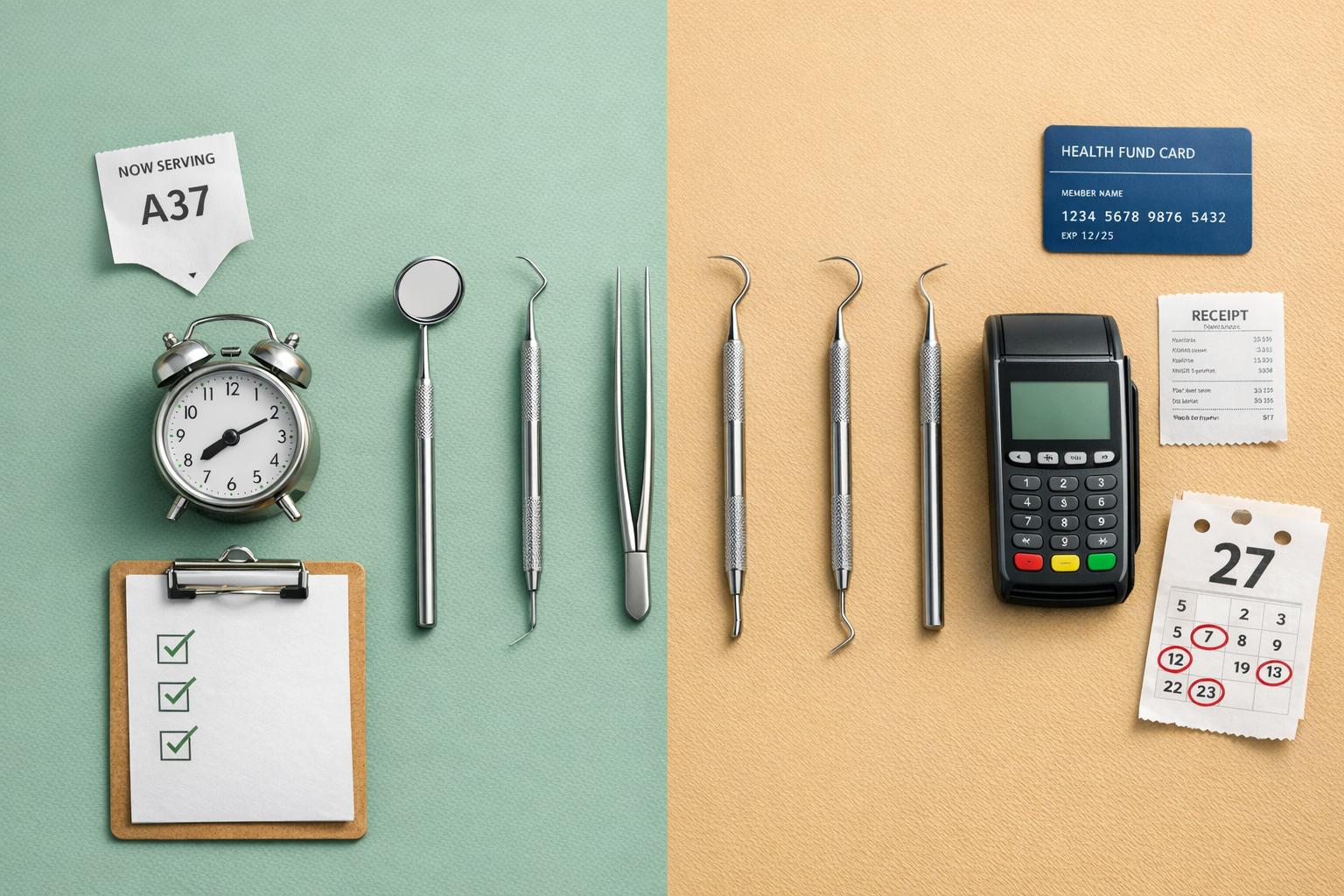
In Australia, dental care costs can be challenging due to limited public funding and high private fees. Public dental services are affordable or free for eligible groups (e.g., concession cardholders), but long wait times – sometimes up to three years – make accessing care difficult. Private clinics, while faster and offering more comprehensive treatments, come with higher costs.
Key points:
- Public Dental Care: Free or low-cost for eligible groups, but limited to basic and emergency procedures. Long wait times are common.
- Private Dental Care: Accessible to everyone, offering a wider range of treatments, but costs are significantly higher. A routine check-up can cost $200–$300, and dental implants range from $4,500–$6,000.
- Insurance: Extras cover can reduce costs but often leaves a gap. Annual limits and waiting periods apply.
- Statistics: In 2022–23, Australians spent $12 billion on dental care, with the average individual spending $458 annually.
Quick Comparison:
| Feature | Public Dental Care | Private Dental Care |
|---|---|---|
| Cost | Free/low-cost for eligible groups | High, varies by clinic |
| Wait Times | Months to 3 years | Days to weeks |
| Eligibility | Limited to concession cardholders | Open to all |
| Treatment Range | Basic/emergency-focused | Comprehensive |
| Appointment Choice | Limited | Flexible |
Choosing between public and private care depends on your eligibility, budget, and urgency of treatment. Public care is ideal for low-cost essential services, while private care offers faster access and a broader range of options.
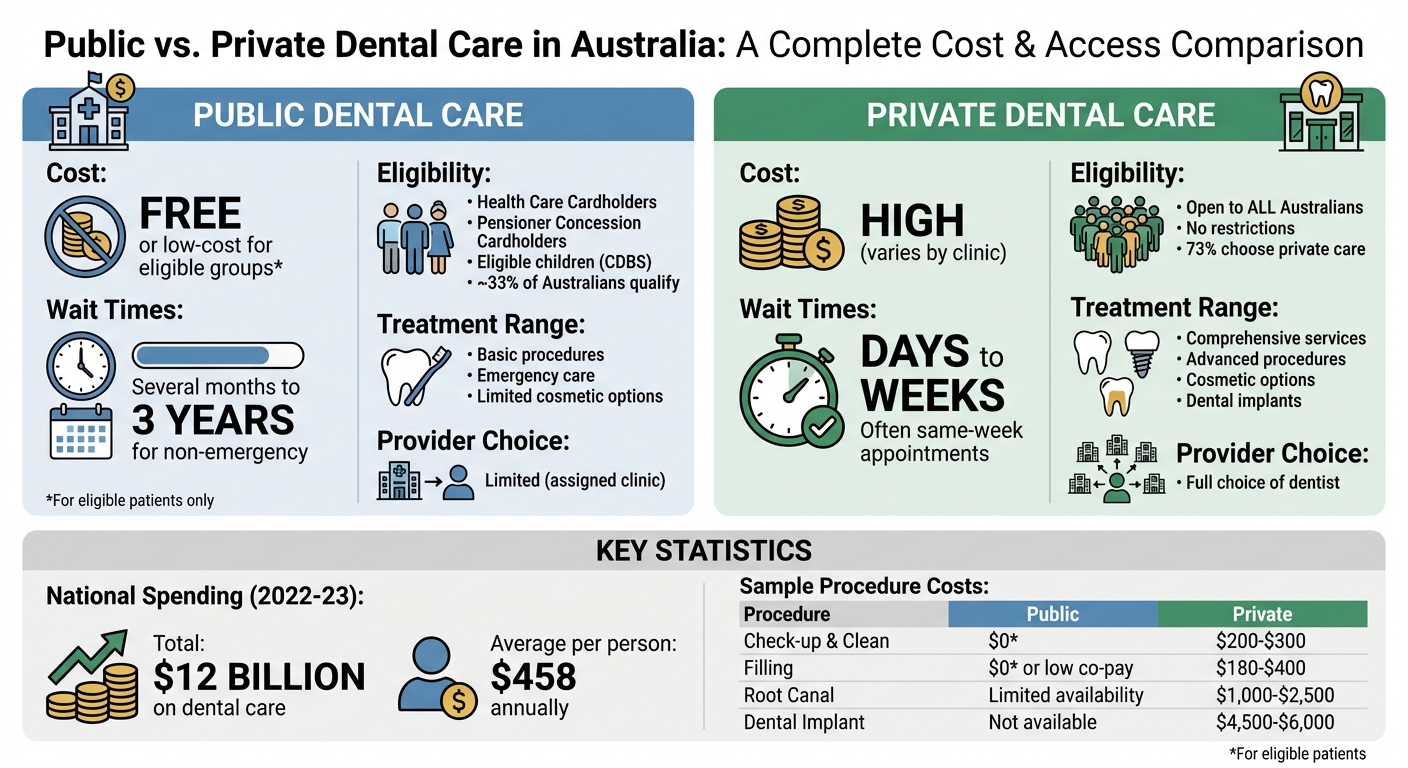
Public vs Private Dental Care in Australia: Cost and Access Comparison
Australia’s ‘completely unaffordable’ dental system | ABC News
sbb-itb-2be92ed
How Public Dental Care Works in Australia
Public dental care in Australia is managed by state and territory health departments, with eligibility rules, fees, and services differing across regions. Additionally, the federal government supports eligible children through the Child Dental Benefits Schedule (CDBS), which offers capped benefits for basic dental care.
Who Qualifies and How to Access Services
Roughly one-third of Australians are eligible for public dental care [7]. Adults typically need a valid Health Care Card or Pensioner Concession Card from Centrelink or the Department of Veterans’ Affairs. In New South Wales (NSW) and Queensland, the Commonwealth Seniors Health Card is also accepted.
For children, eligibility varies by state. NSW and Tasmania provide free public dental care to all individuals under 18. Other states focus on school-aged children or those from families holding concession cards. The CDBS applies to eligible children aged 0–17, offering up to $1,132 over two calendar years for basic dental treatments. Parents can check eligibility through their Medicare online account on myGov or by contacting the Medicare helpline at 132 011.
Certain groups receive priority access, including Aboriginal and Torres Strait Islander people, refugees, asylum seekers, and those registered under the Cleft Lip and Palate Scheme. In Western Australia and the Northern Territory, residents living over 100 kilometres from a private dentist may also qualify for public services, although full fees may apply without a concession card.
Available Treatments and What They Cost
Public dental clinics provide emergency and general treatments, such as check-ups, fillings, and extractions. The CDBS covers essential dental care but excludes orthodontics and Invisalign, cosmetic treatments, and hospital-based procedures. Costs vary by state. For instance:
- Queensland offers free care to eligible residents.
- Victoria charges co-payments, such as $32.00 per visit for adults with concession cards, capped at $128.00 for a full course of treatment.
- Dentures in Victoria cost around $77.50 per denture, with a maximum of $155.00 for full upper and lower sets.
Children using the CDBS are bulk-billed, meaning families do not face out-of-pocket expenses. These cost structures highlight the differences between public and private dental care across the country.
Limitations of Public Dental Care
One of the biggest challenges in public dental care is the long wait times, which can range from several months to up to three years for non-emergency treatments [8]. As noted in The Conversation:
Demand for these services continues to exceed supply. As a result, many Australian adults face long waits for access, which can be up to three years in some states. [8]
Public clinics prioritise basic and emergency care, leaving advanced or cosmetic procedures to private providers. Patients also face limited flexibility in scheduling appointments and choosing dentists. Services are concentrated in urban areas, making access more difficult for those in rural or remote locations. With only about one-third of Australians qualifying for public dental care, many turn to private options for their dental needs. Up next, we’ll dive into how private dental care operates and its cost structure.
How Private Dental Care Works in Australia
Private dental care in Australia operates separately from the public system, with over 85% of dental services provided through private clinics [10]. Unlike public dental care, which mainly caters to concession card holders and eligible children, private practices are open to anyone who can pay out-of-pocket or use private health insurance. Dentists in these clinics set their own fees, which depend on factors like location, operational costs, and their experience level [9]. This independence allows for a wider range of services and more flexible scheduling.
Treatment Options and Appointment Availability
Private dental clinics offer a much broader selection of treatments compared to public services. These range from standard check-ups to advanced procedures like dental implants, orthodontics, and cosmetic options such as porcelain veneers and teeth whitening. Another advantage is the quicker access to appointments – often within the same week – while public systems can involve lengthy waiting periods [3][5][10].
As the Australian Dental Association highlights:
At a private dental clinic, you can choose to see whichever dentist you want. You can also access a full range of treatment options [10].
Fees and Private Health Insurance
Fees at private clinics are unregulated and can vary significantly. For example, a check-up, cleaning, and X-ray package in Melbourne might cost anywhere from $160 to $500 [9]. Many patients rely on private health insurance through Extras Cover, which divides treatments into general, major, and orthodontic categories. Insurers typically rebate a percentage of the costs, but waiting periods apply – usually 2–6 months for general treatments and up to 12 months for major procedures [11][12]. To understand what your insurance covers, ask for treatment plans with ADA item codes [9].
What to Consider When Choosing a Private Clinic
When selecting a clinic, location can significantly impact costs. Clinics in central business districts (CBDs) often charge higher fees, while suburban or regional practices may be more affordable [9]. For major procedures, always request written quotes. If you’re planning complex treatments like evaluating the cost-effectiveness of dental implants, consider spreading the work over multiple calendar years to maximise your insurance benefits [11]. Many clinics, such as Complete Smiles Bella Vista (https://completesmilesbv.com.au), also provide flexible payment plans or third-party financing to help manage upfront expenses.
Cost Comparison: Public vs. Private Dental Services
Average Costs by Procedure
In Australia, the cost of dental care can vary widely depending on whether you choose public or private services. Public dental care is often free or comes with minimal co-payments for eligible groups, such as Health Care Cardholders, Pensioner Concession Cardholders, or children under the Child Dental Benefits Schedule [4]. On the other hand, private clinics operate without government fee regulations, leading to significant price differences – even within the same neighbourhood. The table below highlights these cost disparities for common procedures [9].
| Procedure | Private Clinic Cost | Public Clinic Cost |
|---|---|---|
| Check-up & Clean | $150 – $300 | $0 (for eligible patients) |
| Composite Filling | $180 – $400 | $0 or low co-payment |
| Simple Extraction | $200 – $400 | $0 or low co-payment |
| Root Canal | $1,000 – $2,500 | Limited availability / Long wait |
| Dental Crown | $1,200 – $2,500 | Rarely covered |
| Dental Implant | $3,000 – $6,000 | Generally not available |
For more complex procedures like crowns or implants, public dental care options are either limited or unavailable, often leaving private clinics as the only choice [2][4]. While these figures provide a general idea, individual costs can vary depending on multiple factors.
What Affects the Final Cost
Several elements influence the final price of dental care. Location plays a significant role in private clinic pricing. For instance, a survey of over 700 Melbourne dentists found that the cost of a basic check-up, cleaning, and two X-rays ranged from $160 to $500 – within the same council area [9]. Clinics in inner-city areas like Sydney or Melbourne often charge more due to higher rents and operational expenses. Suburban and regional practices, however, tend to offer lower rates [9].
The complexity of the procedure and materials used also impacts costs. For example, a simple filling will cost less than a multi-surface one, and a porcelain crown (averaging $1,809) is generally less expensive than a gold crown, which averages around $2,148 [13]. Between 2020 and 2022, dental fees rose by an average of 3.7%, with orthodontic services seeing the largest increase at 6.9% [14]. As Anthony Cade from DentalAware explains:
A Dentist is free to set their own costs, so the prices they charge can vary greatly [9].
Private health insurance can help reduce out-of-pocket expenses, but patients are still responsible for the "gap" between the dentist’s fee and the insurer’s rebate. To make informed decisions, ask for a written treatment plan that includes specific ADA item codes. This allows you to compare prices between clinics and verify what your insurer will cover [9]. Understanding these factors can help you decide whether public or private dental care is the better option for your situation.
Advantages and Disadvantages of Each Option
Building on the earlier comparison of costs and accessibility, it’s essential to weigh the trade-offs between affordability, access speed, and the range of general dental treatments available. Public dental care provides free or very low-cost treatment for eligible Australians, such as those holding Health Care Cards or Pensioner Concession Cards [4][3]. This system acts as a vital safety net, especially for emergency care and essential treatments for socio-economically disadvantaged groups [15][3]. However, the downside is the extended wait times. The Grattan Institute highlights the issue:
Most states have waiting lists of well over a year for public dental care – and if people need to wait a year for care, their conditions are only going to get worse [5].
On the other hand, private dental care prioritises immediate access and offers a broader range of treatments. With private care, appointments are often available within days, and patients can access a full suite of treatments – from cosmetic procedures to advanced restorative options like dental implants [3][16]. Additionally, private care allows you to choose your dentist and offers more flexible scheduling [3]. However, this convenience comes at a price. Costs can vary significantly between clinics, and even with insurance, out-of-pocket expenses can be considerable, though some clinics offer gap-free dental packs for new patients [17][18]. Dr Adrian Webster from the Australian Institute of Health and Welfare underscores this challenge:
For many Australians, cost may be a barrier to ensuring they receive the care they need, when they need it [6].
The type of care also differs between public and private systems. Public dental patients are 1.69 times more likely to undergo tooth extractions, while receiving preventive treatments and restorative care far less often. For example, their odds of receiving oral prophylaxis (teeth cleaning) are 0.50, and crowns or bridges are even less likely at 0.34 [15]. This reflects the emergency-oriented nature of public care, whereas private clinics tend to focus on prevention and long-term maintenance [15][3].
Public vs. Private: Side-by-Side Comparison
| Feature | Public Dental Care | Private Dental Care |
|---|---|---|
| Cost | Free or very low cost for eligible patients [8][3] | Higher upfront costs; varies by clinic [4][3] |
| Wait Times | Long (months to 3 years) [8][3] | Short (days to weeks) [3][16] |
| Eligibility | Limited to concession card holders and priority groups [4][8] | Open to all Australians [3] |
| Treatment Range | Basic and emergency focused; limited cosmetic options [15][3] | Comprehensive; includes cosmetic, implants, and advanced technology [3][16] |
| Provider Choice | Limited; usually assigned to a state-run clinic [3] | High; patients choose their own dentist [4][3] |
| Appointment Flexibility | Restricted times and availability [3] | Flexible scheduling and extended hours [3][19] |
This breakdown highlights the key differences, helping you decide based on your budget, the urgency of your dental needs, and the type of care you’re looking for.
Managing Costs and Using Insurance
Balancing quality dental care with affordability often comes down to managing costs wisely and making the most of your insurance. Whether you opt for public or private care, understanding how to reduce expenses and maximise insurance benefits is essential. Private health insurance, particularly Extras cover, is a common way Australians offset dental costs, though it requires careful planning to get the best value.
Getting the Most from Your Insurance
Private health insurance typically covers about 50% of your dental bill. However, some not-for-profit or restricted funds may provide rebates of up to 75%[11]. Keep in mind, this doesn’t mean you’ll always pay only 25–50% out of pocket. Policies come with annual limits that cap how much you can claim, and these limits usually reset on 1 January or at the start of the financial year[11]. Once you hit your limit, any additional costs will need to be covered entirely out of pocket until the limit resets.
Waiting periods are another factor to consider. For general dental services like check-ups, cleans, and simple fillings, the waiting period is often around two months. For major procedures like crowns or root canals, you may need to wait up to 12 months. Orthodontic treatments can have even longer waiting periods, ranging from one to three years[20]. This makes it tricky to rely on insurance for urgent treatment.
To get the most out of your insurance, always ask for a detailed treatment quote that includes item numbers before any work begins. Share this with your insurer to understand exactly what will be covered and what you’ll need to pay. If you’re close to reaching your annual limit, consider postponing non-urgent procedures until the limit resets. Alternatively, use any remaining benefits for check-ups or cleaning at the year’s end. For costly treatments, like implants, ask your dentist if the work can be split across two calendar years to take advantage of two sets of annual limits.
Some funds have preferred provider networks or their own clinics, which can offer higher rebates or fixed fees – another way to stretch your coverage further.
Practical Ways to Reduce Dental Costs
Beyond insurance, there are other ways to lower dental expenses. Since dental fees aren’t standardised in Australia, prices for the same procedure can vary widely between clinics. Use the Australian Government’s Medical Costs Finder tool to compare prices and shop around.
If private insurance feels too expensive, consider dental discount plans like Smile.com.au. For an annual membership fee of less than $100, these plans offer discounts of 15–40% at participating dentists, often without waiting periods or claim limits[12].
Families receiving government benefits should check if their children qualify for the Child Dental Benefits Schedule (CDBS). This program provides up to $1,000 over two calendar years for eligible kids aged 2–17, with many services bulk-billed through Medicare.
For major treatments exceeding $1,000, many private clinics offer payment plans that let you spread the cost over several months. Preventive care is another smart way to save – most insurers fully cover two check-ups and cleans per year. Regular maintenance can help catch issues early and avoid more expensive treatments later on.
Choosing Between Public and Private Dental Care
Deciding between public and private dental care often comes down to factors like eligibility, cost, and how urgently you need treatment. If you have a Health Care Card or Pensioner Concession Card, public dental services can provide low-cost or free care. However, the downside is the waiting time – non-emergency treatments can take over a year to schedule [4][5]. Such delays may allow minor dental issues to escalate into more serious, expensive problems. On the other hand, private clinics typically offer much faster access, often within days.
Private dental care not only provides quicker appointments – sometimes within the same week – but also offers a wider range of treatments [3][16]. In fact, about 73% of Australians who visited a dentist in 2019–2020 chose private care, largely because of the shorter wait times [16]. However, this convenience comes at a cost. For instance, even after rebates, the median out-of-pocket expense for a crown is $786, with some patients paying as much as $1,989 [6].
When it comes to routine check-ups and preventive care, private services can often be the smarter choice. Spending $200–$300 on preventive care can save you from much higher costs down the road. For example, root canals range from $950 to $2,000, and dental implants can cost between $4,500 and $6,000 [1][5]. These numbers highlight the financial trade-offs between public and private dental care.
"Most states have waiting lists of well over a year for public dental care – and if people need to wait a year for care, their conditions are only going to get worse" [5].
Before committing to private treatment, it’s a good idea to request a written quote with item numbers. This allows you to compare prices across clinics or confirm rebate amounts with your health fund. If you have children aged 2–17, check if they qualify for the Child Dental Benefits Schedule, which covers up to $1,000 over two calendar years for basic dental services [4][5]. For major procedures, you might also ask whether treatments can be spaced out over time to better manage insurance caps.
Ultimately, your choice should align with your immediate dental needs and financial situation. Dr Adrian Webster from the AIHW puts it plainly:
"For many Australians, cost may be a barrier to ensuring they receive the care they need, when they need it" [6].
This highlights the importance of exploring all your options – whether that’s public care, private treatment, or payment plans – to ensure you get the dental care you need without unnecessary delays.
FAQs
How do I check if I’m eligible for public dental care in my state?
Eligibility for public dental care in Australia depends on where you live. For instance, in New South Wales (NSW), adults need to hold a valid concession card – like a Health Care Card or Pensioner Concession Card – and must also be eligible for Medicare. Meanwhile, children under 18 are usually covered.
In Victoria, the rules are a bit different, as eligibility depends on both a person’s age and whether they hold a concession card.
For exact details, it’s best to reach out to your nearest public dental clinic or visit your state health department’s website.
What’s the best way to estimate my out-of-pocket cost with Extras cover?
To get a clear picture of your out-of-pocket expenses with Extras cover, start by checking the dental benefits and limits outlined by your private health fund. It’s also a good idea to look into the average treatment costs in your area since fees can differ widely. Extras cover typically refunds a portion of the total cost, so make sure you’re familiar with the specifics of your policy to avoid surprises.
When is it worth choosing private dental care instead of waiting for public care?
Private dental care can be a good option if you prioritise shorter wait times, personalised care, or flexible scheduling. In Australia, public dental services often face long waiting lists, which can delay procedures like wisdom teeth removal – even when they’re urgent. Private clinics, on the other hand, generally provide quicker access and more individualised treatment, especially for complex or cosmetic procedures. However, it’s worth noting that this convenience often comes with higher out-of-pocket expenses.
Related Blog Posts
- Transparent Dental Pricing Explained
- Cost Comparison: Implants, Bridges, and Dentures in 2025
- Dental Sealants Cost in Australia: What to Expect
- Tooth Decay Treatment Costs: Options Explained
Important Notice: Any surgical or invasive procedure carries risks. Before proceeding, you should seek a second opinion from an appropriately qualified health practitioner.
Individual results may vary. The information provided in this article is for educational purposes only and does not constitute medical advice.
Checkout Related Blogs




Get in touch with us
For more information, call us now to start feeling better. Or fill the form below to make appointment
The Latest News from Complete Smiles
How to Clean Clear Plastic Retainers
Checklist for Choosing Wearable Dental Devices
Checklist for Choosing Cloud AI Platforms in Dentistry

Complete Smiles Bella VistaAccepts All Major Health Funds, Including





