





Patient Outcomes in Minimally Invasive Dentistry

Minimally invasive dentistry focuses on preserving natural tooth structure while improving patient comfort and long-term oral health. This approach uses early detection, preventive care, and advanced techniques like air abrasion, laser treatments, and adhesive materials to reduce damage, speed up recovery, and lower the risk of complications. Key insights include:
- Better treatment durability: Porcelain veneers show a 100% survival rate over nine years, outperforming conventional methods.
- Lower risk of decay: Techniques that retain more enamel reduce bacterial plaque and secondary decay.
- Faster recovery: Patients heal quicker with methods like Single Incision Access and laser dentistry.
- Less pain: Procedures minimise damage to healthy tissue, often eliminating the need for anaesthesia.
- Improved aesthetics and confidence: Digital smile design and veneers enhance appearance while reducing dental anxiety.
- New technologies: Lasers and digital imaging improve precision, shorten treatment times, and boost patient satisfaction.
These methods prioritise natural tooth preservation and use advanced tools to create safer, more comfortable dental experiences.
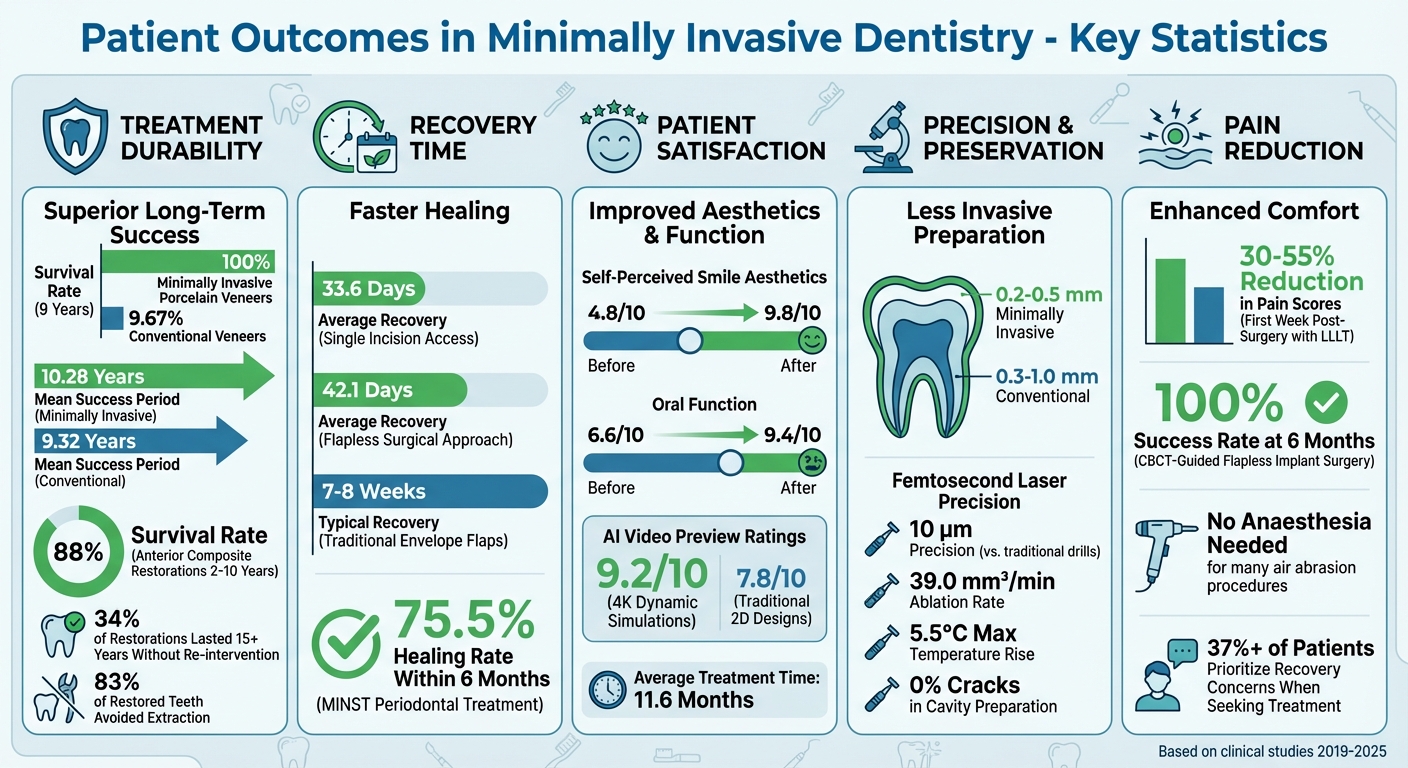
Minimally Invasive Dentistry Patient Outcomes: Key Statistics and Success Rates
Treatment Effectiveness of Minimally Invasive Dentistry
Long-Term Success in Restorative Treatments
A nine-year study highlighted a 100% survival rate for minimally invasive porcelain veneers, compared to just 9.67% for conventional ones. The mean success periods were 10.28 years for minimally invasive veneers and 9.32 years for their traditional counterparts[4]. By bonding directly to preserved enamel, these veneers create a stable foundation that can effectively handle chewing forces. Abbasi Begum Meer Rownaq Ali, from Riyadh Elm University‘s Department of Prosthodontics, noted:
"MPVs demonstrated advantages such as enhanced survival rates and extended mean success periods, implying their potential as viable long‐term restorative options”[4].
For anterior composite restorations addressing localised tooth wear, the survival rate over 2–10 years stands at 88%[5]. A broader analysis of 3.5 million resin composite restorations revealed that 34% lasted 15 years without needing re-intervention, and 83% of the restored teeth avoided extraction entirely[6]. Unlike crowns, composite restorations tend to fail in ways that preserve the tooth structure, while crown failures often lead to more severe damage. This distinction not only improves treatment predictability but also enhances patient safety. Alongside their durability, these techniques also reduce the risk of secondary decay.
Lower Risk of Secondary Decay
Minimally invasive techniques involve thinner preparation (0.2–0.5 mm compared to 0.3–1.0 mm), preserving more enamel and reducing the likelihood of bacterial plaque accumulation and decay[4]. Retaining enamel creates a stronger, more durable bonding surface that maintains its seal over time. This effectively protects the tooth from bacterial infiltration, contributing to better long-term outcomes for patients.
In endodontically treated teeth, overlay designs (offering cuspal coverage) have shown significantly better marginal adaptation and lower rates of caries over 24 months compared to inlays that lack cuspal coverage[7]. The superior marginal fit of overlays minimises microleakage at restoration edges, which is often the starting point for secondary decay. This added precision directly supports the longevity and health of the restored tooth.
sbb-itb-2be92ed
How and Why We Do Minimally Invasive Dentistry
Recovery Times and Postoperative Comfort
Minimally invasive dentistry has gained popularity for its ability to speed up recovery and reduce discomfort, both of which are crucial for patient satisfaction.
Faster Healing Periods
A split-mouth trial conducted at the University of Genoa (2019–2021) involving 42 patients and 84 teeth revealed that the Single Incision Access (SIA) technique significantly shortened recovery times. Patients treated with SIA healed in an average of 33.6 days compared to 42.1 days for those who underwent the Flapless Surgical Approach (FSA). This is a notable improvement over the typical 7–8 weeks required for recovery with envelope flaps[8]. This difference is especially important for third molar extractions, as over 37% of patients seek treatment with concerns about the recovery process[8].
As Materni explained:
"The novel SIA approach follows the positive early post-surgery FSA results but shows faster tissue healing and recovery than FSA in late post-surgery follow-up"[8].
By minimising incision size and preserving more healthy tissue, these methods enable the body to heal more quickly. In periodontal treatments, techniques like Minimally Invasive Non-Surgical Therapy (MINST) have demonstrated a 75.5% healing rate within six months while significantly reducing gingival recession[10].
This quicker recovery is paired with a notable reduction in postoperative discomfort.
Less Pain and Sensitivity After Treatment
Minimally invasive techniques not only speed up healing but also help reduce pain and sensitivity after procedures. By limiting damage to healthy tissue, these advanced methods make recovery far more comfortable. For example, laser gum surgery reduces bleeding and swelling during procedures like gum reshaping, which translates to less pain during recovery. Cuong Ngu from Charles Sturt University highlighted this benefit:
"Laser dentistry minimises bleeding and swelling, leading to quicker recovery times and less discomfort for patients"[1].
Similarly, air abrasion, which uses a stream of abrasive particles instead of traditional drilling, often eliminates the need for local anaesthesia altogether[1].
The Hall Crown Technique offers another example of pain-free dentistry. This approach seals dental caries in children using stainless steel crowns without tooth preparation, caries removal, or local anaesthesia[3]. For postoperative care, simple measures like ice packs, warm salt water rinses, and a soft food diet can further ease discomfort and reduce swelling[9].
Patient Satisfaction and Mental Health Benefits
Minimally invasive dentistry does more than just speed up recovery and reduce physical discomfort – it also contributes to psychological wellbeing. With its positive clinical results and mental health benefits, this approach highlights how dental care can address both physical and emotional needs. These advantages are evident in areas like improved aesthetics and reduced dental anxiety.
Appearance and Function Results
A 2025 study led by Dr Marco Tallarico at the University of Sassari demonstrated the impact of minimally invasive dentistry on both appearance and function. Five adult patients treated at a private clinic in Rome underwent a protocol combining digital smile design, clear aligner therapy, and minimally invasive veneers. The results were striking: self-perceived smile aesthetics improved from 4.8 to 9.8, and oral function increased from 6.6 to 9.4 on a 10-point scale. Additionally, the use of AI-generated 4K video previews significantly enhanced patient understanding and acceptance of treatments. These dynamic simulations were rated 9.2/10, compared to 7.8/10 for traditional static 2D designs. The average treatment time was approximately 11.6 months [11].
The preference for natural aesthetics is becoming more pronounced. Modern patients lean towards subtle, harmonious enhancements that complement their facial features rather than the overly white or "perfect" smiles often seen in older prosthetic treatments [11]. As Kokich and colleagues put it:
"Aesthetic dental treatment should aim to create a smile that is harmonious in terms of tooth proportions, colour, alignment, gingival architecture, and its integration with the patient’s facial features." [11]
Lower Dental Anxiety and Better Self-Confidence
Improved appearance naturally boosts self-esteem, but the reduced invasiveness of these procedures also plays a critical role in lowering dental anxiety. Cuong Ngu from Charles Sturt University highlighted this psychological benefit:
"From a psychological perspective, the reduced pain and invasiveness associated with MID can alleviate dental anxiety, encouraging patients to seek regular care." [1]
Digital tools further enhance the experience by actively involving patients in their treatment plans. This participatory approach builds trust and satisfaction. Pietro Ruggiero from Melbourne Dental School observed:
"This collaborative approach fosters trust and enhances patient satisfaction, as individuals feel more empowered and informed about their treatment options." [2]
New Technologies in Minimally Invasive Dentistry
Advances in laser systems and digital imaging are transforming minimally invasive dental care, offering improved precision and reliability. These innovations build on earlier approaches, further reducing the invasiveness of procedures and enhancing patient outcomes.
Laser-Based Treatments
Laser technology has reshaped dental procedures by replacing traditional mechanical tools with light-based ablation. Unlike drills, lasers eliminate vibrations and shock waves that can cause micro-cracks in enamel and require continuous water cooling [13]. Different types of lasers cater to specific dental needs:
- Diode lasers (810–1064 nm): Ideal for soft tissue procedures, these lasers offer excellent control and help manage bleeding effectively.
- Nd:YAG lasers (1064 nm): These penetrate deep into periodontal pockets, aiding in bacterial reduction.
- Er:YAG lasers (2940 nm): Used for hard tissue and calculus removal, they minimise thermal effects on surrounding tissues [12].
The standout innovation is femtosecond lasers, which deliver a precision of 10 µm – far surpassing high-speed drills [13]. In 2022, researchers from the Australian National University and the University of Queensland demonstrated the potential of a Carbide 40W femtosecond laser (1029 nm, 275 fs) for minimally invasive cavity preparation. Their study achieved ablation rates of up to 39.0 mm³/min in dentine with a maximum internal temperature rise of just 5.5°C, resulting in crack-free cavities [13]. As noted by the researchers:
"The femtosecond laser ‘drill’ is much quieter and causes little to no direct pain during its operation." [13]
Lasers also aid in recovery. Low-level laser therapy (LLLT), or photobiomodulation, accelerates wound healing by reducing inflammation and promoting faster tissue regeneration. Research shows that LLLT can lower pain scores by 30–55% within the first week after oral surgery [14]. This combination of cutting-edge precision and healing support makes laser technology especially beneficial for patients with dental anxiety or complex medical needs.
Digital Imaging and Computer-Guided Surgery
Digital imaging and computer-guided surgery complement laser advancements, streamlining treatment planning and execution. Tools like Cone Beam CT (CBCT) and computer-aided design systems offer unparalleled accuracy. CBCT provides detailed three-dimensional images, enabling dentists to visualise bone structures, nerve pathways, and other anatomical features before any procedure. This precision is particularly crucial for implant placement, where accuracy directly affects long-term outcomes.
One compelling example comes from a study conducted between June 2022 and December 2023 at the Affiliated Hospital of Chifeng University in China. Researchers used CBCT-guided, touch-controlled flapless surgery on 54 patients receiving 60 mandibular first molar implants. The flapless technique preserved blood flow and minimised surgical trauma. The results were impressive: a 100% success rate at six months, minimal bone resorption, and reduced postsurgical swelling compared to traditional methods [15].
Additionally, computer-guided surgery has paved the way for single-visit restorations through CAD/CAM technology. Dentists can now design and fabricate custom crowns, veneers, or inlays during a single appointment. This approach not only reduces the time patients spend in the chair but also improves the precision of prosthetics while adhering to the principles of minimally invasive dentistry [2][15]. By integrating digital imaging with manufacturing tools, these technologies enhance recovery times and boost overall patient satisfaction.
Conclusion
Minimally invasive dentistry represents a meaningful shift in dental care, focusing on preserving oral health while enhancing patient comfort and long-term outcomes. By safeguarding healthy tooth structure, these methods help maintain the natural strength of teeth and reduce risks like pulp exposure and postoperative sensitivity – findings that align with earlier research [16][1]. Studies demonstrate that adhesive techniques and conservative restorative materials can match or even outperform traditional options like amalgam and crowns in terms of durability [16].
The benefits extend beyond physical health. As Dr Jason Cellars explains:
"By saving as much tooth structure as possible we can create both stronger restorations and stronger underlying tooth structure" [16].
This approach also reduces inflammation in surrounding tissues, promoting healthier outcomes and lowering sensitivity risks over time. The combination of clinical and psychological advantages is further amplified by advancements in dental technology.
Modern tools such as laser systems and digital imaging have made it easier to achieve these results consistently. Lasers minimise bleeding and swelling, often eliminating the need for anaesthesia, while digital imaging allows for precise, single-visit restorations that conserve more of the natural tooth [1][2]. These innovations not only improve recovery times but also enhance patient satisfaction, reinforcing the benefits discussed throughout this article.
Looking ahead, minimally invasive dentistry is poised to grow further with the development of regenerative techniques and bio-mineralisation. These advancements aim to continue prioritising natural tooth preservation, minimising trauma, and empowering patients with effective, lifelong oral care.
FAQs
Am I a good candidate for minimally invasive dentistry?
Minimally invasive dentistry could be a good option for you, depending on the condition of your teeth and gums. It’s particularly well-suited for addressing early-stage decay or small cavities, as it prioritises conserving as much of your natural tooth structure as possible. Advanced tools, such as lasers and air abrasion, are often used in these procedures, helping to minimise discomfort and speed up recovery.
That said, if your teeth have more extensive damage, traditional dental treatments might be necessary. A thorough evaluation by your dentist will help determine whether minimally invasive techniques are the right choice for your oral health needs.
Are laser and air abrasion treatments safe for teeth and gums?
Laser and air abrasion treatments are considered safe for both teeth and gums. These methods are less invasive, which often means less discomfort after the procedure, quicker recovery times, and minimal damage to surrounding tissues. Compared to traditional techniques, patients usually notice reduced bleeding and swelling.
How long do minimally invasive restorations usually last?
Minimally invasive restorations typically last around 10 years, boasting a survival rate of about 90%. However, their durability can vary based on factors like the materials chosen and the specific needs or conditions of the patient.
Related Blog Posts
- What Is Minimally Invasive Cavity Preparation?
- Minimally Invasive Tooth Extraction Techniques
- 5 Benefits of AI in Laser Dental Treatments
- Minimally Invasive Veneers: Eco Benefits
Important Notice: Any surgical or invasive procedure carries risks. Before proceeding, you should seek a second opinion from an appropriately qualified health practitioner.
Individual results may vary. The information provided in this article is for educational purposes only and does not constitute medical advice.
Checkout Related Blogs




Get in touch with us
For more information, call us now to start feeling better. Or fill the form below to make appointment
The Latest News from Complete Smiles
How to Clean Clear Plastic Retainers
Checklist for Choosing Wearable Dental Devices
Checklist for Choosing Cloud AI Platforms in Dentistry

Complete Smiles Bella VistaAccepts All Major Health Funds, Including





