





Top 3 Minimally Invasive Tooth Replacement Options

When it comes to replacing missing teeth, you don’t always need extensive procedures. Here are three straightforward options that are less intrusive and designed to preserve your oral health:
- Resin-Bonded Bridges: A fixed, non-surgical solution ideal for front teeth. They last 5–15 years and are affordable compared to implants.
- Removable Partial Dentures: A budget-friendly choice with no surgery. Denture costs range from $700 to $2,500 depending on materials, but they require regular cleaning and adjustments.
- Mini Dental Implants: A smaller, less invasive version of traditional implants. They help prevent bone loss and are suitable for stabilising dentures or replacing smaller teeth. Costs range from $900 to $6,500 per jaw.
Each option has its pros and cons, so consulting with a dentist is essential to determine what works best for your needs.
Quick Comparison
| Option | Surgical? | Best For | Cost (AUD) | Lifespan |
|---|---|---|---|---|
| Resin-Bonded Bridges | No | Front teeth | Mid-range | 5–15 years |
| Removable Partial Dentures | No | Multiple missing teeth | $700–$2,500 | 5–10 years |
| Mini Dental Implants | Yes | Smaller teeth or dentures | $900–$6,500 per jaw | 20+ years |
Replacing missing teeth promptly is essential to maintain oral health and prevent complications like jawbone loss or shifting teeth. Always consult a qualified dentist for personalised advice.
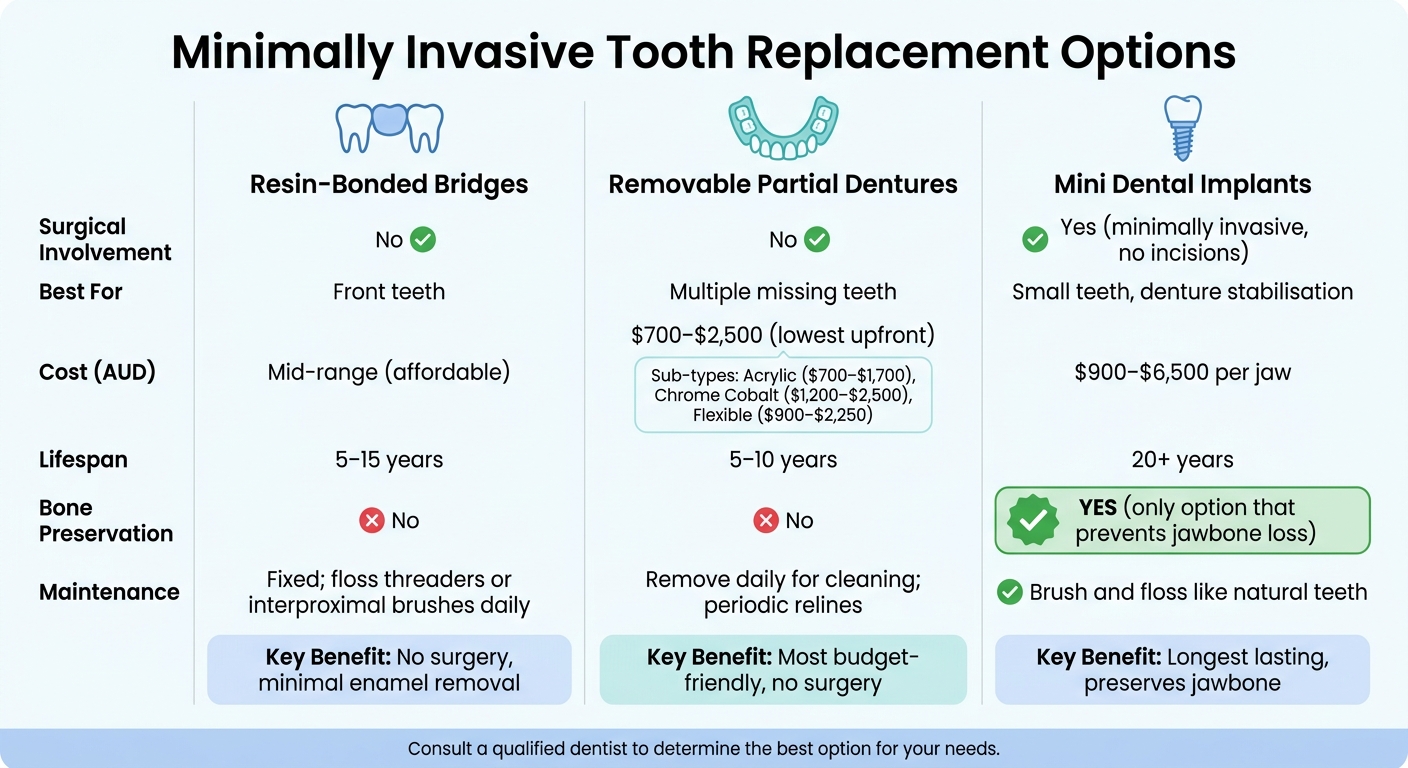
Minimally Invasive Tooth Replacement Options Compared
Minimally Invasive Tooth Replacement Strategies in the Esthetic Zone
sbb-itb-2be92ed
1. Resin-Bonded Bridges
A resin-bonded bridge, often called a Maryland bridge, is a solution for replacing a missing tooth. This type of bridge works by securing an artificial tooth (pontic) to the adjacent teeth using metal or ceramic wings and dental resin cement. Unlike traditional bridges, this option typically requires little to no removal of healthy enamel, making it a low-impact choice.
The procedure is straightforward and usually completed in two visits. During the first appointment, the dentist prepares the teeth and takes impressions. The second appointment involves fitting and bonding the bridge. Since there’s no surgery and minimal drilling, recovery is quick and uncomplicated.
This option is best suited for front teeth, as they experience lighter biting forces. However, it’s not ideal for back teeth because the higher chewing pressure can weaken the bond.
Resin-bonded bridges are generally less expensive than dental implants, including their costs and care, with a typical lifespan of 5 to 15 years[2]. If the bridge loosens but remains undamaged, it can often be reattached. Proper oral hygiene plays a key role in ensuring it lasts as long as possible.
| Factor | Detail |
|---|---|
| Invasiveness | Minimal – no surgery, little to no enamel removal |
| Best suited for | Front teeth replacement |
| Typical lifespan | 5–15 years |
| Cost | Generally more affordable than dental implants |
| Maintenance | Requires daily cleaning with floss threaders or interproximal brushes |
Daily cleaning underneath the bridge is essential to maintain healthy gums and prevent decay in the supporting teeth. Tools like floss threaders or interproximal brushes work well for this. Additionally, avoiding hard foods – such as ice or hard lollies – can help protect the bond and extend the life of the bridge.
2. Removable Partial Dentures
A removable partial denture is a custom-made appliance designed to replace missing teeth. It attaches to your natural teeth using metal or gum-coloured clasps. The process is straightforward – no surgery required – and it doesn’t involve altering healthy adjacent teeth. Your dentist will take impressions and fit the denture over two to three visits. This makes it a practical option for those looking to avoid invasive procedures or for individuals with insufficient bone density for implants.
The cost of these dentures depends on the material used. Acrylic dentures are the most economical, priced between $700 and $1,700, while chrome cobalt (metal-framed) dentures range from $1,200 to $2,500. Flexible partials like ThermoSens fall somewhere in the middle, costing $900 to $2,250 [4]. Most private health insurers classify dentures as major dental, with annual rebates typically falling between $200 and $1,000 [4].
When considering long-term value, the choice of material plays a crucial role. Here’s how the options compare:
| Type | Price Range (AUD) | Average Lifespan | Cost Per Year | Key Drawback |
|---|---|---|---|---|
| Acrylic | $700 – $1,700 | 5–7 years | $143 – $340 | Bulkier; may affect taste |
| Chrome Cobalt | $1,200 – $2,500 | 7–10+ years | $170 – $321 | Higher upfront cost; less adaptable to changes |
| Flexible | $900 – $2,250 | 3–5 years | $300 – $750 | Short lifespan; challenging to repair |
This table underscores the balance between initial cost and durability. While chrome cobalt dentures have a higher upfront price, they often provide the best long-term value due to their durability. As Simone Hargrave from Northern Rivers Denture Clinic explains:
"By approaching your partial denture purchase as a long-term health investment rather than a one-time expense, you’ll be better positioned to make a choice that serves you well for years to come." [4]
Here’s a tip: booking directly with a dental prosthetist can save you 10–30% compared to going through a general dentist [4]. Most new wearers adapt to their dentures within one to two weeks.
Next, we’ll explore mini dental implants as an alternative option.
3. Mini Dental Implants
Mini dental implants (MDIs) are a smaller alternative to traditional dental implants, with a diameter of less than 3 mm [6]. Their design allows for placement without the need for incisions or stitches, which means recovery is often much quicker – just a few days compared to the longer healing time associated with traditional implants [8]. This makes MDIs an appealing option for certain patients.
One of the main benefits of MDIs is their suitability for individuals with lower jawbone density, as they often don’t require bone grafting [8]. This can be particularly helpful for people with medical conditions like diabetes or heart issues, which might complicate more invasive procedures [7].
In Australia, the cost of mini dental implants varies widely, typically ranging from AUD $900 to $6,500 per jaw, depending on how many implants are needed. In contrast, a single traditional implant can cost between AUD $3,000 and $7,500 per tooth [6][5]. While MDIs can offer significant savings upfront, it’s important to weigh the cost-effectiveness of dental implants and potential compromises.
| Feature | Mini Dental Implants | Traditional Dental Implants |
|---|---|---|
| Diameter | Under 3mm | 3mm to 6mm |
| Surgery | Minimally invasive; no incisions | Requires incisions and may need bone grafts |
| Best Use | Replacement for small teeth and stabilising dentures | Suitable for molars and full-arch bridges |
| Lifespan | Shorter, with a higher failure risk | Typically 20+ years |
| Cost (AUD) | $900 – $6,500 per jaw | $3,000 – $7,500 per tooth |
That said, MDIs do come with limitations. Their smaller size means they’re not as strong as traditional implants, leading to a higher risk of failure. As a result, they’re generally used for stabilising removable dentures or replacing smaller teeth, such as front teeth. Before undergoing the procedure, a CBCT scan for implant planning is essential to evaluate the jawbone structure and ensure suitability [8]. This assessment is a crucial first step when considering MDIs or other minimally invasive dental solutions.
Side-by-Side Comparison
Here’s a quick look at the three options to help you weigh the pros and cons. The table below outlines key factors for each option. For more detailed insights, check the sections above. Keep in mind, your choice will depend on how you prioritise cost, durability, and the level of surgical involvement.
| Factor | Resin-Bonded Bridges | Removable Partial Dentures | Mini Dental Implants |
|---|---|---|---|
| Surgical Involvement | Non-surgical; minimal alteration to adjacent teeth [1] | Non-surgical [1] | Surgical; titanium post placed in the jawbone [1] |
| Typical Cost (AUD) | Mid-range [1] | Lowest initial cost [1] | Highest upfront cost [1] |
| Expected Lifespan | 7–15 years [1] | 5–10 years [1] | 20+ years with proper care [1] |
| Maintenance | Fixed in place; regular brushing and flossing; monitor for trapped food [1] | Remove daily for cleaning; periodic relines and adjustments needed [1] | Brush and floss like natural teeth; twice-daily cleaning [3] |
| Bone Preservation | No | No | Yes – the only option that prevents jawbone loss [1] |
While removable dentures may seem appealing due to their lower initial cost, it’s worth considering the longevity and reduced maintenance of mini dental implants. With proper care, they can last over 20 years, making them a strong contender for those seeking a long-term solution [1].
Conclusion
Deciding on the right option depends on several factors, including how many teeth are missing, the condition of your bone, your budget, and how well you handle surgical procedures. Resin-bonded bridges offer a fixed solution without requiring surgery. Removable partial dentures are a cost-effective choice. Meanwhile, mini dental implants involve surgery but provide lasting durability and help maintain your jawbone. Each method has its pros and cons, making a personalised evaluation by a dental professional crucial.
When weighing your options, it’s wise to think about long-term value rather than just the upfront cost. As Dr Kristian Van Mourik, Oral & Maxillofacial Surgeon, explains:
"While implants have a higher upfront cost, they often work out more cost-effective over time. Bridges and dentures usually require replacement or adjustment, whereas a well-maintained implant can last a lifetime." [1]
Don’t delay replacing a missing tooth. Waiting too long can lead to shifting of nearby teeth and worsening jawbone loss [9]. Taking action promptly and reviewing these insights with your dentist will guide you toward the best minimally invasive solution for your situation. For a tailored treatment plan that aligns with your oral health goals, visit Complete Smiles Bella Vista.
FAQs
Which option looks most natural?
Dental implants stand out as the option that most closely mimics natural teeth. They not only replicate the look but also the function of real teeth, giving a seamless and natural feel. Plus, their durability means they offer a long-term solution for replacing missing teeth, making them a practical and reliable choice.
Am I suitable for mini dental implants without bone grafting?
If you’re considering mini dental implants without bone grafting, the key factor is whether you have enough bone volume and density to support them. A dental professional will need to conduct a detailed evaluation to see if this approach suits your situation. Make sure to consult a qualified dentist who can assess your oral health and recommend the best course of action for your needs.
How do I clean under a resin-bonded bridge or around a partial denture?
Maintaining good oral hygiene is key when cleaning under a resin-bonded bridge or around a partial denture. Use tools like interdental brushes or floss threaders to reach those tricky spots. Combine this with regular brushing and rinsing – either with water or mouthwash – to get rid of plaque and food particles. Paying extra attention to cleaning around the margins of the bridge or denture can help prevent plaque build-up, tooth decay, and gum problems.
Related Blog Posts
- Pros and Cons of Dental Bridges and Dentures
- Cost Comparison: Implants, Bridges, and Dentures in 2025
- Dental Implants vs Bridges: Pros and Cons
- Pros and Cons of Dental Implants vs Dentures
Important Notice: Any surgical or invasive procedure carries risks. Before proceeding, you should seek a second opinion from an appropriately qualified health practitioner.
Individual results may vary. The information provided in this article is for educational purposes only and does not constitute medical advice.
Checkout Related Blogs




Get in touch with us
For more information, call us now to start feeling better. Or fill the form below to make appointment
The Latest News from Complete Smiles
How to Clean Clear Plastic Retainers
Checklist for Choosing Wearable Dental Devices
Checklist for Choosing Cloud AI Platforms in Dentistry

Complete Smiles Bella VistaAccepts All Major Health Funds, Including





