





Locator Attachments vs. Ball Attachments: Cost Comparison
Looking for the best option for implant-supported dentures? Here’s the bottom line: Locator attachments cost more upfront but need less maintenance, while ball attachments are cheaper initially but come with higher ongoing expenses.
Key Takeaways:
- Locator attachments: Higher initial cost (2.2x ball attachments) but fewer maintenance visits (0.9/year) and lower complication rates (14–20%). Long-term costs balance out due to durability and reduced repairs.
- Ball attachments: Lower upfront cost (about 45% of Locator systems) but require more frequent maintenance (1.8 visits/year) and have higher complication rates (24–35%).
Quick Comparison:
| Feature | Locator Attachments | Ball Attachments |
|---|---|---|
| Initial Cost | Higher (2.2x ball attachments) | Lower |
| Maintenance Visits | 0.9 per year | 1.8 per year |
| Complication Rate | 14–20% | 24–35% |
| Patient Satisfaction | 8.1–9.0/10 | 6.7–7.9/10 |
What does this mean for you? If you value long-term savings and fewer dental visits, Locator attachments might be worth the higher upfront cost. But if you’re on a tight budget and can manage more frequent maintenance, ball attachments could be a better fit. Always consult your dentist to decide what works best for your needs and budget.
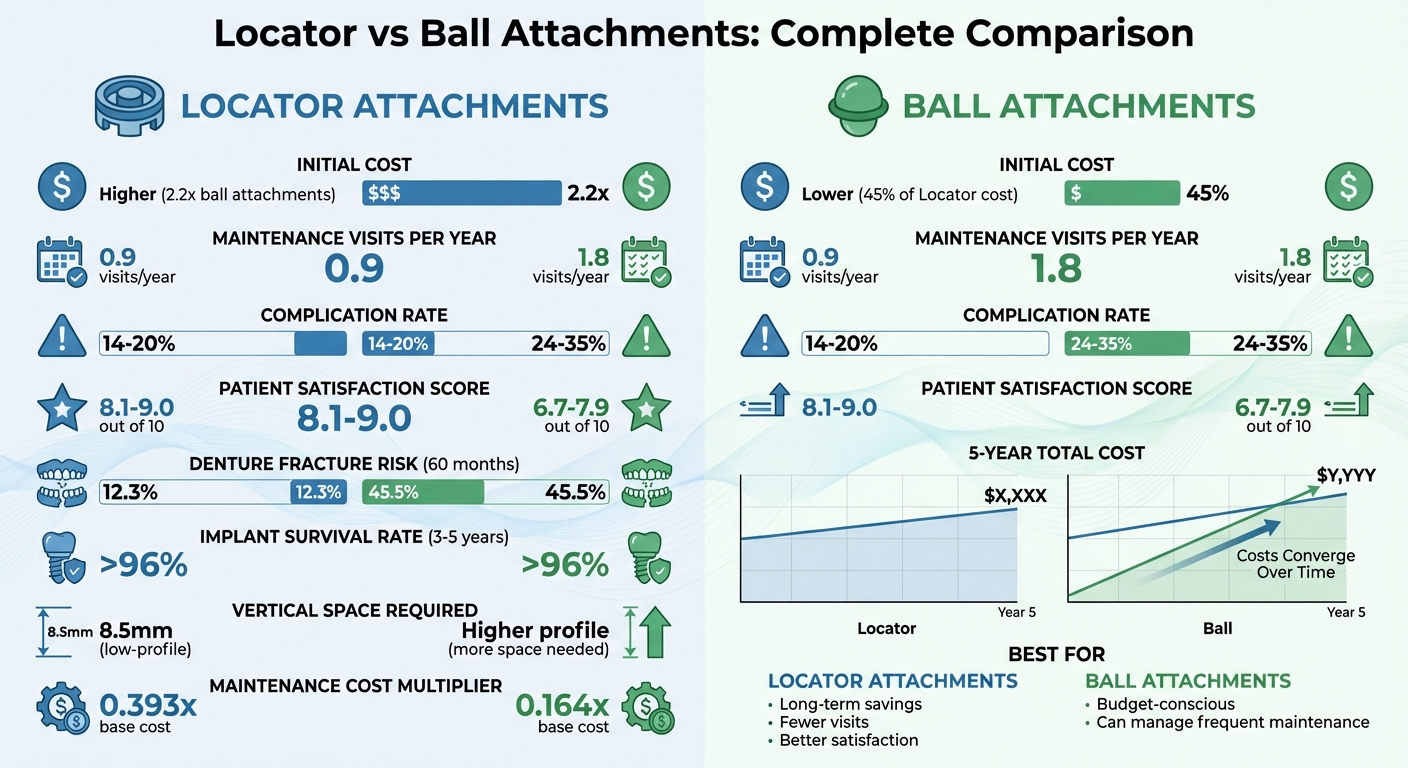
Locator vs Ball Attachments: Cost and Performance Comparison Chart
Stud Attachments and Overdenture Bars: Locator Attachments and Inserts (Part 2)
sbb-itb-2be92ed
What Are Locator Attachments?
Locator attachments are compact, stud-style systems designed to secure implant-supported prostheses. These systems include three main components: a metal abutment attached to the implant, a metal housing embedded in the denture, and a replaceable retentive insert.
What sets locator attachments apart is their dual retention mechanism, which combines internal and external friction. This design not only ensures even distribution of occlusal forces but also features a snap-fit, self-aligning mechanism. This allows for slight denture pivoting, making them a practical option for patients who may struggle with manual dexterity. Studies show that patients using locator attachments report satisfaction scores ranging from 8.1 to 9.0 out of 10, outperforming ball attachments in this area [2].
Features of Locator Attachments
One standout feature of locator attachments is their reduced vertical height, making them particularly useful when interarch space is limited. This compact design helps minimise stress on the peri-implant areas during everyday activities like chewing and speaking [2][3].
Another advantage is their versatility in treatment planning. For example, systems like LOCATOR FIXED allow clinicians to transition a patient from a removable overdenture to a fixed full-arch prosthesis without replacing the abutments. This is achieved by simply swapping the retentive inserts and housings. This streamlined adaptability can save up to 30% of chair time compared to traditional bar overdenture procedures [5].
Locator Attachment Costs
Locator attachments come with a higher upfront price tag – approximately 2.2 times more expensive than traditional ball attachments [4]. In Australia, the exact cost may vary depending on the practice and supplier, but the price reflects the advanced design and functionality of the system.
Maintenance costs are also higher. Replacement components like inserts and housings can make aftercare expenses 2.39 times greater than those for ball attachments [4]. However, locator attachments typically require fewer maintenance interventions – about 0.9 visits per year, compared to 1.8 for ball attachments [2]. This reduced maintenance demand helps offset the initial investment, offering long-term cost efficiency.
Next, we’ll delve into the features and costs of ball attachments to provide a clearer picture of their overall value.
What Are Ball Attachments?
Ball attachments provide a straightforward and reliable way to secure implant-supported dentures. The system is built around two main components: a spherical abutment (the male part) attached to a dental implant or natural tooth root, and a socket-like housing (the female part) embedded in the denture. Inside this housing is a replaceable insert, usually made from durable materials like nylon or silicone, which grips the ball abutment. This setup allows for controlled movement, ensuring functionality during everyday use [6].
One of the standout features of this design is its ability to allow up to 11 degrees of movement, which helps minimise stress on the implants during chewing and other activities [6]. The spherical shape also creates a secure "click" mechanism, making it user-friendly – especially for patients who may struggle with manual dexterity [6].
Ball attachments are most commonly used for implant-retained overdentures in cases of full tooth loss. However, they can also be applied to tooth-retained overdentures and removable partial dentures [6]. Impressively, implant survival rates for overdentures using ball attachments exceed 96% over three to five years [2]. That said, they are not without drawbacks, as prosthetic complications are reported in 24–35% of cases [2].
Here’s a closer look at the features that contribute to their affordability and functionality.
Features of Ball Attachments
Ball attachments are known for being simple and affordable. The abutments are usually made from biocompatible titanium alloys (Grade 5), which offers strength and resistance to corrosion. Some higher-end models include a gold-coloured titanium nitride coating for a more polished appearance [10][8]. The retentive caps, made from nylon or silicone, are designed for vertical flexibility and to reduce friction [4].
However, ball attachments do require more vertical space than low-profile systems like locators, which can make them unsuitable for patients with limited interarch clearance [6][2]. They also tend to need more maintenance, averaging about 1.8 to 1.9 visits per year, compared to 0.9 for locator systems [2][3]. The most common maintenance task is replacing the nylon O-ring or matrix component, which wears out over time [6][3]. While this might sound like a downside, the straightforward design of ball attachments helps keep both initial and ongoing costs relatively low.
In terms of patient satisfaction, ball attachments score between 6.7 and 7.9 out of 10 [2]. While this is decent, it’s slightly lower than the 8.1 to 9.0 scores typically given to locator systems. Nevertheless, ball attachments are often regarded as the "gold standard" for affordability and effectiveness in overdenture retention [6][4].
Ball Attachment Costs
The design of ball attachments makes them a cost-effective choice, both initially and over time. Research shows that the initial cost of ball attachment systems is about 45% of the cost of newer systems like the CM-LOC [4]. For example, individual ball attachment units are priced at approximately $110–$120 AUD (converted from $75–$80 USD) in research scenarios [4].
In Australia, prices vary depending on suppliers and practices. Typical costs include:
- Straight ball abutments: $10–$28 AUD
- Angulated abutments: $55–$67 AUD
- Retentive caps (nylon or silicone): $8–$13 AUD
Complete sets of ball attachments generally range between $23 and $75 AUD [7][9][8][10].
Maintenance costs are also relatively low. Studies indicate that ongoing care for ball attachment systems costs about 0.164 times the base system cost, compared to 0.393 times for CM-LOC systems [4]. This affordability, combined with their proven reliability, makes ball attachments a practical choice for many patients.
Cost Comparison: Locator vs Ball Attachments
Initial Costs: Locator vs Ball
When it comes to upfront costs, ball attachments are the more economical option. In Australia, the exact prices can vary, but research from Cairo University indicates that Locator attachments are approximately 2.2 times more expensive than ball attachments [4]. However, upfront costs are only part of the picture – maintenance and aftercare significantly influence long-term expenses.
Maintenance and Aftercare Costs
The initial price difference between the two systems becomes more pronounced when you factor in ongoing maintenance. While Locator attachments come with a higher upfront cost, they require less frequent maintenance. In contrast, ball attachments demand roughly double the number of maintenance visits each year [2].
Ball attachments also need more frequent replacement of their nylon O-rings or caps, typically every 12–18 months. Locator systems, on the other hand, use replaceable nylon inserts that are easier to swap out during a routine dental visit. With regular dental check-ups costing between $200–$300 AUD and cleanings priced at $100–$200 AUD [12], the annual maintenance expenses for ball attachment users can add up quickly.
Total Costs Over 5 Years
Over a five-year period, the higher initial cost of Locator attachments can be mitigated by their lower maintenance demands and reduced complication rates. A study found that the total cost of a Locator system, including one year of maintenance, is 2.22 times that of a ball attachment system [4]. However, the long-term cost gap narrows when you factor in the higher complication rates associated with ball attachments (24–35%) compared to Locator systems (14–20%) [2]. Additionally, the risk of denture fractures over 60 months is significantly higher with ball attachments (45.5%) than with Locator attachments (12.3%) [3]. These complications often lead to extra repair or replacement costs.
Another advantage of Locator systems is their ability to reduce chair time by around 30%, which can lower indirect costs related to clinical visits [1]. Over time, these benefits can help offset the higher initial investment.
"Locator attachments appear to offer superior clinical outcomes in terms of bone preservation, retention, reduced maintenance, and patient satisfaction when compared to ball attachments."
– Michele Miranda, Department of Clinical Sciences and Translational Medicine, University of Rome Tor Vergata [2]
Factors That Affect Cost Differences
The difference in costs between attachment systems often comes down to the materials used, the complexity of their design, and the manufacturing processes involved.
Ball attachments, for instance, are made up of a metal ball patrix paired with a replaceable nylon or polyethylene cap [2][4]. These materials are relatively basic, which helps keep production costs low – pricing typically starts at around $75–$80 [4]. On the other hand, locator systems incorporate advanced polymers like PEKK, known for their excellent chemical and mechanical resistance. While PEKK offers durability, its rigidity can lead to increased wear due to friction during denture movement [4].
Design complexity is another key factor. Ball attachments rely on a simple single-point retention mechanism, making them easier and less expensive to manufacture. Locator systems, however, feature a dual-retention, self-aligning design that accommodates implant angulation differences of up to 40° [2][13]. This versatility is a key part of how dental implants work to support overdentures. This level of sophistication raises production costs, with locator hardware being about 2.2 times more expensive than ball attachments [4].
There are also hidden costs to consider. Ball attachments can weaken the denture acrylic, often requiring metal reinforcements to maintain structural integrity [3]. These reinforcements add to both material and lab expenses, which might not be apparent when comparing initial prices. Locator systems, by contrast, distribute stress more evenly, reducing the need for such reinforcements.
"The ball attachment system showed better cost-effectiveness compared to the CM-LOC attachment from the beginning of the study and throughout all the treatment period during the first year." – Amr Ahmed Naguib, Department of Removable Prosthodontics, Cairo University [4]
Ultimately, these factors highlight the importance of choosing an attachment system that balances clinical requirements with long-term cost-effectiveness.
Choosing the Right Attachment System
When it comes to deciding between locator and ball attachments, the choice isn’t just about cost – it’s about finding the right balance between clinical needs, lifestyle, and budget. Each option has its own strengths, making it suitable for different situations.
Anatomical factors often play a big role in the decision. For instance, if there’s limited vertical space between your jaws, locator attachments tend to be a better fit. Thanks to their low-profile design, they only need about 8.5 mm of vertical space to work effectively [11]. On the other hand, for individuals who struggle with manual dexterity, the self-aligning feature of locator attachments makes handling the prosthesis much easier [2].
Cost is another key consideration, but it’s important to think beyond the initial price tag. While ball attachments are often cheaper upfront, they require about twice as many maintenance interventions compared to locator attachments [2]. This means more visits to the dentist and potentially higher costs over time. Ball attachments might be a good option if you’re focused on keeping upfront costs low and prefer a simpler clinical approach [2]. However, the long-term maintenance aspect is something to weigh carefully.
"Locator attachments demonstrate superior clinical performance in terms of patient satisfaction and lower complication rates, with reduced maintenance interventions compared to ball attachments." – Michele Miranda, Department of Clinical Sciences and Translational Medicine, University of Rome Tor Vergata [2]
Ultimately, a thorough clinical assessment with your dental professional is essential. They’ll consider factors such as your jaw anatomy, interarch space, bone density, and your financial plans to help you make the best choice [2].
FAQs
Which attachment is cheaper over 5 years?
Over a five-year period, the CM-LOC attachment system tends to be a more cost-effective choice compared to ball or locator attachments. This primarily comes down to its reduced maintenance expenses and greater value over time. Studies show that ball and locator attachments often lead to higher prosthetic upkeep costs, which can make them less economical in the long term. For single implant mandibular overdentures, the CM-LOC system offers a more budget-friendly solution over time.
How often do the inserts or O-rings need replacing?
O-rings or inserts in locator attachment systems typically require replacement around every two months. That said, this timeframe can shift based on factors like how often they’re used and the level of wear they experience. To keep these attachments working at their best and to extend their lifespan, it’s a good idea to perform regular maintenance and inspections.
Which option works better if I have limited jaw space?
Locator attachments work well when jaw space is limited. They take up less vertical space and provide stronger retention compared to ball attachments. This makes them ideal for situations where space is tight, ensuring overdentures stay securely in place even with spatial constraints.
Related Blog Posts
- Denture Costs in Australia: 2025 Guide
- Checklist: Evaluating Cost-Effectiveness of Dental Implants
- 3D Printing in Implants: Cost vs Benefits
- Pros and Cons of Dental Implants vs Dentures
Important Notice: Any surgical or invasive procedure carries risks. Before proceeding, you should seek a second opinion from an appropriately qualified health practitioner.
Individual results may vary. The information provided in this article is for educational purposes only and does not constitute medical advice.
Checkout Related Blogs




Get in touch with us
For more information, call us now to start feeling better. Or fill the form below to make appointment
The Latest News from Complete Smiles
How to Clean Clear Plastic Retainers
Checklist for Choosing Wearable Dental Devices
Checklist for Choosing Cloud AI Platforms in Dentistry

Complete Smiles Bella VistaAccepts All Major Health Funds, Including





