





Ultimate Guide to Laser Wavelengths in Dentistry
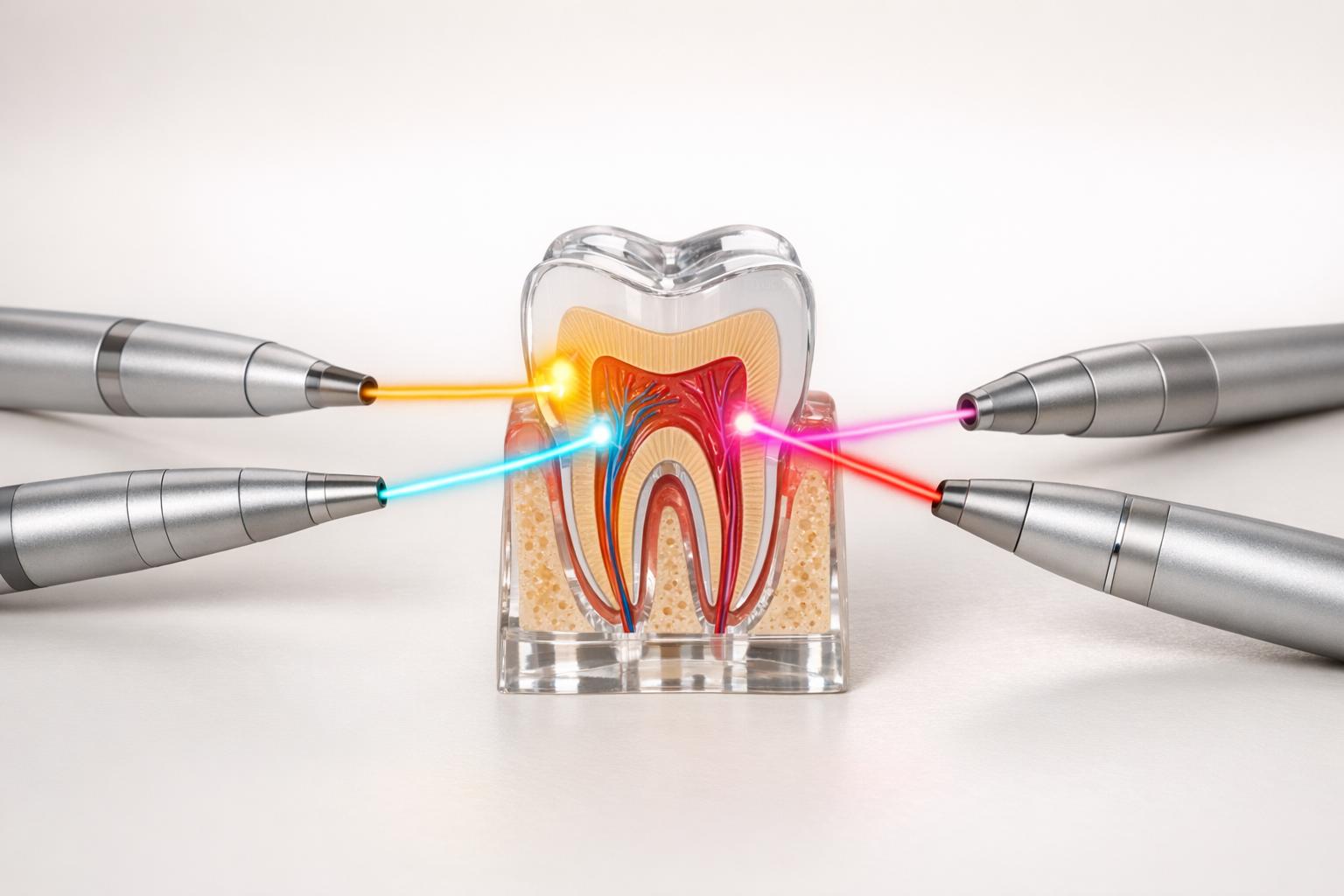
Lasers have revolutionised dental care, offering precise, tissue-specific treatments. Whether for soft tissue surgery, cavity preparation, or teeth whitening, understanding laser wavelengths is key to safe and effective outcomes. Here’s what you need to know:
- Wavelengths matter: Dental lasers operate between 488 nm and 10,600 nm, with each wavelength targeting specific tissue components like water, haemoglobin, or hydroxyapatite.
- Soft vs. hard tissues: Blue and near-infrared lasers (445–1064 nm) excel in soft tissue procedures, while mid-infrared lasers (2780–2940 nm) are ideal for hard tissues.
- Laser types: Common lasers include diode (445–1064 nm), erbium (2780–2940 nm), Nd:YAG (1064 nm), and CO₂ (9300–10,600 nm), each suited to specific tasks.
- Patient benefits: Lasers reduce bleeding, promote faster healing, and minimise discomfort during procedures.
- Safety first: Proper training, protective eyewear, and calibrated equipment are essential to avoid risks like thermal damage or eye injury.
Lasers offer precision and efficiency, but their use requires expertise and careful planning for optimal results.
How Laser Wavelengths Interact with Dental Tissues
Absorption, Reflection, and Scattering
When laser light meets dental tissue, it undergoes a variety of processes including absorption, reflection, scattering, and transmission [5]. Of these, absorption plays the most vital role in achieving clinical effects. This process involves chromophores absorbing the laser’s energy and converting it into thermal, chemical, or mechanical energy [7].
"As the prime factor governing interaction, the absorption coefficient of any tissue element is a function of the degree of energy attenuation of a chosen incident laser wavelength." – Steven Parker, Leicester School of Pharmacy [7]
Reflection occurs at the tissue surface, redirecting energy without any therapeutic benefit. Scattering, on the other hand, spreads the laser light, reducing its surgical intensity but potentially aiding in photobiomodulation [7]. Transmission allows the laser energy to penetrate superficial layers and reach deeper structures like the dental pulp [4]. The attenuation coefficient, which measures how much energy is reduced as it passes through tissue, varies with wavelength. For example, in dental hard tissue, the attenuation coefficient is 5.42 cm⁻¹ at 450 nm, 1.87 cm⁻¹ at 650 nm, 2.45 cm⁻¹ at 810 nm, and 2.55 cm⁻¹ at 980 nm [4]. Blue light (450 nm) has the highest attenuation, meaning it struggles to penetrate tooth structures compared to red or near-infrared light.
The table below highlights how different laser wavelengths interact with various dental tissue components:
| Tissue Component | Primary Laser Wavelengths | Interaction Type |
|---|---|---|
| Soft Tissue (Haemoglobin/Melanin) | 445 nm, 532 nm, 810 nm, 980 nm, 1064 nm | Photothermal (Pigment absorption) |
| Soft Tissue (Water) | 2780 nm, 2940 nm, 10,600 nm | Photothermal (Water vaporisation) |
| Enamel/Dentine (Hydroxyapatite) | 2780 nm, 2940 nm, 9300–9600 nm | Photomechanical/Photothermal |
| Dental Pulp | 650 nm, 810 nm, 980 nm | Photobiomodulation (Transmission) |
Dental Tissues Affected by Lasers
Expanding on these interactions, dental tissues exhibit unique responses to various laser wavelengths due to their specific compositions. Soft tissues contain chromophores like haemoglobin and melanin, which are highly responsive to visible and near-infrared wavelengths (405–1064 nm). Meanwhile, mid-infrared (Erbium) and far-infrared (CO₂) wavelengths are primarily absorbed by water [7][9]. Soft tissue ablation occurs at approximately 60°C, as proteins begin to dissociate [7].
Hard tissues, such as enamel and dentine, demand a different approach. Mid-infrared lasers (2780–2940 nm) are absorbed efficiently by water and hydroxyapatite, causing rapid vaporisation of interstitial water and fragmentation of the mineral structure [7][8]. Enamel’s translucency increases when the laser beam aligns parallel to hydroxyapatite rods. In contrast, dentine’s response depends on factors like tubule diameter, density, and orientation, which influence light scattering [4].
"Clinicians should recognise that significant attenuation occurs during laser energy delivery to the pulp, influenced by the wavelength, thickness, and tooth type." – Lasers in Dental Science [4]
For instance, the transmittance of 980 nm laser energy through the dental crown to the pulp ranges between 2% and 18% [4]. This considerable energy loss requires clinicians to adjust the laser’s surface dose to effectively target sub-surface structures [4].
The Myths and Physics of Soft Tissue Surgical Dental Lasers with Peter Vitruk, PhD, MInstP, CPhys
Types of Dental Lasers and Their Wavelengths
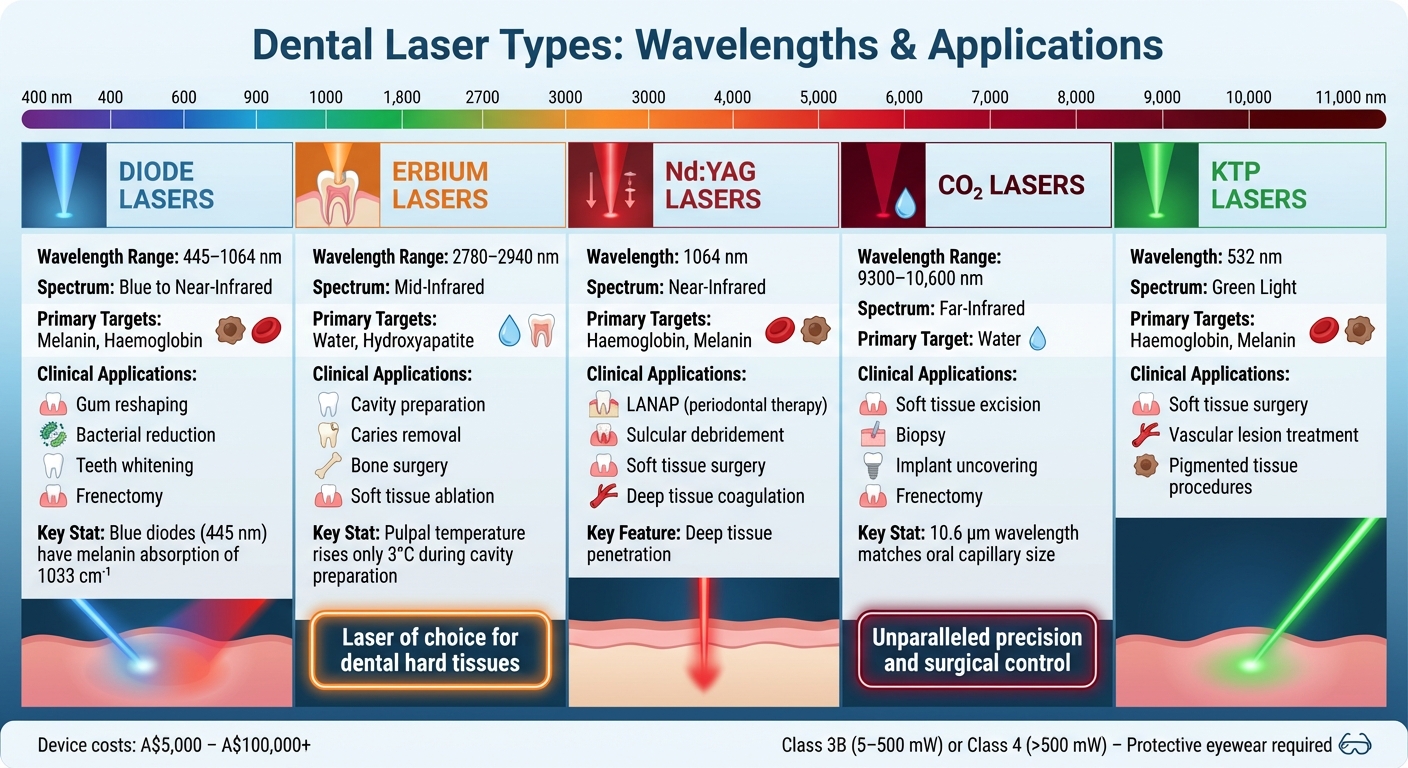
Dental Laser Types: Wavelengths, Targets, and Clinical Applications Comparison Chart
Understanding the various types of dental lasers sheds light on why dentists choose specific wavelengths for different procedures. Each laser operates within a unique wavelength range, targeting specific tissue components with varying levels of precision and thermal effects. Below, we break down the key laser types, their wavelengths, and their clinical applications.
Diode Lasers (445–1064 nm)
Diode lasers, made from semiconductors, cover wavelengths from blue light (445 nm) to near-infrared (1064 nm). Blue diode lasers (445–450 nm) are highly absorbed by haemoglobin (1404 cm⁻¹) and melanin (1033 cm⁻¹), making them excellent for cutting tissues – even without direct contact. They’re also effective at reducing Enterococcus faecalis in dentine at low power settings like 0.6 W in continuous mode[2]. Near-infrared diodes (803–1064 nm) are commonly used for procedures like gum reshaping, frenectomies, and photobiomodulation, though they are less suited for hard tissue work[11].
Erbium Lasers (2780–2940 nm)
Erbium lasers, including Er,Cr:YSGG (2780 nm) and Er:YAG (2940 nm), are the go-to choice for hard tissue procedures. Their strong absorption in water and hydroxyapatite ensures precise work. As noted in the South African Dental Journal:
"The erbium wavelengths have a high affinity for hydroxyapatite and the highest absorption of water of any laser wavelengths. Consequently, it is the laser of choice for treatment of dental hard tissues."[11]
This makes them ideal for cavity preparation, caries removal, and bone surgery. For example, during cavity preparation with an Er:YAG laser, the pulpal temperature rises by only 3°C – well within the safe range to prevent pulp damage.
Nd:YAG Lasers (1064 nm)
Nd:YAG lasers, operating at 1064 nm in the near-infrared spectrum, penetrate deeply into tissues. Like diode lasers, they are absorbed by haemoglobin and melanin, but their energy travels deeper before converting to heat. This makes them highly effective for cutting and coagulating soft tissues while ensuring excellent haemostasis. They’re widely used in periodontal therapy, including procedures like Laser-Assisted New Attachment Procedure (LANAP) and sulcular debridement. However, precise control of power settings is essential to avoid excessive thermal effects on nearby tissues[11].
CO₂ Lasers (9300–10600 nm)
CO₂ lasers work in the far-infrared range (9300–10600 nm) and primarily target water in tissues. The 10.6 µm (10,600 nm) wavelength is particularly suited for soft tissue surgery, as it aligns closely with the size of oral soft-tissue capillaries[10]. According to Martin A. Kaplan, DMD, from the American Academy of Pediatric Dentistry:
"The adjustments for various tissue types and the exact precision of ablation are unparalleled. No other laser allows for this fine surgical control."[10]
CO₂ lasers excel at creating a dry surgical field with minimal bleeding, as they evaporate intracellular fluids rapidly. This shallow penetration minimises swelling and speeds up healing, making them ideal for soft tissue excisions, biopsies, implant uncovering, and frenectomies.
Other Laser Types
Specialised lasers like Argon and KTP are used for niche applications. KTP lasers, for instance, emit green light at 532 nm, which is strongly absorbed by pigmented tissues[2][11]. These options provide clinicians with additional tools to address specific procedural needs.
The table below summarises the main characteristics of each laser type:
| Laser Type | Wavelength(s) | Primary Target | Clinical Applications |
|---|---|---|---|
| Diode | 445–1064 nm | Melanin, Haemoglobin | Gum reshaping, bacterial reduction, whitening, frenectomy |
| Erbium | 2780–2940 nm | Water, Hydroxyapatite | Cavity preparation, caries removal, bone surgery, soft tissue ablation |
| Nd:YAG | 1064 nm | Haemoglobin, Melanin | Periodontal therapy (LANAP), sulcular debridement, soft tissue surgery |
| CO₂ | 9300–10600 nm | Water | Precise soft tissue excision, biopsy, implant uncovering, frenectomy |
| KTP | 532 nm | Haemoglobin, Melanin | Soft tissue surgery, vascular lesion treatment |
Dental laser devices range widely in price, from approximately A$5,000 to over A$100,000, depending on their wavelength and power output. Most surgical lasers fall into Class 3B (5–500 mW) or Class 4 (above 500 mW), requiring strict safety measures. Both patients and dental staff must use wavelength-specific protective eyewear during procedures[6][3].
sbb-itb-2be92ed
Laser Applications by Dental Specialty
The use of lasers in dentistry stems from their ability to interact with tissue in highly specific ways, making them a valuable tool across various dental specialties. Each wavelength offers unique benefits, tailored to address specific clinical needs.
General Dentistry
In general dentistry, erbium lasers are a go-to for hard tissue procedures. Their high absorption in water and hydroxyapatite makes them perfect for cavity preparation and caries removal, achieving precision without causing thermal damage. For teeth whitening, lasers like Argon (488 nm), CO₂, and blue diodes are employed to activate bleaching gels. Blue diode lasers (445 nm), in particular, enhance the bleaching process when paired with matching oxidisers[2]. Additionally, diode lasers are commonly used for gum reshaping, showcasing their flexibility in general dental treatments.
Periodontics
Nd:YAG lasers, operating at 1064 nm, are pivotal in periodontal care. They are integral to procedures like the Laser Assisted New Attachment Procedure (LANAP) and sulcular debridement[12][11]. These lasers penetrate deeply and are absorbed by haemoglobin, facilitating tissue regeneration and controlling bleeding. Erbium lasers complement Nd:YAG lasers by efficiently removing calculus from root surfaces. Together, these wavelengths enable periodontists to address gum disease while encouraging tissue healing.
Cosmetic Dentistry
Cosmetic dentistry has greatly benefited from blue diode lasers (445–450 nm), especially for treating gingival hyperpigmentation. With a melanin absorption coefficient of 1033 cm⁻¹, they provide faster results compared to traditional 2780 nm wavelengths[2]. CO₂ lasers, operating at 9.3 µm, are another asset for cosmetic procedures. According to Convergent Dental, this wavelength allows seamless work on enamel, dentine, decay, gingiva, and bone, with 95% of procedures reportedly performed without anaesthesia[13]. This reduces discomfort, noise, and vibration, improving the overall patient experience. Diode lasers (810–980 nm) are also widely used for precise gingival contouring, while Argon lasers play a role in activating teeth whitening agents[14].
Oral Surgery
In oral surgery, CO₂ lasers stand out for their precision in soft tissue ablation. They create a dry surgical field with minimal bleeding, reduced swelling, and faster recovery times, making them ideal for procedures like biopsies, implant uncovering, and frenectomies. Erbium lasers are employed when bone surgery or hard tissue modifications are needed, while Nd:YAG lasers are preferred for deeper soft tissue work requiring effective coagulation. These capabilities make lasers an indispensable tool for oral surgeons.
Benefits, Limitations, and Patient Considerations
Advantages of Laser Dentistry
Laser dentistry offers several benefits compared to traditional dental tools. For starters, lasers can reduce pain by blocking pain signals and slowing down nerve conduction, which often means less need for local anaesthesia – especially when erbium lasers are used for cavity preparation[14]. During surgery, lasers seal blood vessels and lymphatic channels, creating a nearly bloodless environment. This often eliminates the need for sutures and minimises swelling thanks to their anti-inflammatory properties[14][6]. Healing times are generally quicker because laser energy boosts cellular activity, encourages collagen production, and improves blood flow[14]. Additionally, the high-intensity light from lasers effectively kills bacteria and pathogens, reducing the risk of infection in the surgical area[14][1]. These advantages make treatments more comfortable and recovery smoother for patients.
Limitations of Lasers in Dentistry
Despite their benefits, lasers do have some drawbacks. The cost of dental laser devices can range from A$5,000 to over A$100,000[6], and these expenses may impact treatment fees. Insurance coverage can vary, as many plans base reimbursements on treatment codes rather than the method used.
Lasers also have limitations in their application. For example, they cannot be used on teeth with metal restorations, and traditional drills are still necessary for tasks like shaping fillings and adjusting bite alignment[14][1]. Some lasers, such as the Er:YAG, might weaken the bond strength of restorative materials to enamel or cause discolouration at cavity edges[1]. Moreover, high-intensity diode lasers may not offer long-term benefits over conventional non-surgical treatments[1].
Safety is another concern. Class 4 lasers can cause serious eye damage or skin burns if not handled properly. Incorrect settings could lead to irreversible damage, such as pulp necrosis or issues with implant integration[3][2][14]. Laser procedures also produce surgical plumes, requiring specialised suction systems and high-filtration masks[3].
Training is crucial for safe and effective laser use. Dimitris Strakas from Aristotle University of Thessaloniki highlights the risks, stating:
"The fact that inexperienced and uneducated dental laser users are using them as ‘another dental laser diode’ makes them a potentially dangerous tool as thermal effects can be very dramatic"[2]
The Australian Dental Association reinforces this point:
"Safe use of lasers in a dental practice must be achieved by following a program of laser safety activities and procedures which are monitored, reviewed and audited to achieve best practice"[3]
Questions to Ask Your Dentist
Given the pros and cons of laser dentistry, it’s important for patients to have an open and thorough conversation with their dentist. Start by confirming your dentist’s qualifications and training, including certifications specific to the laser device being used and any manufacturer-specific training they’ve completed[16][19]. Also, ensure the laser equipment is listed on the Australian Register of Therapeutic Goods[16][3].
Ask why a laser is being recommended for your procedure instead of traditional methods[19]. Discuss whether local anaesthesia will be necessary and what risks or side effects might arise, such as temporary sensitivity or mild gum irritation[17][18][15][16].
Financial aspects are also worth addressing. Request a cost comparison between laser and traditional treatments, and check with your insurance provider about coverage for the specific procedure code[15][19]. Additionally, ask for written aftercare instructions that include details on medication, diet, and oral hygiene adjustments[17]. Lastly, confirm that the practice provides appropriate laser-protective eyewear for you and the staff during the procedure[16][3].
Conclusion
Laser wavelengths play a key role in ensuring safe and effective dental treatments. Blue and near-infrared wavelengths are suited to different clinical applications, while erbium lasers are particularly effective for hard tissue procedures[1][2][4].
The Australian Dental Association advises practitioners to carefully select laser parameters – such as wavelengths, doses, and irradiance – tailored to the patient’s needs and the specific clinical situation. Factors like tooth thickness and type can significantly influence how much laser energy reaches the intended tissues[3][4]. These precise adjustments not only improve treatment outcomes but also establish essential safety measures.
Safety protocols are non-negotiable, especially when using Class 4 lasers, which exceed 500 mW and can pose risks like severe eye damage and skin burns[3]. Accurate calibration is critical, as the displayed power settings on equipment often differ from the actual output. To ensure patients receive the intended treatment dose, clinicians should routinely check their devices with a calibrated power meter[4]. This step is key to achieving the correct dosing.
Getting the dose right is essential. Too little energy won’t be effective, while too much can interfere with healing. This highlights the importance of specialised training and careful parameter selection[4]. Ultimately, successful outcomes depend on matching the appropriate wavelength to the clinical need, all while adhering to strict safety standards. This approach enhances precision, improves healing times, and increases patient comfort.
FAQs
How do laser wavelengths impact dental treatments?
Laser wavelengths are a crucial factor in dental treatments, as they determine how the laser interacts with various oral tissues. Each wavelength has distinct absorption characteristics, which directly impact the precision, effectiveness, and safety of the procedure.
For soft tissue treatments, wavelengths in the visible spectrum, such as 450 nm or 650 nm, are absorbed by pigments like melanin and haemoglobin. This makes them perfect for achieving precise cuts and effective coagulation. On the other hand, near-infrared wavelengths, like 810 nm or 980 nm, can penetrate deeper into tissues. While this is advantageous for certain procedures, it requires precise control to prevent overheating the surrounding areas.
When it comes to hard tissue applications, wavelengths like 2940 nm (Er:YAG) are particularly effective. They are highly absorbed by water and hydroxyapatite, which allows for precise cutting of enamel or bone with minimal heat damage. Selecting the right wavelength is key to achieving optimal results while reducing potential risks, tailored to the specific tissue type and treatment objectives.
What safety precautions are necessary when using lasers in dental treatments?
Safety is always a top concern when it comes to using lasers in dentistry, ensuring both patients and practitioners are well-protected. One essential step is the use of protective eyewear for everyone in the treatment area, as laser light can pose serious risks to the eyes. Additionally, lasers must be operated in a carefully controlled environment to avoid any accidental exposure.
Handling laser equipment should be left to trained professionals who understand laser-tissue interactions, know how to adjust power settings appropriately, and are familiar with emergency protocols. In Australia, dental practices must adhere to strict safety standards like AS/NZS IEC 60825, ensuring all equipment is regularly maintained and audited for safe use.
By sticking to these safety measures, dental practices can confidently provide laser treatments that prioritise both safety and effectiveness.
Why are different lasers used for specific dental treatments?
Lasers play a crucial role in dental treatments because their wavelengths interact differently with various types of tissues. This unique interaction allows dentists to target specific areas with precision, whether working on hard or soft tissues. For example, Er:YAG and Er:YSGG lasers are excellent for hard tissue procedures like cavity preparation. These lasers can precisely remove enamel while minimising damage to the surrounding tissue. Meanwhile, diode and Nd:YAG lasers are more effective for soft tissue treatments, such as gum surgery or periodontal therapy, as they are absorbed efficiently by pigmented tissues like haemoglobin.
When choosing a laser, factors like safety, the desired outcome, and patient comfort are carefully considered. Lasers that produce minimal heat are often preferred for delicate procedures, as they ensure accuracy and reduce discomfort. By tailoring the laser choice to the specific treatment, dentists can deliver precise results while prioritising patient safety and comfort.
Related Blog Posts
- Advances in Laser Whitening Technology 2025
- Top Uses of Lasers in Soft Tissue Dentistry
- Guide to Laser Safety in Periodontal Care
- 7 Pros And Cons Of Laser Dentistry
Important Notice: Any surgical or invasive procedure carries risks. Before proceeding, you should seek a second opinion from an appropriately qualified health practitioner.
Individual results may vary. The information provided in this article is for educational purposes only and does not constitute medical advice.
Checkout Related Blogs




Get in touch with us
For more information, call us now to start feeling better. Or fill the form below to make appointment
The Latest News from Complete Smiles
How to Clean Clear Plastic Retainers
Checklist for Choosing Wearable Dental Devices
Checklist for Choosing Cloud AI Platforms in Dentistry

Complete Smiles Bella VistaAccepts All Major Health Funds, Including





