





Guide to Laser Safety in Periodontal Care

Using lasers in periodontal care offers precise treatment with less discomfort and quicker recovery. However, without proper handling, these tools can cause severe injuries, burns, and even fire risks. Here’s a quick overview of the key points on laser safety:
- Laser Types: Diode, CO₂, and Er:YAG lasers are commonly used. Each has specific applications, risks, and safety measures.
- Main Risks: Eye injuries, skin burns, and exposure to harmful surgical plumes. Fire hazards are also a concern.
- Protective Equipment: Wavelength-specific eyewear, high-filtration masks, and proper ventilation are essential.
- Workplace Protocols: Pre-procedure equipment checks, controlled laser zones, and clear warning signs help prevent accidents.
- Patient Safety: Pre-treatment evaluations, informed consent, and post-procedure care are critical for effective recovery.
Quick Tip: Always match protective eyewear to the laser’s wavelength and ensure high-volume suction systems are in place to manage surgical plumes.
Following these safety protocols ensures effective treatment while reducing risks for both patients and practitioners. Let’s dive into the details.
Laser Types in Periodontal Procedures
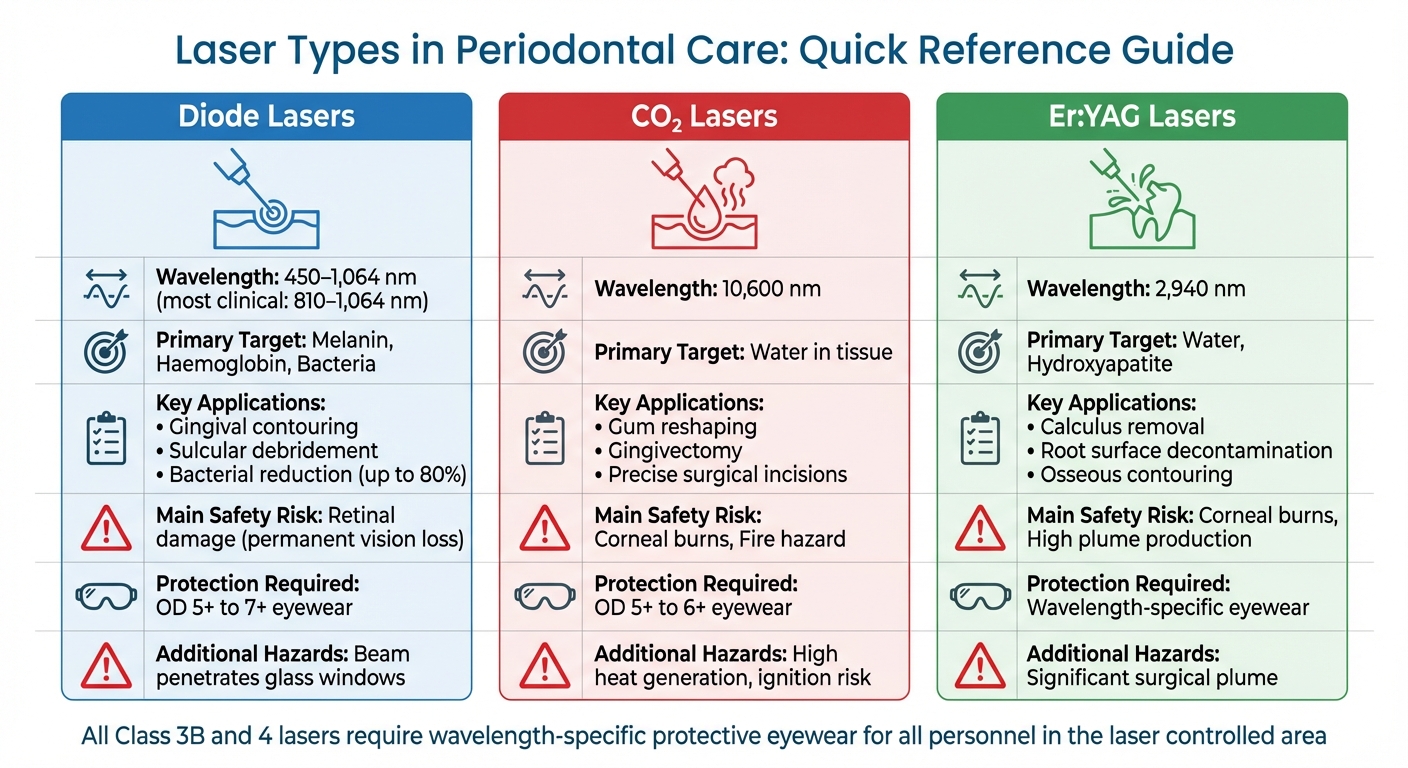
Comparison of Laser Types Used in Periodontal Care: Wavelengths, Applications, and Safety Risks
In Australian periodontal care, three primary laser types are commonly used. Each comes with distinct wavelengths and safety considerations, making it essential to understand their applications and risks.
Diode Lasers
Diode lasers operate within a range of 450 to 1,064 nm, with most clinical models functioning between 810 and 1,064 nm. Some variations include 445 nm (blue) and 660 nm (red). These lasers target pigments like melanin and haemoglobin, as well as bacteria, using a photothermal effect that makes them particularly effective for soft tissue treatments.
In periodontal procedures, diode lasers are often used for gingival contouring, sulcular debridement, and reducing bacteria in periodontal pockets. Studies suggest that this laser therapy can remove up to 80% of harmful bacteria in the mouth [7]. Their precision comes from their ability to focus on pigmented tissues, minimising damage to surrounding healthy areas.
However, diode lasers pose risks, particularly to vision. Their beams can penetrate the cornea and lens, with haemoglobin absorption potentially leading to permanent central vision loss [8]. These risks extend beyond the treatment area since the beams can pass through glass windows. To mitigate this, protective measures such as window blinds or non-flammable barriers are crucial [8]. Additionally, incorrect power settings can lead to thermal injuries, causing tooth sensitivity or structural damage [6].
For a different wavelength and safety profile, CO₂ lasers offer another option.
CO₂ Lasers
CO₂ lasers operate at a wavelength of 10,600 nm and are absorbed primarily by water in tissue. This makes them excellent for soft tissue applications such as gum reshaping, gingivectomy, and precise surgical incisions [9][10]. These lasers are among the earliest introduced to dentistry, valued for their precision and minimally invasive capabilities.
The safety concerns for CO₂ lasers differ significantly from diode lasers. Their long wavelength is absorbed by surface water, so the primary ocular risk is corneal burns, not retinal damage [8]. However, CO₂ lasers present a considerable fire hazard due to the high heat they generate. Dry materials, alcohol-based solutions, or oxygen-enriched areas can ignite during use. Preventive measures include removing dry gauze and alcohol-based solutions from the surgical field, keeping water accessible, and having a fire extinguisher nearby [8].
Er:YAG Lasers
Erbium:YAG lasers emit light at 2,940 nm, a wavelength absorbed by both water and hydroxyapatite – the mineral found in bone and teeth. This dual absorption capability makes Er:YAG lasers highly versatile, suitable for both soft and hard tissue treatments. They are commonly used for calculus removal, root surface decontamination, and osseous contouring.
Like CO₂ lasers, Er:YAG lasers primarily pose a risk of corneal injury rather than retinal damage [8]. However, they produce a significant amount of surgical plume during hard tissue ablation. This airborne debris can carry toxic or infectious particles, requiring high-volume evacuation systems and appropriate respiratory protection for safety [8].
| Laser Type | Wavelength | Primary Target | Key Periodontal Use | Main Safety Risk |
|---|---|---|---|---|
| Diode | 450–1,064 nm | Melanin, Haemoglobin | Gingival contouring, sulcular debridement, bacterial reduction | Retinal damage (permanent vision loss) |
| CO₂ | 10,600 nm | Water | Surgical incisions, tissue ablation | Corneal burns, fire hazard |
| Er:YAG | 2,940 nm | Water, Hydroxyapatite | Calculus removal, root surface decontamination, osseous contouring | Corneal burns, high plume production |
A clear understanding of these lasers helps ensure proper safety measures, such as wavelength-specific protective eyewear, and adherence to operative protocols [1][8].
Personal Protective Equipment for Laser Safety
Proper protective gear is essential to reduce risks for both practitioners and patients during Class 3B and Class 4 laser procedures.
Wavelength-Specific Eyewear
Laser light operates at a single wavelength, so protective eyewear must be specifically matched to the laser’s wavelength. Generic safety glasses won’t cut it. The Optical Density (OD) rating indicates how much laser radiation the eyewear blocks – the higher the OD, the better the protection. For instance, diode lasers (810–980 nm) require eyewear with OD ratings of 5+ to 7+, while CO₂ lasers (10,600 nm) need OD 5+ to 6+ protection [11].
Anyone within the laser hazard zone – whether it’s the practitioner, dental assistant, or patient – must wear the correct eyewear [1]. Always check the labels on the glasses to confirm the wavelength and OD rating, and inspect them regularly for damage. While high OD ratings are critical, choosing eyewear with a high Visible Light Transmission (VLT) (75–95%) ensures clear vision and accurate colour perception during procedures [11].
The cost of laser safety glasses varies depending on the type:
- CO₂ safety glasses: A$45–59
- Er:YAG glasses: A$99
- Diode/Nd:YAG glasses: A$194–499 [11]
In addition to eyewear, managing laser plumes is a key part of maintaining a safe environment.
Masks and Ventilation
When lasers vaporise tissue, they produce plumes containing biological particles, chemical fumes, and toxic gases. Class 4 lasers can also generate ozone, which can irritate the eyes and respiratory system. Unfortunately, standard room ventilation alone isn’t enough to handle these airborne hazards.
To stay safe, use high-filtration masks specifically designed for surgical plumes – ordinary surgical masks won’t provide adequate protection [1]. Pair these masks with high-volume suction systems positioned close to the treatment area to capture plumes effectively. The Australian Dental Association underscores the importance of this approach, stating:
safe use of lasers in a dental practice must be achieved by following a program of laser safety activities and procedures which are monitored, reviewed and audited to achieve best practice [1].
A formal risk assessment should be conducted before each procedure to identify potential hazards from vaporised materials and to ensure that appropriate safety measures, such as engineering controls, are in place [2].
Workplace Safety Protocols for Laser Use
Ensuring a safe environment for laser procedures requires every team member to follow well-defined safety protocols consistently.
Pre-Procedure Equipment Checks
Start with a thorough pre-activation checklist to confirm that all laser systems are in proper working order. Check that the laser is registered on the Australian Register of Therapeutic Goods (TGA) and that all calibration, servicing, and electrical testing and tagging are current and properly documented [1]. Ensure the equipment displays the three mandatory labels: a hazard warning symbol, an explanatory label describing the hazard, and an aperture label showing where radiation is emitted. These labels must be durable and clearly legible [2].
Test all engineering controls, including interlocks, beam shutters, emergency shutoff mechanisms, and the laser key function, to confirm they are operational [2]. Additionally, verify that laser handpieces have been cleaned and sterilised in line with infection control standards and manufacturer guidelines [1]. If beam alignment is required, always use the lowest possible power setting to minimise risks [2].
Once the equipment is confirmed to be in working order, focus on creating a controlled environment to limit laser exposure.
Controlled Laser Zones
After completing the equipment checks, establish a restricted laser zone to ensure the safety of staff and patients. For Class 3B and Class 4 lasers, create a designated "laser controlled area" where access is limited to authorised personnel only [2][3]. Place compliant warning signs at all entry points, clearly indicating the laser class and the minimum required personal protective equipment (PPE) [2][3].
Before activating the laser, ensure that environmental safeguards – such as window blinds or screens – are in place to stop the laser beam from escaping the treatment area [1]. Assign a Laser Safety Officer (LSO) or Laser Protection Supervisor (LPS) to oversee safety measures and ensure compliance with protocols [3]. When the laser is not in use, secure the laser key in a safe location to prevent unauthorised activation. Additionally, use fire-resistant backstops or targets to terminate all laser beams safely [2].
sbb-itb-2be92ed
Patient Safety and Post-Procedure Care
Ensuring patient safety involves thorough pre-treatment evaluations and attentive care during the recovery phase.
Pre-Procedure Medical Assessments
Start by reviewing the patient’s medical history for conditions like uncontrolled diabetes, epilepsy, vitiligo, autoimmune disorders, or pregnancy and breastfeeding, as these can affect both the treatment process and recovery. Ask specifically about any photosensitising medications or supplements taken within the last six months, as these can elevate the risk of burns.
Carefully examine the treatment area for moles, lesions, or unusual pigmentation. Use the Fitzpatrick scale to determine the patient’s skin type – darker skin tones may have a higher risk of injury. If needed, conduct a patch test on a small area and observe for adverse reactions over 48 hours before proceeding with the full treatment.
"In instances where the client presents any potential contraindications to treatment, you should refer them to a medical practitioner for medical clearance prior to commencing any light-based treatment." – ARPANSA [4]
During the consultation, explain the laser type, potential risks, side effects, recovery expectations, and alternative options. Obtain written informed consent from the patient. Also, ensure patients remove any jewellery, such as rings and watches, that could reflect the laser beam during the procedure. Record any baseline sun exposure and ask about a history of cold sores or shingles, as these could influence treatment outcomes.
Once these assessments are complete, attention shifts to post-procedure care to support recovery and minimise risks.
Post-Procedure Sterilisation and Follow-Up
After the procedure, immediately sterilise all laser equipment according to the manufacturer’s guidelines. Interestingly, about 84% of cross-infection prevention coordinators report needing to contact manufacturers for clarification on proper sterilisation methods [12].
Provide patients with personalised aftercare instructions. For instance, in LANAP treatments, advise against brushing, flossing, or using interdental brushes for 7–10 days to protect the clot. Recommend a liquid diet for the first three days, transitioning to soft foods, and then resuming a normal diet by the two-week mark [13]. Let patients know that treated gum tissues may appear discoloured for 10–14 days, which is a normal part of the healing process.
Arrange a follow-up appointment two weeks after the procedure to monitor progress. Additionally, suggest professional cleanings every three months for the first year. Emphasise that smoking can significantly hinder the healing process and should be avoided during recovery [13].
Conclusion
Laser safety in periodontal care is an ongoing commitment that protects both patients and practitioners. The Australian Dental Association underscores this importance:
"Safe use of lasers in a dental practice must be achieved by following a program of laser safety activities and procedures which are monitored, reviewed and audited to achieve best practice" [1].
This principle forms the backbone of the safety measures and protocols discussed earlier.
High-power Class 3B and 4 lasers require strict safety protocols due to their rapid energy delivery, which can bypass natural protective reflexes. Adhering to these protocols ensures effective and safe treatment. Key practices include tailoring laser parameters to individual patient needs, using wavelength-specific protective eyewear, and establishing controlled laser zones to prevent accidental exposure [1][5]. Regular equipment maintenance, thorough staff training, and robust infection control procedures further reduce risks and enhance safety.
Regulatory compliance is equally vital, ensuring adherence to Australian standards while addressing legal responsibilities. These regulations reinforce the importance of equipment checks and controlled environments, as outlined earlier [1][3][5]. By maintaining consistent vigilance and following systematic safety protocols, practitioners can confidently deliver quality periodontal care while ensuring a safe environment for everyone involved.
FAQs
What are the key safety concerns when using lasers in periodontal care?
When using lasers in periodontal care, safety is a top priority. The main risks include eye injuries from accidental exposure to the laser beam, skin burns from direct or reflected contact, and fire hazards when working with high-powered lasers (Class 3B/4). These dangers underscore the need for proper training, protective gear, and strict adherence to safety protocols.
To minimise these risks, practitioners should always wear suitable protective eyewear, ensure the environment is carefully controlled, and strictly follow the manufacturer’s operational guidelines. When these measures are in place, lasers can be a safe and effective tool for periodontal treatments.
What are the different types of dental lasers, and how do their uses and safety measures differ?
Dental lasers are categorised by their power output and wavelength, both of which determine how they are used and the safety measures required in periodontal treatments. Low-power lasers, such as Class 1 and Class 2, are typically used for diagnostics and to aid healing. These lasers carry minimal risk and are generally safe, as natural reflexes like blinking provide adequate protection. Mid-range lasers, including Class 3R and Class 3B, are commonly employed for soft-tissue procedures like reshaping gums, reducing pockets, and disinfecting root canals. High-power lasers, classified as Class 4, are used for more complex tasks such as sculpting bone, lengthening crowns, and removing calculus from root surfaces.
To maintain safety, all lasers must adhere to Australian standards (AS/NZS 4173 and IEC 60825). Both operators and patients are required to wear wavelength-specific protective eyewear, and clinics need to implement a comprehensive laser safety program. This program should include risk assessments, proper signage, and restricted access to areas where lasers are in use. For high-power lasers, additional measures like protective barriers and interlocked doors are crucial. Ongoing training for dental professionals is also vital to ensure these advanced tools are used effectively and safely, safeguarding both practitioners and patients during procedures.
What safety measures are important for patients and practitioners during laser treatments in periodontal care?
Ensuring safety during laser procedures requires a combination of protective strategies for both patients and practitioners. All lasers must adhere to Australian standards (AS/NZS 4173) and be accurately classified. Devices like Class 3B and Class 4 lasers can present risks, including eye injuries and burns, so strict precautions are essential. A controlled area should be set up with prominent warning signs, and access should be limited to essential staff during procedures.
Personal protective equipment (PPE) plays a key role in safety. Both patients and practitioners need to wear laser-specific safety goggles designed for the device’s wavelength. Patients may also be shielded with protective drapes or covers to protect soft tissues, while clinicians should use laser-resistant gloves, face shields, and non-flammable lab coats to reduce exposure risks.
Administrative safeguards are equally important. These include having a written laser safety policy, performing regular equipment maintenance, and establishing clear emergency protocols. By combining the right equipment, proper PPE, and thorough safety procedures, periodontal laser treatments can be carried out safely and in line with Australian regulations.
Related Blog Posts
- Laser Dentistry for Pain Relief
- How Dentists Evaluate Patients For Laser Gum Surgery
- Advances in Laser Whitening Technology 2025
- 5 Benefits of AI in Laser Dental Treatments
Important Notice: Any surgical or invasive procedure carries risks. Before proceeding, you should seek a second opinion from an appropriately qualified health practitioner.
Individual results may vary. The information provided in this article is for educational purposes only and does not constitute medical advice.
Checkout Related Blogs




Get in touch with us
For more information, call us now to start feeling better. Or fill the form below to make appointment
The Latest News from Complete Smiles
How to Clean Clear Plastic Retainers
Checklist for Choosing Wearable Dental Devices
Checklist for Choosing Cloud AI Platforms in Dentistry

Complete Smiles Bella VistaAccepts All Major Health Funds, Including





